
Search Results:
Search Results:
Search Results:
Search Results:
Find the best screwdrivers & tool kits here at Sparky Direct. [ Read More ]
Screwdrivers are among the most-used tools on any electrical job. Terminal screws on circuit breakers, switchboard components, socket outlets, and light fittings all require the correct driver for a secure, undamaged connection. A mismatched or worn driver bit can strip a screw head, damage a terminal, or create a loose connection that becomes a fault point. For licensed electricians working to the requirements of AS/NZS 3000:2018, secure terminations are not optional.
The variety of fastener types encountered in Australian electrical work is broad. Clipsal and other major manufacturers use Phillips and Pozidriv heads across their accessories range. Switchboard components often use flathead terminal screws. Security equipment and specialised fittings increasingly use Torx drive. A comprehensive screwdriver kit covers all of these without the need to carry loose individual drivers.
Low-quality tools introduce risk at two levels. First, a poorly fitted blade can slip under torque and cause injury. Second, a driver that damages screw heads wastes time and may require the fastener to be replaced entirely. On a commercial fit-out where hundreds of outlets are being installed, that adds up quickly.
Quality screwdrivers from recognised trade brands are manufactured to closer tolerances, use harder blade steel, and are designed to maintain their fit over thousands of use cycles. The upfront cost difference between a quality kit and a budget set is recovered in efficiency and longevity on a typical first job.
A baseline electrical tool kit for a qualified electrician typically covers flathead drivers in multiple widths, Phillips and Pozidriv drivers in PH1 and PH2 sizes, a set of Torx drivers, an insulated voltage tester, pliers, wire strippers, and cable cutters. Many electricians add a multi-bit driver with interchangeable bits for speed, alongside a set of insulated VDE-rated screwdrivers for any live work.
Sparky Direct stocks electrician hand tools and hand tools to build out a complete kit for apprentices through to experienced tradespeople. The electrical tools range covers screwdrivers, cutters, strippers, and more.
Online electrical wholesalers provide access to a wider product range than most physical trade outlets, with the ability to compare specifications across brands before purchasing. For licensed electricians, buying through a specialist electrical wholesaler means the product range is curated for trade use rather than a mix of consumer and professional grades.
Sparky Direct operates as an online electrical wholesaler serving trade professionals across Australia. The screwdriver and tool kit range is stocked with products suited to electrical installation work, including insulated VDE-rated sets, impact-rated driver bit sets, and multi-tool kits from trade-recognised brands.
A reliable trade supplier maintains consistent stock of the brands and models you rely on, provides accurate product specifications, and offers fast dispatch. When comparing suppliers, check whether the product listings include torque ratings, blade material, VDE certification status (for insulated tools), and handle material. Vague listings make it difficult to confirm you are purchasing to the right specification.
Sparky Direct provides detailed product pages for its screwdriver kits and lists manufacturer specifications so trade buyers can confirm suitability before ordering.
For contractors running multiple sites or managing apprentice tool requirements, bulk purchasing reduces per-unit cost and simplifies stock management. Sparky Direct offers Australia-wide delivery on all orders. Tool bags and organised kits are stocked at tool bags for trade buyers who need ready-to-go solutions rather than sourcing tools individually.
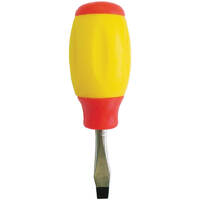
Flathead screwdrivers are used on terminal screws throughout electrical installations. Distribution board terminal screws, older-style outlet accessories, and conduit fittings commonly use slotted heads. The key to a good flathead fit is matching blade width to screw slot width: too narrow and the blade rocks; too wide and it overhangs and can damage surrounding material. A quality electrical tool kit includes flathead drivers in at least three widths: narrow (2.5-3mm), medium (5-6mm), and wide (8mm).
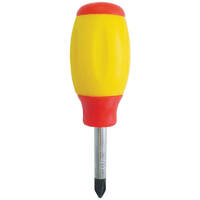
Phillips (PH) drive is found across Australian general electrical accessories, including Clipsal and other mainstream brands. Phillips drivers are designed for some cam-out under high torque, which was originally intentional for production line use but is a drawback in precision hand work. Pozidriv (PZ) drive looks similar to Phillips but has additional contact points that provide a more positive engagement and resist cam-out under higher torque. Square drive (Robertson) is common in Canadian-manufactured products and some switchboard hardware.
Most electrician screwdriver kits include both PH and PZ in sizes 1 and 2, covering the majority of fasteners encountered on Australian residential and commercial sites. Driver bits in these profiles are also available for use in power tools and electric screwdrivers.
Torx (star drive) fasteners appear in switchboard equipment, security fittings, data and communications hardware, and an increasing range of electrical accessories. The six-pointed star profile provides high torque transfer with minimal cam-out. Security Torx (Torx Plus or tamper-resistant Torx) adds a pin to the centre of the recess, requiring a dedicated driver. Electricians working in commercial or industrial environments will encounter both standard and security Torx regularly. A full-coverage kit includes T10 through T30 as a minimum, plus corresponding tamper-resistant bits.
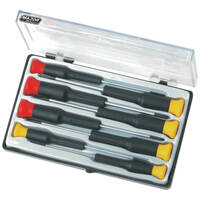
Multi-bit screwdrivers use a single handle with interchangeable blades stored in the handle itself. These are practical for reducing bulk in a tool belt while still carrying multiple drive profiles. The trade-off is that the handle is shared across all bits, so blade-to-handle fit quality matters: a loose chuck or poor-quality blade seat reduces torque transfer and can damage screw heads.
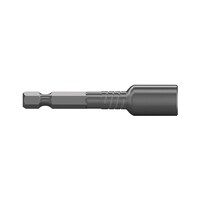
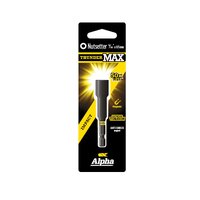
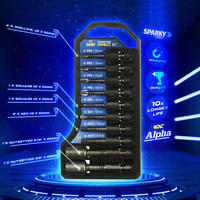
Impact-rated driver bit sets are designed to withstand the high-torque impulse loading of impact drivers. Standard bits used in impact drivers fracture prematurely. An impact-rated set from a brand like Klein Tools or Alpha is worth having if impact drivers are part of the workflow.
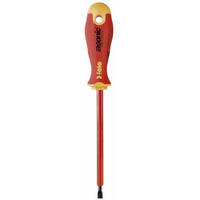
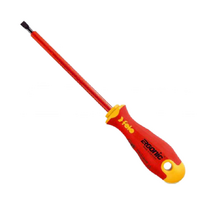
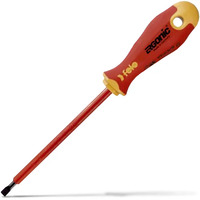
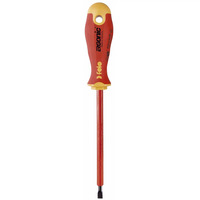
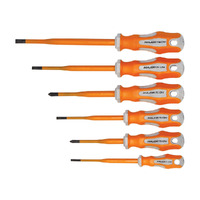
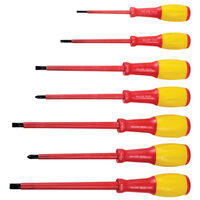
Insulated screwdrivers have the blade and handle covered in a non-conductive material, typically a dual-layer thermoplastic, with only the working tip of the blade exposed. The insulation provides a barrier between the user's hand and any live conductor that the blade may inadvertently contact during work. This is not the same as a standard plastic-handled screwdriver, which provides grip comfort but no rated electrical insulation.
The insulation layer must be continuous, undamaged, and rated to the appropriate voltage. Cracks, cuts, or chemical degradation of the insulating material compromise protection. Insulated tools should be inspected before each use and replaced if any damage is found.
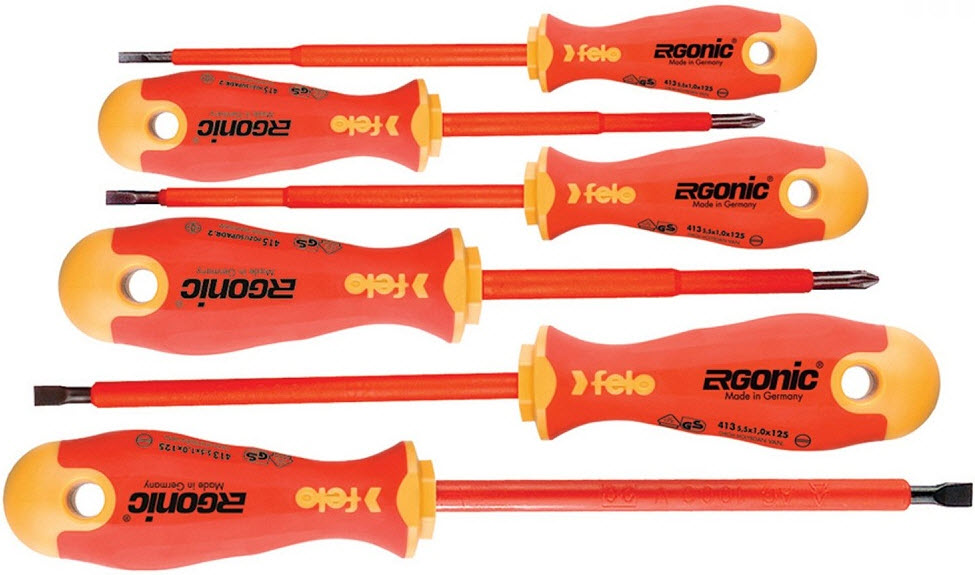
VDE (Verband der Elektrotechnik) is a German testing and certification organisation. VDE-certified insulated tools are tested to IEC 60900, the international standard for hand tools for live working. The VDE mark on a screwdriver confirms that the insulation has been independently tested to 10,000 V AC (withstanding voltage) and rated for use at 1,000 V AC in service. IEC 60900 is the underlying standard; VDE is the testing body whose mark provides third-party verification. Tools certified to IEC 60900 by other accredited bodies carry equivalent protection. Wiha and Felo are two brands that produce VDE-certified insulated screwdrivers available through Sparky Direct.
Australian mains voltage is 230 V AC (single phase) and 400 V AC (three phase). Insulated tools rated to 1,000 V AC cover both standard supply voltages and provide adequate margin for work on energised switchboards and distribution equipment. Tools rated to 1,000 V are suitable for use on Australian mains circuits when working to a safe work procedure and under the appropriate licence category.
Important: Insulated tools reduce the risk of electric shock during incidental contact with live parts. They do not remove the risk of working live and are not a substitute for safe work procedures, appropriate PPE, or compliance with the relevant electrical safety regulations in your state or territory.
Apprentice kits are designed to cover the tools required for the first year or two of an electrical apprenticeship without excessive cost. A typical starter kit includes a set of flathead and Phillips screwdrivers, lineman's pliers, wire strippers, a voltage tester, a tape measure, and a utility knife. The emphasis is on covering the core tasks encountered during training placements: rough-in work, pulling cables, and fitting-off accessories.
For apprentices, durability is more important than premium specification. A mid-tier kit from a recognised brand will survive job site conditions better than budget tools that need replacing within months. As the apprentice progresses, individual tools can be upgraded or supplemented rather than replacing the entire kit.
Residential electricians work across new construction, renovation, and fault-finding. The tool kit needs to cover domestic accessories (Clipsal, HPM, and equivalents), switchboard work, sensor and smart home device installation, and rough-in cable work. A residential kit builds on the apprentice baseline with insulated screwdrivers, a broader range of driver profiles, a multimeter, RCD testers, and fish tapes or cable pullers.
Commercial and industrial environments introduce higher-voltage switchgear, three-phase equipment, cable management systems, and a wider variety of fastener types including Torx and security heads. A commercial kit typically includes a full insulated VDE screwdriver set, impact-rated driver bits, heavy-duty cutting tools, and a calibrated test instrument. The Klein Tools range at Sparky Direct covers many of the tools suited to commercial-grade electrical work.
Non-trade buyers purchasing general purpose kits for home maintenance should note that any work involving your home's fixed wiring must be carried out by a licensed electrician in Australia. A general screwdriver set is appropriate for assembling furniture, maintaining appliances, and replacing non-fixed items such as light globes and battery-operated equipment. DIY tool kits from Sparky Direct are available for these general uses.
Screwdriver kits marketed for general use are often adequate for light-duty or occasional automotive work but may not include the drive profiles most common in electrical work, particularly Pozidriv. When purchasing specifically for electrical trade use, look for kits that explicitly include PZ1 and PZ2 alongside the standard Phillips range, and confirm whether insulated options are included or available as an add-on.
Compact kits prioritise portability, typically using shorter blade lengths and slimmer handle profiles. These suit electricians working in roof spaces, wall cavities, meter boxes, and other confined areas where a full-length driver is impractical. Full-size kits provide more leverage for tight or corroded fasteners and are better suited to switchboard and panel work where working space is not a constraint.
Some professionals carry both: a compact set for fit-off work and a full-size set for switchboard or panel tasks. Kits with a mix of stubby and standard-length drivers offer a practical middle ground.
Roll-up pouches and compact zip cases keep screwdrivers protected and organised in a tool bag without bulk. Electricians who move between multiple sites in a day benefit from a kit that can be grabbed and carried independently. Tool bags from Sparky Direct are available to complement screwdriver and hand tool kits.
Some tool kits bundle a non-contact voltage tester or socket tester with the screwdriver set. This is practical for fault-finding and testing before working on a circuit. Standalone voltage testers and test equipment are available separately at Sparky Direct for those who prefer to source items individually.
Cam-out occurs when a driver blade rides up and out of a screw recess under torque. The primary cause is a mismatch between driver tip geometry and fastener recess profile. A Phillips driver used in a Pozidriv fastener, or vice versa, will cam-out at lower torque than the correct driver. Worn tips with rounded corners also cam-out at lower torque because the contact area between blade and recess is reduced. Replacing worn drivers is more cost-effective than dealing with stripped screws on every job.
Using a driver that is too small for the fastener concentrates force on a small contact area and accelerates tip wear. Using a driver that is too large risks damaging the surrounding material when driving flush. For terminal screws on switchboard components, using the correct size flathead is also important for maintaining the integrity of the terminal: over-tightening or slipping can damage the conductor or the terminal body.
Screwdriver blades stored in damp conditions or exposed to cutting fluids and cleaning chemicals can develop surface rust. Chrome-finished blades resist this better than bare steel, but no finish is indefinitely resistant if tools are not dried and stored correctly. Light surface rust on a blade does not necessarily affect performance but indicates that storage conditions need attention. Rust on the handle body of insulated screwdrivers can indicate that the handle seal is compromised, which warrants inspection of the insulation layer.
Multi-bit driver handles with a loose chuck or worn retention clip will not hold bits securely under torque. This is a safety issue as well as a performance one: a bit ejected under load can cause injury. Inspect the bit retention mechanism before first use and replace the handle or clip if retention is inadequate. For kits with interchangeable bits, keep a record of the full bit inventory so missing sizes are identified before they are needed on site.
The cost difference between a budget and a professional-grade screwdriver kit reflects differences in steel quality, manufacturing tolerance, handle materials, certification (VDE for insulated tools), case quality, and brand warranty. A premium kit from Wiha or Felo uses higher-grade blade steel with tighter tip geometry tolerances, handle materials designed for chemical resistance and grip durability, and independent certification of the insulation system. These differences are reflected in both performance and service life.
For apprentices or occasional-use buyers, a mid-tier kit provides adequate performance at a lower entry cost. For working tradespeople using the same kit daily across years of service, a premium kit's longer service life and better performance under sustained use typically delivers better value over time. The calculation changes if tools are lost or stolen regularly: in high-risk environments, buying mid-tier in bulk may be more practical than carrying premium tools.
| Brand | Tier | Insulated VDE Range | Best Suited For |
|---|---|---|---|
| Wiha | Premium | Yes | Precision electrical and switchboard work |
| Felo | Premium | Yes | Trade electricians, ergonomic priority |
| Klein Tools | Premium | Selected models | Commercial and heavy-duty trade use |
| Bordo | Mid-tier | Selected models | General trade and electrical work |
| Alpha | Mid-tier | Selected models | Driver bits and accessory sets |
Electrical contractors managing apprentices or running multiple crews benefit from purchasing tool kits in volume. Standardising on a single kit specification simplifies training (everyone uses the same tools), reduces the need to stock a broad range of spares, and enables bulk purchasing at trade pricing. Contact Sparky Direct directly to discuss trade account options for volume purchasing.
Store screwdrivers in a dry environment and dry them before storage if they have been exposed to moisture. Tool bags and pouches protect blades from physical damage during transport. Avoid storing screwdrivers loose in a bucket or drawer where tips can contact and abrade each other. A light wipe of blade surfaces with a dry cloth after use on dirty or damp sites is sufficient for routine maintenance. For tools used around cutting oils or chemicals, check that the handle material is compatible with the substances encountered.
Insulated screwdrivers should be visually inspected before each use. Check the full length of the insulated handle and blade sleeve for cuts, gouges, bubbling, discolouration, or any breach of the insulation layer. Check that the tip is the correct profile and is not worn or deformed. A screwdriver with damaged insulation must not be used for any work where contact with live parts is possible. Replace the tool rather than attempting to repair the insulation. Some manufacturers provide replacement insulation sleeves for specific models; check brand documentation before assuming a repair is possible.
Time spent searching for the right driver on a busy site is time lost. Colour-coded handles (a feature of Wiha and Felo kits) allow rapid visual identification of drive type. Labelled roll pouches or moulded cases with designated slots ensure each tool returns to the correct position. Consistent organisation also makes it immediately apparent when a tool is missing before leaving a site, reducing the risk of leaving tools behind.
Replace a screwdriver when the tip is visibly worn, rounded, or chipped; when the handle is cracked or the grip material is separating; or when the blade has a visible bend. For insulated tools, replace when any damage to the insulation layer is present, regardless of whether the blade is otherwise serviceable. The cost of a replacement driver is negligible compared to the risk of using a damaged insulated tool near live parts.
Switchboard work is the highest-risk application for screwdrivers in electrical trade. Terminal screws on circuit breakers, busbars, and distribution board components require precise torque and the correct driver profile. Over-tightening can damage terminals or conductors; under-tightening creates high-resistance connections that can cause overheating. In this context, insulated VDE-rated screwdrivers are the professional standard, and tip condition is critical for applying the correct torque without slipping.
For fitting-off electrical accessories such as power outlets, switches, and light fittings, a quality PH2 and PZ2 combination covers the majority of Australian domestic accessories. Screwdrivers and driver bits for this work are available at Sparky Direct.
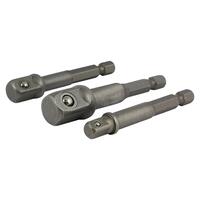
Automotive and mechanical screwdriver applications involve more varied fastener types and higher torque requirements than general electrical work. Impact-rated driver bits and sockets are more relevant in this context. A trade electrician venturing into automotive electrical work (EV charging installation, automotive electrical accessories) needs a driver bit set rated for impact driver use. The Alpha drill socket extension and hex adapter sets available at Sparky Direct are suited to this type of application.
On a new construction site, electricians use screwdrivers and driver bits for fixing conduit saddles, mounting electrical enclosures, installing anchor screws, and driving bugle head screws into plasterboard and timber framing. Self-drilling screws for this work are also stocked at Sparky Direct, including Clipsal bucket packs supplied with a free Phillips double-ended magnetic driver bit.
For non-trade use, a basic six to ten piece screwdriver set covering flathead and Phillips in common sizes handles the majority of household maintenance tasks. Assembly of flat-pack furniture, appliance maintenance, and minor fitting work does not require trade-grade tools, but a set from a recognised brand provides noticeably better fit and feel than budget imports. Sparky Direct supplies tool sets appropriate for general home use as well as trade applications.
Insulated hand tools for use in live electrical work in Australia are required to comply with IEC 60900 (Hand tools for live working: hand tools for up to 1000 V a.c. and 1500 V d.c.). This standard sets the test voltage (10,000 V AC withstand), the working voltage rating (1,000 V AC), and the test methods for verifying insulation integrity. Tools certified to this standard by an accredited testing body, including those carrying the VDE mark, meet the Australian requirement for insulated screwdrivers used in live electrical work.
AS/NZS 3000:2018 (the Wiring Rules) does not specify individual tool requirements but establishes the overall framework for safe electrical work in Australia. State and territory electrical safety regulations set the licensing and work practice requirements within which tool selection is made.
Even with correctly rated insulated tools, working on or near live electrical equipment carries residual risk. Insulated tools protect against incidental contact; they do not make working live safe in all circumstances. Always follow the applicable safe work procedure, verify isolation where required, and use the appropriate PPE for the risk level of the task. For switchboard work on energised equipment, arc flash risk assessment may be required under workplace health and safety legislation in some jurisdictions.
Some electrical components specify a maximum driver blade width or torque for terminal screws. Where this information is provided by the manufacturer (typically in the installation instructions for distribution board components and switchgear), follow it. Using a driver blade that is too wide for a terminal recess can deform the terminal body or create a short circuit path within the enclosure.
Purchasing a quality screwdriver kit that lasts ten or more years of regular trade use generates significantly less waste than replacing a budget kit every two to three years. The environmental cost of manufacturing tools (materials extraction, processing, and transport) is spread over a much longer service period with a quality product. This is a practical sustainability argument that also makes economic sense for working tradespeople.
Some premium screwdriver systems allow blade replacement independently of the handle, extending the useful life of the tool when only the blade wears. Multi-bit systems where worn bits are individually replaced rather than discarding the whole handle also reduce waste. When evaluating a kit purchase, check whether replacement blades or bits are available for the specific brand and model, particularly for premium handles where the investment is in the ergonomics and construction of the handle itself.
Metal screwdriver blades are generally recyclable through scrap metal streams. Handle materials vary: some are recyclable thermoplastics, others are composite materials that cannot be separated for recycling. Check with your local council or waste facility for guidance on tool disposal. Do not dispose of insulated tools in general waste without removing or destroying the insulated sleeve if the material is identified as non-recyclable composite. Trade tool suppliers and some manufacturer take-back schemes accept worn professional tools for responsible processing.
Club Clipsal is Australia's largest electrician community offering trade rewards, business support, and exclusive benefits. When you nominate Sparky Direct as your preferred wholesaler, we automatically apply your Clipsal spend points to your Club Clipsal account daily.
Entry-level offering coaching, mentoring, and training discounts
Unlock exclusive industry tools and networking events
Access Toyota fleet offers and business software discounts
Maximum benefits, including VIP experiences and rewards
1. Sign Up: Create your Club Clipsal account at clipsal.com/club-clipsal or via the iCat mobile app
2. Nominate Sparky Direct: Select Sparky Direct from the wholesaler dropdown menu in your profile
3. Add Email: Enter your Sparky Direct account email address in the membership number field
4. Start Earning: Every dollar spent on Clipsal products earns points automatically
Redeem points from the rewards store, including gift cards, tools, and experiences. Access business summits, product training, and industry networking events. Receive early access to new product launches and special promotions. Connect with fellow electricians via the Club Clipsal community app.
Watch 10 Piece Impact Driver Bit Set | TBS10 video
Watch Bordo 5700-ES200 | Dual Mode Electric Screwdriver video
Watch Bordo 5330-1-4QC | Carabiner Hook with 5 x 1/4" Quick Change Hex Holders video

This set is just perfect size for the toolbag with solid casing and a couple of spare bits as well. They are magnetic which really helps with accuracy and less drops. The service I received is second to none, I will definitely be buying again.
Love the product so far, have only had it on one job so far but it was flat out working for about 4 hours. Only downfall is the head of the Phillips bit being a bit large in diameter for small circuit breakers and 40-amp connectors.
They are a good quality product and the assortment of bits allows you to open most appliances with security screws.
Quality products in stock • Fast Australia-wide delivery • Competitive trade pricing
Browse Screwdriver Kits → Get Expert Advice →The right kit depends on the type of work you do and the range of screw types you commonly encounter.
Sparky Direct supplies screwdriver and tool kits Australia-wide, offering reliable kits with convenient delivery.
Tool kits are packaged securely and delivered via standard courier services.
Unused kits are typically eligible for return according to the seller’s returns policy.
Warranty coverage varies by manufacturer and generally covers defects in materials or workmanship.
Yes, they are sold as complete sets with the tools listed in the product description.
Basic care such as keeping tools clean and dry helps maintain performance.
With regular use, tools may wear, but quality kits are designed for long service life.
Yes, they are well suited for beginners as they provide essential tools in one package.
Yes, organised cases help prevent lost tools and improve efficiency.
Trade-rated kits are designed for frequent use in workshop or site environments.
Quality kits feature ergonomic handles designed to reduce hand fatigue.
Weight varies by kit size, but most are designed to be portable.
Screwdriver and tool kits provide a selection of common hand tools used for fastening, adjustments, maintenance, and general installation tasks.
Most kits come in cases or organisers that make storage and transport simple.
A kit provides multiple tools in one set, offering convenience and better value for common tasks.
Replacement bits are commonly available for kits that use interchangeable bit systems.
Most kits include a variety of head types such as Phillips, slotted, Torx, and hex.
Yes, screwdriver kits are ideal for general household repairs and maintenance tasks.
Yes, many kits are designed for trade use, offering durability and a practical range of tools.
Screwdrivers are typically made from hardened steel with ergonomic plastic or rubber handles for grip and comfort.
Yes, certain kits include insulated screwdrivers designed for work near live electrical components when used appropriately.
Individual tools within kits may comply with relevant AS/NZS standards, particularly insulated tools designed for electrical applications.
Some screwdriver kits are suitable for electrical tasks, but any electrical work must be carried out by a licensed electrician.
Kits commonly include screwdrivers, bits, handles, and may also include pliers, hex keys, testers, or small hand tools depending on the set.