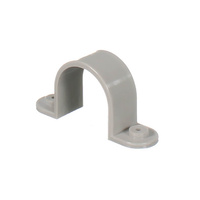

Search Results:
Search Results:
Search Results:
Search Results:
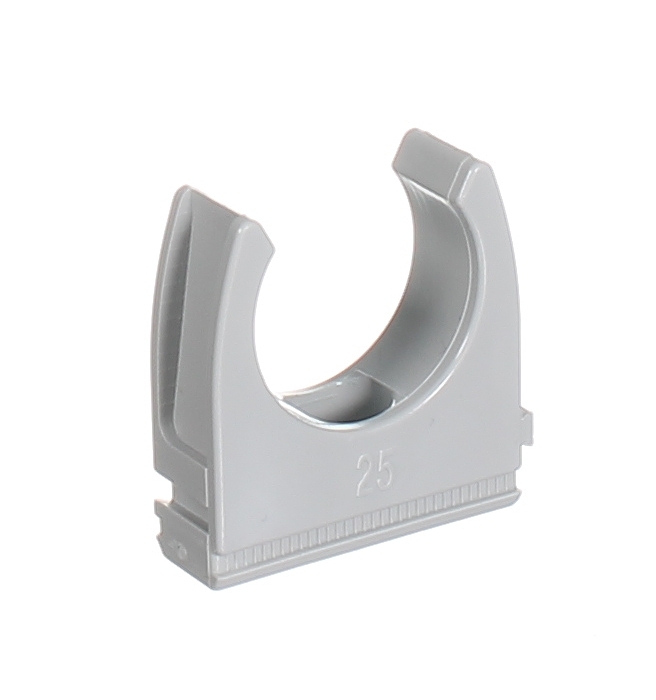
Find the best PVC conduit clip saddles here at Sparky Direct. [ Read More ]
Every conduit run needs regular fixing points along its length. Without them, the conduit sags, twists, or pulls away from the wall. PVC clip saddles solve this with a simple, low-cost mechanism that suits both rough-in and exposed surface installations.
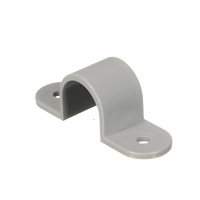
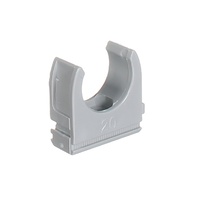
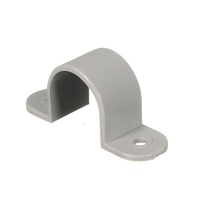
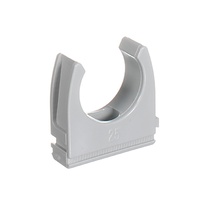
A PVC clip saddle is an injection-moulded polymer bracket sized to a specific conduit diameter, supplied in single-piece or two-part configurations depending on duty rating. The body has a curved channel that grips the conduit, plus a flat fixing tab with a pre-drilled screw hole sized for standard wood, masonry, or self-drilling fasteners. The clip-on style includes a hinged or split design that allows the conduit to snap into place after the saddle is mechanically fixed to the substrate.
The plastic body is flexible enough to flex around the conduit during installation, but rigid enough to hold it firmly against the surface under operational loads. This even contact distribution eliminates point-loading on the conduit wall, which can otherwise crack rigid PVC over time, particularly at junctions and stress-concentrating fittings. The smooth internal surface of the saddle channel also means no abrasion on cables passing through the conduit run.
Saddles keep multiple parallel conduit runs evenly spaced and properly aligned along the surface they fix to. This matters for appearance on exposed surface installations and, more importantly, for safe and predictable cable pulling during fit-out and any subsequent re-cabling. Saddles also transfer mechanical loads from impact, thermal stress, and accumulated cable weight out of the conduit body and into the structural surface, protecting the run as a complete system.
Conduit support is not optional. AS/NZS 3000 sets out the wiring rules for fixed installations, and clip saddles are the standard means of meeting the support clauses for PVC conduit.
AS/NZS 3000:2018 (the Australian and New Zealand Wiring Rules) requires that wiring systems be supported at intervals appropriate to the conduit type, diameter, and installation orientation. The relevant clauses cover both horizontal and vertical conduit runs and apply to all rigid PVC conduit installations, including domestic, commercial, and industrial fixed wiring. Manufacturers publish recommended maximum saddle spacing tables for each conduit size and duty rating, and these are the practical reference for compliant installations.
Unsupported conduit will deflect under its own weight or under the accumulated weight of cables enclosed within it. Over time this deflection stresses solvent-glued joints, cracks coupling connections, and abrades cable insulation against rough internal surfaces or fittings. Correctly spaced saddles distribute the support load across the run and keep deflection within the safe limits set by the conduit manufacturer.
Inspection failures often relate to inadequate or missing saddles, especially on long horizontal runs and at unsupported transitions through walls or ceilings. Each saddle must be fixed with a screw and anchor combination appropriate to the substrate, never relying on the clip-on grip alone with no mechanical anchor behind it. A finished run that flexes when pushed by hand has too few support points and will not pass a compliance inspection.
PVC saddles come in several configurations. The right one depends on conduit type, surface, and whether the conduit is fed in before or after the saddle is fixed.
The standard snap-in is the workhorse of the range. The clip saddle is fixed first, then the conduit is pushed into the open channel until it snaps under the retaining lip. This lets electricians fix all saddles before pulling conduit, which speeds up large runs.
For larger diameters or heavier loaded runs, two-piece designs offer more clamping force. The base is fixed to the surface, the conduit is laid in, and the cap is screwed or clipped over the top.
Offset saddles raise the conduit away from the substrate. This is useful on damp masonry, behind switchboards, or where the surface is irregular and a flush saddle would not sit properly.
Rigid medium duty PVC conduit uses a smooth-bore saddle. Corrugated conduit needs a different profile that grips the ribs. Mixing them up gives a loose fit and possible movement.
Saddle size must match conduit outer diameter. A loose saddle lets the conduit shift; a tight one risks cracking the saddle as the conduit expands and contracts.
Australian PVC conduit follows nominal sizes of 20mm, 25mm, 32mm, 40mm, and 50mm. Saddles are sold to match each size. The most common sizes in domestic and light commercial work are 20mm and 25mm. Larger sizes appear in industrial runs and main service feeds.
The "20mm" saddle fits 20mm nominal conduit, which has an actual outer diameter very close to 20mm. Buy by the conduit size, not by what looks similar. A 25mm saddle on 20mm conduit will not hold the run securely.
An undersized saddle either splits during installation or refuses to clip closed. An oversized saddle leaves the conduit free to slide and rotate. Both problems show up later as alignment drift, cracked glue joints, or saddles popping off the wall.
| Conduit Size | Typical Use | Saddle Match |
|---|---|---|
| 20mm | Lighting and power circuits | 20mm clip saddle |
| 25mm | Sub-mains, larger circuits | 25mm clip saddle |
| 32mm | Mains, heavy loads | 32mm saddle (often two-piece) |
| 40mm and 50mm | Industrial mains, services | Matching heavy duty saddle |
Spacing rules exist so the conduit run stays straight, supports cable weight, and survives thermal cycling without movement at the joints.
Manufacturers typically recommend support every 600mm to 1200mm for horizontal rigid PVC, with closer spacing on smaller diameters. Vertical runs can usually go further between supports because gravity is acting along the conduit axis, not across it. Always check the conduit manufacturer's data sheet for the size in use.
Add a saddle within roughly 150mm of each bend, coupling, or termination. This stops the joint from carrying bending stress as the run flexes. A saddle close to a junction box also keeps the box square to the wall.
Inspectors look for evenly spaced saddles, no visible sag between supports, and saddles fixed with appropriate screws (not glue or tape). Long unsupported spans, missing saddles around bends, and saddles fixed only by friction are common pickups during compliance inspections.
PVC saddles handle most indoor and protected outdoor environments. Where conditions get harsh, material grade matters.
Standard PVC saddles will progressively degrade if exposed to direct sunlight over a period of years, with photo-oxidation breaking down the polymer chains. UV-stabilised PVC grades incorporate additives that hold up significantly better in continuous outdoor exposure. For long-term external work in full sun, particularly in Australian conditions, many electricians prefer galvanised or stainless steel saddles or specifically UV-rated PVC alternatives.
PVC handles humidity, rain splash, and most common industrial and domestic chemicals encountered in fixed wiring environments. It does not corrode like ferrous metals and is well suited to bathrooms, laundries, pool plant rooms, and externally sheltered runs. Cleaning agents and most petroleum products will not attack standard rigid PVC under normal service conditions.
PVC has a higher coefficient of thermal expansion than steel, which means saddles must accommodate that movement without cracking or losing grip on the conduit. Standard rigid PVC conduit is rated for the normal range of Australian indoor and shaded outdoor temperatures, typically up to around 60 degrees Celsius. In high-heat locations such as roof spaces above ceiling insulation, expect significantly more thermal cycling and check the conduit and saddle ratings against site conditions.
Material choice affects cost, strength, corrosion resistance, and how long the saddle lasts in a given environment.
Steel half saddles and full saddles deliver greater clamping strength and handle larger conduit loads, particularly on heavy duty orange or industrial installations. PVC is significantly cheaper, faster to fit during rough-in, and avoids the rust streaking that ferrous saddles produce on rendered or painted surfaces. For domestic surface runs, PVC is normally the better trade-off, while industrial or heavy-load environments often justify the additional material cost of steel.
Nylon (polyamide) saddles offer better heat tolerance and impact resistance than standard rigid PVC formulations, particularly where the run sees mechanical knocks during service. Nylon also tends to retain UV resistance for longer than non-stabilised PVC. The trade-off is higher unit cost, more limited stocked sizes at most wholesalers, and lower availability for unplanned site requirements.
For interior domestic and commercial work, standard PVC saddles are the default selection on cost and ease of installation grounds. For exposed outdoor sites, particularly coastal or high-UV locations, stainless steel or UV-rated alternatives last considerably longer over the installation lifespan. For heated roof spaces or industrial environments, nylon or galvanised metal generally outperforms standard PVC across the typical asset life of the installation.
The fixing screw and the wall plug or anchor must suit the substrate. The saddle is only as strong as its fixing point.
Drill a clearance hole, insert a wall plug sized to the screw gauge, and drive the screw home. Match the plug to the screw, not the other way around. A correctly sized wall plug holds the saddle firm against vibration and pull-out.
Timber takes a wood screw direct. Plasterboard alone will not hold a saddle under any real load: locate a stud behind the board or use a hollow wall anchor rated to the expected load.
Self-drilling tek screws work for thin steel sheeting. For structural steel, drill and tap or use a suitable thread-cutting fastener. Avoid over-driving, which can split the saddle body or strip the thread.
The right saddle is the cheapest one that does the job for the expected service life of the installation.
A snap-in PVC saddle suits most rough-in and surface work. Two-piece or heavy duty designs come in for larger conduit, mains feeds, or runs that carry heavier cable bundles.
Indoor and protected: standard PVC. Outdoor under cover: UV-stabilised PVC. Coastal, industrial, or exposed: metal or stainless steel. The cost difference is small, the longevity difference is large.
Buy the saddle from a known conduit family where possible. National Light Sources (NLS) and Clipsal both supply matched conduit and accessory ranges that fit cleanly together.
Saddles are cheap, but pulling a run apart to replace failed saddles is expensive. Specifying for the environment up front pays off.
Standard rigid PVC turns brittle after years of UV exposure as the polymer molecular structure breaks down under ultraviolet radiation. The first visible sign is hairline cracking around the screw boss, where mechanical stress concentrates the failure pattern. Specifying UV-rated PVC or moving to galvanised or stainless metal is the practical answer for any run that sees direct sun for extended service periods.
A long PVC run can expand by 10mm or more across a few metres on a hot Australian summer day, particularly in north-facing or roof-space installations. Saddles must allow this expansion to occur without cracking the saddle body or distorting the conduit alignment. Avoid overtightening the fixing screws into the saddle body, since over-compression removes the small amount of float that the saddle needs to accommodate thermal cycling.
Vibration from nearby plant or traffic, repeated thermal cycling between day and night temperatures, and water ingress around exposed fixing screws all weaken the bond between saddle and substrate over the asset life. Periodic visual inspection on long-life or critical installations catches loose fixings before the conduit comes adrift and creates a wiring or compliance issue.
For working sparkies, saddles are a fast-moving consumable. Buying in trade quantities cuts unit cost and avoids running out mid-job.
Trade packs of 50, 100, or 200 saddles bring the unit price well below single-buy levels. Larger jobs can use several hundred saddles, so bulk pricing has a real impact on cost-of-build.
Standardising on one or two saddle sizes (typically 20mm and 25mm) simplifies van stock. Most domestic work fits inside this range, with occasional 32mm orders for sub-mains.
Material cost is set by PVC resin pricing. Pack quantity drives unit cost. Freight is a small share for saddles, since they are light and pack densely. Larger orders generally beat minimum-order freight thresholds.
Most saddle problems come from a small set of recurring errors. None of them are hard to avoid once you know to look for them.
Wrong size for the conduit, non-UV PVC outdoors, and overtightened screws that crack the saddle body. All three are easy to spot once a run is in place, and all three can require partial rework to fix.
Selecting a saddle by visual estimation rather than by labelled nominal size leads to loose fits and conduit that slips through the channel under thermal or mechanical loading. Always read the printed nominal size on the saddle pack and match it precisely to the conduit nominal size before committing to a bulk fix-out.
Standard rigid PVC saddles in continuous direct sunlight will crack, chalk, and lose grip within a few years of installation in typical Australian conditions. For external runs, specify UV-rated PVC saddles or step up to galvanised, zinc-plated, or stainless steel options. The unit cost difference at install time is trivial compared to the labour cost of a callback to repair a UV-failed run.
The fixing screw should pull the saddle firmly and squarely against the substrate, with no further compression once the saddle body is in full contact with the surface. Driving the screw past that contact point bows or splits the saddle body, particularly around the screw boss, and a cracked saddle loses most of its grip on the conduit through the damaged channel.
Saddles are stocked by every electrical wholesaler. Trade buyers usually look at price per pack, brand consistency, and stock availability.
Sparky Direct stocks the full range of PVC conduit clip saddles alongside conduit bends, couplings, and junction boxes. Online ordering with Australia-wide delivery suits both site-based contractors and home installers.
Very cheap saddles often use thinner PVC and a smaller fixing tab. They work, but break more easily during install and crack sooner in service. Trade-grade product from established brands costs slightly more and lasts longer.
Confirm the conduit size, the pack quantity, the brand, and whether the saddle is rated for outdoor use if you need that. Photos online are useful but the labelled spec on the listing is the definitive check.
When a saddle problem appears on a finished run, the cause is almost always one of three things.
Diagnose the failure mode before reaching for a replacement saddle. Check whether the fixing screw has worked loose, the wall plug has crumbled out of the substrate, or the saddle body itself has cracked through UV or impact damage. The corrective action depends on the underlying cause: re-tighten the screw, replace the plug with the correct size and type, or swap the saddle and possibly upgrade the specification.
If the conduit run sags noticeably between fixing points, there are either too few support saddles installed or the spacing exceeds what the conduit size and orientation can safely span. Add intermediate saddles at the manufacturer-recommended spacing for the size in use. If the conduit slips axially through the saddles when pushed, the saddles are the wrong nominal size for the conduit.
White or grey surface haze, chalking on the saddle body, or hairline cracks radiating from the screw boss all point to UV-induced material degradation rather than mechanical failure. There is no field repair available for a UV-failed saddle. Replace the affected saddles with UV-rated PVC or metal alternatives, and consider whether the conduit run itself shows similar degradation requiring review.
When to call it: If multiple saddles on the same run have failed for the same reason, treat the run as a system problem rather than fixing one saddle at a time. Specify a more durable product, replace as a set, and document the change.
Watch NLS 30560 | 20mm Clip-On PVC Full Saddle video
Watch NLS 30568 | 25mm Clip-On PVC Full Saddle video
Watch NLS 30305 | 20mm PVC Full Saddle video

Very easy to purchase from this company. I did not have to put up with - I can’t sell to you unless you have an electrical license like I have had with other companies. Information on the website made it very easy for me to purchase the correct item(s) I required.
I was very happy to find these stainless steel saddles as I have just had some electrical work done which included a fair bit of outside conduit. Being near the ocean I new it was only a matter of time before I had the rust marks dripping down walls. I have replaced all these standard saddles this the new stainless ones and stainless screws. Time will tell.
The saddles came on time. I ordered a box. There was no issues with the amount I ordered. When ever I asked, "How many come in a box?" I am always informed immediately. Thats one of the reasons I deal with SparkyDirect, they are always on the ball.
Quality products in stock • Fast Australia-wide delivery • Competitive trade pricing
Browse PVC Conduit Clip Saddles → Get Expert Advice →Yes, evenly spaced clips help create a clean and professional finish.
Sparky Direct supplies PVC conduit clip saddles Australia-wide, offering reliable conduit fixing solutions with convenient delivery.
Conduit clips are securely packaged and delivered via standard courier services.
Unused products are generally eligible for return according to the seller’s returns policy.
Warranty coverage varies by manufacturer and typically covers defects in materials or workmanship.
Yes, conduit clips are typically sold as individual electrical fixings.
Yes, choosing the correct size ensures a secure fit and compliant installation.
Once installed correctly, they generally require no maintenance.
Yes, they are commonly used when installing new or upgrading existing conduit runs.
They may be visible in surface-mounted conduit installations.
Quality PVC clips are designed to withstand everyday installation conditions.
Yes, they help stop conduit from shifting or vibrating over time.
They are straightforward for trained professionals to install as part of a compliant system.
Conduit clips, also known as PVC conduit saddle clips, are fixings used to secure electrical conduit neatly to walls, ceilings, or other surfaces.
Yes, they are a standard fixing used in most conduit installations.
They provide a simple, neat, and reliable way to secure conduit.
Yes, PVC clips do not rust and are suitable for most indoor environments.
Yes, they help keep conduit straight and evenly spaced along surfaces.
Yes, they are suitable for residential, commercial, and light industrial applications.
Yes, they are widely used for indoor electrical conduit installations.
They are made from durable PVC designed for electrical installations.
They are available to suit common conduit sizes such as 16mm, 20mm, 25mm, and 32mm.
Yes, they are commonly used with rigid PVC electrical conduit.
Quality conduit clips are manufactured to meet relevant AS/NZS electrical and safety standards when used correctly.
They are used to hold conduit firmly in place and maintain straight, organised conduit runs.