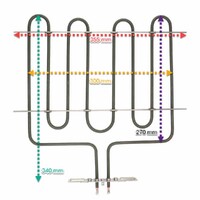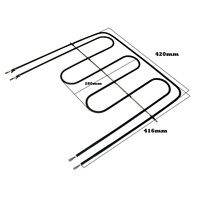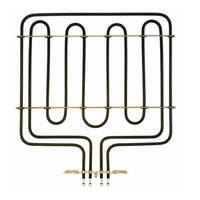

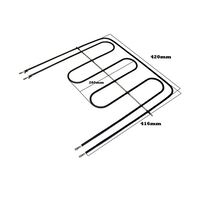
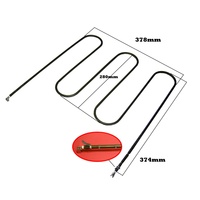
Grill Element 2200W | GRE-03 / 10319 / VU82C000 / 10322 / VU82G000 / 0122004499
$29.03
$26.39 ex. GST
Search Results:
Search Results:
A grill element sits at the top of an oven cavity, facing downward. It heats by electrical resistance. Current flows through a metal sheath containing a resistance wire packed in magnesium oxide insulation. The sheath reaches operating temperature quickly, radiating heat directly onto food placed below it.
The element acts as a radiant heat source. Unlike a fan-forced element, it does not rely on air circulation. It applies intense, directed heat from above. This produces browning, caramelisation, and crisping on the surface of food. Without a working grill element, these results are not achievable using other oven functions.
The internal resistance wire opposes current flow. This converts electrical energy into heat. The surrounding magnesium oxide transfers that heat to the outer sheath. The sheath glows red-orange at operating temperature, emitting infrared radiation directly toward the food surface. Output depends on wattage: higher wattage elements radiate more heat per unit time.
Grill performance affects a specific set of cooking tasks: grilling meat, browning casserole tops, melting cheese, toasting bread in an oven, and finishing dishes that need surface colour. A faulty element produces uneven browning or no heat at all. These faults cannot be compensated by other oven modes. Replacement is the only effective fix.
Grill elements are a standard replacement item for licensed electricians and appliance repair technicians. Sparky Direct stocks them as part of a broader appliance parts range, including elements for most common Australian residential oven brands.
Online trade suppliers generally offer wider stock depth and faster delivery than local appliance parts stores. Model-specific filtering is easier when product listings include cross-reference part numbers and dimensions. A reliable online supplier will also hold stock of less common elements that local stores rarely carry. The key advantage of buying online is access to a broader catalogue without travel time.
Choose a supplier that lists wattage, dimensions, and terminal configuration for each element. Cross-reference part numbers from multiple brands are a strong indicator of a well-managed catalogue. Returns policies matter when matching parts by specification rather than OEM number. A supplier who answers technical queries by phone reduces the risk of ordering the wrong part.
Electricians completing appliance repairs on residential jobs need fast turnaround. Sparky Direct provides Australia-wide delivery with most elements dispatched from stock. Trade account holders can access competitive pricing on repeat orders. Bulk buying for appliance service businesses reduces per-unit cost and minimises return visits caused by parts delays.
Grill elements are not interchangeable between oven models without verification. Physical design, mounting method, and terminal arrangement all vary. Understanding the main types helps with identification and ordering.
Selecting the wrong wattage or physical size causes installation failure, performance problems, or damage to the oven. These three specifications must be confirmed before ordering any replacement grill element.
Residential grill elements typically range from 1800W to 3000W. Most standard single-cavity ovens use elements in the 2000W to 2500W range. Commercial ovens may use higher ratings. Wattage is stamped on the original element or listed in the oven's technical data plate. Installing a higher-wattage element than specified risks overloading the oven's wiring and control components.
Grill elements are bent into specific patterns to distribute heat across the full grill area. Common patterns include U-shape, W-shape, M-shape, and double-loop configurations. The overall length and the outer dimensions of the bend pattern must match the oven cavity. An element that fits physically but has a different bend pattern produces uneven heat distribution across the grill area.
Terminals are the connection points where the element attaches to the oven's wiring. Their position, spacing, and orientation must match the original element. Most residential grill elements use spade-type terminals. The terminal block or connector in the oven is fixed, so the replacement element's terminals must align precisely. Mounting holes or brackets must also match the existing fixing points in the oven cavity.
An element with the wrong wattage may overheat internal wiring or cause the oven thermostat to malfunction. A physically oversized element can contact the oven walls and cause a short circuit. An undersized element heats unevenly. Terminals that do not match may be forced into connection, creating a loose contact that arcs under load. Always verify all three specification groups before purchasing.
Before ordering, confirm: wattage rating (watts), overall element length (mm), bend pattern dimensions (width x depth), terminal type and spacing, and mounting bracket hole positions. If you cannot locate the original element's data plate, measure the cavity opening and cross-reference against the appliance model number.
Correct identification is the most important step in the replacement process. A wrong element wastes time and money on returns, and may not be noticed until after installation if the physical fit is close.
The oven model number is the most reliable starting point. It is stamped on a data plate inside the door frame, on the back of the appliance, or inside the storage drawer. The model number identifies the exact element specification from the manufacturer's parts list. Suppliers who maintain cross-reference databases can match a model number to a compatible replacement part, including aftermarket options.
If the original element is available for inspection, measure the overall length, the width and depth of the bend pattern, and locate the wattage stamp on the element body. Compare these to the replacement element's listed specifications before ordering. Tolerances of a few millimetres in overall length may be acceptable, but bend pattern dimensions must match closely to ensure even heat distribution.
Photograph the original element's terminals and mounting brackets before removal. The photo gives you a reference for terminal spacing, orientation, and spade size. It also records the mounting hole positions and any spacers or ceramic insulators that form part of the assembly. This information is essential when assessing whether an aftermarket element is a direct fit.
Many Australian ovens were sold under multiple brand names with shared components. A part made for a Westinghouse oven may be identical to one fitted in a Chef or Simpson model from the same production run. Aftermarket element suppliers maintain cross-reference tables linking OEM part numbers across multiple brands. Wilson Elements and Global Components both supply cross-referenced replacement elements for a wide range of Australian appliance brands.
Once the correct specification is confirmed, the choice between OEM, aftermarket, and universal elements depends on cost, availability, and the intended application.
A domestic oven used for regular family cooking needs a reliable element that tolerates repeated heating cycles. A rental property repair requires a part that is available quickly and priced competitively. A commercial kitchen needs an element rated for continuous duty and sourced from a supplier who holds stock in depth. The right choice depends on the context, not just the specification.
Residential grill elements are sized for intermittent use: a few cycles per day in a household kitchen. Commercial elements must tolerate continuous operation under higher demand. Commercial elements are typically higher wattage and built from heavier gauge sheath material. Fitting a residential element into a commercial oven leads to premature failure. Always confirm the rated duty cycle when selecting elements for commercial applications.
OEM (original equipment manufacturer) elements are produced by the appliance brand or their contracted supplier. They are guaranteed to fit and match the original specification. Aftermarket elements are produced by independent manufacturers to the same specification, often at lower cost. Quality varies between aftermarket suppliers. Established suppliers like Wilson Elements produce aftermarket parts to consistent standards and back them with cross-reference data.
Universal elements are designed to fit a range of oven models through adjustable mounting brackets or variable lead lengths. They are suitable when an OEM or exact-match aftermarket element is no longer available for an older appliance. A universal element requires careful measurement to confirm that wattage and physical dimensions fall within the acceptable range for the target oven. Universal elements are not recommended when an exact replacement is available.
Not all replacement elements perform equally. These indicators help assess quality before purchase and monitor performance after installation.
A well-manufactured element reaches operating temperature within 60 to 90 seconds. Slower heating may indicate a wattage mismatch or a manufacturing fault in the resistance wire. Output intensity should be consistent across the full grill surface with no cold spots visible during operation. Cold spots indicate uneven resistance distribution in the element wire.
The bend pattern of a grill element is engineered to distribute heat evenly across the grill area. Uneven browning across a test piece of bread is the most practical indicator of uneven heat distribution. This can result from a bend pattern that does not match the oven cavity dimensions, or from a manufacturing defect in the element wire itself.
Each heating and cooling cycle creates thermal stress in the element sheath and resistance wire. Quality elements use sheath materials that tolerate thousands of cycles without failure. Elements using thin sheath material or insufficient magnesium oxide packing fail earlier. Ask suppliers about expected cycle life when purchasing elements for high-frequency applications like commercial kitchens.
Elements sold in Australia must comply with relevant electrical safety standards. Compliant elements carry appropriate certification markings. Purchasing from established suppliers reduces the risk of receiving uncertified product. Brands with established Australian distribution networks provide traceable product and consistent quality control.
Grill element faults fall into a small number of recognisable categories. Correct diagnosis before ordering a replacement avoids unnecessary parts purchases.
Complete failure to heat is the most common fault. The element either shows no heat at all, or heats for a short time and then stops. This usually indicates an open circuit in the resistance wire caused by burnout at a hot spot. Test with a multimeter set to resistance (ohms): an open circuit reading confirms element failure. A reading within the expected resistance range suggests the fault is elsewhere in the circuit.
Partial heating indicates either a partial break in the resistance wire or a high-resistance connection at the terminals. The element heats along part of its length but not all of it. This produces uneven browning across the grill surface. Partial breaks are not repairable. The element must be replaced.
Sparking from the element area indicates a short circuit or arcing at a connection point. This can result from a cracked sheath, loose terminal contact, or contamination between adjacent loops of the element. Sparking is a safety hazard. Switch off and isolate the oven immediately. Do not operate it again until the fault is identified and rectified by a licensed electrician.
A bulging, cracked, or discoloured section of the element sheath indicates localised overheating. This is caused by a high-resistance fault in the wire at that point. A visible hole or break confirms burnout. Any element with visible physical damage must be replaced before the oven is returned to service.
Safety note: Do not operate an oven with a visibly damaged grill element. A cracked or broken sheath can expose live components inside the oven cavity. Isolate the appliance and arrange replacement before further use.
Understanding failure modes helps identify contributing factors and extend the life of replacement elements.
Each heating cycle expands the sheath and resistance wire, and each cooling cycle contracts them. Over thousands of cycles, this repeated stress fatigues the metal at bends and stress concentration points. Fatigue cracks develop slowly and eventually cause open circuit failure. This is a normal end-of-life mechanism, not a defect. Elements used more frequently reach end of life sooner.
A short circuit within the element occurs when the resistance wire contacts the outer sheath. This is caused by degradation of the magnesium oxide insulation, usually through moisture ingress or extreme overheating. A short circuit causes rapid failure of the resistance wire and may damage associated wiring and control components.
The outer sheath is robust under normal operating conditions, but is susceptible to mechanical damage. Using abrasive cleaners, metal utensils, or high-pressure water near the element can damage the sheath surface. Even minor surface damage creates stress concentrations that accelerate fatigue cracking. Impact from oven shelves being pushed against the element causes localised deformation that leads to premature failure.
A loose terminal connection creates resistance at the contact point. This causes localised overheating at the terminal, accelerating fatigue in the adjacent section of the element wire. Loose connections also cause intermittent operation, which creates repeated thermal shock at the connection point. Checking terminal tightness at installation and at subsequent service intervals prevents this failure mode.
Basic electrical testing identifies whether the grill element is the source of a fault before parts are ordered. A licensed electrician carries out this work as part of an appliance repair job.
An open circuit failure means the resistance wire has broken internally. Current cannot flow, so the element produces no heat. Visual inspection may show a bulge or discolouration at the break point, but many open circuit failures show no visible external damage. Electrical testing is required to confirm the fault.
Set the multimeter to resistance (ohms). Isolate the oven from the supply before testing. Disconnect the element terminals from the oven wiring. Place the meter probes on the two element terminals. A correctly functioning element shows a finite resistance reading, typically between 15 and 100 ohms depending on wattage. An open circuit (infinite resistance or OL on the meter display) confirms element failure. A reading of zero ohms indicates a short circuit within the element.
If the element tests within its expected resistance range, the fault lies in the switching circuit or wiring rather than the element itself. Common causes include a failed oven thermostat, a faulty selector switch, a blown thermal fuse, or an open circuit in the element supply wiring. Each of these components requires separate testing. Replacing a serviceable element without testing the full circuit wastes money and does not resolve the fault.
All electrical work on fixed appliances in Australia requires a licensed electrician. This includes element testing, fault diagnosis, and replacement. Homeowners can observe symptoms and record them, but must not carry out electrical testing or repairs themselves. An electrician completing a service job on an oven uses appliance repair skills that combine electrical knowledge with appliance-specific component knowledge.
Element replacement is a licensed electrical task. The process is straightforward for an experienced technician but must not be performed by an unlicensed person.
The oven must be isolated from the mains supply before any work begins. This means switching off the circuit breaker at the switchboard and confirming isolation with a voltage tester before touching any internal component. For wall ovens hardwired to a dedicated circuit, this means locking out the breaker to prevent inadvertent re-energisation while work is in progress.
After isolation, the oven door and any shelf supports are removed to access the element. The mounting brackets are unscrewed and the element is carefully manoeuvred out of the cavity. Terminals are disconnected from the wiring. The replacement element is connected to the same wiring, mounted in the same bracket positions, and the assembly is reassembled in reverse order. Before reconnecting power, all connections are checked for tightness and correct orientation.
Terminal connections must be firm. Loose spade connections on a grill element circuit carry current in the range of 8 to 15 amps at operating load. A loose connection at this current level generates heat, which further degrades the connection and eventually causes arcing. Inspect existing spade terminals for signs of heat damage or corrosion and replace them if they are damaged or do not grip the new element's terminals firmly.
Australian electrical safety legislation requires all electrical installation and repair work to be carried out by a licensed electrician. This requirement applies to oven element replacement in all states and territories. Unlicensed electrical work is illegal, voids appliance warranties, and creates safety risks. The oven thermostat and switch components connected to the element circuit are also within scope of this requirement.
Grill element replacement is one of the most cost-effective appliance repairs available. The total cost of the repair, including parts and labour, is typically well below the cost of a replacement oven.
OEM elements carry a price premium over aftermarket alternatives. For older appliances where OEM parts may no longer be available, quality aftermarket elements from established suppliers are the practical choice. The performance difference between a quality aftermarket element and an OEM part is negligible in normal residential use. The main risk with aftermarket parts is purchasing from suppliers who do not verify specifications against the target appliance model.
Grill elements for standard residential ovens range in price depending on the brand and specification. The element cost is a fraction of the total repair cost for most jobs. Labour cost for a straightforward residential oven element replacement is typically one to two hours. The total repair cost remains substantially below the cost of a new oven in most cases, making replacement a sound investment for appliances in otherwise good condition.
Appliance repair businesses benefit from holding stock of the most common element types. This eliminates supply delays and allows same-day completion of the most frequent repair jobs. Sparky Direct's appliance parts range supports trade buyers with competitive pricing and consistent stock availability. Combining element purchases with related items such as hot plate elements and hot water elements reduces shipping cost per order.
A grill element fault alone does not justify appliance replacement. The oven's remaining functional life must be considered. If the oven cavity, door seals, and control components are in good condition, element replacement is the correct decision. Multiple simultaneous faults across different components may shift the economics toward replacement. An electrician completing the repair assessment can advise on this if other faults are identified during the service visit.
Grill elements are consumable components, but correct maintenance practices extend service life and reduce the frequency of replacement.
Clean the oven cavity and element area using non-abrasive cleaners. Do not apply chemical oven cleaners directly to the element surface. Do not scrape food residue from the element using metal utensils. Allow the oven to cool completely before cleaning. Moisture on a hot element causes localised thermal shock that accelerates sheath degradation. Wipe the element support brackets clean of grease buildup, as accumulated grease can ignite and concentrate heat at fixed points on the element.
Take care when inserting and removing oven shelves near the grill element. Shelves that contact the element can deform the sheath or cause surface damage. Avoid placing heavy items in the upper oven position. Do not use the grill element as a shelf support. If the element shows any visible deformation or damage following physical contact, arrange inspection before further use.
Occasional uneven browning may indicate the early stages of element degradation before complete failure occurs. Running a simple test using a sheet of bread across the full grill area allows a visual assessment of heat distribution. Any cold spots or areas of significantly reduced browning warrant investigation. Catching partial failure early prevents the situation where an element fails completely in the middle of a cooking cycle.
In commercial kitchens and high-use residential settings, preventative element replacement on a scheduled basis avoids unplanned downtime. The service interval depends on use frequency and operating conditions. An electrician completing routine appliance servicing can assess element condition and recommend replacement before failure occurs. A spare element held on site eliminates delay when replacement is needed.
Grill element replacement is a core task in domestic appliance repair work carried out by licensed electricians and appliance service technicians.
Residential grill element replacement is the most common appliance repair job involving oven components. The repair is typically completed in a single visit, provided the correct part is available. Electricians working in residential service benefit from access to a supplier who holds broad stock of common element types and can despatch quickly for next-day completion of delayed jobs. The fan forced oven element is a closely related component often replaced on the same service visit.
Commercial ovens, grills, and combination cookers use grill elements rated for continuous duty at higher wattages than residential equivalents. Element failure in a commercial kitchen has immediate operational impact. Electricians and kitchen equipment service technicians working in this sector need suppliers who maintain stock of commercial-rated elements and can respond quickly to urgent orders. Confirming the duty rating of a replacement element is critical before fitting it to a commercial appliance.
Service technicians maintaining appliance fleets in aged care facilities, accommodation, and multi-unit residential buildings benefit from established supplier relationships and consistent part availability. Scheduling element inspections as part of routine appliance servicing reduces emergency call-outs. Related components including oven fan motors and oven thermostats and switches are also subject to wear and should be assessed at the same time as grill element replacement.
Electrical safety requirements for appliance work in Australia are non-negotiable. The following points apply to all grill element work.
Replacement elements must be appropriate for use in Australian electrical installations. The relevant standards for domestic appliance elements include AS/NZS 4268 (which addresses electrical safety of appliances) and AS/NZS 3000:2018 (the wiring rules), which governs the installation work. Elements sourced from established Australian trade suppliers are generally supplied in compliance with applicable safety requirements. Verify with the supplier if compliance documentation is required for a specific job.
Homeowners sometimes attempt oven element replacement as a DIY task after observing instructional videos online. This is illegal in all Australian states and territories. The risks include electric shock from inadequately isolated circuits, incorrect wiring connections that create fire hazards, damage to appliance components, and invalidation of home and contents insurance policies. A licensed electrician completes this work safely and provides the documentation required for compliance.
New elements are not electrically live during handling, but observe standard precautions. Do not bend or flex the element during installation. The resistance wire inside is fragile and can fracture if the sheath is deformed. Handle the element by the end sections and mounting brackets. Do not allow the element to contact metallic surfaces in the oven cavity during installation as this can damage the sheath coating.
An incorrectly installed grill element creates multiple hazards. A loose terminal connection causes overheating and arcing at the connection point. An element that contacts the oven wall creates a short circuit path. An element installed with the wrong polarity (where relevant) may not operate on the correct control circuit. Correct installation by a licensed electrician eliminates these risks and ensures the replacement performs as specified.
Licensed work required: Grill element replacement is electrical installation work under Australian law. It must be carried out by a licensed electrician in all states and territories. Compliance documentation may be required in some jurisdictions.
Watch Fan Forced Oven Element 2000W EUROMAID HIGHLANDER | FE-33 video
Watch Fan Forced Oven Element 2100W | FE-35 video
Watch Fan Forced Oven Element 2200W | FE-05 / 10318 / GA26A000 video

Just so you know this works perfectly as a replacement for bottom oven element in Malleys Viceroy Wall Oven Model VR96ARB. It's about 30 years old and in Masterton home. I found this exact model hard to find much on other than I already had a Wilson one in it. The ovens they used back then and still good. The last one of these branded elements lasted 12 years or so whereas a replacement genuine one only went for 12 months! It is different shape - hour glass / z shape compared to original square one. I purchased 2 so have a spare! All good.
We have a trusty old Simpson conventional double oven for over 3 decades now, loving everything about it. Its heating element died recently and we were concerned that we had to get a whole new unit installed thinking no replacement parts would be available for such an old unit...until we came across this replacement oven element that was a direct fit without any modification at all!! The crispy pork roasts roast again, rich cheese cakes come out perfectly, day in day out, just as they always have been, no changes to my old recipe. yey.
The replacement element was easy to install, great quality for a fair price. You can definitely tell the difference in heating time compared to the old unit as the new element heats up within seconds. Very happy with the purchase.
Quality products in stock • Fast Australia-wide delivery • Competitive trade pricing
Browse Grill Elements → Get Expert Advice →Yes, it can impact grilling results and overall cooking performance.
Sparky Direct supplies grill elements Australia-wide, offering reliable oven replacement parts with convenient delivery.
They are securely packaged and delivered via standard courier services.
Unused grill elements are usually eligible for return according to the seller’s returns policy.
Warranty coverage varies by manufacturer and generally covers defects in materials or workmanship.
Yes, grill elements are typically sold as individual replacement components.
Yes, electrical appliance repairs must be carried out by licensed professionals.
They generally require no maintenance other than normal appliance care.
Using the wrong element can affect safety and appliance performance.
They are designed for long service life under normal usage conditions.
In some cases, damaged elements can cause electrical faults.
Replacement should be carried out by a licensed electrician or qualified appliance technician.
Many grill elements glow red when operating, which is normal.
A grill element is an electric heating component used in ovens to provide direct top heat for grilling and browning food.
Yes, repeated high-temperature use can cause grill elements to wear over time.
Signs include uneven heating, slow grilling, or the element not heating at all.
They play a role in controlled heating, working alongside thermostats and switches.
Replacement grill elements are available for many popular oven models.
Yes, grill elements are commonly used in residential electric ovens.
Power ratings vary by element size and oven design and should match manufacturer specifications.
Yes, grill elements come in various lengths, shapes, and wattages to suit different oven models.
They are typically made from metal heating elements designed to withstand high temperatures.
Yes, grill elements are often model-specific and must match the appliance’s design and power rating.
Grill elements are generally manufactured to meet relevant AS/NZS electrical safety standards, depending on the product.
They are commonly used in electric ovens, freestanding cookers, and some combination oven appliances.