
Search Results:
Search Results:
Search Results:
Search Results:
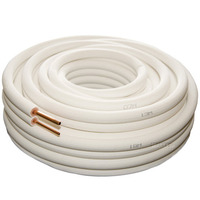
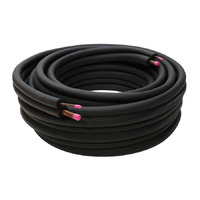
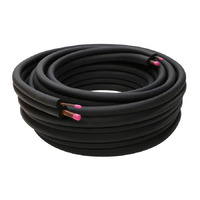
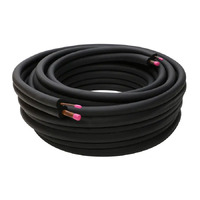
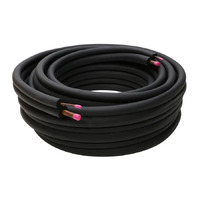
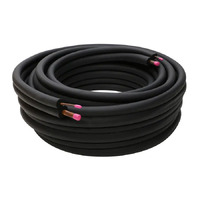
Pair coil copper is the refrigerant pipework that carries gas between the two halves of a split system air conditioner. The indoor head unit (the evaporator) and the outdoor condensing unit must be connected by two sealed copper lines. Pair coil supplies both lines in one pre-insulated, pre-coiled length, which saves time on site and removes the need to insulate pipes individually.
The product is used on every standard split system installation, whether a single-head residential unit or a larger ducted system. Typical coil lengths sold in Australia are 15 metres and 20 metres, which covers the majority of domestic pipe runs between an indoor wall unit and an outdoor compressor.
A split system works by moving refrigerant in a closed loop. The outdoor compressor pressurises the refrigerant gas, which then travels through the liquid line to the indoor evaporator. Inside the evaporator the refrigerant absorbs heat from the room air and turns back into a vapour. That vapour returns to the outdoor unit through the suction line, where the cycle repeats.
The pair coil is the physical path for this entire circuit. Any leak, kink, or contamination along either line will reduce capacity or stop the system entirely, so the pipework must be clean, sealed, and correctly sized from the day it is installed.
Every pair coil contains two different pipe sizes. The smaller tube is the liquid line, which carries high-pressure liquid refrigerant from the outdoor unit to the indoor unit. The larger tube is the suction line, which carries low-pressure gas back to the compressor.
A typical residential size is written as 1/4 x 3/8, meaning a 1/4 inch liquid line paired with a 3/8 inch suction line. Both sizes are specified by the air conditioner manufacturer based on the system capacity, and the two must be fitted to the correct ports on each unit.
Standard copper tube is sold as a single pipe, uninsulated, and intended for general plumbing or gas work. Pair coil copper is purpose-built for refrigerant use. The two pipes are drawn to tighter tolerances, cleaned internally to remove oil and moisture, capped at both ends to keep them clean during transit, and pre-insulated with a closed-cell foam jacket.
Using plumbing-grade copper tube for refrigerant work is not acceptable under AS/NZS 1571. Refrigerant-grade tube is the only type permitted for pressurised HVAC applications.
Copper transfers heat faster than almost any other affordable metal. That matters for refrigerant lines because any heat gain on the suction line reduces cooling capacity, and any heat loss on the liquid line reduces condenser performance. Copper lets the insulation do its job without the pipe material adding resistance.
The combination of copper tube and closed-cell insulation gives a thermal profile that aluminium and steel cannot match at the same wall thickness.
Soft-drawn copper bends by hand around gentle radii and bends cleanly with a copper pipe bender for tighter turns. That flexibility lets installers route pair coil through wall cavities, around corners, and behind cornices without needing fittings at every direction change. Fewer fittings means fewer potential leak points.
Copper also flares reliably. A clean 45 degree flare on the end of a copper pipe gives a metal-to-metal seal that holds refrigerant pressure for the life of the installation.
Copper resists corrosion in almost every environment an air conditioner will encounter. It does not rust, it tolerates humidity, and it reacts predictably to the refrigerants and compressor oils used in modern split systems. In coastal installations the external insulation protects the copper from salt spray, so a properly jacketed pair coil is suitable for Australian coastal conditions.
Refrigerant-grade pair coil uses deoxidised high phosphorus copper, known as DHP copper, at a minimum purity of 99.9 percent. The deoxidising process removes residual oxygen from the metal, which would otherwise form oxides on the inside of the pipe during brazing. Those oxides can flake off, circulate in the refrigerant, and damage the compressor.
Every pair coil sold at Sparky Direct is manufactured to this purity standard and sealed at both ends to keep the internal surface clean until the installer cuts it open on site.
Australian pair coil is sold in imperial sizing, written as liquid line x suction line. The five common combinations cover residential and light commercial work:
| Pair Coil Size | Liquid Line OD | Suction Line OD | Typical System Capacity |
|---|---|---|---|
| 1/4 x 3/8 | 6.35 mm | 9.52 mm | 2.0 to 3.5 kW |
| 1/4 x 1/2 | 6.35 mm | 12.70 mm | 3.5 to 5.0 kW |
| 1/4 x 5/8 | 6.35 mm | 15.88 mm | 5.0 to 7.1 kW |
| 3/8 x 5/8 | 9.52 mm | 15.88 mm | 7.1 to 10.0 kW |
| 3/8 x 3/4 | 9.52 mm | 19.05 mm | 10.0 to 14.0 kW |
Most domestic split systems use either 1/4 x 3/8 or 1/4 x 1/2. A 2.5 kW bedroom unit almost always takes 1/4 x 3/8, while a 5 kW living-room unit will typically take 1/4 x 1/2. Larger open-plan systems at 7 kW and above step up to 1/4 x 5/8 or 3/8 x 5/8, depending on the manufacturer.
Always check the specification sheet for the specific indoor and outdoor unit pairing before ordering pair coil. Two units at the same kilowatt rating can call for different pipe sizes.
Light commercial ducted systems and large multi-head units often require 3/8 x 5/8 or 3/8 x 3/4. For capacities above 14 kW the installer may specify individual copper lines rather than pre-paired coil, because the larger suction line becomes difficult to handle in a bonded pair.
Wall thickness is set by AS/NZS 1571 and by the working pressure of the refrigerant. For R32 and R410A, which operate at higher pressures than the older R22, minimum wall thickness increases as pipe diameter increases. A 1/4 inch liquid line typically has a 0.61 mm wall, while a 5/8 inch suction line is 0.81 mm and a 3/4 inch line is 1.0 mm.
Do not substitute thinner-walled plumbing copper. The wall thickness on pair coil is the reason the pipe can safely hold refrigerant at working pressure.
Every air conditioner specification sheet lists a required liquid line diameter and a required suction line diameter. Those two numbers determine the pair coil size. For example, a Daikin split system at 2.5 kW typically lists 1/4 inch and 3/8 inch as the factory connection sizes, so the correct pair coil is 1/4 x 3/8.
Never oversize or undersize the pipe to save cost. The manufacturer has calculated the line diameters based on refrigerant velocity, oil return, and pressure drop. Changing either line diameter changes those calculations.
Using the wrong pair coil size voids the manufacturer warranty on most air conditioners. It also causes the installer to fall outside AS/NZS 5149 and the relevant installation instructions, which can void building insurance on the installation itself.
Always keep the invoice or packaging from the pair coil purchase as evidence that refrigerant-grade tube to the correct size was used.
An undersized suction line starves the compressor of refrigerant vapour and causes the unit to ice up on the indoor coil. An oversized suction line lets compressor oil pool in the pipe instead of returning to the sump, which can destroy the compressor within a season.
On the liquid line side, an undersized pipe causes flash gas and reduces cooling capacity, while an oversized pipe holds too much refrigerant and upsets the factory charge.
Standard coils come in 15 metre and 20 metre lengths. Every manufacturer specifies a maximum pipe run, typically 15 to 30 metres for residential units, beyond which additional refrigerant must be charged into the system.
Vertical rise is also limited, usually to 8 to 15 metres depending on the unit. Check both the total length and the vertical rise against the specification sheet before finalising the pipe route.
AS/NZS 1571 is the Australian and New Zealand standard for seamless copper tube used in air conditioning and refrigeration. It sets the requirements for copper purity, wall thickness, internal cleanliness, dimensional tolerance, and end capping. Every pair coil sold in Australia must comply with AS/NZS 1571, and the tube itself is usually printed with the standard reference along the length of the pipe.
R32 and R410A are the two refrigerants used in almost every split system sold in Australia today. Both operate at higher pressures than the older R22, which is no longer sold for new installations. Modern pair coil is rated for both refrigerants without any change in specification, because the copper and insulation are both compatible.
The older R22 pair coil has thinner walls and is not safe to reuse with R32. If you are retrofitting an existing site, the pipework generally needs to be replaced.
Refrigerant handling is licensed work: Handling, charging, or recovering refrigerants in Australia requires an ARCtick licence. Buying pair coil is unrestricted, but the final refrigerant connection and commissioning must be done by a licensed technician.
R32 and R410A systems run at roughly 4.3 MPa on the high side during normal operation, with test pressures up to 4.8 MPa. Pair coil made to AS/NZS 1571 has a burst rating well above these working pressures, with a typical safety factor of 3 to 1 on the liquid line.
Any damage to the copper during installation, such as a crimp from a dropped tool or a deep scratch from a poor deburring job, reduces the effective wall thickness and compromises that safety margin.
Pair coil insulation is generally a closed-cell polyethylene foam with a Group 3 or Group 4 early fire hazard rating under AS/NZS 1530.3. In some commercial installations this is acceptable as supplied, but other buildings require higher-rated insulation such as Class 0 elastomeric foam. Check the building specification before ordering.
The suction line runs cold, often 5 to 10 degrees Celsius, while the ambient air can be 30 degrees or higher. Without insulation, water condenses on the pipe the same way it forms on a cold drink, and that condensate drips into ceilings, walls, and wiring.
Insulation prevents condensation, reduces heat gain on the suction line, and protects the copper from UV exposure and mechanical damage during installation. Every pair coil sold at Sparky Direct ships with both lines fully insulated.
Standard pair coil has an insulation thickness of around 6 mm, suitable for indoor concealed runs in temperate climates. Heavy duty pair coil uses 9 mm insulation, which is the Australian industry norm and the product Sparky Direct stocks as standard. Heavy duty insulation is suitable for all residential and light commercial applications in Australian conditions, including Queensland humidity and tropical North installations.
R-value measures thermal resistance. A 9 mm closed-cell polyethylene foam gives an R-value of approximately 0.35, which is adequate for all standard split system runs. For very long runs, for cold climate heat pump applications, or for hot roof space installations, upgrading to a thicker aftermarket insulation jacket is sometimes warranted.
The insulation jacket is the weak point during installation. Pulling the coil through a tight hole, scraping it against brick, or stepping on it in a roof space will all tear the foam and expose the copper. Once torn, the jacket must be patched with matching foam tape or the section replaced.
Wall sleeves and bushings prevent damage where the pair coil passes through building fabric. Duct covers protect the run where it is exposed to sunlight on an external wall.
The largest use for pair coil is single-head residential split systems. A typical bedroom or living room installation uses one 15 to 20 metre coil, routed through the wall cavity, into the roof space, and down to the outdoor unit.
Light commercial ducted systems and small cassette units in shops and offices also use pair coil. Capacity ranges from 7 kW up to around 20 kW, which covers 3/8 x 5/8 and 3/8 x 3/4 sizes. Longer runs and higher vertical rises are more common, so installers need to check the spec sheet carefully.
Multi-split systems use one outdoor unit connected to multiple indoor heads. Each indoor unit needs its own dedicated pair coil run back to the condenser. The installer typically uses several coils in different sizes, matched to the capacity of each indoor head.
Pre-insulated pair coil is faster, cleaner, and more reliable for standard installations. Field-insulated copper uses individual copper pipes insulated on site. It is reserved for specialist jobs such as very long commercial runs, VRF systems with oversized lines, or retrofits where the existing pipe route cannot accept a bonded coil.
Good pair coil arrives with both ends tightly capped, a clean uniform insulation jacket, no visible kinks in the coil, and the AS/NZS 1571 reference printed on the copper itself. Any pair coil with missing caps, torn insulation, or a flattened coil should be set aside and not used.
When comparing different suppliers, check three numbers: outside diameter of each pipe, wall thickness of each pipe, and insulation thickness. Cheap imported pair coil sometimes has thinner walls or thinner insulation than the Australian industry standard, and those savings disappear the first time the pipe leaks.
Sparky Direct stocks heavy duty insulated pair coil in all common sizes, rated for R32 and R410A, with 9 mm insulation as standard. The pair coil copper range ships direct from our Brisbane warehouse and is priced for trade buyers.
In Australia, any work that involves handling refrigerant (including pressure testing with nitrogen, evacuating the system, and charging refrigerant) requires an ARCtick licence issued by the Australian Refrigeration Council. Running the copper and mechanically connecting it to the units is unrestricted, but the final commissioning is licensed work.
Electrical connection of the outdoor and indoor units is separate licensed electrical work under AS/NZS 3000.
Plan the full pipe route before uncoiling the pair coil. Mark entry and exit points, note every bend, and measure the total length plus 10 percent for waste. Uncoil the pair carefully to avoid kinks. A kinked pipe cannot be straightened without damaging the wall.
Use proper flaring kits to prepare each end, and deburr the cut before flaring to avoid copper shavings entering the system. A clean, square flare is the foundation of a leak-free joint.
Bend radius matters. A 1/4 inch line can be bent to a 50 mm radius by hand, while a 5/8 inch line needs a pipe bender and a larger radius, typically 100 to 150 mm. Forcing a tight bend causes the pipe to collapse, which cannot be seen from the outside once the insulation is back in place.
Secure the pair coil at least every 1.2 metres on horizontal runs and every 1.5 metres on vertical runs. Use proper line set clamps, not cable ties, to avoid compressing the insulation.
Keep the end caps in place until the moment the pipe is cut. Store coils flat, off the floor, and away from direct sunlight. Any pair coil that has been left open to air for more than a few hours should be flushed with dry nitrogen before commissioning to remove moisture.
A leaking or poorly insulated pair coil reduces efficiency in two ways. Loss of refrigerant charge reduces cooling capacity and forces the compressor to run longer, and poor insulation lets the suction line warm up, which further reduces capacity. A typical split system loses 1 to 3 percent efficiency for every degree Celsius of suction line heat gain.
Properly installed pair coil lasts the life of the air conditioner, typically 15 to 20 years. The insulation may deteriorate sooner on exposed external runs, which is why duct cover should be used wherever the pair coil is not concealed.
Pair coil needs replacement in several situations. Retrofitting from R22 to R32 requires new pipe because older R22 coil has thinner walls. Degraded insulation that drips condensation is another trigger. Damage from pests, building work, or a leak in the middle of a pipe run also calls for replacement. Small leaks on flared joints can usually be repaired by re-flaring.
Pair coil pricing is driven almost entirely by the copper commodity market and the size of the two lines. As a rough guide, a 1/4 x 3/8 coil at 20 metres is the cheapest common size, 1/4 x 1/2 is mid-range, and 3/8 x 5/8 is the most expensive standard residential size. Prices move with the LME copper spot price, so wholesalers update pricing regularly.
The cheapest pair coil per metre is almost always 1/4 x 3/8 in a 20 metre coil, because buying a full coil is more cost-effective than buying cut lengths. Splitting a coil across multiple jobs is common on small residential work.
Trade buyers who install multiple systems each week benefit from holding a full stock of each common size. Buying 5 or 10 coils at a time reduces per-coil freight cost, and full pallets of mixed sizes are available for larger contractors. Sparky Direct supplies both single coils for one-off jobs and bulk quantities for trade stock.
Trade electrical wholesalers carry pair coil in all common sizes, with stock on hand and pricing set for professional buyers. Retail channels typically hold one or two sizes at premium pricing. For licensed installers, a trade supplier is both faster and cheaper.
Sparky Direct holds all common pair coil sizes in stock and ships Australia-wide. Standard orders dispatched on the same business day reach most metro areas within 1 to 3 days. Remote and regional delivery varies by area.
Start with the air conditioner specification sheet. Record the required liquid and suction line sizes, the maximum pipe length, and the maximum vertical rise. Then choose a pair coil size and length that meets all three, with some margin for bends and routing.
If you are installing a system from Daikin, Mitsubishi Electric, Fujitsu, or any other major brand, the factory connection sizes are printed on the unit or in the installation manual.
Plan pair coil purchases alongside pair coil fittings, air conditioning ducting, wall brackets, and an installation kit for any unusual pipe routes. Check the local council if the outdoor unit is to be wall-mounted in a sensitive location.
Pair coil should come from a recognised trade wholesaler that stocks to AS/NZS 1571 and can supply compliance documentation if asked. Sparky Direct ships Australia-wide from Brisbane and holds all five common residential sizes as core stock, with air conditioning tools, vacuum pumps, manifold gauges, pump oil, and wall brackets all available from the same order.
Trusted refrigeration brands stocked by Sparky Direct include RectorSeal for flaring kits, Polybender for copper tube benders, NAVTEK for cordless flaring tools, and K-FLEX for specialist insulation.
Watch Polybender | 1/2 Internal Copper Tube Bender | Red video
Watch Polybender | 3/8 Internal Copper Tube Bender | Yellow video
Watch NAVTEK NEF6LM | HVAC Cordless Power Flaring Tool 7.4V 2Ah 14.8Wh video

Excellent coil. Whenever I need air conditioning pair coil 1'4 x 3 /8' 410a 20m Polyethylene UV Protected Insulated Copper Heat Resistant up to 120°c I'll be sure to use this excellent product.
Meets standards. Did the job it was intended for. Great communication. Postage time was very quick. Gladly recommend the product and the company.
Great product and at half the price of individual pipes. AS described, and a fantastic delivery service to our area.
Quality products in stock • Fast Australia-wide delivery • Competitive trade pricing
Browse Pair Coil Copper → Get Expert Advice →Yes. Pair coil copper is commonly used in residential split system air conditioning installations.
Pair Coil Copper is available from Sparky Direct, providing access to quality materials with Australia-wide delivery.
Yes. Most air conditioning pair coil copper is supplied with insulation already fitted for convenience and compliance.
Yes. Pair coil copper is commonly available for delivery to both residential and commercial locations.
Warranty coverage depends on the manufacturer and supplier, with conditions applying when used as intended.
Consider the required pipe sizes, length, refrigerant compatibility, insulation quality, and installer requirements.
When properly installed and protected, pair coil copper can last for many years as part of an air conditioning system.
In most installations, pair coil copper is concealed within walls, ceilings, or protective ducting.
Correctly sized and installed pair coil copper supports smooth refrigerant flow, which can help minimise operational noise.
Reusing pair coil copper is not always recommended, as contamination or wear may affect system performance. A licensed installer should assess suitability.
Pair coil copper should be kept sealed, dry, and protected from physical damage prior to installation.
Yes. Insulation helps prevent condensation forming on the copper lines during cooling operation.
Yes. Larger diameter and longer length pair coil options are available for light commercial systems.
Air conditioning pair coil copper is insulated copper tubing supplied as a matched pair, used to connect the indoor and outdoor units of a split system air conditioner.
Using high-quality pair coil copper helps maintain efficiency, reduce the risk of leaks, and support long-term reliability.
Correct sizing ensures efficient refrigerant flow, reliable performance, and helps prevent system faults.
Yes. Connection and installation of pair coil copper must be carried out by licensed refrigeration and electrical professionals.
Copper tubing can be shaped as required, but bending and installation must be performed by licensed professionals to avoid damage or leaks.
Pair coil copper is commonly supplied in pre-cut coil lengths, with options varying depending on supplier and application.
Yes. Modern pair coil copper is suitable for use with R32 refrigerant when correctly rated and installed.
Pair coil copper must match the size and refrigerant requirements specified by the air conditioner manufacturer to ensure correct operation.
Yes. Air conditioning pair coil typically includes factory-applied insulation to reduce heat transfer and prevent condensation.
Pair coil copper is available in various diameter combinations to suit different air conditioner capacities and manufacturer specifications.
Quality pair coil copper supplied in Australia is manufactured to meet relevant AS/NZS material and safety requirements when used in compliant systems.
Copper is used due to its durability, corrosion resistance, and excellent thermal conductivity, making it suitable for refrigerant transfer.