
Search Results:
Search Results:
Search Results:
Search Results:
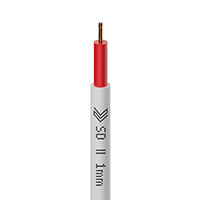
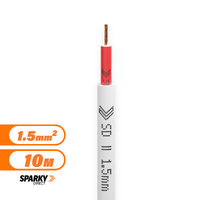
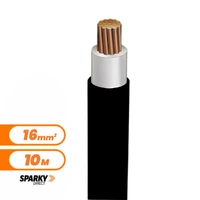
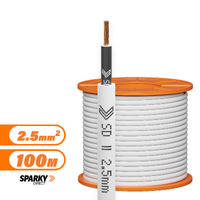
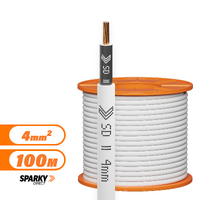
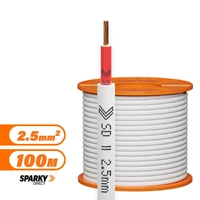
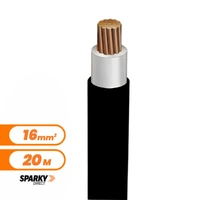
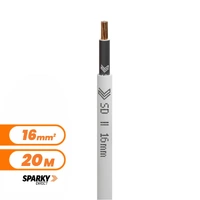
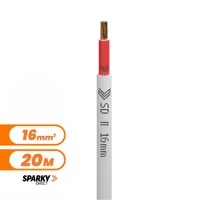
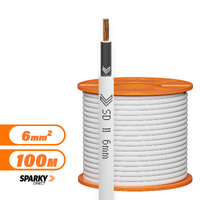
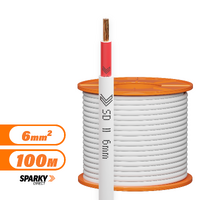
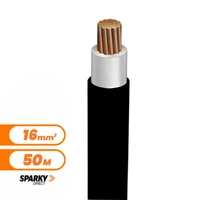
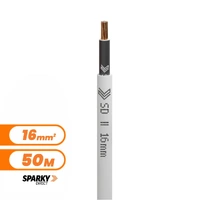
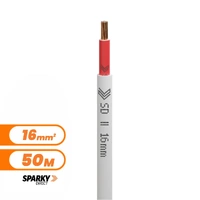
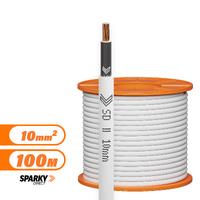
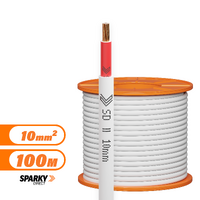
SDI stands for Single Double Insulated, and the name describes the construction: a single stranded copper conductor with two separate layers of PVC insulation. The inner layer provides electrical insulation, while the outer layer adds mechanical protection and colour identification. This makes SDI cable a V90 grade building wire compliant with AS/NZS 5000.2 for general wiring applications.
Traditional sheathed cables such as TPS flat twin and earth combine several conductors inside a common outer sheath, whereas SDI is supplied as individual single-core wires. Electricians run multiple SDI conductors together through conduit, cable tray, or switchboard trunking to form a circuit. The double insulation replaces the sheath, so each wire is already rated for direct contact with enclosure walls and adjacent conductors.
SDI cable is the standard choice inside switchboards and distribution panels, where it bends tightly around circuit breakers, RCDs, and busbars. Colour-coded insulation makes phase, neutral, and earth identification simple during rough-in and testing. The flexibility reduces fatigue on terminations, which helps maintain contact pressure on circuit breakers and cable lugs over the life of the installation.
Australian-made SDI cable uses annealed stranded copper conductors, with stranding specified in the product code. For example, 7/050 means seven strands of 0.50mm wire, giving a nominal 1.5mm² cross-section. Stranded copper bends more easily than solid wire, which matters for tight switchboard work and repeated termination.
The inner primary insulation is V75 or V90 grade PVC rated for 75 or 90 degrees Celsius continuous conductor temperature. The outer sheath is a second PVC layer, typically in the same colour. The two layers bond during extrusion but remain distinct enough to meet the double-insulation test requirements of AS/NZS 5000.2.
Most Electra-Cables SDI stocked at Sparky Direct is rated 450/750V, suitable for all standard 230V and 400V Australian installations. The V90 temperature rating allows continuous operation at 90 degrees Celsius in the conductor, which is the figure used when calculating current-carrying capacity under AS/NZS 3008.1.1.
SDI is stocked in the conductor sizes most commonly used on Australian domestic and commercial boards. Each size matches a typical circuit current and breaker rating. Always verify the derated current-carrying capacity for your installation method and grouping before selecting a size.
| Conductor Size | Stranding | Typical Use | Indicative Circuit Rating |
|---|---|---|---|
| 1.0mm² | 7/0.40 | Lighting circuits, control wiring | 10A |
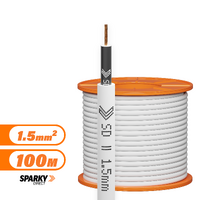
| 1.5mm² | 7/0.50 | Lighting, switchboard interconnections | 10A-16A |
| 2.5mm² | 7/0.67 | General power circuits, GPO sub-circuits | 20A-25A |
| 4mm² | 7/0.85 | Hot water, range circuits, sub-mains | 25A-32A |
| 6mm² | 7/1.04 | Sub-mains, large appliance circuits | 32A-40A |
Electra-Cables SDI is available in red, black, blue, white, yellow, and green or green-yellow striped. Red is commonly used for active conductors on single-phase work, while black often designates neutral in older installations and green-yellow is reserved for earth. Multi-phase work uses red, white, and blue for active phases under the AS/NZS 3000 standard colour scheme.
Colour Discipline: Maintaining consistent colour identification across the entire installation is a basic safety practice. Mixing colours mid-run creates a hazard for the next electrician working on the board. Order full drums when a large job is planned so colour supply does not run short part-way through.
Start with the circuit design current, then apply derating factors for installation method, ambient temperature, and grouping with other circuits. Cross-check against the protective device rating so the cable clears before the breaker under short-circuit conditions. AS/NZS 3008.1.1 provides the tables for this calculation, and you should never size purely on breaker rating alone.
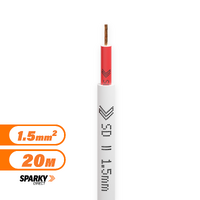
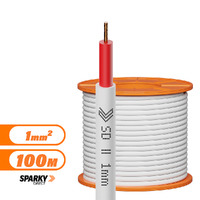
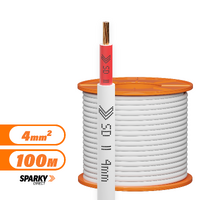
Sparky Direct stocks SDI in 20-metre cut lengths and full 100-metre drums. Cut lengths suit switchboard rewires, small extensions, and job-specific requirements, while full drums are more cost-effective per metre on larger commercial work. Check the cable cuts range for available short-length options.
SDI is one of several wiring cable types used in Australian installations. Choosing between them depends on installation method, mechanical protection, and whether a shared sheath is needed.
| Cable Type | Construction | Typical Use | Key Characteristic |
|---|---|---|---|
| SDI (Single Double Insulated) | Single core, two PVC layers | Switchboards, conduit runs, sub-mains | Flexibility and individual colour coding |
| TPS Twin and Earth | Two insulated conductors plus bare earth in sheath | General domestic power and lighting | One cable per circuit, fast to install |
| Orange Circular | Sheathed multicore, heavy duty | Sub-mains, outdoor runs, underground | Higher mechanical protection |
| Coaxial | Central conductor, dielectric, shield, jacket | TV signal, antenna distribution | Signal carriage, not power |
Choose SDI when conductors will be grouped inside conduit, trunking, or a switchboard. The ability to pull individual wires of different colours through a single conduit gives design flexibility that a sheathed cable cannot match. For fixed surface wiring in domestic premises, a flat twin and earth cable is usually faster to install.
Orange circular cable is specified where mechanical damage risk is higher, such as buried runs or exposed sub-mains. TPS suits clipped runs in roof spaces, wall cavities, and under floors where conduit is not required. A current overview of orange circular cable and standard TPS cable sizing helps with the comparison at the design stage.
SDI is the standard wire inside Australian domestic and commercial switchboards. It connects busbars to circuit breakers, circuit breakers to neutral links, and RCDs to downstream protective devices. The flexibility makes tight bend radii possible without stressing the conductor or the termination.
On commercial and industrial sites, sub-mains often run inside rigid or corrugated conduit. SDI in 6mm², 10mm², or larger sizes serves as the active, neutral, and earth conductors. Pulling three or four single wires through a single conduit is typically easier than drawing one heavy sheathed cable, especially through long runs with multiple bends.
1.0mm and 1.5mm SDI suits lighting circuits where the cable runs in conduit or trunking. It also serves control wiring inside mechanical plant, motor control centres, and PLC panels. Small sizes are easy to terminate into control-gear screw terminals and DIN-rail equipment.
Green-yellow SDI is widely used as a protective earth in switchboards and equipotential bonding systems. It runs from the main earth bar to sub-boards, water pipe bonds, and exposed metalwork. Sizing follows the earth conductor rules in AS/NZS 3000 Section 5.
Use a proper cable pulling lubricant to reduce friction, especially on longer runs or high-fill conduits. Bend radius matters: tight bends damage the inner insulation without necessarily showing external damage. Keep bend radius at least six times the cable outer diameter as a working rule. A cable selection that matches the conduit size avoids overfilling and future pulling problems.
Strip only the outer sheath needed for the terminal, because leaving excess bare conductor creates a shock hazard inside the enclosure and reduces the double-insulation benefit. Use a stripper set to the correct depth so the copper is not nicked, since nicked strands break under vibration and reduce long-term reliability.
Keep 230V power conductors segregated from extra-low-voltage data cabling where practical, since AS/NZS 3000 includes specific segregation rules inside shared enclosures. Use dividers or separate conduits where mixed voltages share a cable tray. Proper segregation reduces induced noise on control and data circuits.
Conduit fill is limited by AS/NZS 3000 to prevent overheating and make future pulling possible, with a common target of 40 percent fill for conduits with multiple bends. Calculate the combined cross-sectional area of the cables planned, then compare against the internal area of the conduit before installation, and upsize the conduit rather than force-fit cables.
Label each conductor at both ends with the circuit number, because consistent labelling saves significant time during future fault-finding and board upgrades. After installation, complete insulation resistance testing, continuity testing, and polarity testing before energising, then document the results against the circuit schedule.
Electra-Cables SDI is manufactured to AS/NZS 5000.2, the Australian and New Zealand standard for PVC-insulated cables rated up to 450/750V. Each cable carries the manufacturer mark, voltage rating, conductor size, and standard number printed on the outer insulation at regular intervals.
Wiring rules sit under AS/NZS 3000:2018, commonly called the Australian Wiring Rules. Section 3 covers general selection and installation requirements, Section 5 covers earthing, and Section 8 covers verification and testing. A compliant installation depends on correct cable selection, correct protection, and correct testing at handover.
AS/NZS 3008.1.1 provides the current-carrying capacity tables used by designers and licensed electricians. Figures vary with installation method, insulation grade, ambient temperature, and grouping. Using the correct table row prevents under-sized cables from overheating under load.
Licensed electricians must issue a Certificate of Compliance for Electrical Work in most Australian states and territories. The certificate references the circuits installed, the testing completed, and the applicable standards. Keep test records filed against the job for the period required by state regulation.
Short lengths from 20 metres suit small jobs, switchboard rewires, and spare stock for the ute. Cost per metre is higher on cut lengths than on drums because of handling and packaging. Sparky Direct stocks standard cut options alongside the full drums, so buying only what is needed for a single job is straightforward.
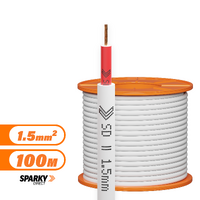
Full drums offer the lowest cost per metre and are the practical option for new-build and commercial work. A single 100-metre drum of red 1.5mm SDI covers the majority of active wiring on a medium domestic switchboard project. Keeping a full drum of each common size on the truck reduces return trips to the wholesaler.
SDI priced by the metre is typically comparable to equivalent single-core building wire options from Electra-Cables. Factor in labour when comparing sheathed cables: SDI inside conduit is slower to install overall than flat TPS on surface runs, but it gives design flexibility that sheathed cables cannot match. Price per metre is only part of the total job cost.
Sparky Direct ships Australia-wide, and for commercial projects ordering multiple drums at once, bulk pricing is available through the trade enquiry line. Delivery of full drums is palletised on larger orders to reduce handling damage in transit.
Before ordering, list every circuit on the job with its conductor size and approximate length. Add 10 to 15 percent for terminations, drops, and unforeseen extensions. Buying too little and topping up mid-job costs more in delivery fees and time than slightly over-ordering at the start.
SDI work usually needs supporting products on the same order. Consider heavy duty rigid conduit for buried or exposed runs, cable glands for enclosure entries, cable ties for dressing inside boards, and crimping tools where lug terminations are required. Brands such as CABAC and Klein Tools cover the tooling side.
Sparky Direct delivers across Australia with express options on most in-stock items. For urgent jobs, checking stock via the product page before ordering avoids disappointment. Call the trade line for same-day dispatch confirmation on large orders.
Watch 1.5mm SDI Red Cable | Single Double Insulated 1.5mm Red 20mtr Cut | 15SDI-R20 video
Watch Cable Puller Tool | Electricians Yellow Tongue 3.6mtr | SER4 video
Watch TUFFR30HD | Cable Pull Through Snake with Holder 30 Meter x 6.0mm | Fibreglass Twist Fish Rod video

Happy with our first order, the delivery was prompt and every ordered arrived at once, likely to use Sparky Direct again.
Will only install high quality cable. Can't beat the quality and price of this product.
Quality cable at a great price. Speedy order processing and pick up availability
Quality products in stock • Fast Australia-wide delivery • Competitive trade pricing
Browse SDI Cable → Get Expert Advice →Yes. SDI cable is commonly installed within wall cavities, ceilings, and conduits.
Single double insulated cable is available from Sparky Direct, offering access to compliant electrical products with Australia-wide delivery.
Delivery options depend on the supplier and location, with availability across metropolitan and regional Australia.
Yes. SDI cable is suitable for new construction, renovations, and electrical upgrades.
Warranty coverage depends on the manufacturer and supplier, with conditions applying to correct use and installation.
Consider conductor size, insulation rating, application requirements, compliance markings, and electrician recommendations.
Yes. When compliant products are installed by licensed electricians, SDI cable provides a safe wiring solution.
Yes. When correctly sized, SDI cable is suitable for modern residential electrical loads.
Yes. SDI cable offers flexibility suitable for routing through conduits and confined spaces.
The cable itself does not require maintenance but is checked during routine electrical inspections.
Yes. SDI cable is often used during electrical upgrades and renovation projects.
When correctly installed and protected, SDI cable can provide many years of reliable service.
In most cases, SDI cable is concealed within conduits or building structures once installed.
Single double insulated cable, commonly known as SDI cable, is an electrical cable with a single conductor that has two layers of insulation for added safety.
SDI cable is designed for professional use and is manageable for licensed electricians during installation.
SDI cable offers flexibility and added insulation, making it suitable for lighting and switch wire applications.
Yes. Installation of SDI cable must be carried out by a licensed electrician to ensure safety and compliance.
SDI cable is primarily designed for indoor or protected environments and is not intended for direct exposure to weather.
Yes. SDI cable is commonly installed within conduit systems for protection and compliance.
Yes. SDI cable is available in a range of conductor sizes to suit different electrical loads and applications.
SDI cable typically uses copper conductors due to their excellent conductivity and reliability.
Yes. SDI cable is widely used in Australia and is suitable for approved applications when installed by a licensed electrician.
Double insulated means the conductor is protected by two layers of insulation, reducing the risk of electric shock if one layer is damaged.
Quality SDI cable supplied in Australia is manufactured to meet relevant AS/NZS electrical and safety standards when installed correctly.
SDI cable is commonly used for fixed wiring applications such as lighting circuits, switch wires, and control wiring in residential and light commercial installations.