
Search Results:
Search Results:
Search Results:
Search Results:
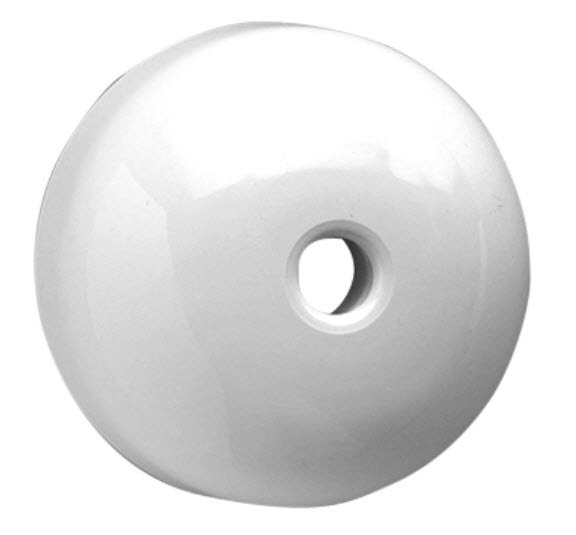
Find the best ceiling roses here at Sparky Direct [ Read More ]
Pendant lighting is one of the most common fitting styles in Australian homes, and the ceiling rose is the small but critical component that makes it possible. Understanding what a ceiling rose actually is, and what it isn't, clears up most of the confusion electricians and homeowners run into when planning a lighting upgrade.
A ceiling rose is a circular electrical accessory mounted directly to a ceiling joist or batten. Inside its housing sits a terminal block where the building's fixed lighting circuit cable terminates. The pendant flex (the flexible cord that holds the lamp) drops down through a cord grip in the rose, with the flex conductors landing on the same terminal block. The whole assembly is then covered by a snap-on or screw-on cap that hides the wiring.
In short, a ceiling rose is the safe, code-compliant junction point between the rigid wiring buried in the ceiling and the flexible cord hanging the pendant.
On a standard Australian loop-in lighting circuit, the ceiling rose performs three jobs at once:
This is the most common point of confusion, especially during renovations. A decorative plaster rose (sometimes called a Victorian or heritage rose) is a moulded plaster or polyurethane disc fixed to the ceiling purely for visual effect: it has no electrical function whatsoever. An electrical ceiling rose is a current-carrying accessory tested to AS/NZS 60669.1 and certified for use as part of a lighting circuit.
If you're matching a heritage look, you fit the decorative plaster rose first, then mount the electrical ceiling rose at the centre of it.
Ceiling roses have been the default Australian solution for pendant lighting for decades, and there are good engineering reasons why electricians keep specifying them over alternatives.
The purpose of a ceiling rose is to provide a single compliant fitting that combines three functions: cable termination, circuit looping, and mechanical pendant support. Without it, you would need a separate junction box buried in the ceiling cavity plus a cord-grip plate at the surface: two products doing one job, with extra labour and an inaccessible junction.
One cable run can serve multiple light points without buried junctions in the ceiling cavity.
Every connection sits behind a removable cover, so future maintenance does not mean cutting into plaster.
Almost every pendant light sold in Australia is designed to hang from a standard ceiling rose.
The fitting is tested and certified as a single unit, keeping installs straightforward under AS/NZS 3000.
"Direct pendant wiring", running flex straight from the ceiling cable into the lamp without a rose, is not a compliant option in Australia for permanent installations. The flex needs an anchored cord grip and the cable joints need to be enclosed in a tested accessory. A ceiling rose provides both. Some integrated pendant fittings include their own canopy that acts as the rose, but you still need an approved accessory at the ceiling.
Not all ceiling roses are the same. Choosing the right type depends on the circuit configuration, the pendant style, and whether the fitting needs a loop terminal.
The two main types you will see on Australian shelves are:
Both types are physically similar from the outside, but the terminal block layout inside is different.
A pendant light fitting is the complete suspended assembly. It includes the ceiling rose at the top, the flex (often three-core 0.75mm² or 1.0mm² heat-resistant cord), the lampholder (BC, ES, or modern integrated LED module), and the shade or diffuser. Some pendants ship as a complete kit including a matching rose; others assume you will supply the rose separately. Decorative pendants (woven, glass, metal) almost always rely on a separately purchased ceiling rose paired with a matching pendant suspension cord.
For pendant lights specifically, the ceiling rose is the suspension point. It carries the lamp's full hanging weight through the cord grip, which is why pendant weight ratings matter (covered in the Sizes and Ratings section below). A ceiling rose is not a generic mounting plate: it is engineered for the dynamic load of a hanging fitting.
Use a ceiling rose when fitting a pendant, chandelier, or any lamp that hangs from a flex.
Use a batten holder when fitting a bare bulb directly to the ceiling with no shade or with a clip-on shade.
A batten holder integrates the lampholder into the ceiling fitting itself: there is no flex involved. A ceiling rose, by contrast, is just the connection point, with the lampholder at the other end of the cord.
The terminal block is where everything happens inside a ceiling rose. Knowing what each terminal does is fundamental to safe loop-in wiring.
A standard Australian ceiling rose has four main components:
A typical 4-terminal Australian ceiling rose has:
The loop terminal carries the unswitched active conductor through the rose to the next light point on the same circuit. This is what makes loop-in wiring work: instead of running every light back to a central junction, the circuit hops from rose to rose, with the loop terminal acting as the through-connection. The loop terminal is electrically isolated from the switched active that feeds the lamp itself.
On a typical Australian loop-in circuit:
| Conductor | Modern Cable Colour | Older Cable Colour |
|---|---|---|
| Active | Brown | Red |
| Neutral | Blue | Black |
| Earth | Green/Yellow | Green |
| Switch wire (loop active) | Brown (sleeved) | Red |
Older Australian installations may still use red/black/green TPS cable. When working on existing installations, always test before assuming colour conventions, and re-identify any conductor that does not match its function with the correct sleeving.
Ceiling roses are part of the fixed wiring of a building, which means installation, replacement, and modification are regulated electrical work. This is not an area where DIY is legally available, even when the work looks simple.
In every Australian state and territory, replacing or installing a ceiling rose is regulated electrical work that must be carried out by a licensed electrician. Replacing the cover or shade of an existing fitting is sometimes considered maintenance, but anything involving terminal connections, cable handling, or the rose body itself is licensed work. Penalties for unlicensed electrical work in Queensland and New South Wales are substantial, and unlicensed work voids home insurance in the event of a fire.
The relevant standards are:
Ceiling roses sold by Sparky Direct are certified to the relevant Australian standards.
Yes, for lighting circuits. A 4-terminal ceiling rose is specifically designed to function as the junction point at each light position, which eliminates the need for a separate junction box. This is the basis of loop-in wiring. However, a ceiling rose is not a general-purpose junction box: it cannot be used to join cables that are not part of a lighting circuit feeding a pendant or terminating at that point.
A standard ceiling rose is not rated to support the weight, vibration, or torque of a ceiling fan. Ceiling fans require a fan-rated mounting block or canopy. The mount must be mechanically fixed to a structural ceiling member and certified for the dynamic loads a fan produces. Using a ceiling rose to hang a fan creates a serious safety risk. The fitting can detach, the cord grip can fail, and the terminal block is not designed for the continuous current draw of a fan motor. If you are replacing a pendant with a ceiling fan, the rose comes out and a fan-rated mount goes in.
Ceiling roses look similar across brands, but the electrical and mechanical ratings can vary significantly. Matching the rose to the pendant is the part most people get wrong.
Australian ceiling roses are typically 70-95mm in diameter and 25-45mm deep. The mounting hole pattern usually accepts standard 50mm or 60mm fixing centres, which matches most ceiling battens and mounting blocks. Cable entries accept standard 1.0mm² and 1.5mm² TPS cable, with cord-grip exits sized for 0.75mm² to 1.0mm² flex.
Most Australian ceiling roses are rated at 6A or 10A at 250V AC. For domestic lighting circuits, which are typically protected by a 10A or 16A circuit breaker, a 6A rose is sufficient for any normal residential pendant. A 10A rose offers extra headroom for chandeliers with multiple lamps or for circuits feeding a long string of lights via the loop terminal.
Standard ceiling roses are typically rated for pendants up to 2-5kg, depending on the brand and the cord grip type. Heavier decorative pendants, multi-lamp chandeliers, and large glass fittings can easily exceed this: a 7kg pendant on a 3kg-rated rose will eventually fail. Always check the manufacturer's pendant weight rating in the product datasheet before specifying. For heavy fittings, use a rose with a metal-reinforced cord grip or fit a separate suspension hook through to the ceiling joist.
Yes. Ceiling roses are voltage-rated, not lamp-technology-specific, so any modern ceiling rose will work with LED, CFL, or incandescent pendants. The lower current draw of LED light bulbs actually makes ceiling roses operate well within their rating. The only consideration is whether the LED pendant has an integrated driver. If it does, make sure the rose's terminal block can accommodate the slightly larger conductor cross-section some LED pendants use.
The ceiling rose itself is not a dimmable component: dimming is controlled by the wall dimmer, not the fitting at the ceiling. As long as the dimmer is compatible with the lamp technology in the pendant (leading-edge, trailing-edge, or LED-specific), any standard ceiling rose will work in a dimmable circuit. There is no such thing as a "dimmable ceiling rose" as a product category; the rose is a passive accessory that simply carries whatever signal the dimmer sends.
The build quality of a ceiling rose matters more than its price tag suggests. A failed rose at ceiling height is an awkward and expensive callback.
Almost every modern Australian ceiling rose is moulded from polycarbonate or self-extinguishing thermoplastic rather than metal. There are good engineering reasons for this:
Metal ceiling roses do exist (mostly in heritage and UK-imported product) but they are uncommon in current Australian stock and require additional earthing considerations.
When evaluating a ceiling rose at the trade counter, check for:
Look for housings rated to UL94 V-0 for flammability. This means the material self-extinguishes within 10 seconds of an ignition source being removed. Quality ceiling roses also specify a glow-wire test temperature (typically 850°C for accessories supporting current-carrying components) under IEC 60695. These ratings matter because the rose sits in close contact with the pendant flex and the supply cable, both of which can develop fault temperatures.
For typical Australian residential pendants, specify a 4-terminal polycarbonate ceiling rose from a trade-grade brand such as Clipsal, HPM, or NLS. A 6A or 10A rating with a 3-5kg pendant capacity will handle anything from a kitchen pendant to a bedroom feature light. Step up to a higher-capacity rose, or use a separate suspension hook, for chandeliers and heavy decorative fittings.
Most ceiling roses are designed for sheltered indoor use only. Outdoor applications need a different specification.
The IP rating system describes ingress protection. IP23 means the fitting is protected against solid objects greater than 12mm (a finger) and against spraying water at angles up to 60° from vertical. That is enough for a covered alfresco area or a verandah, but it is not suitable for direct rain exposure. For full weather exposure you need IP44 or higher, with IP54 being typical for genuinely exposed locations.
For outdoor pendants on verandahs, alfresco kitchens, or covered patios, specify a ceiling rose with at least an IP44 rating, sealed cable entries, and a gasketed cover. Most outdoor-rated installations use a weatherproof junction box with a sealed pendant gland rather than a standard ceiling rose, because true IP-rated roses are uncommon. For exposed coastal locations, also check the housing material for UV stability and corrosion resistance on any metal components.
Ceiling roses used to be purely functional: white plastic discs nobody noticed. Modern pendant design has changed that, and finish options now matter as much as electrical rating.
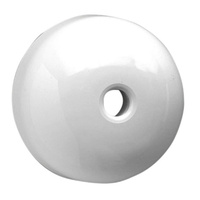
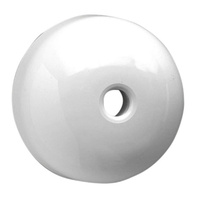
The standard white ceiling rose is the default choice for the vast majority of Australian residential installations. It blends with painted ceilings, works with almost any pendant style, and is the lowest-cost option. White is what most builders specify in new construction unless the project brief calls for something different.
Black ceiling roses have become significantly more popular as black-finish pendants and industrial-style lighting have moved into mainstream Australian homes. A black rose disappears against a dark pendant flex and finishes the fitting cleanly without the visual break of a white disc. Black roses are particularly common in kitchens, dining areas, and feature lighting where the pendant is meant to be seen as a sculptural object.
Beyond white and black, current options include:
For modern pendant installations, look for a rose that matches the pendant's flex colour. White flex pairs with a white rose; fabric-braided flex suits a slim metallic rose. The cover should snap into place cleanly with no visible screws. The Clipsal Iconic ceiling rose range and the equivalent HPM and NLS modern lines all hit these design targets while staying compliant with Australian electrical standards.
Three brands account for most of the ceiling roses installed in Australian homes. Each has a slightly different position in the market.
Clipsal, now part of Schneider Electric, is the most widely specified accessories brand in Australia. The Clipsal ceiling rose range covers traditional 4-terminal models, slim-profile renovation versions, and design-led variants matched to the Iconic and Saturn ranges. Clipsal roses are typically the default specification on new builds and are stocked nationwide via the Clipsal electrical accessories range.
HPM is the other major Australian electrical accessories brand, with a strong presence in the residential and trade markets. HPM ceiling roses are direct alternatives to Clipsal equivalents and are often specified on project work where HPM is the standard switchgear. The build quality is comparable, and electricians frequently mix-and-match between the two brands without compatibility issues.
NLS sits in the trade-priced segment of the market: same Australian compliance, same electrical performance, lower per-unit cost. For volume residential work where the rose is not a finished design feature (white roses behind a shade, ceiling cavities, rental properties), NLS is the brand most contractors specify. Sparky Direct also stocks several other compliant trade-grade alternatives such as CABAC for high-volume installs.
The honest answer is that both meet the same Australian standards and both will give you decades of reliable service. The decision usually comes down to:
Both brands are stocked at Sparky Direct and shipped nationwide.
Club Clipsal is Australia's largest electrician community offering trade rewards, business support, and exclusive benefits. When you nominate Sparky Direct as your preferred wholesaler, we automatically apply your Clipsal spend points to your Club Clipsal account daily.
Entry-level offering coaching, mentoring, and training discounts
Unlock exclusive industry tools and networking events
Access Toyota fleet offers and business software discounts
Maximum benefits, including VIP experiences and rewards
1. Sign Up: Create your Club Clipsal account at clipsal.com/club-clipsal or via the iCat mobile app
2. Nominate Sparky Direct: Select Sparky Direct from the wholesaler dropdown menu in your profile
3. Add Email: Enter your Sparky Direct account email address in the membership number field
4. Start Earning: Every dollar spent on Clipsal products earns points automatically
Redeem points from the rewards store, including gift cards, tools, and experiences. Access business summits, product training, and industry networking events. Receive early access to new product launches and special promotions. Connect with fellow electricians via the Club Clipsal community app.
Pulling all the selection criteria together into a practical decision framework.
For a typical residential pendant, the best ceiling rose is a 4-terminal polycarbonate model rated 10A at 250V. Look for at least 3kg pendant weight capacity, an RCM compliance mark, and a recognised brand (Clipsal, HPM, or NLS). Match the cover finish to the pendant flex (white for white flex, black for black flex) and you have a rose that will install cleanly and stay reliable for the life of the fitting.
From feedback across Sparky Direct's trade customer base, the most consistently top-rated ceiling roses fall into three groups. The Clipsal 4-terminal range stands out for long-standing reliability and good terminal access. The HPM standard ceiling rose offers similar performance and is often available when Clipsal stock is short. The NLS trade range covers volume work at a lower per-unit cost. Electricians consistently rate ease of cable entry, terminal screw quality, and cord grip reliability as the top selection criteria.
Clipsal or HPM 4-terminal 10A polycarbonate rose with 3-5kg pendant capacity.
Higher-capacity rose paired with a separate suspension hook through to the ceiling joist.
IP44+ weatherproof rose or a sealed junction with pendant gland.
NLS trade-grade ceiling rose for cost-effective, compliant installs.
Installation is licensed electrical work in Australia. The notes below are a compliance-level overview for trade context: they are not a how-to.
A compliant ceiling rose installation follows a sequence of regulated steps. The electrician isolates the circuit at the switchboard and removes the old fitting if replacing. The new rose is mechanically fixed to a ceiling batten or noggin. The supply, switch wire, and any loop conductors are terminated at the terminal block. The pendant flex is mounted and load-tested through the cord grip, and the cover is fitted. Verification testing covers insulation resistance, polarity, and earth continuity. The work must be carried out by a licensed electrician and recorded on a Certificate of Compliance (CoC) or Certificate of Electrical Safety (CES) as required in the relevant state.
For trade efficiency, look for ceiling roses with:
Modern Clipsal, HPM, and NLS ceiling roses all incorporate these features as standard.
Ceiling roses are simple components, but a few faults come up regularly on service calls.
Flickering at a ceiling rose is almost never a fault in the rose itself. The most common causes are a loose connection at one of the terminal screws (Active or Neutral), or a failing lamp at the end of the flex. With LED pendants, the issue is most often a dimmer that is not compatible with the LED driver. A licensed electrician can isolate the circuit, check terminal tightness, and confirm continuity to identify the cause. If the rose itself is at fault, the terminal block is usually heat-damaged and the whole rose should be replaced.
A loose ceiling rose is almost always a mechanical fixing issue, not an electrical fault. Common causes include the rose being fixed to plasterboard alone rather than to a batten or noggin. A heavy pendant exceeding the rose's weight rating, vibration from a nearby ceiling fan, or fixing screws that have stripped out over time will all loosen the rose. The fix is to remount the rose onto a solid ceiling member with appropriate fixings, or to fit a separate ceiling-fixing block if the original mounting point is not suitable.
Replace a ceiling rose when you see any of:
If you are swapping out a pendant and considering keeping the existing rose, check:
If any of these fail, replace the rose. They are inexpensive enough that there is no good reason to keep a marginal one in service.
Sparky Direct stocks ceiling roses for residential, commercial, and trade applications, with same-day dispatch on stocked items.
Sparky Direct ships ceiling roses Australia-wide from our distribution warehouses. The ceiling rose category covers the major brands: Clipsal, HPM, NLS, and trade-grade alternatives, across white, black, and design-led finishes, with both 3-terminal and 4-terminal configurations. Order online at sparkydirect.com.au or speak to the trade team for project pricing.
For electrical contractors and project work, bulk ceiling rose pricing is available across all stocked brands. Carton-quantity pricing applies to NLS trade ranges and selected Clipsal and HPM lines. Contact the trade desk with your project requirements for a quote: Sparky Direct works directly with electrical contractors across Australia on volume supply, including matching lamp holders and DIY light fittings.
In-stock ceiling roses ordered before the daily cut-off ship same-day from our Australian warehouses. Standard delivery to metro Brisbane, Sydney, Melbourne, and Adelaide is typically next business day; regional and remote delivery times vary by carrier. Live stock levels are shown against each product on the site, and the team can confirm availability on bulk orders before you commit.
Watch Clipsal Iconic 40MLEDW | Clipsal Iconic - Switch Mechanism, LED Module, 250V, White | Single Buy video
Watch Clipsal Iconic 41EPBDWCLMZ-VW | Zigbee Wiser Connected Dimmer with ControlLink video
Watch CLIPSAL Iconic O3025-BK | Double Weatherproof Power Point 10amp | Black | IP54 video

Product has great connections , a ground and two or one more cable fittings to the back plate design is excellent , both advantage the support of wiring in, make and outer housing is a comparable consideration
Just what I needed 4 a up and coming project. These give far more light than down lights. They may be old school but far more practical and far less cost of copper wiring for the budget. Thanks Sparky
I was very happy with the service I received. The ordering process was simple and quick and the goods arrived very quickly. I am also happy with the products. They are excellent quality and exactly what I needed.
Trusted brands • Expert advice • Fast Australia-wide delivery • Trade pricing
Shop Ceiling Roses → Get Expert Advice →Yes, they remain visible and are usually positioned centrally on the ceiling.
Yes, there are different types of ceiling roses. They come in various designs and materials, and some are more complex than others in terms of wiring configurations. Some ceiling roses, for example, have multiple terminals to allow for the wiring of multiple light fixtures. Sparky Direct sell ceiling roses in White and Black.
No.
Wiring a ceiling rose involves connecting the live, neutral, and earth wires from a switched circuit to the corresponding terminals in the ceiling rose. The light fixture's active, neutral, and earth wires are also connected to the corresponding terminals. It's essential always to use a professional licenced electrician.
A ceiling rose works by providing a secure and safe connection point for the wiring of a light fixture. The wires from a switched circuit are connected to the terminals in the ceiling rose, and the wires from the light fixture are also connected here. This allows the electrical current to flow to the light fixture when the switch is turned on.
A ceiling rose is a decorative element that also serves a practical purpose in electrical wiring. It is a circular object that is attached to the ceiling and houses the wiring connections for a light fixture. It often serves as the base from which a pendant light or chandelier hangs.
Sparky Direct supplies ceiling roses Australia-wide, offering reliable electrical connection solutions with convenient delivery.
They are securely packaged and delivered via standard courier services.
Unused products are generally eligible for return according to the seller’s returns policy.
Warranty coverage varies by manufacturer and typically covers defects in materials or workmanship.
Yes, ceiling roses are typically sold as individual electrical fittings.
Yes, choosing the correct type and rating ensures safe and neat installation.
They can be discreet or decorative, depending on the style chosen.
They generally require minimal maintenance once installed.
Yes, they are frequently used during lighting upgrades and renovations.
A ceiling rose is an electrical fitting used to terminate fixed wiring at the ceiling and connect it to a light fitting or pendant.
Yes, they are often used in both older and modern properties.
Yes, they are commonly used for pendant and hanging light fittings.
Yes, they make it easier to replace or change light fittings without disturbing fixed wiring.
Yes, they are a standard component in many lighting installations.
A ceiling rose provides a neat, accessible, and compliant connection point for light fittings.
Yes, they are designed for long-term use when installed correctly.
Yes, they are available in various sizes and finishes to suit different installations.
Yes, ceiling roses are typically surface mounted to the ceiling.
Yes, ceiling roses are compatible with LED light fittings when correctly rated.
Common types include standard ceiling roses, batten holders with rose bases, and decorative ceiling roses.
Yes, they are suitable for residential and light commercial applications.
Yes, they are commonly used in residential homes for pendant and decorative lighting.
Quality ceiling roses are manufactured to meet relevant AS/NZS electrical and safety standards when installed correctly.
It provides a secure connection point between the building wiring and the light fitting, allowing for safe electrical termination.