

Search Results:
Search Results:
Search Results:
Search Results:
PVC conduit glue is technically a solvent cement rather than a conventional adhesive, working through chemical interaction with the polymer rather than through surface adhesion. The solvents soften the contact surfaces of the conduit and fitting on application, then evaporate progressively as the joint cures. The fused surfaces produce a continuous PVC wall across the joint, structurally indistinguishable from the conduit itself.
The active ingredients (typically tetrahydrofuran, methyl ethyl ketone, and cyclohexanone) aggressively dissolve a thin film on each polymer surface during application. When the conduit is inserted into the fitting socket, those dissolved polymer layers commingle and intermix. As the volatile solvents flash off into the surrounding atmosphere, polymer chains from both surfaces interlock permanently. The resulting bond is a chemical weld, mechanically and chemically distinct from a friction-fit or adhesive joint.
Mechanical joints rely on friction, threaded engagement, or compressive force from elastomeric components to retain assembly integrity. By contrast, a solvent-welded joint behaves as a continuous monolithic component once fully cured. Mechanical assemblies can typically be disassembled with appropriate tooling, even after extended service. A correctly cured solvent weld cannot be separated without physically cutting through the conduit material.
For installations where the cabling enclosure must remain consistently sealed, solvent welding is the only reliable method to ensure long-term joint integrity throughout the installation's lifetime. Push-fit assembly alone permits axial movement, progressive water ingress, and gradual joint separation under thermal cycling and mechanical loads.
A correctly executed solvent-welded joint produces a continuous PVC wall around the enclosed conductors. Water cannot wick into the conduit through the joint interface, which is critical for runs entering moist ground, traversing external walls, or embedded within concrete slabs. The cured weld also withstands hydrostatic pressure significantly better than equivalent unglued push-fit assemblies.
PVC conduit expands and contracts measurably with ambient temperature variation. Throughout months of seasonal cycling, an unglued push-fit joint can creep apart progressively. By contrast, a solvent-welded joint behaves as a single continuous component, distributing differential thermal movement along the conduit run rather than concentrating displacement at vulnerable fitting interfaces.
AS/NZS 3000:2018 (the Wiring Rules) requires that wiring systems be installed and maintained so they remain mechanically and electrically sound throughout the installation's intended service life. Solvent-welded joints in heavy duty rigid conduit and other rigid PVC conduit systems present the inspector with a defensible compliant installation that demonstrably will not separate during ongoing service.
Solvent-welded PVC conduit is the default specification for installations where serviceability is not a future requirement and joint integrity is the primary engineering concern. The same materials and methods serve light commercial, heavy industrial, and residential work across Australia.
Direct-buried orange heavy-duty conduit must be solvent-welded at every joint interface to comprehensively exclude moisture, ground movement, and biological intrusion from the cabling environment. Sweep bends, couplings, and conduit junction boxes installed below grade receive identical treatment throughout the assembly. A single unglued joint can flood a substantial conduit run within weeks of trench backfilling.
Surface-mounted conduit installations using medium duty rigid conduit on external walls, eaves, and roof structures rely on glued joints to accommodate UV-driven thermal expansion and persistent rain exposure. Solvent-welded joints remain reliably sealed even when surface fixings progressively loosen across years of accumulated thermal movement.
Plant rooms, dairies, car washes, and exposed coastal sites all benefit from solvent-welded PVC because the joint is impervious to the same chemicals the conduit itself resists. Where a metallic system would corrode, solvent-welded PVC stays sound.
Selecting the correct cement formulation depends on conduit duty rating, joint diameter range, and ambient environmental conditions during the curing period. Specifying an inappropriate product remains one of the most frequent contributing causes of premature joint failure on Australian sites.
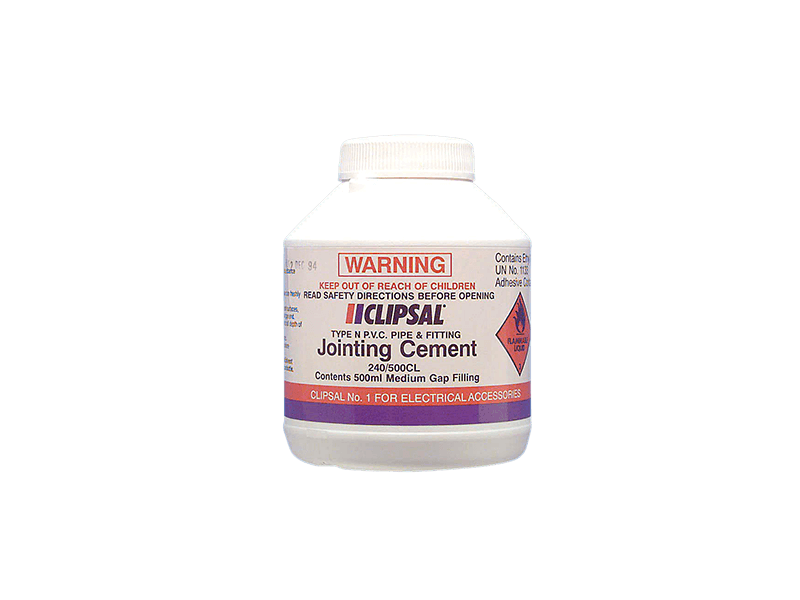
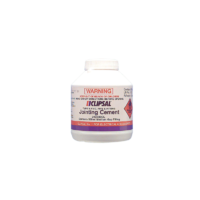
Medium-duty grey conduit and heavy-duty orange conduit feature different wall thicknesses and impact ratings, but share identical polymer chemistry. A general-purpose PVC solvent cement (such as a Clipsal-format 500 ml jointing cement) services both categories effectively. The specified fitting interference dimension changes between duty ratings, while the recommended cement formulation does not.
Standard-set cements provide approximately 30 to 60 seconds of effective working time at 25 °C ambient temperature. Fast-set products cure within seconds and are formulated specifically for hot conditions or repair work where joints require immediate mechanical loading. Fast-set products provide minimal time for fitting alignment, so most experienced electricians prefer the standard formulation for general installation work.
Cold-weather cements maintain workability below 5 °C ambient, where standard formulations thicken excessively and skin over before assembly completion. Hot-weather formulations incorporate extended flash-off times so the solvent does not evaporate before the conduit seats fully into the fitting. In typical Australian conditions, standard cement adequately covers most of the working year.
Solvent welding is documented as a three-stage process in some manufacturer specifications and as a two-stage process in others. For electrical PVC conduit work in Australia, primer is rarely specified; cleaner combined with cement does the job. Knowing what each component does is still worth the time.
Primer is an aggressive solvent (commonly coloured purple for application visibility) that rapidly softens the PVC surface before subsequent cement application. It remains mandatory for pressure pipework under plumbing codes but is not generally required for electrical conduit installations. When applied, primer accelerates the cement's polymer-dissolution action significantly.
Cleaner removes accumulated dust, swarf particles, and cutting oils from both conduit and fitting surfaces prior to assembly. Surface contamination prevents the active solvent from penetrating the polymer effectively, producing a structurally compromised joint. A clean rag and a brief wipe of cleaner constitute the minimum acceptable surface preparation for a reliable weld.
The cement formulation carries the active solvents in suspension alongside a measured proportion of dissolved PVC resin. The resin component fills minor dimensional gaps within the joint, while the volatile solvents perform the polymer welding action. As solvent evaporation proceeds, the resin and dissolved surface plastic cure together as a single homogeneous component.
Solvent welding represents one of several technically valid methods for joining electrical conduit. Each available method has appropriate applications. Understanding the practical trade-offs helps with material selection on installations where some structural flexibility is needed across the project.
| Joining Method | Joint Strength | Watertight | Reusable |
|---|---|---|---|
| Solvent-welded PVC | Permanent, full strength | Yes, when correctly applied | No |
| Threaded conduit (screwed) | High mechanical strength | With sealant or tape | Yes |
| Compression fittings | Moderate | Yes, with O-ring seal | Yes, with new seals |
| Push-fit only | Low; relies on friction | No | Yes |
Threaded conduit, paired with corresponding screwed fittings such as screwed reducers, provides a serviceable mechanical joint that can be disassembled when required. Solvent-welded joints are mechanically stronger but functionally permanent. Specify threaded systems where access for future cable pulling matters; specify solvent welding where a sealed permanent run delivers superior outcomes.
Compression fittings are commonly specified for air conditioning installations and pressure water applications. They use an O-ring or compression ferrule to maintain the seal. For electrical conduit applications, compression fittings are comparatively rare; solvent welding is cheaper, faster to assemble, and produces a more reliable seal in typical low-pressure electrical installations.
Use solvent welding for buried, sealed, or otherwise inaccessible conduit runs. Use threaded systems for termination points where the conduit interfaces with switchboards, draw boxes, or equipment that may require future replacement. Many real-world installations consistently use both methods, deploying solvent-welded joints throughout the run with threaded terminations at gear interfaces.
For most Australian electrical installation work, a 500 ml tin of standard PVC jointing cement adequately covers typical project requirements. The relevant decision points are conduit size range, anticipated ambient temperature during application, and whether the installation environment is internal or buried.
General-purpose PVC cement formulations service all standard electrical conduit diameters from 20 mm through to 50 mm without modification. The same product specification works equivalently well on communication conduits as on power conduit, since both products use identical PVC chemistry. Larger pressure pipework above 80 mm requires heavy-bodied cement formulations with elevated resin content to fill the wider joint clearance.
If the joint will be assembled in direct sunlight on a 38 °C day, a hot-weather cement formulation provides additional working time before solvent flash-off. If the joint cures overnight in a cold roof space, a cold-weather formulation prevents premature surface skinning. Standard cement remains the default selection for typical conditions across southern and central Australia throughout most of the year.
Indoor work prioritises ventilation and clean handling. Outdoor work adds weather exposure during the cure period: rain, dust, and direct sun all affect the joint. Cure assemblies under cover where practicable, and tape or cap the open conduit end if rain is forecast during the cure window.
Joint failures in solvent-welded PVC conduit are almost always procedural failures rather than product failures. The cement performs reliably when the joint is cut squarely, prepared adequately, and assembled within the manufacturer's specified working time window.
Use a dedicated PVC pipe cutter for clean square cuts that maximise joint surface area. A general-purpose hacksaw works adequately but produces swarf accumulation and rough cut edges. Internal and external burrs must be removed using a deburring tool or sharp knife so the cement spreads evenly across the prepared surfaces.
Always perform a dry-fit assembly of the conduit and fitting before applying cement to either component. The conduit should slide in snugly and bottom firmly against the internal stop of the conduit coupling or termination fitting. If the dry-fit assembly is loose or sloppy, the glued assembly will demonstrate equivalent looseness after cure. Investigate a different fitting batch or check for an out-of-specification conduit dimension.
Apply a thin even film of cement to both the conduit termination and the internal surface of the fitting socket. Push the conduit fully home with a controlled quarter-turn rotational motion to spread cement evenly, hold under pressure for 10 to 15 seconds, then wipe excess from the external surface. The complete sequence should require under 30 seconds per joint at typical ambient temperatures.
PVC cement thickens rapidly once exposed to atmospheric moisture and air circulation. Replace the lid between joint assemblies, not at the conclusion of the run. A thickened tin produces stringy unreliable welds and gets discarded considerably earlier than necessary.
Working time describes how long the cement remains workable after application to the surfaces. Cure time describes how long before the joint can take mechanical load or be backfilled with confidence. Both depend heavily on temperature and humidity.
At 25 °C ambient temperature, a standard cement formulation provides approximately 30 to 60 seconds of effective working time. At 35 °C and above, working time decreases to between 10 and 20 seconds. In cold conditions below 10 °C, working time can extend to several minutes but the cure progression also slows correspondingly. Always plan to the slowest joint, never the fastest.
A useful general specification: leave a glued joint undisturbed for 30 minutes before any handling. Wait two hours minimum before applying internal pressure or pulling cable through the assembled run. Allow 24 hours before backfilling or any installation activity that mechanically loads the joint structure. Manufacturer data sheet specifications always supersede these general guidelines where different times are documented.
Elevated atmospheric humidity slows solvent flash-off and extends the overall cure period. Surface water on the joint constitutes a hard installation failure; the cement cannot weld effectively through a wet surface film. If conditions are damp, dry the joint with a clean rag before cementing, and protect the curing joint from rainfall throughout the cure period.
Most failed glued joints fall into one of three categories. None of them are about the cement itself.
Cement cannot weld through accumulated dust, swarf debris, or surface moisture. A 30-second wipe of the conduit end and the fitting socket with a clean rag (and cleaner if the surfaces are oily) prevents the most common failure mode on Australian sites.
The conduit must seat firmly against the internal shoulder of the fitting socket for adequate weld coverage. A short joint relies on a thin band of welded material that fails under sustained load. Misaligned bends produce stress in the joint that adds to the load on the bond line.
Pressure-pipe cement on electrical conduit, or PVC cement on ABS pipework, will produce visually neat joints that fail unpredictably in service. Always verify the product label specifies PVC electrical conduit, and avoid mixing different polymer systems on a single conduit run.
A correctly executed solvent-welded joint will last as long as the conduit material itself supports continued service. PVC conduit demonstrates a service life measured in decades when adequately protected from UV exposure or installed below grade. The welded joint is not the weak point in a properly executed installation.
The fused PVC material at the joint interface behaves identically to the surrounding conduit wall material. It expands, contracts, and ages at precisely the same rate as the parent material. There is no separate adhesive layer that can creep, crack, or peel away progressively during service.
The cured joint is impervious to water, salt spray, and most chemicals at the concentrations found on building sites. It does not corrode, rot, or oxidise. The joint also tolerates the same temperature range as the parent material, typically -10 °C to 60 °C in continuous service.
Soil settlement, vehicular surface loads, and tree root intrusion all impose mechanical stress on buried conduit installations. A consistently glued run distributes accumulated stress along the entire conduit length. An unglued or partly-glued run concentrates the imposed load on individual joints, where mechanical failures consequently appear first.
Solvent welding is not the appropriate technical solution for every conduit joint. Understanding where solvent-welded joints fall short prevents inappropriate specifications and frustrating site rework during commissioning.
A fully cured joint is permanent. The run cannot be repositioned by a few centimetres after cure has started, the way a screwed joint can. Plan the layout before glue meets pipe, and dry-fit the whole assembly first if the geometry is tight.
If the run will be opened in future for cable replacement or rework, plan threaded or bolted access points at sensible intervals. Trying to break a glued joint in the field nearly always means cutting and replacing a section.
Modular installations, temporary builds, exhibition wiring, and any location where conduit will be moved during the building's life are better served by mechanical systems. Glue is for permanent infrastructure.
Conduit cements contain flammable volatile solvents that produce hazardous atmospheric vapour during application and cure. Both site safety practices and product compliance verification deserve adequate attention before opening the cement container on a working installation.
The conduit and fittings must comply with the AS/NZS 2053 series covering rigid PVC conduit and associated fittings. The selected cement should be specifically suitable for use on those certified products, as documented on the label or supporting product data sheet. Mixed-system installations using non-compatible materials can effectively void the regulatory certification of the entire conduit run.
PVC cements contain volatile organic solvents that are flammable and demonstrably toxic in concentrated atmospheric exposure. Avoid prolonged skin contact, keep the container away from any open flame or ignition source, and store in a cool ventilated location. The Safety Data Sheet for the specific product details exposure limits and recommended first-aid responses.
Use cement exclusively in well-ventilated working spaces with active air circulation. In confined areas such as small plant rooms, ceiling cavities, or excavated trenches, use mechanical ventilation or a fresh-air respiratory supply. Keep ignition sources removed during application and cure. Workplace health and safety regulations require formal risk assessment for solvent work conducted indoors.
Site Safety Note: PVC cement vapour is heavier than ambient air and can accumulate progressively in trenches and pits. Ventilate thoroughly before entry and deploy a gas monitor in confined spaces.
The use cases for solvent-welded PVC conduit cover the full spectrum of Australian electrical installation work. The fundamental product specification remains identical across applications; the volumes consumed and the working environmental conditions vary substantially between project types.
Submains running from the meter box to a granny flat, supply circuits to garden lighting, and dedicated cable feeds to swimming pool equipment all routinely use solvent-welded orange heavy-duty conduit. Sweep bends and conduit junction boxes receive cement application at every joint to maintain the run sealed once the trench is closed.
Tilt-up warehouses, retail tenancy fit-outs, and corporate office refurbishments routinely specify solvent-welded PVC for surface-mounted and concealed conduit runs. The combination of rigid conduit, solid elbows, and standard bends, all consistently solvent-welded throughout the assembly, produces a tidy installation that satisfies inspection requirements reliably.
Mining sites, water treatment plants, and substantial civil engineering works consistently specify solvent-welded PVC for conduit runs traversing corrosive atmospheres and buried utility services. The consumption volume on these projects is significant; multiple cans of cement are typically used per working day, frequently kept in shaded crates to maintain predictable working time.
Conduit cement is supplied commercially in tins of 125 ml, 250 ml, and 500 ml capacities, with integrated application brushes built into the lid assemblies. Sparky Direct stocks trade-grade cements at competitive trade pricing, with stock dispatched daily across Australia.
Sparky Direct stocks the PVC conduit glue range for online order with fast delivery to all Australian destinations. Trade pricing is available with no minimum spend, and current stock levels are visible against each individual product.
The cheapest tins on the market often have low resin content and a short shelf life. Trade-grade Clipsal jointing cement, for example, has the body and the open time professional electricians expect from a reliable product. The price difference per joint is small.
Larger contractors order 500 ml tins by the carton for big jobs. Sparky Direct can quote on bulk orders through the contact form. Stocking the right cement size for the job avoids the waste of half-used tins thickening in the back of the work van.
When a solvent-welded joint fails during commissioning or service, the observable symptom and the underlying cause typically point to one of three diagnostic categories. Working through these systematically saves stripping out conduit runs that are actually structurally sound.
A joint that pulls apart by hand was never welded. The two most likely causes are cement that flashed before assembly (too hot, too thin a film, too slow to seat) and contamination on the surfaces. Cut the failed joint out and remake it with fresh cement and clean surfaces.
If a bend points the wrong way after the cure has started, it cannot be twisted back. Cut it out and replace the section. To avoid this, mark alignment lines with a felt pen on both parts during the dry fit, and align the marks during assembly.
A joint that stays soft or smells of solvent for hours is curing slowly because the surrounding air is cold, damp, or both. Give it more time, ventilate the area, and avoid loading the joint until it has fully hardened.
Club Clipsal is Australia's largest electrician community offering trade rewards, business support, and exclusive benefits. When you nominate Sparky Direct as your preferred wholesaler, we automatically apply your Clipsal spend points to your Club Clipsal account daily.
Entry-level offering coaching, mentoring, and training discounts
Unlock exclusive industry tools and networking events
Access Toyota fleet offers and business software discounts
Maximum benefits, including VIP experiences and rewards
1. Sign Up: Create your Club Clipsal account at clipsal.com/club-clipsal or via the iCat mobile app
2. Nominate Sparky Direct: Select Sparky Direct from the wholesaler dropdown menu in your profile
3. Add Email: Enter your Sparky Direct account email address in the membership number field
4. Start Earning: Every dollar spent on Clipsal products earns points automatically
Redeem points from the rewards store, including gift cards, tools, and experiences. Access business summits, product training, and industry networking events. Receive early access to new product launches and special promotions. Connect with fellow electricians via the Club Clipsal community app.
Watch Clipsal | 240/500CL Cement Jointing PVC 500ml video
Watch Clipsal 240/500BU | Cement Jointing PVC 500ml Blue video
Watch Sparky Direct PC-42 | PVC Conduit Cutters 42mm video

I needed to feed a 35 metre power cord through 25 meters of PVC conduit. this made it an easy job.
This is a very compact tee and great if space is limited and looks so much better than the bulk inspection tees. Wires are easy to pass through the branch section, however consideration must be given to wire qty and sizing along with the number of through wires due to the minimal area for the radial turn of the branch wire, This tee was perfect for my job and I had no problem using it at all
This is the second time I am ordering from Sparky and I am satisfied with the prices, the products, the service and the delivery. I used all these products to make a crop protection cage for my backyard crop to protect from birds:)
Quality products in stock • Fast Australia-wide delivery • Competitive trade pricing
Browse PVC Conduit Glue → Get Expert Advice →Yes, when used correctly, it forms a strong and permanent joint.
Sparky Direct supplies PVC conduit glue Australia-wide, offering reliable bonding solutions for electrical conduit installations with convenient delivery.
Conduit glue is securely packaged and delivered via standard courier services.
Unused conduit glue is generally eligible for return according to the seller’s returns policy.
Warranty coverage varies by manufacturer and typically covers defects in materials.
Yes, conduit glue is typically sold as individual containers.
Yes, using glue specifically designed for PVC conduit ensures reliable results.
Once cured, the joint generally requires no maintenance.
No, it is applied internally to the joint and is not visible once assembled.
It typically sets quickly, with full strength achieved after curing.
Quality conduit glue is designed to withstand typical outdoor conditions once cured.
Yes, secure joints help maintain straight and tidy conduit runs.
It is straightforward for licensed professionals to apply correctly.
PVC conduit glue is a solvent-based adhesive designed to bond PVC electrical conduit and fittings together.
Yes, it is a standard product used in PVC conduit installations.
It creates a secure and durable connection that helps protect cables inside the conduit.
Yes, it is available in various container sizes to suit different job requirements.
Yes, it is designed to bond conduit to elbows, couplings, junction boxes, and other fittings.
Yes, it is used for both indoor and outdoor PVC conduit installations.
It softens the PVC surfaces and fuses them together as the solvent evaporates.
Yes, it is often used in underground conduit applications when installed correctly.
Yes, it is commonly used with rigid PVC conduit systems.
Yes, it is specifically designed for bonding PVC electrical conduit and fittings.
Quality conduit glue is manufactured to meet relevant AS/NZS requirements for use with PVC conduit systems.
It is used to create strong, permanent joints between PVC conduit lengths and fittings.

.png)