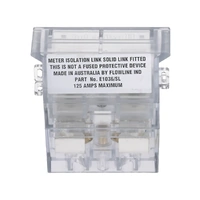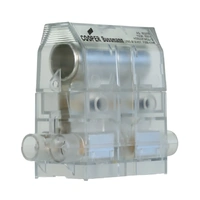

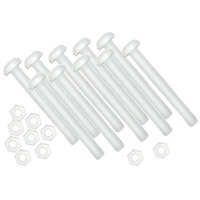
10 Pack
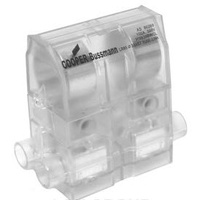
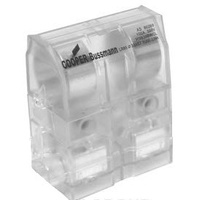
Cooper Bussmann BUSSNW-HSB | Nylon M5 Screw & Nut to suits Service Fuses | 10 Pack
$5.38
$4.89 ex. GST
Search Results:
Search Results:
A service fuse link is a sealed cartridge containing one or more calibrated fuse elements. The element is sized to carry the rated current indefinitely without damage. When a fault drives current well above the rating, the element heats rapidly, melts, and breaks the circuit.
Service fuse links sit at the head of the consumer installation, immediately after the meter. Their job is simple: open the circuit before fault current can damage cables, switchgear, or downstream equipment. They are not designed for routine switching, and they operate only on overload or short-circuit conditions.
Inside the cartridge, the element is surrounded by quartz sand or a similar arc-quenching filler. As fault current rises, resistive heating melts the element. The arc that forms is rapidly cooled and absorbed by the filler, preventing re-strike. The whole event typically completes in milliseconds for short-circuit faults.
The mains supply can deliver very high fault currents close to the network transformer. A standard MCB cannot safely interrupt the highest prospective faults. A correctly rated HRC service fuse link can. That is why fuses remain the preferred device at the service entry on most Australian installations.
Without a service fuse, a faulted main can dissipate enormous energy into supply cables and switchboard hardware. The result is melted insulation, vaporised conductors, and a real fire risk.
The service fuse limits both peak fault current and total energy let-through. This protects the consumer mains, the meter isolator, and the busbar work inside the switchboard. Cable insulation and terminations stay within their thermal limits.
Most switchboard fires start at a high-resistance joint or a faulted cable. A correctly rated service fuse interrupts the fault before sustained arcing can ignite surrounding materials. This is the single most important reason the fuse is fitted.
Although a service fuse is not a switching device, removing the carrier provides positive isolation of the entire installation. This is essential for mains-side work, switchboard upgrades, and fault investigation under safe conditions.
Service fuse links come in several configurations, and the right choice depends on the application, the supply current, and the fault level at the installation point.
General purpose fuse links cover the bulk of residential mains protection. They are robust, predictable, and inexpensive to replace. Ratings of 60A, 80A, and 100A are the most common in single-phase domestic applications.
HRC fuse links are designed to interrupt very high fault currents without venting or rupturing. They are filled with quartz sand to extinguish the internal arc. HRC types are mandatory wherever the prospective fault current exceeds the breaking capacity of standard fuses. Established brands stocked in Australia include NHP and Eaton Bussmann ranges.
High breaking capacity fuses are used close to transformers, on industrial site mains, and in commercial buildings with large incoming supplies. The closer to the source, the higher the fault current the fuse must safely clear.
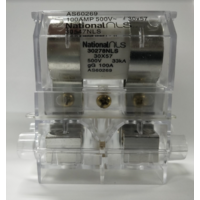
Front wired holders accept cables from the front face. They suit retrofit work where the back of the panel is hard to reach. Back wired holders, like the NLS 30547 100A clear-fronted unit, present a tidy front and route cables behind the board.
Three numbers matter when specifying a service fuse: current rating, voltage rating, and breaking capacity. All three must match the application or the fuse cannot deliver safe protection across the full operating range.
Domestic mains in Australia typically use 60A or 80A fuses on smaller homes and 100A on larger installations, while light commercial sites often use 125A. The rating must align with the supply authority's connection capacity and the consumer mains cable size.
The fuse voltage rating must equal or exceed the system voltage. Australian single-phase supply nominally runs at 230V, while three-phase nominal is 400V phase-to-phase. The 500V rating commonly stamped on service fuse links covers both single-phase and three-phase installations comfortably.
Breaking capacity is the maximum fault current the fuse can interrupt without rupturing. HRC fuses for service applications typically clear 50kA or more. The prospective fault current at the installation point must be calculated and compared to the fuse breaking capacity.
The 500V 100A HRC service fuse link is the most common single-phase service fuse used across Australia. It covers the great majority of domestic and small commercial mains.
Most Australian homes are connected with consumer mains rated for 80A or 100A continuous service. A 500V rated cartridge gives ample voltage margin on a 230V supply. Network distributors and energy retailers list the 500V 100A fuse as the standard reference for residential service connections.
Residential applications include direct-buried mains from the pillar to the meter, overhead service drops, and underground supplies on new estates. Light commercial sites with single-phase supply also commonly use 100A service fuses ahead of the main switches and isolators.
The fuse rating should match or sit just below the consumer mains cable rating. Oversizing the fuse leaves the cable unprotected during sustained overloads. Undersizing causes nuisance operation under normal demand, particularly on hot days when air conditioning load is high.
Both fuses and breakers interrupt fault current, but they do so differently, and each has clear strengths in particular roles within the protection chain.
| Property | Service Fuse Link | Circuit Breaker (MCB) |
|---|---|---|
| Operation | One-shot, must be replaced | Resettable, mechanical trip |
| Breaking capacity | 50kA or higher (HRC) | Typically 6kA to 10kA at consumer level |
| Speed of clearance | Very fast on high faults | Slower at high prospective faults |
| Cost per device | Low | Higher |
| Best position | Service entry, upstream protection | Final subcircuit protection |
A fuse interrupts current by physically melting, while a breaker uses a thermal-magnetic mechanism that opens contacts. The fuse is faster on very high faults because there is no mechanical inertia to overcome.
Fuses are simple, sealed, and cheap, and they have no moving parts to wear out. The main limitation is that a blown fuse must be replaced, not reset. They also cannot be tested under load without operating them.
Many Australian homes built before the 1990s retain rewireable porcelain fuses or HRC cartridge holders at the service entry. The hardware is durable, the breaking capacity is adequate, and there has been no compliance trigger to force a change. Circuit breakers only become mandatory at upgrade or new-installation time.
Protection coordination means each device clears the smallest section of the installation needed to remove the fault. The service fuse should only operate when the downstream devices cannot.
The service fuse sits upstream of the main switch. The main switch is for routine isolation, while the fuse is for fault interruption. The two devices have different jobs and should never be confused.
Final subcircuit MCBs typically have a 6kA breaking capacity. If the prospective fault at the switchboard exceeds 6kA, the upstream service fuse provides the backup. The fuse clears the fault first, sparing the breaker from damage. This coordination is the reason boards using Hager or Clipsal consumer-side breakers still rely on a service fuse upstream.
An RCD detects earth leakage but does not provide overcurrent protection. An RCBO combines both functions, and a safety switch is the household term for the same earth-leakage device. Neither replaces the service fuse, which remains the upstream backstop for the entire installation.
Selection is a matter of matching three factors: cable capacity, switchboard rating, and prospective fault current.
The consumer mains cable has a continuous current rating set by its size and installation method, and the fuse must protect that cable across all foreseeable load conditions. A 16mm² copper consumer mains cable typically suits an 80A or 100A fuse, depending on the run length and installation conditions.
The switchboard busbar and main switch have their own current ratings, and the fuse must not exceed either. A 100A fuse is appropriate where the switchboard is rated 100A or higher, while common 80A configurations pair with 80A fuses.
Oversizing leaves cables and switchgear underprotected, while undersizing causes nuisance operation. Both errors compromise safety or reliability, and the correct rating is set by calculation, not by what was fitted previously.
Service fuse work is mains-side work, and it must be planned, isolated, and carried out by a licensed electrician with appropriate test equipment and PPE.
Before removing a service fuse, confirm the supply is isolated upstream where possible, and use a calibrated voltage tester to verify dead conductors. Apply lockout devices to any switching point that could be re-energised by a third party. Treat the conductors as live until proven dead.
The cartridge must seat squarely in the holder with full contact pressure. Inspect the contact surfaces for pitting, oxidation, or burn marks. Clean any minor oxidation with a fine abrasive, and replace the holder if damage is significant.
Replace a blown fuse with the identical type, rating, and breaking capacity, because mixing types is unsafe and undermines the coordination of the protection chain. A 60A fuse must not be replaced with an 80A fuse to avoid nuisance operation. Investigate the cause of the original fault before energising.
Three errors account for most service fuse problems in the field, and each one stems from cutting corners on calculation, investigation, or routine maintenance.
Fitting a higher-rated fuse to stop nuisance operation is a common mistake, and the result is an underprotected cable that may overheat under sustained load. The correct response to repeated operation is fault investigation, not a bigger fuse.
A fuse only operates when something is wrong, so replacing without investigation hides the underlying problem and the next event may be more serious. Always trace the fault before re-energising the circuit.
High-resistance contact at the holder generates heat, and that heat oxidises the contact surface, which then increases resistance further. The cycle accelerates until the holder fails or the fuse element ages prematurely. Periodic inspection and cleaning prevents this from happening.
HRC fuses dominate Australian service fuse applications because the prospective fault current near distribution transformers can be very high.
The cartridge body is filled with high-purity quartz sand. When the element melts, the arc plasma is forced through the sand. The sand absorbs heat and quenches the arc within milliseconds. The interrupting medium is sealed inside the cartridge.
Service entries close to the network transformer see the highest prospective faults, and HRC fuses are essential here to clear those faults safely. Without them, fault current can exceed the breaking capacity of standard protection and cause catastrophic switchboard damage.
Industrial sites with heavy motor loads, capacitor banks, and rectifier equipment benefit from the high speed of HRC clearance. Damage to expensive plant is minimised when the fault is interrupted in a single half-cycle.
A correctly specified service fuse can sit in service for decades without operation, and long life depends on three factors: contact integrity, thermal management, and freedom from moisture ingress.
Loose contact at the holder is the leading cause of premature ageing, because heat slowly degrades the element over thousands of thermal cycles. Periodic thermal imaging or contact-tightening checks during scheduled work catches the problem early.
Contact pressure must be maintained throughout the service life of the holder. Spring tension can fade after decades of thermal cycling. Replacing the holder during a switchboard upgrade restores full contact integrity.
There is no universal replacement interval for a service fuse that has not operated. Visual inspection during any switchboard work is the practical baseline. Replace the fuse and clean the holder whenever the cover is opened for other reasons.
Many older installations still use rewireable porcelain fuses. These are compliant where they remain, but a board upgrade is often the right next step.
A switchboard upgrade typically retains the service fuse at the entry and replaces downstream porcelain fuses with MCBs and RCBOs. The service fuse provides backup protection for the new lower-breaking-capacity devices. This is a common configuration on retrofit work. Existing meter boxes can usually be retained if they meet current network requirements.
Modern distribution boards add earth leakage protection, individual circuit isolation, and tidier wiring, so fault diagnosis becomes much faster during a callout. Resettable breakers eliminate the need to keep spare fuse wire on hand. Legrand and Hager modular ranges cover most retrofit board configurations.
The cost of an upgrade is balanced against the safety gains. RCD and RCBO protection on every final subcircuit is now best practice. Most insurers and conveyancers expect modern protection on properties undergoing significant work.
Service fuse work is governed by AS/NZS 3000 and the relevant product standards. Local supply authority service rules also apply at the connection point.
The Wiring Rules set the requirements for protection of consumer mains, switchboard arrangement, and isolation provisions. Service fuse selection and installation must comply with the current edition. The fuse forms part of the consumer protection device chain that the Rules govern.
Service fuse links sold in Australia must meet recognised product standards for breaking capacity, time-current characteristics, and physical construction. Genuine trade-grade products from established suppliers carry full compliance documentation.
Mains-side fuse work is restricted to licensed electricians. Network supply rules in each state set additional requirements for tamper-evident sealing and authorised access. Unauthorised work on the supply side of the meter is illegal.
Service fuses are largely fit-and-forget, but inspection during any switchboard work is good practice.
Open the cover, check for discoloration, corrosion, and signs of arcing. Look for melted fuse-holder bodies or scorched conductors. A clean, cool, undamaged holder indicates the installation is operating well.
Green or white corrosion on copper contacts signals moisture ingress. Brown or black scorch marks indicate sustained overheating. Either condition warrants replacement of the affected components.
Spare fuses of the correct type and rating should be available on every commercial site. Document the make, model, and rating of installed fuses on the switchboard schedule, which avoids guesswork during a fault response.
Service fuse links are a stocked trade item. Sourcing from a specialist supplier ensures the product meets compliance requirements and is genuinely manufacturer-supplied.
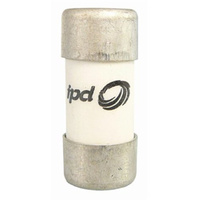
Sparky Direct stocks 500V 100A HRC service fuse links suited to Australian mains applications. The range covers IPD pole service fuses, NLS 100A 500V back-wired meter isolator units, and adjacent fuse wire for older porcelain holders. Browse the full range at the link below.
Trade-grade fuse links carry full breaking capacity testing and compliance documentation, while very cheap imports may not. The cost difference per cartridge is small, but the difference in safety and reliability is large.
Contractors fitting multiple new switchboards or service entries benefit from bulk pricing. Sparky Direct offers trade-tier pricing with fast Australia-wide delivery on stocked items.
Three issues account for most service-fuse callouts, and each one points to a different underlying cause that the electrician needs to diagnose before re-energising.
A fuse that blows again immediately after replacement indicates a downstream short circuit or a sustained overload, so trace the fault before fitting another cartridge. A second blown fuse without investigation is unsafe and a clear indicator of a deeper problem.
Very rarely, an aged fuse may fail to operate cleanly under fault conditions. The result can be sustained arcing inside the cartridge. Replacement with a new HRC unit eliminates this risk. Always replace fuses that show signs of heat distress.
A cartridge that is hard to remove usually indicates a hot, oxidised contact. Specialist pole fuse removers and insulated handles help with awkward overhead work. Persistent removal difficulty signals that the holder needs cleaning or replacement.
Watch IPD RHF80 | Pole Service Fuse 80Amp HRC 415v video
Watch NLS 30547 | 100Amp Service Fuse 500V Back Wired | Clear video
Watch Cooper Bussmann HSB22BWCL-Q | 100-125A Meter Isolator Service Link | Back Wired Clear | QLD Approved video

I was very happy when I found what size fuse wire I had trouble with sourcing. With eBay and Sparky Direct, I now have my air conditioner going again. In old houses, your fuses are a porcelain block you screw the wire through it and then is your safety switch. Thank You for your help.
This is a reliable item to carry in the van for those customers / renters, who have overloaded /blown a rewireable fuse and can not / will not change the fuse wire. Not as cheap as fuse wire, but cheaper that a call out or a fuse board upgrade.
Size as stated, this was an issue and just fitted, plenty of space inside the box. Exchanged a fuse chassis with RCDBO’s, this was an easy job with the layout and space available.
Quality products in stock • Fast Australia-wide delivery • Competitive trade pricing
Browse Service Fuse Links → Get Expert Advice →Overloads, short circuits, or faults in the electrical system can cause operation.
Sparky Direct supplies service fuse links Australia-wide, offering reliable electrical protection components with convenient delivery.
Service fuse links are securely packaged and delivered via standard courier services.
Unused items may be returned if they are in original condition, in line with Sparky Direct’s returns policy.
Warranty coverage varies by manufacturer and typically covers defects in materials or workmanship.
Yes, service fuse links are typically sold as individual components.
Yes, correct rating selection is essential for safety and compliance.
They are primarily used for supply-side and main circuit protection.
Yes, they are a critical part of electrical protection systems.
Selection must match the installation requirements and be carried out by a licensed electrician.
They are usually housed within service fuse carriers or switchboards.
They generally require no maintenance but should be inspected during electrical work.
Quality fuse links are designed for dependable operation under fault conditions.
Service fuse links are protective electrical components designed to interrupt power when excessive current flows through a circuit.
Yes, they are a standard protective component in many electrical supply installations.
They help protect wiring, equipment, and property from damage caused by electrical faults.
Yes, once a fuse link operates, it must be replaced.
Yes, they are designed to interrupt fault currents quickly and safely.
Yes, service fuse links are available in a range of current ratings to suit different applications.
Yes, they are widely used in commercial and light industrial electrical systems.
Yes, they are used in residential installations where service-level protection is required.
They are commonly installed in service fuses, switchboards, and supply protection assemblies.
Quality service fuse links are manufactured to meet relevant AS/NZS electrical and safety standards when installed correctly.
They are used to protect electrical installations from overloads and short circuits at the supply side.
It indicates the fuse link is rated for up to 500 volts and a maximum current of 100 amps.