
Search Results:
Search Results:
Search Results:
Search Results:
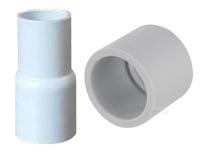
Find the best Plain Reducers Electrical Conduit Fittings here at Sparky Direct. [ Read More ]
Plain reducers solve a small but constant problem on electrical jobs. Cable runs change in size as circuits split, branch, or terminate. A reducer is the compliant way to make that transition without abandoning a length of conduit or compromising mechanical protection.
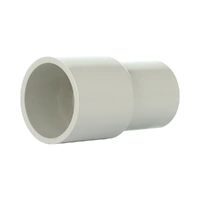
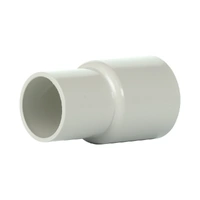
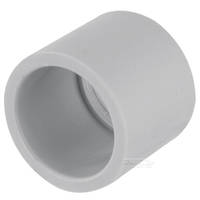
A plain reducer is a short PVC sleeve with two internal diameters: a larger socket on one end and a smaller socket on the other. The fitting is glued onto the end of the larger conduit, then the smaller conduit slots into the reduced end and is glued in turn. Once the cement cures, the joint behaves as a single continuous duct. Plain ends mean no threading is required at either side.
Conduit protects cables from impact, abrasion, UV, moisture, and rodent damage. Any uncovered transition exposes conductors to those same hazards. A reducer maintains the protective envelope through the change of size and keeps the system inspectable, replaceable, and compliant with Australian wiring standards.
Plain reducers are solvent-welded to plain-ended conduit and form a permanent bond. Threaded (screwed) reducers use male and female threads, allowing serviceable joints that can be opened later. Plain types are typical for buried, embedded, or hidden runs. Threaded types suit accessible junction boxes, gland entries, and equipment terminations.
A correctly bonded reducer carries the same mechanical and IP rating as the conduit either side of it. There is no gap, no thread leak path, and no point at which cable insulation contacts a hard edge. The internal taper inside the fitting also guides cables through the reduction without snagging during the pull.
Plain reducers come in several formats. Selecting the right configuration depends on the conduit series, the size step needed, and how the run terminates.
The straight plain reducer is the standard product. It connects two plain conduit ends in a single step (such as 25mm to 20mm) and sits inline with the run. This is the type stocked at Sparky Direct in 25-20mm, 32-25mm, and 40-32mm sizes.
Where a run needs to drop more than one nominal size (for example, 40mm to 20mm), two reducers are typically used in series: a 40-32mm followed by a 32-25mm and then a 25-20mm. Each step adds a bonded joint, so designers usually consolidate transitions to one or two changes per run.
Australian rigid conduit comes in light, medium, and heavy duty series, all sharing common nominal outside diameters. Plain reducers fit any duty rating at the same nominal size, since the socket dimensions match the standard conduit OD. The duty rating governs wall thickness, not coupling geometry.
Reducers also exist for corrugated conduit, communications conduit, and air-conditioning pair coil ducting. Each system uses geometry suited to its host conduit. Plain rigid reducers will not couple to corrugated conduit without an appropriate gland or adaptor.
Plain reducers are predominantly PVC for general electrical work, but other materials appear in specialist applications. Material choice should reflect the host conduit and the operating environment.
Rigid PVC is the dominant material for plain reducers in Australian electrical installations. It is non-conductive, lightweight, easy to cement, and resistant to most domestic chemicals. Grey PVC suits indoor and concealed work; orange PVC is used for buried and heavy duty runs where the conduit colour signals duty rating.
Steel reducers feature in industrial settings where conduit is rigid metallic. These are usually threaded rather than plain, since steel conduit relies on screwed couplings rather than solvent cement. Plain PVC reducers are not used inside metallic conduit systems.
Aluminium fittings appear in specialised industrial and marine work. For most coastal jobs in PVC systems, the simpler choice is to keep the entire run in UV-stable PVC and use stainless steel saddles to fix it. Plain PVC reducers themselves are unaffected by salt air.
Nylon and engineered polymers offer better chemical resistance than standard PVC. They are uncommon in Australian general installations and tend to be specified by engineers for plant, food processing, or laboratory environments where solvents would attack PVC.
Conduit and accessories used in fixed wiring must meet defined Australian Standards. Reducers are part of the conduit system and are covered by the same compliance framework.
AS/NZS 2053 specifies requirements for conduits and conduit fittings used in electrical installations. Compliant fittings carry the appropriate marking and are tested for impact resistance, dimensional accuracy, and resistance to flame propagation. Plain reducers from major Australian brands are manufactured to this standard.
AS/NZS 3000:2018 (the Wiring Rules) sets the rules for how conduit and fittings are installed: support intervals, mechanical protection, segregation of services, and earthing where applicable. Reducers do not change the obligations of the surrounding run. The smaller conduit downstream must still comply with cable fill, support, and protection rules.
The IP rating of a conduit run depends on the weakest joint. A correctly cemented plain reducer maintains the rating of the rigid PVC system. Any uncemented, dry-pushed, or partially seated joint compromises the rating and exposes cables to ingress.
Selection, installation, and termination of conduit systems on fixed electrical wiring is licensed electrical work in every Australian state and territory. Homeowners can choose products and plan layouts. Connection to live circuits and final certification must be performed by a licensed electrician.
Sizing decisions made before a run is laid affect every reducer used in it. Getting nominal sizes and cable fill right at the planning stage avoids rework later.
Australian conduit is sold by nominal size, which reflects the outside diameter rather than the bore. Common rigid sizes are 20mm, 25mm, 32mm, 40mm, and 50mm. Plain reducers are stocked for the size pairings in widest use: 25-20mm, 32-25mm, and 40-32mm. Larger or non-adjacent reductions are made up using two reducers in series.
The reducer must match the nominal OD of both the larger and smaller conduit. Plain reducers do not care about wall thickness or duty rating: a 32-25mm reducer accepts any 32mm and any 25mm rigid PVC conduit, regardless of whether it is light, medium, or heavy duty. Mixing brands within the same nominal size is acceptable for plain rigid PVC fittings made to AS/NZS 2053.
The reduced section must still accommodate the cables passing through it. Cable fill ratios under AS/NZS 3000 set out the maximum cross-sectional area of conductors permitted in a given conduit. A reducer is the most common point at which fill is exceeded by accident, because the smaller bore tightens around the bundle. Cables should always be sized to fit the smaller downstream conduit, not the upstream one.
Forcing cables through an undersized reducer damages insulation, raises pulling friction, and creates compliance issues. If the smaller conduit cannot legally carry the cable count, the correct response is to enlarge the downstream conduit or split the circuit into two runs, not to push the reducer beyond its capacity.
Most reducer choices come down to four questions: what conduit material, what environment, what mechanical exposure, and what brand. Each answer narrows the shortlist quickly.
Plain PVC reducers go with plain PVC conduit. They will not bond reliably to corrugated conduit, metallic conduit, or air-conditioning pair coil ducting. For mixed systems, use a dedicated straight gland fitting or adaptor designed for the transition rather than improvising with a reducer.
Indoor work typically uses grey medium duty conduit and matching reducers. Outdoor and buried runs use orange heavy duty conduit and the same nominal reducer sizes. UV exposure is the main differentiator: orange conduit is formulated for sunlight resistance, grey is not. Reducers should match the host conduit colour and duty rating where possible.
Reducers sit in the middle of a run and inherit its mechanical environment. In high-impact areas, heavy duty conduit either side of the reducer carries the load. In areas of constant vibration or thermal cycling, well-cemented joints outperform mechanical fittings because the bond is continuous.
The two most frequent mistakes are: using a screwed reducer where a plain one was specified (and vice versa), and undersizing the downstream conduit because the cable count was calculated against the larger upstream size. Both errors are caught easily on a quick layout check before solvent cement comes out.
Plain reducers turn up across the full range of Australian electrical work. The pattern is consistent: a larger conduit feeds a smaller one as circuits step down to their final destinations.
In housing, a 25mm submain might step down to 20mm at the consumer mains entry, the meter box, or a sub-board. Lighting circuits usually run in 20mm throughout, but where they branch off a larger feeder, a plain reducer makes the transition. Light commercial fitouts use the same patterns at slightly larger scale.
Industrial work sees larger size steps: 50mm to 40mm at distribution boards, 40mm to 32mm at machinery isolators, and 32mm to 25mm at local control stations. Plain rigid PVC reducers handle these transitions where the conduit is concealed or wall-fixed. Where the joint must be serviceable, screwed reducers are used instead.
Buried and slab-encased runs rely on solvent-cemented joints because there is no opportunity for later access. Plain reducers are well suited here: a single bonded fitting maintains both mechanical protection and water resistance. PVC conduit glue is the bonding medium of choice for these joints.
Civil and infrastructure work typically uses heavy duty orange conduit with plain reducers at branch points. Long, deep runs with multiple draw pits often standardise on one size between pits and use reducers only at the entry to switchboards or pillars.
A plain reducer is a simple fitting with a small number of failure modes. Following a consistent process keeps every joint compliant and watertight.
Both conduit ends should be cut square, deburred inside and out, and wiped clean of swarf and dust. A clean, square end seats fully into the reducer socket and gives the cement a uniform contact area. A ragged end leaves voids that compromise the bond.
Apply solvent cement to both the conduit OD and the reducer socket ID. Push the conduit fully home with a slight twist, hold for several seconds, and wipe excess cement from the outside of the joint. Do not pull cables until the cement has cured for the time stated by the manufacturer.
Square cut ends, deburred inside and out, wiped clean, cement applied to both surfaces, fully seated with a quarter-turn twist, held for 10 seconds, and left to cure before cable pulling. Skipping any step weakens the joint.
Plain reducers do not use grub screws or locking rings: the bond is solvent-welded. Mechanical fixings appear on threaded reducers, glands, and conduit-to-equipment adaptors. Mixing the two systems on the same fitting is not appropriate.
Once cured, joints should resist firm pulling and twisting. Visible cement squeeze-out around the reducer rim indicates a properly wetted joint. Dry, gappy, or partially seated joints should be cut out and remade. Pull tests are routine on commercial jobs before cabling proceeds.
The same handful of issues account for most reducer-related failures. Each has a straightforward cause and a straightforward fix.
Loose joints almost always come back to assembly speed. Solvent cement skins over within a minute on a warm day. If the joint is not fully seated within that window, the bond is compromised. Working in shorter sequences and applying cement to both surfaces at the moment of assembly is the simple fix.
Damage typically appears as nicks in insulation pulled into the reducer step. The cause is usually an unswept transition under load. Designing pulls so the major direction change happens at a sweep bend rather than at a reducer keeps cables off hard edges.
Plain rigid PVC reducers are inert in normal building environments. Problems start when they are paired with conduit they cannot bond to, or installed in continuously hot or chemically aggressive areas without specifying a suitable polymer alternative.
The most consequential compliance failure is using a reducer to mask an over-filled conduit. The smaller downstream section becomes the legal carrier of the cables: if it is over-filled, the installation is non-compliant regardless of what the upstream conduit could have carried.
Reducers are not the only way to handle a size change. The right choice depends on whether the joint needs to be permanent, serviceable, or eliminated entirely.
| Option | Best For | Typical Trade-off |
|---|---|---|
| Plain reducer | Concealed, buried, or in-slab runs | Permanent, cannot be opened later |
| Screwed reducer | Switchboards, equipment terminations | Higher cost, larger physical footprint |
| Plain-to-screw adaptor | Plain conduit run meeting threaded equipment | Adds one extra joint to the run |
| Coupling (no reduction) | Joining same-size conduit | Does not change conduit size |
| Single uniform run | Short runs where size step is avoidable | May oversize most of the conduit |
Plain reducers form a permanent solvent bond. Screwed reducers can be unscrewed for maintenance. Use plain types in walls, slabs, and underground runs. Use threaded types at boards, glands, and anywhere the joint may need to come apart.
A coupling joins two conduits of the same size. A plain-to-screw adaptor changes the joint type but not the size. A reducer changes the size but not the joint type. Many installations need a combination of all three.
If two circuits with very different cable counts share a route, a single oversized conduit with a reducer at the smaller branch is usually cheaper and tidier than two parallel runs. Where the circuits diverge significantly, two separate runs perform better and avoid future fill problems.
The right reducer chosen up front means a clean, compliant transition that lasts the life of the installation. The wrong one means an avoidable rework, often after the conduit has already been painted, plastered, or buried.
A plain reducer is a passive component, but its long-term behaviour shapes the reliability of the whole conduit system around it.
Once cured, a solvent-welded reducer is structurally part of the conduit. Mechanical impact, abrasion, and minor flexing are all absorbed by the bonded body of the run. Cables inside experience the same level of protection at the reducer as they do anywhere else in the duct.
Watertightness depends entirely on cement coverage at the time of assembly. A correctly bonded reducer in PVC conduit forms a seal as effective as the conduit wall itself. Mechanical failure, where it occurs, is almost always at the bond line of an under-cemented joint.
Plain reducers are not designed to be opened. Where future serviceability is required, the reducer should be paired with a nearby junction box or threaded fitting. Cables can then be drawn back to that access point without disturbing the bonded reducer.
Plain reducers in concealed locations need no routine maintenance. Surface-mounted reducers should be inspected during routine electrical maintenance for cracks, UV degradation (in non-rated grey conduit exposed to sunlight), and saddle support either side of the joint.
Plain reducers are inexpensive items, but the cumulative cost across a full job adds up. Buying patterns differ between residential and industrial buyers.
A plain reducer typically sits at the low end of the conduit fittings price range. Per-unit prices vary by size and brand, with 25-20mm fittings the cheapest and 40-32mm fittings priced higher because of the larger PVC volume. Sparky Direct lists trade-competitive prices on the plain reducers range.
Single-unit purchases suit small jobs and rework. For active sites, buying by the box reduces per-fitting cost and means there is always one in the van when a run needs an unplanned step-down. Larger commercial jobs typically take quantities of each common size at the start of the project.
The cheapest fittings on the market are not always AS/NZS 2053 compliant. Non-compliant PVC may have inconsistent wall thickness, brittle behaviour in cold weather, or out-of-tolerance socket dimensions that produce loose joints. Sticking to recognised Australian brands such as Clipsal and National Light Sources avoids that risk.
Trade counter pricing varies considerably. Online wholesalers like Sparky Direct can offer keener pricing because of lower overheads and direct-to-trade logistics. The trade-off is delivery time on small items, which is offset by next-day or two-day Australia-wide shipping for stocked lines.
Plain reducers in the three common sizes are stocked items at Sparky Direct. Orders placed before the daily cut-off ship the same day to most metropolitan areas. Buying in advance for upcoming jobs avoids the all-too-familiar afternoon scramble for one missing fitting.
A short pre-purchase checklist saves time on every conduit job.
Start from the conduit schedule. Identify every size change in the run and count the reducers needed for each. Note whether each transition is buried, embedded, or accessible: that drives the choice between plain and screwed types. Then add a small over-order for unplanned changes on site.
Three mistakes account for most last-minute van trips. First, ordering only the size pair the schedule shows and missing the second pair needed for an in-series step-down. Second, ordering plain reducers for switchboard entries that should have been screwed. Third, forgetting PVC conduit glue at the same time and finding the tin empty when the first joint is ready.
A reasonable working spare is 10 to 15 percent above the schedule count for small fittings. The cost is low, the freight cost on a single forgotten reducer is high, and the productivity cost of stopping work for a missing item is higher again.
Sparky Direct stocks plain reducers in the three common sizes with same-day dispatch from Brisbane. The wider range covers conduit bends, junction boxes, and saddles, so reducers can be added to an order in a single pickup or delivery.
Club Clipsal is Australia's largest electrician community offering trade rewards, business support, and exclusive benefits. When you nominate Sparky Direct as your preferred wholesaler, we automatically apply your Clipsal spend points to your Club Clipsal account daily.
Entry-level offering coaching, mentoring, and training discounts
Unlock exclusive industry tools and networking events
Access Toyota fleet offers and business software discounts
Maximum benefits, including VIP experiences and rewards
1. Sign Up: Create your Club Clipsal account at clipsal.com/club-clipsal or via the iCat mobile app
2. Nominate Sparky Direct: Select Sparky Direct from the wholesaler dropdown menu in your profile
3. Add Email: Enter your Sparky Direct account email address in the membership number field
4. Start Earning: Every dollar spent on Clipsal products earns points automatically
Redeem points from the rewards store, including gift cards, tools, and experiences. Access business summits, product training, and industry networking events. Receive early access to new product launches and special promotions. Connect with fellow electricians via the Club Clipsal community app.
Watch Reducer Plain 25-20mm | 30204 video
Watch Reducer Plain 32-25mm | 30205 video
Watch Reducer Plain 40-32mm | 30206 video

This is a very compact tee and great if space is limited and looks so much better than the bulk inspection tees. Wires are easy to pass through the branch section, however consideration must be given
This is the second time I am ordering from Sparky and I am satisfied with the prices, the products, the service and the delivery. I used all these products to make a crop protection cage for my backya
These coupling just work. I go through hundreds a week on air conditioning drains. They are strong and fit snug. Also the delivery to Sydney was fast. Cheers
Quality products in stock • Fast Australia-wide delivery • Competitive trade pricing
Browse Reducer Plain Conduit Fittings → Get Expert Advice →They are straightforward for trained professionals to install as part of a compliant system.
Sparky Direct supplies plain reducers Australia-wide, offering reliable conduit size transition solutions with convenient delivery.
Plain reducers are securely packaged and delivered via standard courier services.
Unused products are generally eligible for return according to the seller’s returns policy.
Warranty coverage varies by manufacturer and typically covers defects in materials or workmanship.
Yes, plain reducers are typically sold as individual conduit fittings.
Yes, selecting the correct reducer ensures proper fit, protection, and compliance.
Once installed correctly, they generally require no maintenance.
Yes, they help maintain conduit continuity and cable protection.
Yes, they are commonly used when modifying or extending existing conduit runs.
They may be visible in surface-mounted conduit or concealed within walls or ceilings.
Quality plain reducers are designed to withstand everyday installation conditions.
Yes, they provide a clean transition between different conduit sizes.
Plain reducers are conduit fittings used to connect two different conduit sizes within the same conduit system.
Yes, they are a standard fitting when conduit size changes are required.
They allow different conduit sizes to be joined neatly and safely within an installation.
Yes, they are designed to integrate with standard conduit systems and fittings.
Yes, they are designed to ensure a firm and stable connection between conduit sizes.
Yes, they are suitable for residential, commercial, and light industrial applications.
Yes, they are commonly used in indoor electrical conduit systems.
They are available in common size combinations such as 25mm to 20mm or 32mm to 25mm.
They are typically made from durable PVC or similar materials suitable for electrical installations.
Yes, they are designed for use with rigid electrical conduit.
Quality plain reducers are manufactured to meet relevant AS/NZS electrical and safety standards when installed correctly.
They are used to transition from a larger conduit size to a smaller conduit size while maintaining cable protection.