
Search Results:
Search Results:
Search Results:
Search Results:
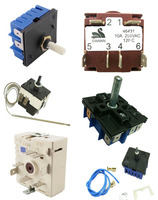
Find the best oven thermostats & oven switches here at Sparky Direct. [ Read More ]
An oven thermostat controls temperature by sensing heat inside the oven cavity and switching the element on or off to maintain the set level. Most capillary thermostats use a sealed tube of liquid or gas connected to a sensing bulb. As the bulb heats up, pressure builds and moves a contact mechanism inside the thermostat body. When the set temperature is reached, the contacts open and cut power to the element. When the cavity cools below the set point, the contacts close and power is restored.
This cycle repeats continuously during cooking. A faulty thermostat breaks this cycle. It may stop the element from switching on, fail to cut power when the oven is hot enough, or produce erratic temperature swings that affect cooking results.
Oven switches direct electrical current to specific functions. A selector switch determines which heating mode is active: top element, bottom element, fan forced, grill, or a combination. A function switch may control the oven light, a timer circuit, or an auxiliary output. Each switch position connects a different set of terminals in the circuit, changing which components receive power.
When a switch fails mechanically or electrically, the affected function stops working. For example, a faulty grill switch means the grill element stays off regardless of the thermostat or dial setting.
In a typical electric oven circuit, the selector switch routes power to the correct element circuit. The thermostat then controls when that element turns on and off based on temperature. Both components must be functional for the oven to heat correctly. Isolating which component has failed is the first step in any repair. See the diagnosis section below for testing methods.
Some cooktops use a simmerstat rather than a true thermostat. A simmerstat is an energy regulator that does not sense temperature directly. Instead, it switches the hotplate element on and off at a fixed duty cycle, set by the control knob position. The Global Components MP-101 Simmerstat is a common replacement used across many Australian cooktop brands. It is not interchangeable with a capillary thermostat.
Oven thermostats and switches are stocked by appliance parts suppliers and online electrical wholesalers. Online purchasing gives access to a broader range of models, faster stock checks, and the ability to cross-reference part numbers before ordering. Physical appliance parts shops can be useful for same-day pickup, but the range is typically limited to high-volume replacement parts.
Sparky Direct stocks oven thermostats and oven switches covering a wide range of domestic oven and cooktop applications, including EGO capillary thermostats, Global Components simmerstats, and function switches suited to common Australian brands.
A reliable supplier should provide clear part numbers and cross-reference data. This helps verify compatibility before purchase. Look for suppliers that include wattage, voltage, temperature range, and terminal configuration in their product listings. Suppliers that also stock related parts such as fan forced oven elements, grill elements, and oven fan motors reduce the need to source from multiple places when completing a full repair.
Appliance repair technicians working at volume benefit from trade accounts and bulk pricing. Sparky Direct offers Australia-wide delivery, making it practical to order parts for multiple jobs at once. For commercial kitchen maintenance contractors, having common thermostats and switches on hand reduces equipment downtime on repeat service visits.
Note on part availability: Not every oven thermostat or switch is stocked as a standard replacement. Some older or less common models may require ordering from the original equipment manufacturer. When an exact match is unavailable, a supplier with technical knowledge can often identify a compatible alternative with the same specifications. This is particularly important for capillary thermostats, where the bulb length and capillary tube length affect fit.
Capillary thermostats are the most common type found in domestic electric ovens. They consist of a sensing bulb mounted inside the oven cavity, connected by a thin capillary tube to the thermostat body located on the control panel. The bulb is filled with a gas or liquid that expands when heated. This expansion activates a snap-action switch mechanism that opens or closes the element circuit.
Capillary thermostats are rated by temperature range, typically 50-320 degrees Celsius for general oven use. The EGO Oven Thermostat Capillary 50-320 degrees Celsius is a widely used replacement compatible with many domestic ovens.
Electronic thermostats use a temperature probe (thermistor or thermocouple) to measure cavity temperature and send a signal to a control board. The board then activates or deactivates the element relay. Electronic thermostats are common in newer oven models with digital displays and programmable functions. Replacing an electronic thermostat often requires sourcing a board-specific component rather than a universal replacement.
An energy regulator (simmerstat) does not respond to temperature. It controls heat output by cycling the element on and off at a set ratio of on-time to off-time. The control knob adjusts this ratio. At the minimum setting, the element is on for a small fraction of each cycle. At maximum, it is on continuously. Simmerstats are used on hotplates and solid fuel cooktop rings rather than oven cavities.
| Type | Sensing Method | Common Application | Replacement Complexity |
|---|---|---|---|
| Capillary thermostat | Gas/liquid expansion in bulb | Domestic oven cavity | Moderate (bulb position, tube length) |
| Electronic thermostat/probe | Thermistor or thermocouple | Digital/programmable ovens | Higher (model-specific control board) |
| Simmerstat (energy regulator) | Bimetallic strip (timed cycling) | Hotplates, solid rings | Low (shaft size, terminal count) |
Identifying the correct thermostat type requires checking the oven model number and the existing part marking. Capillary thermostats from the same manufacturer are often interchangeable within a temperature range, provided the capillary tube length and shaft diameter match. Electronic thermostats are model-specific. Simmerstats are matched by shaft diameter (commonly 6mm), terminal configuration, and wattage rating.
A selector switch is the main function control on most ovens. It routes power to different heating circuits by rotating through positions: off, conventional (top and bottom elements), fan forced, grill, and combinations. Inside the switch, a rotating cam or drum connects different sets of contacts at each position. When the cam wears or contacts corrode, specific positions fail to connect.
Some oven designs use dedicated switches for grill and bake functions rather than a single selector switch. A grill switch is rated for high-current switching because the grill element draws significant amperage during initial heat-up. Bake switches control the lower element circuit and may also connect the fan motor in fan-forced models. Both types must match the original current rating to avoid contact failure under load.
Oven light switches are typically low-current components. They connect a 240V incandescent or LED lamp inside the oven cavity. Auxiliary switches may control a cooling fan, a timer relay, or a door interlock circuit depending on the oven design. These are often small push-button or toggle switches mounted separately from the main function controls.
Replacement switches must match the original in terminal count, contact rating (amps), shaft diameter, and physical mounting dimensions. A switch with the correct shaft size but incorrect terminal arrangement will not restore the original function. Always cross-reference the part number or match terminal layout from the original before ordering.
A cooker switch (also called a cooktop isolator) is a mains isolating switch installed at the wall, used to disconnect the entire appliance from the supply. This is different from the oven's internal function switches. Cooker switches are covered separately under cooker switches in Sparky Direct's switch range.
The most reliable way to find a correct replacement is to use the oven's model number. This is usually on a label inside the door frame or on the back panel. Enter the model number when searching for parts, or contact the supplier with the model and the part description. Cross-reference numbers (such as those printed on the original component) also help identify compatible replacements when the exact OEM part is unavailable.
For thermostats, the key specifications are temperature range (minimum and maximum), current rating (amps), shaft diameter, and capillary tube length. For switches, the key specifications are current rating, number of terminals, switch positions, and shaft or actuator size. Matching all specifications reduces the risk of premature failure or unsafe operation.
Original equipment manufacturer (OEM) parts are made to the exact specification of the appliance. Aftermarket parts from established manufacturers such as EGO and Global Components are designed as direct replacements and are often available at a lower cost. For common thermostat types, reputable aftermarket parts perform reliably when specifications are correctly matched.
The most common mistake is ordering by physical appearance rather than specification. Two thermostats may look identical but have different temperature ranges or terminal layouts. A thermostat with a shorter capillary tube than the original may not reach the sensing bulb mounting point. A switch with the wrong current rating may fail when the element draws peak load on startup. Always verify all specifications before ordering.
A quality oven thermostat should maintain temperature within a narrow range of the set point. In practice, some variation is normal, as the thermostat cycles the element on and off. A well-calibrated capillary thermostat keeps the oven within approximately plus or minus 10-15 degrees Celsius of the set temperature. Wider variation indicates a thermostat that is beginning to fail or was not correctly matched to the oven cavity volume.
Oven thermostats and switches operate in high-temperature environments and must withstand repeated thermal cycling over years of use. Quality components use materials rated for sustained exposure to elevated temperatures. Cheaper components may use plastics or contact materials that degrade faster, leading to earlier failure.
The contacts inside a thermostat or switch carry the full current to the oven element. Poor contact quality leads to arcing, pitting, and eventual failure to make or break the circuit reliably. Quality contacts are made from silver-alloy or similar materials that resist oxidation and wear under repeated switching. Signs of contact degradation include intermittent element operation or visible burn marks on switch terminals.
Established brands in the Australian appliance parts market include EGO, a German manufacturer specialising in thermostat and control components used widely in OEM oven production, and Global Components, which supplies compatible replacement parts for the Australian market. Wilson Elements is another well-regarded supplier for oven heating components across Australian brands. Parts used in Australian appliances should comply with AS/NZS 3000:2018 wiring rules and relevant appliance standards.
If an oven fails to reach temperature or heats too slowly, the thermostat is a common cause. A thermostat that opens its contacts prematurely cuts power to the element before the correct temperature is reached. The element may also be at fault. Testing requires isolating the circuit and checking whether power is reaching the element terminals when the thermostat should be calling for heat. A multimeter is the primary diagnostic tool.
Overheating occurs when the thermostat fails to open its contacts at the set temperature. The element stays on continuously and the oven temperature rises beyond the set point. This is a safety concern. If food burns consistently at normal settings or the oven trips the RCD or circuit breaker due to excess heat, the thermostat is likely stuck in the closed position and must be replaced. Do not continue using an oven that is overheating.
When a specific oven function stops working (for example, the grill heats but the fan does not run, or the bake element operates but the grill does not), the selector or function switch is the likely cause. The thermostat controls temperature across the active circuit. If only one function is affected, the switch routing that circuit has probably failed at that contact position.
Intermittent faults (oven that works sometimes but not always) are harder to diagnose. They can result from a loose connection, a thermostat with worn contacts that make and break unreliably, or a switch with a worn cam mechanism. Intermittent faults often worsen with heat as components expand. Diagnostic testing during operation, rather than when cold, is more likely to reveal the fault.
The first step in diagnosis is identifying what symptom is present. If the oven heats in all modes but cannot maintain correct temperature (over or under), the thermostat is the primary suspect. If a specific function or heating mode does not operate at all, the selector or function switch for that mode is the primary suspect. If no function works and the oven is completely dead, the fault may be upstream (fuse, RCD, power connection) or in a shared control component.
With the oven isolated from the mains supply, a multimeter set to continuity or resistance mode can test both thermostats and switches. A thermostat at room temperature should show continuity (closed contacts) when tested across its main terminals, since it is below any set temperature. A switch in the on position should show continuity across the relevant terminals. Infinite resistance where continuity is expected indicates an open circuit fault.
Isolation required before testing: All testing of oven components must be carried out with the appliance completely isolated from the mains supply. Switch off and lock out the circuit at the switchboard. Do not rely on the appliance's own switches for isolation. This is a legal requirement under AS/NZS 3000:2018.
Thermostats most commonly fail open (permanently open contacts) rather than closed. An open thermostat means the element never receives power. Simmerstats may fail at a specific dial position, working at other settings but not at the one that exhibits the fault. Switches often fail at the contact point for one specific function, leaving other positions functional. Observing which exact function is affected narrows the diagnosis.
A common misdiagnosis is replacing the thermostat when the element has failed, or replacing the switch when the thermostat is actually the fault. Confirm that the element is functional by testing its resistance (a working element shows a few ohms of resistance, not open circuit). Confirm that power is reaching the thermostat input terminals before assuming the thermostat is at fault. Systematic testing from the power supply toward the load avoids unnecessary parts replacement.
Replacement of oven thermostats and switches is electrical work. In Australia, work on fixed wiring and appliance circuits must be carried out by a licensed electrician. Appliance repairs performed by licensed appliance service technicians are also permissible within their scope of work. The appliance must be fully isolated from the mains supply before any component is accessed. This means switching off the dedicated oven circuit at the switchboard and confirming the supply is de-energised before opening the oven control panel.
Capillary thermostats are typically secured by a nut on the control panel shaft and by clips or screws holding the capillary tube and sensing bulb in place inside the oven cavity. The sensing bulb must be re-secured in the same position as the original to ensure correct temperature sensing. Photograph the original wiring before disconnecting terminals, as thermostat terminal layouts vary. The capillary tube must not be kinked during installation, as this can damage the internal fluid path and cause calibration errors.
Function switches are typically secured from behind the control panel with a nut or clip on the shaft, and sometimes with additional screws on the switch body. Photograph all terminal connections before removing wires. Switches with multiple terminals must be wired exactly as the original. Reversing or misplacing wires can cause incorrect function routing or create a short circuit. After installation, verify each switch position activates the correct circuit before reassembling the control panel.
After installation and reassembly, restore power and test all oven functions. Verify that the oven reaches and holds the set temperature, that each selector position activates the correct element, and that the grill and bake functions operate correctly. Use a calibrated oven thermometer to verify temperature accuracy after thermostat replacement. Allow the oven to complete at least two full heating cycles before confirming the repair is successful.
Replacement oven thermostats typically range from around $20 to $80 depending on type and brand. Capillary thermostats for common domestic oven models sit toward the lower end of this range. Electronic control boards for digital ovens are significantly more expensive. Function switches range from $15 to $50 for most domestic applications. Simmerstats for hotplates are generally at the lower end of the cost range.
Labour costs for appliance thermostat and switch replacement vary by region and technician. A typical service call charge plus one hour of labour for a straightforward thermostat replacement will generally cost between $100 and $200. Complex faults requiring additional diagnosis add to this figure. Total repair cost should be compared against the cost and age of the appliance before proceeding.
Appliance repair technicians working at volume should enquire about trade pricing and account options. Buying common replacement thermostats and simmerstats in small quantities reduces lead time on repeat jobs. Stocking frequently replaced parts such as the Global Components MP-101 Simmerstat minimises equipment downtime for clients in commercial kitchens or residential property management contexts.
Thermostat or switch replacement makes strong financial sense when the oven is less than 10-12 years old and is otherwise in good condition. For ovens approaching 15-20 years of age with multiple failing components, the total repair cost may approach or exceed the cost of a replacement appliance. A single thermostat replacement on an older oven in good structural condition is almost always worth doing. Replacing multiple components in the same repair session is often more cost-effective than multiple separate service calls.
Grease and food residue that reaches the oven thermostat sensing bulb can insulate it from the cavity air, causing the thermostat to under-read temperature. Keep the area around the sensing bulb clean. Control panel components are vulnerable to steam and grease migrating through gaps in the panel. Avoid using excessive water or cleaning products around the control panel area.
Temperature inconsistency is often the first sign of thermostat wear. If cooking times that previously worked reliably now produce underdone or overdone results at the same settings, the thermostat may be drifting out of calibration. For switches, increased stiffness in the control knob or a position that requires extra force to engage can indicate a worn cam or contact mechanism. Address these signs early before they result in complete failure.
Arcing occurs when a contact does not close cleanly. It produces heat and burns that accelerate contact wear. Arcing is more likely when current is high (such as switching the grill element under full load). High-quality contacts and correctly rated components reduce arcing risk. Avoid operating the oven with a loose or intermittent switch position, as repeated arcing at that contact will quickly destroy it.
Commercial kitchens and high-use residential properties subject ovens to significantly more thermal cycles than typical domestic use. For commercial equipment, scheduled thermostat inspection every two to three years is reasonable practice. Replacing thermostats proactively based on service history, rather than waiting for failure, reduces the risk of unexpected downtime during meal service.
The majority of oven thermostat and switch repairs occur in the residential sector. A domestic oven in regular use will typically require at least one thermostat or control switch replacement over a 15-20 year lifespan. Licensed electricians and appliance service technicians working in residential settings should be familiar with the common thermostat types used in major Australian oven brands. Access to a reliable parts supplier with fast delivery reduces the time between fault diagnosis and completed repair.
Commercial kitchen ovens operate for extended hours under high thermal load. Control component failure in a commercial setting can disrupt meal service and affect food safety compliance. Maintenance contractors for hospitality venues, aged care facilities, and institutional kitchens should maintain a small stock of common replacement thermostats and simmerstats. The cooktop parts range and hot plate elements complement the thermostat and switch range for complete appliance maintenance capability.
Licensed appliance service technicians carry a restricted electrical licence that covers the repair and maintenance of electrical appliances within their scope. This includes replacing thermostats and switches in ovens and cooktops. Technicians working in this field must comply with AS/NZS 3000:2018 wiring rules, relevant appliance standards, and any state-specific licensing requirements. Access to a broad parts range from a trusted supplier such as Sparky Direct reduces the number of return visits required to complete a repair.
In Australia, electrical work is regulated by state and territory legislation. The wiring rules standard AS/NZS 3000:2018 governs all fixed electrical installations. Working on a fixed oven circuit (including replacing a thermostat or switch connected to that circuit) is classified as electrical work and must be performed by a licensed electrician. Unlicensed electrical work is illegal and creates liability in the event of fire or injury.
Gas ovens that include electrical ignition or electric grill elements may have both gas and electrical components. Gas-side work (burners, valves, regulators) must be performed by a licensed gasfitter. Electrical-side work (ignition modules, thermostats, switches) must be performed by a licensed electrician or licensed appliance service technician. Do not attempt gas-side servicing without the correct licence, regardless of the nature of the fault.
A thermostat installed with incorrect capillary tube routing may fail to sense temperature accurately, leading to overheating. A switch wired incorrectly may route power to the wrong element, create a short circuit, or prevent the oven from operating safely. Incorrect installation of a safety component in an appliance that generates sustained heat presents a fire risk. All replaced components must be verified as correct for the application before returning the appliance to service.
Using a licensed electrician or appliance technician for oven repairs protects the homeowner, the trade professional, and any third parties who may use the appliance. Licensed technicians carry professional indemnity and public liability insurance. Work performed by unlicensed individuals may void the appliance warranty and the building's insurance coverage in the event of a fault. Always use a licensed trade for oven electrical repairs.
Watch Fluke ST240+ | RCD Socket Tester With Beeper video
Watch Fluke ST240+ | RCD Socket Tester With Beeper video
Watch Klein Tools 32288 | 8-in-1 Interchangeable Insulated Screwdriver Set | 1000V video

These guys and girls were great, didn't have the exact product I needed, but they were able to problem solve and give me the next best thing... which is more then 4 other electrical shops could do in the Morayfield/Caboolture vicinity. Thanks everyone you got me out of having to buy a whole new oven.
I purchased two Simmerstat MP 101 over the Internet, they arrived in less than 48 hours. A marking number on them was not the same as shown on the website photo, so I sent an e-mail asking if they are the same. I got a reply within 20 minutes. Impressed and very happy with your service, tank you.
Just so you know this works perfectly as a replacement for bottom oven element in Malleys Viceroy Wall Oven Model VR96ARB. It's about 30 years old and in Masterton home. I found this exact model hard to find much on other than I already had a Wilson one in it. The ovens they used back then and still good. The last one of these branded elements lasted 12 years or so whereas a replacement genuine one only went for 12 months! It is different shape - hour glass / z shape compared to original square one. I purchased 2 so have a spare! All good.
Quality appliance parts in stock • Fast Australia-wide delivery • Competitive trade pricing
Browse Oven Thermostats and Switches → Get Expert Advice →Yes, regular heat exposure and use can cause gradual wear.
Sparky Direct supplies oven thermostats and oven switches Australia-wide, providing reliable appliance components with convenient delivery.
They are securely packaged and delivered via standard courier services.
Unused parts are generally eligible for return according to the seller’s returns policy.
Warranty coverage depends on the manufacturer and typically covers defects in materials or workmanship.
Yes, thermostats and switches are usually sold as individual replacement components.
Yes, oven repairs should be carried out by licensed electricians or authorised appliance technicians.
Using incorrect components can affect performance or safety, so correct matching is essential.
With normal use, they are designed for long service life.
Replacement is usually straightforward for a qualified service technician.
Some thermostats allow calibration, but adjustment should only be carried out by qualified technicians.
They may feel loose, stiff, or inconsistent during operation.
Quality replacement parts restore correct oven operation when properly matched to the appliance.
An oven thermostat controls temperature regulation, while the oven switch manages power functions such as selecting heating modes or turning elements on and off.
Loose knobs, difficulty selecting functions, or the oven not responding can indicate a worn switch.
Common signs include inaccurate temperatures, overcooking, undercooking, or inconsistent heat.
Yes, they play a role in temperature control and safe operation of the appliance.
They are designed to withstand high operating temperatures found inside ovens.
Yes, a damaged or worn switch can prevent power from reaching heating elements.
Yes, a faulty thermostat can cause uneven heating, incorrect temperatures, or failure to heat properly.
These components are primarily used in electric ovens; gas ovens use different control systems.
Oven components are generally manufactured to meet relevant AS/NZS electrical safety standards, depending on the product.
Yes, they are often model-specific and must match the oven’s electrical and mechanical requirements.
An oven switch allows the user to control oven functions such as bake, grill, or fan-forced operation.
An oven thermostat monitors and regulates oven temperature to maintain consistent cooking performance.