
Search Results:
Search Results:
Search Results:
Search Results:
A cooktop drip pan sits directly beneath the heating element on an electric coil cooktop. When food or liquid spills from a pot or pan, the drip pan intercepts it before it runs into the wiring, burner sockets, or cooktop cabinet. This protects internal components from corrosion, short circuits, and grease fires.
The drip pan's shallow bowl profile collects liquid spills, boiled-over sauces, and grease splatter. Without a drip pan in place, debris falls directly onto the cooktop frame and wiring terminals. A functioning drip pan keeps the mess contained to one easily removable component, which simplifies cleaning and reduces service call frequency for rental properties and commercial kitchens.
Chrome and polished steel drip pans reflect radiant heat upward toward the base of the pot. A clean, undamaged pan can improve cooking efficiency by directing heat that would otherwise disperse sideways or downward. Discoloured, warped, or heavily soiled drip pans absorb rather than reflect heat, which increases cooking times and energy use.
The main structural risk from a missing or damaged drip pan is grease reaching the heating element socket or wiring. Accumulated grease can carbonise under heat, creating a fire hazard. It can also corrode terminal connections, causing inconsistent burner performance or complete burner failure. A serviceable drip pan is the first line of defence against this kind of damage.
Cooktop drip pans are available in three main materials, each with different performance, appearance, and maintenance characteristics. The right choice depends on the cooktop model, usage intensity, and whether appearance or durability takes priority.
Chrome-plated steel drip pans are the most common type found on Australian electric coil cooktops. They are bright in appearance, reflect heat effectively, and are easy to wipe clean when residue has not been allowed to bake on. Chrome pans are susceptible to pitting and discolouration over time, particularly from acidic spills or abrasive cleaning products. Once the chrome layer is compromised, surface rust can develop beneath it.
Porcelain enamel drip pans have a baked-on coating over a steel base. The coating resists staining better than bare chrome and can handle stronger cleaning agents without stripping. Porcelain pans are typically found on older Australian-made cooktops from brands such as Chef, Simpson, and Westinghouse. The coating can chip at the edges if the pan is dropped or forced into position incorrectly. Chipped porcelain exposes bare metal to moisture, which leads to rust at the edges.
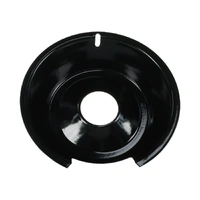
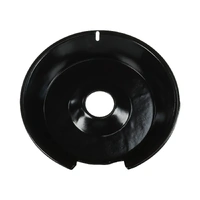
Black steel or black enamel drip pans are common on commercial-grade and mid-range cooktops. They do not reflect as much heat as chrome but hide discolouration and staining more effectively. This makes them a practical choice for high-use environments such as rentals and share accommodation, where cleaning frequency may be lower.
| Material | Heat Reflection | Cleaning Ease | Durability | Best For |
|---|---|---|---|---|
| Chrome | High | Moderate | Moderate | Residential, owner-occupied homes |
| Porcelain | Moderate | Good | Good (if unchipped) | Older OEM replacements, established cooktops |
| Black Steel | Low | Good | Good | Rentals, commercial kitchens, high-use sites |
Cooktop drip pans are only compatible with electric coil cooktops. Gas cooktops, ceramic cooktops, and induction cooktops use entirely different burner designs that do not require or accept drip pans.
Electric coil cooktops feature exposed spiral heating elements that sit proud of the cooktop surface. The coil element plugs into a receptacle in the cooktop, and the drip pan fits beneath the element, surrounding the receptacle. This arrangement is standard across older Australian-manufactured cooktops and many current-production budget and mid-range models.
Gas cooktops use cast iron or steel trivets and burner caps rather than drip pans. Spills on a gas cooktop flow around the burner cap and into a dedicated spillage tray below. Induction cooktops use a flat glass-ceramic surface with no raised elements; spills sit on the surface and are wiped away directly. Neither design creates a gap beneath a raised element where a drip pan would fit.
The majority of electric coil cooktops in Australian rental stock are older models that are no longer in production. Replacement drip pans for these appliances may be OEM parts sourced through spare parts suppliers, or universal-fit pans sized to the standard 6-inch and 8-inch burner diameters. Newer cooktops, where electric coil designs are still used, often accept universal-fit pans more reliably because dimensional standards have converged over time. For older appliances, cross-referencing the cooktop model number against a drip pan compatibility list is the safest approach before purchasing.
Drip pan fit is critical. An ill-fitting pan can tip during cooking, fail to catch spills efficiently, or interfere with the heating element's electrical connection. Getting the size right before ordering saves time and avoids a second freight cost.
The two standard electric coil burner sizes in Australia are 6-inch (small burner, approximately 150 mm diameter) and 8-inch (large burner, approximately 200 mm diameter). Drip pans are sold to match these sizes, with the pan diameter typically running 5 to 10 mm larger than the element to allow clearance. Most cooktops have two or four burners in a mix of these two sizes.
Three dimensions determine drip pan fit: outer diameter, bowl depth, and the diameter of the centre hole. The centre hole accommodates the heating element's burner receptacle post. If the centre hole is too small, the pan will not seat flat. If it is too large, spills bypass the pan and reach the cooktop frame. Measure the existing pan before it is discarded, or reference the cooktop model number to obtain the manufacturer's dimensions.
Universal drip pans are manufactured to standard 6-inch and 8-inch burner dimensions and are designed to fit a wide range of cooktop brands. They are lower in cost than OEM parts and are widely available through cooktop parts suppliers. OEM parts are sourced from the original appliance manufacturer or an authorised parts distributor. They are dimensionally exact for that specific model but may be discontinued for older appliances. Where OEM parts are unavailable, a universal pan of the correct size is a reliable alternative.
A pan that is too small leaves gaps around the element receptacle, allowing spills to reach internal components. A pan that is too large may not sit flat and can rock during cooking, which is a safety risk. A centre hole that is too tight can put mechanical stress on the heating element socket, potentially damaging the connection over time. Always verify dimensions before purchasing.
The two primary selection criteria are dimensional fit and material. Once fit is confirmed, material choice depends on the application and how the cooktop is used day to day.
Start with the cooktop's model number, found on a label inside the cooktop cavity or on the underside of the unit. Search the model number against parts databases at appliance spare parts suppliers. If an OEM pan is listed, note the part number and compare the dimensions to confirm it has not been superseded by a different part. Where no OEM match is found, universal pans sized to 6-inch or 8-inch burners will generally fit standard Australian cooktop formats.
Chrome pans are appropriate for owner-occupied residential properties where spills are wiped up promptly. Porcelain-coated pans suit older appliances where the original pan was also porcelain, maintaining dimensional accuracy and appearance consistency. Black steel pans are well suited to rental property maintenance and high-frequency use, where discolouration from cooking is expected and regular deep cleaning may not occur between tenancies.
Universal chrome pans are the lowest-cost option and available in bulk. Porcelain pans carry a modest price premium and offer better stain resistance. Black steel pans sit in a similar price bracket to chrome and require less aesthetic maintenance. For property managers running multiple units, bulk purchasing chrome or black steel universal pans sized to the most common burner dimensions reduces procurement complexity.
Universal drip pans are suitable when the original OEM part has been discontinued, when the cooktop model is unidentifiable due to a missing label, or when cost and availability are the primary drivers. They are not suitable for cooktops with non-standard element sizes or proprietary mounting designs, which are occasionally found on high-end or imported appliance brands.
Not all drip pans perform equally. Quality differences are visible in how well the pan reflects heat, resists corrosion, and maintains its shape under cooking temperatures.
A clean, bright chrome or polished steel pan reflects a measurable portion of radiant heat back toward the cookware. This is most significant when cooking at low to medium heat, where heat loss to the surroundings is proportionally greater. A blackened or heavily soiled pan absorbs this heat rather than reflecting it, increasing energy consumption and extending cooking times.
Pan durability depends on the base metal thickness and the quality of the surface coating. Thicker steel bases resist warping under high heat and repeated thermal cycling. Chrome plating quality varies between manufacturers; thin chrome layers pit and peel faster than heavier plating. Porcelain coatings applied over thicker steel bases offer better chip resistance than those on thin stampings.
Smooth, well-finished surfaces clean more easily than rough or pitted ones. Chrome pans that are wiped clean after each use maintain their reflectivity and last longer. Porcelain and black steel surfaces are more tolerant of soaking in hot soapy water, which is the standard cleaning approach for baked-on grease. Abrasive pads should be avoided on chrome and porcelain to prevent surface damage.
Quality varies between brands, particularly in the universal pan market. Look for pans with consistent bowl depth, smooth centre hole edges without burrs, and a uniform surface finish. Poor stamping quality produces uneven bowl profiles that do not seat flat against the cooktop surface.
Regular cleaning extends drip pan life and maintains cooking performance. The method depends on the pan material and the degree of soiling.
Wipe chrome drip pans after each use once the cooktop has cooled. This prevents grease from baking onto the surface, which is the primary cause of permanent staining. Porcelain and black steel pans can tolerate slightly less frequent wiping, but weekly removal and washing is recommended for all pan types in active household use. For rental properties between tenancies, full removal and inspection of all drip pans is standard practice.
For lightly soiled pans, hot water and dishwashing liquid applied with a soft cloth or sponge is sufficient. Soak heavily soiled pans in hot soapy water for 20 to 30 minutes before scrubbing. Baking soda paste applied to stubborn baked-on residue and left for 15 minutes before scrubbing removes most deposits without scratching. Commercial degreasers are effective on black steel and porcelain but should be rinsed thoroughly before the pan is returned to the cooktop.
Do not use steel wool or metallic scouring pads on chrome or porcelain pans. These remove surface material and accelerate corrosion. Avoid harsh acidic cleaners such as undiluted vinegar on chrome, as these promote pitting. Allow pans to dry fully before returning them to the cooktop to prevent rust formation at the edges and centre hole.
Surface rust that cannot be scrubbed away, deep pitting in the chrome layer, chipped or flaking porcelain, and warping that prevents the pan from sitting flat are all indicators that cleaning is no longer a useful intervention. At this point, replacement is the correct action. Continuing to use a damaged pan carries safety risks from grease accumulation and poor electrical clearance.
Most drip pan problems produce visible or olfactory symptoms during cooking. Identifying the symptom quickly narrows down the cause.
Smoke rising from the burner area, or a burning odour that does not come from the food, usually means there is accumulated grease or food residue in the drip pan burning off under heat. Remove the element and pan after the cooktop cools, clean both thoroughly, and inspect the element socket for debris. If the smell persists after cleaning, check whether grease has migrated below the drip pan into the cooktop cavity, which requires more thorough servicing.
If spills are reaching the cooktop frame despite a drip pan being in place, the pan may be full, incorrectly seated, or sized too small. A pan that has built up a significant residue layer has reduced effective capacity. Remove and clean the pan. Check that the pan seats flat and that the centre hole aligns correctly with the element socket post.
Drip pans can warp from repeated high-heat cooking, particularly if empty pans are exposed to full element heat with no cookware above them. A warped pan rocks on the cooktop surface and may tip spills toward the cooktop edge. Replace warped pans. They cannot be safely returned to a flat profile once deformed.
If a particular burner is taking longer than usual to bring water to the boil or maintain cooking temperature, and the element itself tests correctly, check the drip pan. A heavily soiled or darkened pan is absorbing heat that should be reflected upward. Replacing or thoroughly cleaning the pan can restore some cooking efficiency at the affected burner.
Drip pans are consumable components. They have a finite service life determined by usage frequency, cleaning practices, and the quality of the original material.
Surface rust on chrome pans typically begins at the centre hole edge, where the chrome plating is thinnest and most exposed to moisture. Once rust is established, it spreads beneath the chrome layer and cannot be reversed by cleaning. Corroded pans should be replaced before rust flakes migrate toward the element socket or food preparation area.
Thermal warping prevents the pan from seating correctly against the cooktop surface. A warped pan allows spills to bypass the collection bowl and reach the cooktop's internal components. This is a maintenance failure that cleaning alone cannot correct.
A pan that is permanently blackened or heavily pitted no longer reflects heat effectively. While the loss is gradual, it contributes to higher energy consumption over time. For a household running four burners through several cooking sessions daily, a clean pan at every burner provides a measurable efficiency benefit over the course of a year.
A cracked or perforated drip pan allows liquids to reach the element socket directly. The combination of liquid, heat, and electrical connections creates both a corrosion and a fire risk. Damaged pans must be replaced, not patched. This applies equally to residential and rental properties, and to commercial kitchens where compliance with appliance safety standards is a tenancy or council requirement.
Cooktop drip pans are low-cost components. The total cost of ownership depends on how frequently they are replaced and whether OEM or universal parts are used.
Universal drip pans are the most affordable option and suit the majority of Australian electric coil cooktops. OEM parts are available for cooktops still in production or with strong parts supply chains, and they provide dimensional certainty for models with non-standard configurations. The price differential between a universal pan and an OEM part can be significant, particularly for older imported brands where OEM parts must be air-freighted from overseas.
Property managers and appliance service technicians often benefit from purchasing drip pans in bulk. Buying a stock of 6-inch and 8-inch universal pans in chrome or black steel eliminates procurement lead time when a tenant reports a damaged pan. It also reduces per-unit cost when purchased in quantities of six or more. Bulk stock is practical for any property portfolio running more than five electric coil cooktops.
Universal chrome drip pans for standard 6-inch and 8-inch burners are available at low cost per unit through online electrical and appliance parts suppliers. OEM parts carry a higher price, which reflects sourcing and supply chain costs. In all cases, the drip pan cost is well below the labour cost of a service call to clean or repair a cooktop cavity that has been damaged by grease ingress from a missing or failed pan.
Replacing drip pans on a regular schedule, rather than waiting for visible failure, is the more cost-effective approach. A pan replaced annually in a high-use rental property costs far less than a technician's call-out to address internal cooktop damage from grease accumulation. Preventive replacement is particularly relevant for properties where the cooktop condition is not regularly inspected between tenancies.
Deciding whether to clean and continue using a drip pan or replace it depends on the condition of the pan and the cooktop's age and usage profile.
Cleaning is sufficient when the pan's surface is intact, it seats flat, the chrome or porcelain coating shows no cracking or peeling, and discolouration is from cooking residue rather than corrosion. A pan that responds well to soaking and scrubbing and returns to a reasonably clean condition is worth retaining. Regular maintenance cleaning extends service life significantly.
Replace the pan when any of the following are present: surface rust that cannot be removed, visible perforation or cracking, warping that prevents flat seating, chipped porcelain exposing bare metal, or baked-on residue that cannot be removed after soaking. Also replace the pan if it no longer seats securely due to deformation of the centre hole.
If the cooktop itself is old and showing signs of element socket corrosion, damaged wiring, or unreliable burner performance, replacement drip pans alone will not resolve the underlying issues. At this point, advising the property owner or client to upgrade to a new cooktop is the more practical recommendation. Modern electric cooktops with ceramic surfaces eliminate the drip pan maintenance requirement entirely.
A functional drip pan maintained through regular cleaning can last several years in residential use. In rental or commercial settings, where pans may be cleaned infrequently or subjected to heavy use, annual replacement is a reasonable benchmark. The cost of two drip pans per year is substantially less than one service call for cooktop cavity cleaning or element socket repair.
Drip pans are a routine item for licensed electricians servicing appliances, property managers maintaining rental stock, and appliance repair technicians.
Electric coil cooktops remain common in older rental properties throughout Australia. End-of-lease inspections regularly identify damaged or missing drip pans as a maintenance item. Property managers who carry a stock of universal 6-inch and 8-inch pans can resolve these items immediately during inspection, without waiting for a parts order. This reduces turnaround time between tenancies and avoids disputes about whether damage is tenant liability or fair wear and tear.
Licensed electricians attending cooktop service calls routinely replace drip pans as part of the service. A technician who arrives with pans in stock can complete the job in a single visit. Sparky Direct supplies hot plate elements, stove trim rings, and drip pans to trade customers Australia-wide, with online ordering and fast dispatch to reduce parts procurement time.
Organisations managing large residential portfolios, student accommodation, or short-term rental properties benefit from standing stock of drip pans in both burner sizes. Establishing a standard replacement schedule, such as replacing all pans at end-of-lease for electric coil cooktops, removes the inspection subjectivity around pan condition and ensures consistent cooktop cleanliness for incoming tenants.
Cooktop drip pan condition is relevant to both fire safety and electrical safety. These are not cosmetic concerns.
Accumulated grease in and around a drip pan is a documented ignition source. At high element temperatures, carbonised grease can ignite, producing a small but potentially spreading fire within the cooktop cavity. Maintaining clean drip pans and replacing them when cleaning is no longer effective is one of the simplest fire prevention measures in a domestic kitchen.
Liquid reaching the element socket through a missing or perforated drip pan can cause a short circuit, damage the socket terminals, or create a ground fault. In severe cases, this results in a blown circuit breaker or damage to the cooktop's wiring. Electricians servicing cooktops with evidence of liquid ingress to the wiring cavity should assess the extent of damage before recommending a repair or replacement path. Compliance with AS/NZS 3000:2018 requires that accessible components are maintained in a condition that does not create shock or fire hazards.
A drip pan that does not fit correctly is not neutral in its effect. An undersized pan that does not cover the element socket area provides less protection than no pan, because it creates a false sense of coverage while leaving gaps. A pan forced into position with a tight centre hole can deform the element socket, making future element removal or replacement more difficult. Use the correct size for the cooktop's burner configuration.
Keep drip pans clean and in serviceable condition. Inspect them during routine cooktop cleaning. Replace them when any structural damage is identified. Do not use the cooktop without drip pans in place, as this exposes the element socket and internal wiring to direct spill contact. These practices apply equally in residential, rental, and commercial kitchen settings.
Electrical work safety note: Cooktop element removal and installation is straightforward for the average user, but any work involving the cooktop's wiring, socket terminals, or internal components must be carried out by a licensed electrician. This requirement applies under AS/NZS 3000:2018 and the relevant state electrical safety regulations across Australia.
Watch Fan Forced Oven Element 2500W | FE-07 / 203174 / VG25B000 / 10926 video
Watch Hotplate Element 1800W HP-04 | 3501-10 - Suits TR-04 + TR-06 + DP-03 video
Watch Trim Ring | TR-07 / 1256-07 / 2799 | Suits HP-05 video

We have a trusty old Simpson conventional double oven for over 3 decades now, loving everything about it. Its heating element died recently and we were surprised to find that this was available as a replacement. Simple as that. We ordered, it arrived and it works great! Sparky Direct were very responsive when I had a question too.
Hot water system failed, l checked it, the element was blown, ordered a replacement same day, picked it up next morning, system was hot enough to shower that day, easy! Great service and price was even better, really happy with result.
Great product so far, adjustable mount bracket slots made it a breeze to install. Hopefully it lasts longer than the genuine elements which have failed repeatedly.
Quality products in stock • Fast Australia-wide delivery • Competitive trade pricing
Browse Drip Pans → Get Expert Advice →Most drip pans can be cleaned with standard kitchen cleaning products once cooled.
Sparky Direct supplies drip pans Australia-wide, offering reliable appliance accessories with convenient delivery.
Drip pans are securely packaged and delivered via standard courier services.
Unused drip pans are generally eligible for return according to the seller’s returns policy.
Warranty coverage varies by manufacturer and typically covers defects in materials or workmanship.
Yes, drip pans are usually sold as individual replacement or accessory items.
Yes, they should be allowed to cool completely before removal or cleaning.
An incorrect size or shape may not fit properly and can interfere with appliance operation.
Yes, they are designed for regular household cooking.
Extended exposure to high heat can cause wear or warping over time.
Dishwasher suitability depends on the material and manufacturer recommendations.
Do drip pans prevent smoke during cooking?
Cooking without a drip pan can lead to grease build-up and make cleaning more difficult.
A drip pan is a removable tray used in ovens, cooktops, and grills to catch grease, spills, and food residue during cooking.
Signs include rust, warping, cracks, or heavy staining that cannot be cleaned.
A drip pan helps collect grease and spills, making cleaning easier and reducing mess inside the appliance.
Yes, drip pans are designed to be easily removable for cleaning or replacement.
Some drip pans are multi-purpose, while others are designed specifically for ovens or grills.
Replacement drip pans are available for many common oven and cooktop models.
They do not affect performance directly but help keep appliances clean and operating efficiently.
Yes, drip pans are designed to withstand high temperatures encountered during cooking.
Drip pans are typically made from enamel-coated steel, stainless steel, or heat-resistant metal.
Yes, many drip pans are designed to fit specific appliance models and sizes.
Drip pans are appliance accessories and are generally manufactured to suit appliances that comply with relevant AS/NZS standards.
Drip pans are commonly used in ovens, under grill elements, beneath hot plates, and in some freestanding cookers.