
Search Results:
Search Results:
Search Results:
Search Results:
Fan forced oven elements generate heat by passing electrical current through a resistive alloy coil, typically nichrome or similar high-temperature wire. The element is positioned at the rear of the oven behind a baffle or cover plate. A fan motor draws air across the element and pushes it into the oven cavity through vents in the rear panel.
The element produces radiant heat directly from its surface. The fan motor circulates this heated air continuously around the oven interior. This combination reduces temperature variation between oven zones. Without the fan, hot air rises and concentrates at the top of the cavity, which causes uneven cooking results.
The circulating air also strips away the cooler boundary layer that forms on food surfaces during cooking. This improves browning and speeds up the cooking process compared to a static oven environment.
Fan forced ovens typically reach target temperature faster than conventional ovens of the same wattage. The moving air transfers heat to food more efficiently than still air. Most convection ovens allow recipe temperatures to be reduced by approximately 10 to 20 degrees Celsius compared to conventional oven settings, though this varies by model and application.
A fan forced oven requires both the heating element and the fan motor to function correctly. If the fan runs but the element fails to heat, the circuit to the element is open. If the element heats but the fan does not run, air circulation is lost and cooking performance drops significantly. Both components should be tested when diagnosing an oven fault. Sparky Direct stocks oven fan motors alongside replacement elements.
Fan forced oven elements are available in several physical configurations. Selecting the correct type requires matching the element profile to the oven's rear panel mounting arrangement.
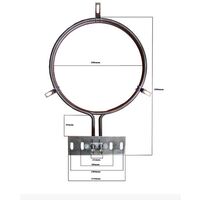
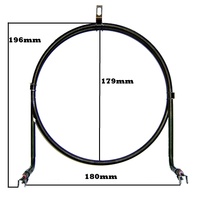
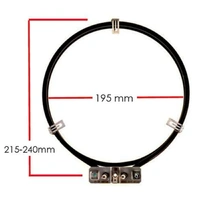
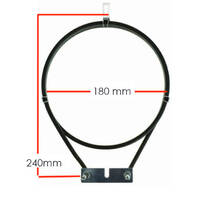
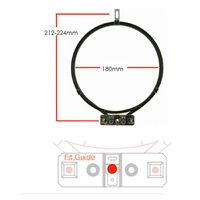
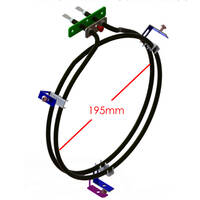
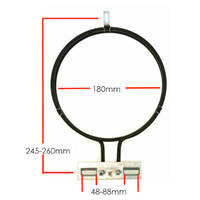
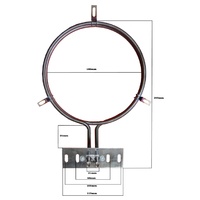
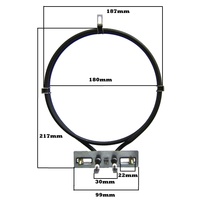
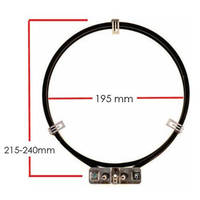
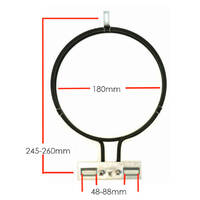
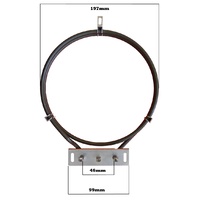
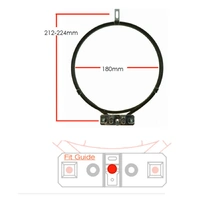
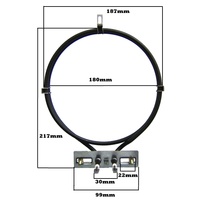
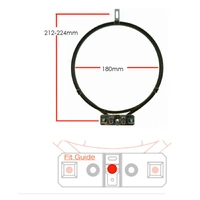
The most common design in domestic fan forced ovens is the circular or ring element. This element forms a complete or near-complete circle around the fan motor housing. Diameters typically range from 175mm to 220mm. The ring shape provides uniform heat distribution around the fan outlet, which supports even air temperature before it enters the oven cavity.
Some older domestic ovens and certain commercial oven models use straight bar elements mounted horizontally or vertically at the rear. These are less common in modern domestic appliances but remain available as aftermarket parts for service work on older equipment.
Domestic ovens in Australia operate on single-phase 230V supply. Three-phase elements are found in commercial ovens and large institutional cooking equipment. Three-phase elements connect across multiple phases of a 400V three-phase supply. Fitting a three-phase element to a single-phase circuit, or vice versa, will damage the element and may create a safety hazard. Always verify the supply type before ordering a replacement.
Commercial oven elements are built for continuous duty operation across multiple shifts per day. They use heavier-gauge alloy wire and more robust terminal connections. Domestic elements are designed for intermittent use. Commercial and domestic elements are not interchangeable. If replacing an element in commercial kitchen equipment, specify a commercial-grade part rather than fitting a domestic equivalent.
Wattage is the most important electrical specification when selecting a replacement fan forced oven element. Fitting an element of the wrong wattage affects oven temperature accuracy and may cause the thermostat to cut out prematurely or fail to reach the set temperature.
Australian domestic fan forced oven elements typically range from 1,800W to 2,600W. The most common ratings are 2,000W, 2,200W, and 2,400W. Some compact or budget models use lower wattage elements. Heavy-duty domestic models and commercial units may use elements above 2,600W. Always confirm the wattage of the original element before ordering a replacement.
A higher wattage element recovers temperature faster after the oven door is opened. It also reaches the set temperature more quickly from a cold start. An element of lower wattage than the original will cause the oven to heat more slowly and may result in the thermostat operating more frequently as it struggles to maintain temperature.
All domestic oven elements in Australia are rated at 230V AC. The element rating label or stamping should confirm both voltage and wattage. Some imported ovens are originally rated at 220V or 240V. A 230V element is a direct replacement in Australian installations. Never fit a 120V element to a 230V Australian circuit.
Fitting a higher wattage element than specified increases current draw and may exceed the rating of the element terminals, wiring, or thermostat. This can cause overheating at connection points and create a fire risk. Fitting a lower wattage element reduces cooking performance and may cause persistent undertemperature faults. Always match the original wattage unless a specific substitution is confirmed as compatible by the parts supplier.
Important: Do not assume a visually similar element is electrically equivalent. Two elements of the same diameter can have different wattage ratings. Always confirm the wattage from the oven model number or the element's own markings before ordering.
A conventional oven uses radiant elements at the top and bottom of the cavity without forced air circulation. A fan forced oven places the heating element at the rear and adds a fan to move air. The physical element construction is similar, but the operating environment and thermal demands are different.
Conventional ovens develop a temperature gradient from bottom to top. The fan forced design minimises this gradient by actively distributing heat throughout the cavity. This makes fan forced ovens suitable for baking multiple trays simultaneously with consistent results across all shelf positions.
Forced air convection reduces cooking time in most applications. The moving air transfers heat to food surfaces more effectively than radiant heat alone. Energy consumption per cooking cycle is typically lower because the oven reaches temperature faster and recovers quickly after the door is opened.
The fan motor and element are controlled by the oven thermostat. In most domestic designs, the element and fan operate together when the oven is in fan forced mode. The thermostat cycles the element on and off to maintain the set temperature. The fan may continue to run after the element switches off to cool the oven cavity. Check the oven thermostat and switch if the element heats intermittently or the oven does not hold temperature.
Fan forced mode suits most everyday cooking, including roasting, baking cakes, and cooking on multiple trays. Grill mode uses a separate top element without the fan. Bake mode uses bottom heat, sometimes with top radiant heat added, without forced air. Each mode uses a different element or combination of elements. Replacing a fan forced element does not affect grill elements, which are separate components.
| Feature | Fan Forced | Conventional |
|---|---|---|
| Element position | Rear of cavity | Top and/or bottom |
| Air circulation | Forced by fan motor | Natural convection only |
| Temperature uniformity | High | Moderate (gradient top to bottom) |
| Preheat time | Faster | Slower |
| Multi-tray baking | Suitable | Results vary by shelf position |
Selecting the correct replacement element requires matching physical dimensions and electrical specifications to the original part. Fitting a visually similar but incompatible element may result in poor fit, incorrect performance, or a safety hazard.
The oven model number is the most reliable starting point for identifying the correct replacement element. The model number is typically found on a label inside the oven door frame, on the rear of the appliance, or inside the storage drawer below the oven cavity. Use the full model number when searching for replacement parts. The model number identifies the exact element specification required, including wattage, diameter, and terminal configuration.
Beyond wattage, the correct replacement must match the element's outer diameter, the number and position of mounting holes or brackets, and the terminal configuration. Some elements use a two-terminal connection (one active, one neutral). Others have a three-terminal configuration or an earth terminal at the mounting bracket. Incorrect terminal configuration prevents correct wiring and may leave the element unearthed.
Euro long neck elements require a specific extended neck length to pass through the rear panel of certain European-brand ovens. A standard neck element will not seat correctly in these models even if the electrical specifications match.
Original equipment manufacturer (OEM) elements are produced by or for the oven manufacturer and are guaranteed to match the original specification. Aftermarket elements are produced by third-party manufacturers to fit a range of oven models. Quality aftermarket elements from reputable suppliers meet or exceed OEM performance in most applications. Wilson Elements and Global Components are established aftermarket suppliers with a strong track record in the Australian appliance parts market.
Many aftermarket elements are designed to fit multiple oven brands within a shared physical format. An element listed as fitting Westinghouse, Chef, and Simpson models may share a common mounting pattern across these brands due to shared manufacturing platforms within the Electrolux group. Always verify compatibility against the specific model number rather than relying on brand name alone.
Element quality affects both cooking performance and service life. Cheap elements may use lower-grade alloy wire that degrades faster under thermal cycling, leading to premature failure.
A correctly functioning fan forced element produces consistent heat output across its full length. Uneven heat distribution from an element can result from localised resistance changes caused by corrosion, contamination, or mechanical damage. If an oven produces hot spots or uneven browning that it did not previously, the element may be developing a fault even if it appears physically intact.
The fan motor directs airflow across the element during operation. This continuous airflow accelerates oxidation of the element surface over time. Elements designed for convection oven use are typically treated or alloyed to resist this oxidation more effectively than elements intended for radiant-only applications.
Each oven cycle expands and contracts the element wire as it heats and cools. Over many cycles, this mechanical stress causes fatigue at bends and connection points. Higher-quality elements use alloys with lower expansion coefficients and better fatigue resistance. This extends service life, particularly in ovens used frequently or for extended cooking sessions.
Replacement elements sold in Australia should carry RCM (Regulatory Compliance Mark) or equivalent certification. This confirms the product meets the relevant Australian and New Zealand electrical safety standards. Elements without compliance markings carry regulatory and safety risk and should not be fitted to appliances used in commercial or rental properties.
Most fan forced oven faults fall into a small number of categories. Systematic diagnosis identifies whether the fault lies with the element, the fan motor, the thermostat, or the power supply.
If the oven does not reach the set temperature or takes significantly longer than usual to heat, start by confirming the power supply is intact. Check the circuit breaker and the oven's internal thermal fuse if one is fitted. Test the element for continuity using a multimeter. A reading of open circuit (infinite resistance) confirms the element has failed. A typical fan forced oven element has a resistance between 20 and 40 ohms depending on wattage.
Uneven cooking in a fan forced oven may indicate a partially failed element, a failing fan motor, or a blocked rear baffle. Inspect the element visually for cracks or burn marks. Check that the fan motor runs freely when the oven is powered. A fan motor that runs slowly due to worn bearings reduces air circulation and creates uneven temperature zones.
A tripping circuit breaker when the oven is switched on indicates a short circuit in the element or connecting wiring. A shorted element creates a low-resistance path to earth, drawing excess current. The circuit breaker trips to protect the wiring. Do not reset and retry repeatedly. Isolate power, then test the element with a multimeter for continuity between each terminal and earth. A reading other than open circuit between terminal and earth indicates a short to earth in the element.
If the fan motor runs but the oven does not heat, the element circuit is open. This is typically a failed element. It can also indicate a faulty thermostat that is not closing the element circuit, or a failed thermal cutout. Test the element first, then trace the circuit through the thermostat and any safety cutouts. The oven thermostat and switch should be tested if the element tests as serviceable.
Recognising the signs of element failure early allows for planned replacement rather than emergency breakdown. Most element failures show clear warning signs before complete failure occurs.
Inspect the element with the oven cold and power isolated. Cracks in the element sheath, blistered or bubbled sections, discolouration with a distinct brown or black burn pattern, and areas of the element that appear melted or collapsed are all indicators of failure. Any visible physical damage to the element wire or sheath confirms replacement is needed.
An oven that fails to heat or takes twice as long as normal to reach temperature when the fan is running indicates a failed or degraded element. Compare preheat time to the oven's original performance. A consistent pattern of slow preheating that progressively worsens over time suggests the element resistance is increasing due to internal degradation.
Food that consistently browns unevenly, with one side or section overcooked relative to others, can indicate a section of the element has failed or reduced in output. The fan continues to circulate air but the heat source is uneven, producing predictable hot and cold zones in the cavity.
A burning or acrid smell from the oven that is not caused by food residue suggests element insulation breakdown or arcing within the element sheath. Visible sparking or flashing inside the oven cavity when the fan forced mode is selected requires immediate power isolation. Do not continue to operate an oven showing these symptoms. Inspect and test the element before returning the appliance to service.
Correct testing of a fan forced oven element requires power isolation before any contact with the element or its terminals. All testing described here is carried out with the oven completely de-energised.
Set the multimeter to resistance (ohms) mode. Isolate power to the oven at the switchboard. Access the element terminals, typically by removing the rear panel inside the oven cavity. Disconnect the element terminals from their connectors. Measure resistance across the two main element terminals. A healthy element reads between approximately 20 and 40 ohms. An open circuit reading (OL or infinity) confirms a failed element. A very low resistance reading (close to zero ohms) indicates a short circuit within the element.
An open circuit element has a broken wire internally. Current cannot flow, so the element produces no heat. A shorted element has an internal fault where the element wire contacts the outer sheath or earth, creating a low-resistance path to ground. A shorted element will trip the circuit breaker and may cause the RCD to operate. Both conditions require element replacement.
If the element tests as serviceable (correct resistance, no earth fault), check the thermostat by measuring continuity across its contacts when the oven is set to a temperature above ambient. A thermostat that does not close its contacts at the set temperature has failed. The fan motor can be tested by applying rated voltage directly to its terminals (with appropriate electrical safety precautions) to confirm it runs freely.
Testing involves working within the oven's electrical circuit. If the fault cannot be isolated by element continuity testing alone, or if the oven has complex control electronics, the remaining diagnosis should be carried out by a licensed electrician. In Australia, connection and disconnection of fixed wiring to appliances is restricted work in most states and territories.
Understanding the causes of element failure helps identify whether a replacement is the only action needed or whether an underlying condition should be addressed at the same time.
Every heating and cooling cycle puts mechanical stress on the element wire. The wire expands when heated and contracts when cooled. Over hundreds or thousands of cycles, this fatigue concentrates at bends in the element form and at the seal points where the wire exits the sheath terminals. Cracks develop at these high-stress points and eventually cause an open circuit failure.
Internal short circuits develop when the insulating material within the element sheath degrades. This degradation occurs gradually through thermal cycling and can be accelerated by moisture ingress or contamination from cooking residue. Once the insulation breaks down, the element wire contacts the outer sheath and a short to earth occurs.
Grease deposits on the element surface can cause localised overheating. Grease ignites at temperatures well below the element's operating temperature, and repeated combustion on the element surface accelerates surface oxidation and degradation. Keeping the oven clean, and specifically keeping the element surface free of grease build-up, extends element life.
Loose or corroded terminal connections increase resistance at the connection point, causing localised overheating at the connector. This can damage both the connector and the element terminal. Corroded connectors should be cleaned or replaced when fitting a new element. High-resistance connections at the terminal also reduce effective element wattage and affect oven performance.
Replacing a fan forced oven element involves accessing the rear of the oven cavity, disconnecting the failed element, and fitting the replacement. The physical process is straightforward in most domestic ovens. Legal requirements for who may carry out the work vary by state and territory.
The oven must be completely isolated from the power supply before any work begins. For built-in ovens, isolate at the dedicated circuit breaker in the switchboard and verify isolation with a multimeter or voltage tester before touching any terminals. For freestanding ovens, unplug the appliance. Do not rely on the oven's own power switch as the only isolation method.
In most domestic fan forced ovens, the element is accessed from inside the oven cavity by removing a rear cover panel secured with screws. The fan motor and element are located behind this panel. Some models require removal of the fan guard or fan blade to access the element mounting points. Refer to the appliance service manual for the specific access procedure for the model being serviced.
With the rear panel removed, the element terminals are accessible. Note the terminal positions and connector orientation before disconnecting. Photograph the connections if needed. The element is typically secured by two or three screws at the mounting bracket. Remove the screws, pull the element forward carefully, and disconnect the terminal connectors. Fit the new element in the reverse order. Ensure the terminal connectors are fully seated and the mounting screws are tight before reassembling the panel.
In most Australian states and territories, disconnecting and reconnecting an oven from fixed wiring (hardwired installation) is classified as electrical work and must be carried out by a licensed electrician. Replacing an element in a freestanding oven that connects via a plug and socket may not require a licensed electrician for the element replacement itself, but local regulations vary. Check with the relevant state electrical safety regulator if there is uncertainty about what work is permitted without a licence. Appliance technicians and licensed electricians both carry out this type of repair work.
Safety notice: Always verify that the replacement element is fully compatible with the oven model before fitting. Confirm power is isolated before starting work. If the oven is hardwired, engage a licensed electrician to disconnect and reconnect the supply.
Replacing a fan forced oven element is almost always more cost-effective than replacing the appliance. Even with labour costs for a technician, the repair cost is typically a fraction of a new oven purchase.
OEM elements sourced through the appliance manufacturer or authorised dealers are generally priced higher than aftermarket equivalents. Aftermarket elements from established suppliers such as Wilson Elements offer comparable performance at lower cost. For older appliances, OEM parts may no longer be available, making aftermarket the only practical option.
Domestic fan forced oven elements range from approximately $30 to $120, depending on the brand, wattage, and whether the part is OEM or aftermarket. Universal-fit aftermarket elements with adjustable mounting brackets typically sit in the lower to mid price range and cover a wider range of oven models than model-specific OEM parts.
Appliance service technicians who regularly replace oven elements benefit from maintaining a stock of common elements covering the most frequently encountered wattages and physical configurations. Sparky Direct's appliance parts range is supplied directly to trade buyers with competitive pricing and fast Australia-wide delivery.
The decision to repair or replace depends on the age of the appliance, the cost of the repair relative to appliance value, and whether other components are also approaching end of life. An oven that is less than ten years old with a single failed element is a clear candidate for repair. An oven over fifteen years old with multiple failing components may be more economically replaced. The element cost itself is rarely the deciding factor. Technician labour and access costs vary by location and oven installation type.
Routine maintenance practices that keep the oven clean and the element free from contamination are the most effective ways to extend element service life.
Grease and food residue on the element surface cause localised overheating during cooking. Clean the oven interior regularly to prevent build-up. Avoid spraying cleaning products directly onto the element. Do not use abrasive cleaners on the element surface. Allow the oven to cool completely before cleaning. If the oven has a self-cleaning function, use it according to the manufacturer's instructions rather than manual cleaning with chemical products around the element.
Placing large amounts of very cold food directly into a hot oven causes rapid temperature drops that increase element cycling frequency. This accelerates thermal fatigue. Allow frozen items to thaw partially before oven cooking where practical. Avoid running the oven at maximum temperature for extended periods when lower temperatures are adequate for the cooking task.
Track changes in oven performance over time. If preheating takes noticeably longer, if cooking times increase for familiar recipes, or if browning becomes uneven, investigate the element and fan motor before the fault progresses to complete failure. Catching a failing element early allows for planned replacement rather than an unplanned breakdown.
In commercial kitchen environments, scheduled inspection and preventative replacement of oven elements during planned maintenance periods reduces the risk of mid-service breakdowns. A visual inspection of the element at each service interval identifies physical degradation before electrical failure occurs.
The Australian domestic oven market is dominated by a relatively small number of manufacturing platforms, which means a single aftermarket element often fits multiple brands within a group.
Westinghouse, Chef, and Simpson ovens are all part of the Electrolux manufacturing group. Many models within this group share common element dimensions and terminal configurations. Aftermarket elements covering this group are among the most widely stocked in Australia due to the large installed base of these appliances. The Wilson Elements CO-02 and FE-series elements cover many models across this group.
European-brand ovens typically require Euro long neck elements or elements with specific mounting bracket configurations that differ from the Electrolux group. Smeg, Bosch, and Miele models each have distinct element specifications. Euro long neck elements are designed to clear the thicker rear panels common in European-brand built-in ovens. Confirm the neck length and bracket type before ordering for any European-brand model.
Fisher and Paykel and Omega ovens have their own element specifications, though several common aftermarket elements cover models from these brands. The FE-07 2500W element is listed as compatible with several Omega oven models. Always verify against the specific model number.
Older Australian oven brands including Malleys, Kelvinator, and Hoover have limited OEM parts availability. Aftermarket suppliers maintain stocks of elements that fit these older models based on physical specifications. Providing both the model number and measured element dimensions improves the chance of finding a compatible aftermarket replacement for an obscure or discontinued model.
Fan forced oven element replacement is a routine task for appliance service technicians and electricians working in residential and commercial settings.
Residential oven element replacement is one of the most common domestic appliance repair jobs in Australia. The element is a wear item with a finite service life, and most ovens will require at least one element replacement during their working life. Trade buyers can access a full range of fan forced oven elements and grill elements through Sparky Direct.
Property managers and facilities maintenance teams responsible for rental properties with ovens benefit from maintaining a stock of the most common element types. Fast element replacement reduces tenant inconvenience and call-out response times. Stocking hot plate elements alongside fan forced oven elements covers the most common appliance heating faults in a single stock holding.
Commercial oven elements differ from domestic types in construction and duty rating. Licensed electricians servicing commercial kitchen equipment should confirm whether a commercial-grade element is required or whether a domestic element meets the equipment specification. Commercial kitchen breakdowns have significant operational impact, making fast parts availability critical. Check current stock availability for commercial element types before attending a commercial site.
Electrical safety requirements apply to both the replacement element itself and to the work involved in fitting it. Non-compliant parts and unlicensed electrical work both carry legal and safety consequences.
Electrical appliances and their components sold in Australia must comply with relevant AS/NZS standards and carry the Regulatory Compliance Mark (RCM). For domestic ovens, the relevant standard is AS/NZS 60335.2.6, which covers safety requirements for stationary cooking ranges, hobs, ovens, and similar appliances. Replacement elements should meet the electrical and thermal requirements of this standard.
Replacing a fan forced oven element in a hardwired installation requires disconnecting the oven from its fixed wiring. This is licensed electrical work in all Australian states and territories. Unlicensed electrical work on fixed wiring carries significant legal and safety consequences. For freestanding ovens connected via a plug and socket, the element replacement itself may be within what a non-licensed person can do legally, but the legal position varies by state. When in doubt, engage a licensed electrician or appliance technician.
New elements are fragile before installation. Handle them carefully to avoid bending the element wire, which can create stress points that lead to premature failure. Do not power an element outside the oven. The element is designed to operate within the thermal environment of the oven cavity. Powering it in open air will cause the element to overheat rapidly and may cause burns or fire.
A correctly fitted element sits securely in its mounting bracket with no mechanical contact between the element wire and the oven cavity walls or other components. Incorrect fitment can cause the element to contact metal surfaces during thermal expansion, creating a short circuit risk. Verify that all terminal connections are secure and that the element wire is clear of the fan motor housing and rear panel before reassembling.
Sourcing replacement fan forced oven elements through a specialist electrical wholesaler gives trade buyers access to a wider product range, more accurate technical information, and faster delivery than general hardware or appliance retailers.
Online specialist suppliers carry more extensive catalogues than local appliance parts shops, which typically stock only high-volume elements for current popular models. Online purchasing allows model-specific searches and cross-referencing by part number or physical specification. Sparky Direct's fan forced oven element range is searchable by element type, wattage, and compatible oven brand.
A reliable appliance parts supplier provides accurate compatibility information, clear product specifications including wattage and physical dimensions, and stock of both OEM and aftermarket options. Clear returns policies for incorrectly ordered parts reduce the cost of unavoidable ordering errors when matching parts to unfamiliar oven models. Sparky Direct also stocks complementary hot water elements and other appliance parts in the same order for combined deliveries.
Trade buyers working on multiple service calls benefit from next-business-day delivery across most of Australia. Sparky Direct dispatches in-stock parts quickly, reducing the time between fault diagnosis and completed repair. For high-volume trade buyers, account pricing and bulk ordering reduce per-unit costs on common element types. The full appliance parts range includes elements, fan motors, thermostats, and associated components in a single catalogue.
Watch Fan Forced Oven Element 2200W | FE-06 / 203174 / VG25B000 / 806890122 / 10518 / 11656 video
Watch Fan Forced Oven Element 2200W | FE-08 / 1976 / 9666 video
Watch Fan Forced Oven Element 2500W | FE-07 / 203174 / VG25B000 / 10926 video

Just so you know this works perfectly as a replacement for bottom oven element in Malleys Viceroy Wall Oven Model VR96ARB. It's about 30 years old and in Masterton home. I found this exact model hard to find much on other than I already had a Wilson one in it. The ovens they used back then and still use nowadays I believe are top quality and worth fixing instead of replacing. The Wilson element was the same rating as original. A very easy fix.
We have a trusty old Simpson conventional double oven for over 3 decades now, loving everything about it. Its heating element died recently and we were concerned that we had to get a whole new unit installed thinking no replacement parts would be available for such an old unit...until we came across Sparky Direct. We ordered the Wilson element and it arrived within a few days. It was a direct replacement, worked first time, very happy!
I selected the Sparkydirect generic replacement for my Smeg oven element because of the good price and the packaged bolts and nuts and adjustable fixing plate. The element was a breeze to fit and works perfectly. 5 stars.
Quality elements in stock • Fast Australia-wide delivery • Competitive trade pricing
Browse Fan Forced Oven Elements → Get Expert Advice →Yes, repeated heating cycles can cause gradual wear.
Sparky Direct supplies fan forced oven elements Australia-wide, offering reliable replacement parts with convenient delivery.
They are securely packaged and delivered via standard courier services.
Unused items are generally eligible for return according to the seller’s returns policy.
Warranty coverage varies by manufacturer and typically covers defects in materials or workmanship.
Yes, they are usually sold as individual replacement components.
Yes, electrical appliance repairs must be completed by licensed professionals.
They generally require no maintenance beyond normal appliance care.
Using the wrong element can affect safety and appliance performance.
They are designed for long service life under normal household use.
They may glow slightly during operation, which is normal.
Replacement should be carried out by a licensed electrician or qualified appliance technician.
Yes, it can lead to uneven or inconsistent cooking.
A fan forced oven element is a circular heating element used in ovens with a fan to evenly distribute heat during cooking.
Other functions may work, but fan forced cooking will not operate correctly.
Signs include uneven cooking, slow heating, or the oven not reaching the set temperature.
They work alongside thermostats and control switches to regulate oven temperature safely.
Replacement elements are available for many common oven brands and models.
They help provide even heat distribution, which can improve cooking consistency.
Yes, they are commonly used in residential electric fan forced ovens.
Power ratings vary by oven model and must align with manufacturer specifications for safe operation.
They are made from metal heating elements designed to withstand high operating temperatures.
Yes, they are often model-specific and must match the oven’s design, wattage, and electrical requirements.
Fan forced oven elements are generally manufactured to meet relevant AS/NZS electrical safety standards, depending on the product.
It is typically positioned around the oven fan at the rear of the oven cavity.