
Search Results:
Search Results:
Search Results:
Search Results:
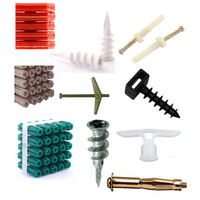
Find the best anchor screws here at Sparky Direct. [ Read More ]
Anchor screws are fastening systems designed to secure fixtures and equipment to base materials that cannot grip a standard screw on their own. These include concrete, brick, masonry, plasterboard, and hollow block. A wall anchor works by expanding or toggling within the base material to spread the applied load across a larger area. This prevents pullout and keeps the fixture secure. Browse anchor screws at Sparky Direct to find the right system for your substrate and load requirement, including wall plugs, plasterboard fixings, nylon nail-in anchors, and hollow wall anchors.
A standard screw driven directly into soft or hollow material relies entirely on thread engagement with a small volume of material. In plasterboard, this is rarely more than 12mm of gypsum. In hollow block, there may be no material at all along the drill path. The result is low pullout resistance and a fixture that fails under any meaningful load.
An anchor system changes this by distributing force. Expansion anchors grip against the sides of a drilled hole. Toggle anchors clamp against the inside face of a hollow panel. In every case, the load path is spread across a much greater contact area, giving you a far higher and more predictable holding capacity.
The anchor's job is to create a reliable load transfer between the fixture and the base material. For solid substrates like concrete and brick, the anchor expands mechanically against the hole wall. For hollow substrates like plasterboard and hollow block, the anchor spreads behind the panel face. The screw then connects the fixture to the anchor body, carrying the load back to the wall.
Electricians use anchor screws daily. Common tasks include mounting conduit saddles to masonry walls, securing switchboard enclosures to block walls, fixing cable trays to concrete ceilings, and attaching electrical equipment brackets to plasterboard or hollow stud walls. Construction trades rely on anchors for structural connections, equipment bases, and facade fixings. DIY users typically need anchors for shelving, TV brackets, and bathroom accessories.
When mounting electrical equipment or conduit to a substrate you have not previously worked with, test-drill a small pilot hole first. The material that comes out tells you a lot: powdery grey dust is concrete, red or orange dust is brick, hollow sound is hollow block or plasterboard. Each substrate has its preferred anchor type.
Every anchor is rated for two types of load: pullout (tensile) strength and shear strength. Pullout strength is the force required to pull the anchor straight out of the hole. Shear strength is the force required to slide the anchor sideways through the material. Most anchoring applications involve a combination of both, depending on the orientation of the fixture.
Manufacturers publish these ratings for specific base materials, hole diameters, embedment depths, and edge distances. These ratings assume correctly drilled holes, clean substrates, and proper installation. Real-world values are lower. Apply a safety factor of at least 4:1 for static loads and 8:1 or more for dynamic or shock-loaded applications.
Light-duty anchors cover loads up to roughly 80kg per fixing point in static conditions. Plastic wall plugs, small toggle bolts, and lightweight plasterboard anchors fall into this group. They suit picture hooks, light switch and socket outlet plates, small conduit saddles, and decorative fittings. Do not use them for anything subject to vibration, impact, or overhead loads without consulting the manufacturer's ratings.
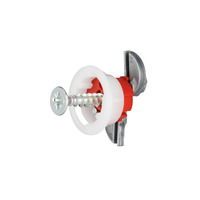
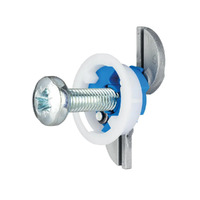
Medium-duty anchors handle loads from roughly 80kg to 400kg per point. Sleeve anchors, metal toggle bolts, and quality plasterboard fixings like the Gripit range sit in this category. They are appropriate for wall-mounted television brackets, cabinet fixings, and medium-weight shelving. For TV brackets in plasterboard, a Gripit fixing rated to 60kg gives reliable, repeatable holding capacity.
Heavy-duty anchors are designed for loads exceeding 400kg per point. Wedge anchors and through-bolts are typical heavy-duty solutions. They are used for machinery bases, structural connections, cable tray hangers carrying significant cable weight, and equipment pads. Heavy-duty anchors in concrete must meet the embedment and edge distance requirements specified in the anchor manufacturer's technical data.
The anchor market covers a wide range of designs. Choosing the right type depends on the base material, the load, and whether the substrate is solid or hollow. The main anchor categories stocked at Sparky Direct include expansion anchors, sleeve anchors, plastic wall plugs, toggle bolts and hollow wall anchors, concrete screws, and hammer drive anchors.
Expansion anchors work by mechanically expanding against the walls of a drilled hole as a bolt or screw is tightened. The expanding element grips the hole wall through friction and mechanical interlock. These anchors are designed for solid substrates: concrete, solid brick, and dense masonry. They do not perform well in hollow or cracked substrates.
A wedge anchor consists of a threaded bolt with a clip and cone at the base. The bolt is driven into a pre-drilled hole, and as the nut is tightened, the cone is drawn up into the clip, forcing it to expand against the hole wall. The expansion creates high frictional and mechanical holding forces. Wedge anchors are installed below the surface of the concrete and can carry heavy loads in both tensile and shear directions.
Wedge anchors are the most common choice for heavy-duty concrete fastening. Drop-in anchors and internal expansion anchors work on a similar principle but are set using a setting tool rather than a bolt. Drop-in anchors are often used where a flush or recessed fastening point is needed. Stud anchors sit between these options: they offer a threaded stud projecting from the surface, useful when equipment must be removed and remounted repeatedly.
Wedge anchors suit equipment bases, cable tray hangers, structural brackets, and any application where the substrate is solid concrete with a minimum embedment depth of 25mm for small-diameter anchors and 50mm or more for larger sizes. Always check edge distance requirements: an anchor placed too close to the edge of a concrete slab can cause the concrete to crack and fail prematurely.
Sleeve anchors consist of a bolt surrounded by a threaded sleeve. As the nut is tightened, the sleeve is compressed against the bolt body and expands outward to grip the hole wall. The sleeve distributes the expansion force over a longer contact length than a wedge anchor, making sleeve anchors more tolerant of minor variations in hole quality and substrate consistency.
Sleeve anchors come in hex nut, round head, and flat countersunk head configurations to suit different fixture types. Installation is straightforward: drill to the correct diameter and minimum depth, clean the hole, insert the anchor through the fixture, and tighten to the specified torque. The anchor expands as it is tightened and should not be over-torqued, as this can crack the surrounding masonry.
Sleeve anchors perform well in concrete, solid brick, and block masonry. They are suitable for load ratings that cover most trade applications: cable tray supports, conduit hangers, bracket fixings, and equipment mounts in medium load ranges. Their main advantage over wedge anchors is adjustability: the bolt can be removed and replaced if needed, whereas a wedge anchor is generally permanent.
Sleeve anchors require a matching diameter hole and achieve grip through expansion. Concrete screws cut their own thread into the substrate and do not require a separate anchor body. For lower load applications where many fixings are needed quickly, concrete screws are faster. For higher loads or when a removable fixing is needed, sleeve anchors are the better choice.
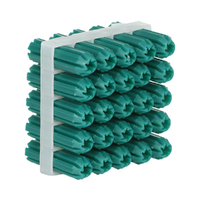
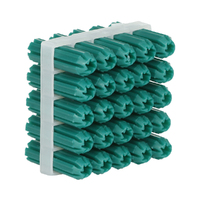
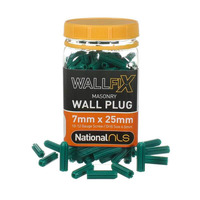
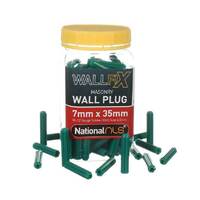
Plastic wall plugs, also called rawl plugs or nylon wall anchors, are the most commonly used anchors in general construction and electrical work. They are inexpensive, simple to install, and available in a wide range of sizes. They work by expanding inside a drilled hole as a screw is driven in, gripping the hole wall by friction and radial pressure. Wall plugs at Sparky Direct are available in standard colour-coded sizes used throughout Australia.
Ribbed wall plugs have longitudinal ribs that bite into the hole wall as the screw expands the plug. These are the standard choice for most masonry and brick work. Conical anchors have a tapered body that expands more uniformly and can accommodate some variation in hole quality. Both designs are available in nylon and polyamide formulations, with nylon being the more common option for general use.
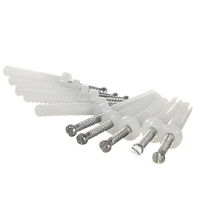
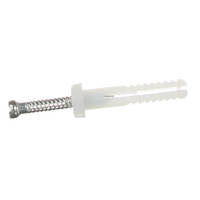
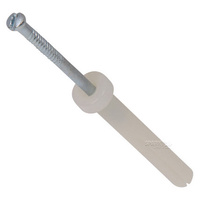
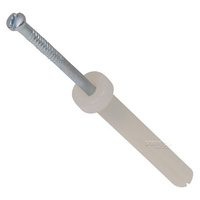
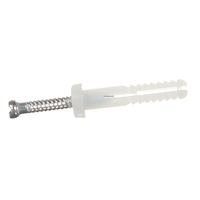
The NLS range includes nylon nail-in anchors that combine a plastic body with a nail-in installation method, eliminating the need for a separate screw in some applications. These are commonly used for fixing conduit saddles and surface-mounted electrical accessories to masonry. The flat-head profile keeps the fixing close to the surface.
Standard ribbed plastic plugs are designed for solid masonry, brick, and block. When used in tile, a smaller pilot hole is needed to avoid cracking the tile during installation. In drywall or plasterboard, standard plugs are not recommended for anything beyond the lightest loads. The gypsum material around the hole will crumble before the plug can develop meaningful grip. Use a dedicated plasterboard anchor instead.
Plastic plugs rely on a tight fit between the plug and the hole wall. Oversize holes, soft or crumbly masonry, and lightweight block can all reduce holding capacity significantly. Plastic anchors also creep under sustained load, meaning the grip reduces gradually over time if the load is constant. For any sustained or critical loading, move to a metal anchor type.
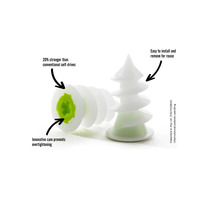
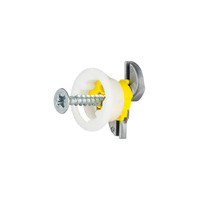
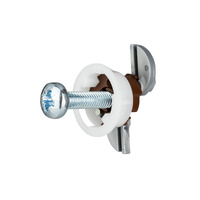
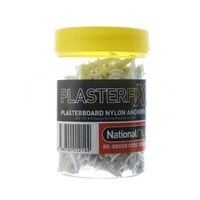
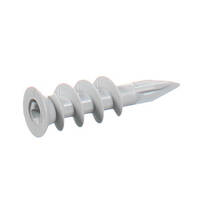
Toggle bolts and hollow wall anchors are designed for plasterboard, hollow block, and other substrates that have no solid backing material. Rather than gripping the hole wall, these anchors pass through the hole and spread open behind the panel face. The clamping force between the spread anchor and the panel face provides the holding capacity. Gripit Anchors are a leading brand for plasterboard fixings used across Australian trade and residential projects.
A toggle bolt uses spring-loaded wings that fold to pass through the hole and then open behind the panel. When the bolt is tightened, the wings clamp against the back of the plasterboard. The load capacity depends on the panel thickness, the number of fixing points, and the direction of loading. Toggle bolts in standard 13mm plasterboard can hold significant shear loads but are more limited in tension (pullout). Never rely on a single toggle bolt for heavy overhead or tensile loads.
Molly bolts and hollow wall anchors work on a similar principle. The anchor body is inserted through the hole and, as the screw is tightened, the back portion collapses and spreads against the inside face of the panel. Unlike toggle bolts, the anchor body remains fixed when the screw is removed, allowing the screw to be taken out and reinserted. This makes molly bolts useful for applications where the fixture needs to be temporarily removed.
Locate studs or noggins before relying on a plasterboard anchor for heavy loads. A screw driven into a timber stud is always stronger than any hollow wall anchor in the panel alone. Use a stud finder or knock-test the wall. Where studs cannot be located, match the anchor rating to the actual load and use multiple anchor points. Distribute the load across at least two fixings for anything heavier than a picture frame.
Important: Hollow wall anchors are not suitable for overhead or ceiling installations in plasterboard unless they are specifically rated for that use. Check the manufacturer's data sheet for orientation-specific load ratings before installing.
Concrete screws and hammer drive anchors are two fast-installation fastening options for solid masonry and concrete. Both eliminate the need for a separate anchor body, reducing the number of components and installation steps.
Concrete screws, sometimes called Tapcon-style screws, cut their own thread directly into the concrete substrate. A pilot hole is drilled to a specific diameter, the hole is cleaned, and the screw is driven in using an impact driver or drill. The main advantage is speed: no anchor needs to be tapped or set before the screw goes in. The screw can also be removed and replaced if needed, with holding capacity usually acceptable for a small number of removals. Concrete screws are well suited to electrical conduit saddles, surface-mounted equipment, and bracket fixings in concrete and solid block.
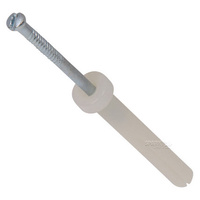
Hammer drive anchors have a nail that is driven into the body of the anchor with a hammer. As the nail is driven in, the anchor body expands against the hole wall. Installation is extremely fast: drill the hole, insert the anchor, drive the nail flush. These anchors are widely used for fixing conduit clips, cable clips, and lightweight brackets to masonry walls and concrete floors.
| Feature | Concrete Screw | Hammer Drive Anchor |
|---|---|---|
| Installation tool | Drill or impact driver | Hammer and drill |
| Removable | Yes (limited cycles) | No (permanent) |
| Load range | Light to medium | Light to medium |
| Speed | Fast | Very fast |
| Best use | Conduit, brackets, equipment | Cable clips, conduit clips |
The correct anchor depends on four factors: the base material, the load requirement, the environmental conditions, and the material and finish of the anchor itself. Work through each factor before selecting a product.
Concrete: Use expansion anchors (wedge or sleeve) or concrete screws. The grade and condition of the concrete affects the achievable load. Brick: Use plastic wall plugs or sleeve anchors in solid brick. Avoid large expansion anchors in older or soft brick, as they can crack the material. Hollow block: Use toggle-style anchors or sleeve anchors rated for hollow substrates. Plasterboard and drywall: Use dedicated plasterboard anchors such as Gripit fixings, toggle bolts, or molly bolts. Never use standard wall plugs in plasterboard for any meaningful load. Tile: Drill through the tile with a diamond-tipped bit and anchor into the substrate behind it. Use a wall plug or sleeve anchor suited to the substrate.
Calculate the maximum expected load on the fixing. Include the weight of the fixture plus any dynamic loading (vibration, wind, impact). Select an anchor with a rated load at least four times the expected maximum. For overhead applications, increase this factor to eight or more. Where multiple fixing points are used, do not assume the load divides evenly: worst-case distribution should be used for design.
Indoor dry environments: Standard zinc-plated steel anchors are appropriate. Wet areas such as bathrooms: Use stainless steel or hot-dip galvanised anchors. Zinc plating is inadequate for sustained moisture exposure. Outdoor exposure: Grade 316 stainless steel or hot-dip galvanised to Australian standards. High wind environments or coastal locations: Grade 316 stainless steel only. Salt-laden air causes rapid corrosion of galvanised coatings over time.
Zinc-plated steel is suitable for most indoor, dry applications. It offers basic corrosion resistance for protected environments. Galvanised steel provides better corrosion protection and suits outdoor and moderately damp environments. Stainless steel (Grade 304 or 316) is the correct choice for wet areas, outdoor installations, and coastal or marine environments. Grade 316 contains molybdenum, which significantly improves chloride resistance.
Television brackets require a secure fixing into either timber studs or the plasterboard itself. Fixing into studs is always preferred: use 65mm to 75mm structural screws driven into the stud behind the plasterboard. Where studs cannot be located at the bracket bolt pattern, a quality plasterboard anchor rated to the TV weight is required. The Gripit TV Bracket Fixing Kit is specifically designed for this purpose and is rated to 60kg per fixing point in standard 13mm plasterboard.
Shelving loads are almost always a combination of shear (weight pressing down) and tension (the shelf pulling away from the wall). Use anchors rated for both load directions. In masonry, sleeve anchors or concrete screws are suitable for most domestic shelving. In plasterboard, locate studs wherever possible. For floating shelves on plasterboard without stud access, use multiple toggle anchors distributed across the bracket length.
Conduit saddles on concrete and masonry walls are typically fixed with nylon nail-in anchors or plastic wall plugs. The NLS nylon nail-in anchor range is designed for this application and provides a fast, reliable fixing for conduit in both indoor and outdoor environments. Switchboard enclosures on block or concrete walls need sleeve anchors or concrete screws matched to the enclosure weight and vibration loading from switching operations.
Equipment bases on concrete floors require anchors sized to resist both the equipment weight and any operational forces (vibration, torque, start-stop). Large wedge anchors with appropriate embedment depths are the standard approach. A licensed structural engineer should specify anchor type, diameter, and embedment for any equipment where failure would have safety implications.
Bathroom accessories are typically mounted in tiled walls. The correct process is to drill through the tile using a diamond-tipped bit, then use a wall plug sized for the substrate behind the tile. Stainless steel or nylon anchors should be used in wet areas to prevent rust staining. For grab rails and safety fixtures, fixing into the timber framing behind the tile wall is always preferable to anchoring into the tile substrate alone.
Outdoor anchors face moisture, UV exposure, and in some locations, salt-laden air. The wrong material selection leads to anchor failure through rust and corrosion long before the expected service life. Select the anchor material to match the exposure conditions.
Hot-dip galvanised anchors provide good protection in most outdoor environments away from the coast. The zinc coating forms a physical barrier and sacrificially protects the underlying steel. In coastal areas within roughly 1km of the ocean, galvanised coatings corrode too quickly to provide acceptable service life. Grade 316 stainless steel is the correct choice in coastal and marine environments. It contains molybdenum, which resists chloride attack. Grade 304 stainless is suitable for most inland outdoor applications but should not be used in marine zones.
Even stainless steel anchors can show surface staining if they contact dissimilar metals or if the installation disturbs the passive oxide layer. Use compatible washers and fasteners. Avoid mixing stainless and carbon steel components in the same fixing assembly. Where dissimilar metals must contact, use an insulating washer to prevent galvanic corrosion. Keep cut surfaces and drilled areas clean and free of iron filings from drilling.
For coastal installations, use Grade 316 stainless steel throughout the fixing assembly: anchor body, bolt, nut, and washer. Inspect anchors annually in marine zones, as even high-grade stainless steel can show crevice corrosion in sustained salt exposure. For extreme marine environments such as offshore structures, specialist duplex stainless steel or non-metallic anchor systems may be required. Consult the anchor manufacturer for guidance on environment-specific product selection.
Correct installation is as important as correct product selection. A well-specified anchor that is poorly installed will not achieve its rated load. Follow these guidelines to ensure anchors perform as intended.
Brick cracking during anchor installation usually results from drilling too close to the edge or mortar joint, using too large an anchor for the brick size, or over-torquing expansion anchors. Maintain a minimum edge distance of at least five anchor diameters from any edge or joint. Use a hammer drill in rotation-only mode (not hammer mode) when drilling into soft or older brick to reduce the risk of fracture. Anchor into the brick body rather than the mortar joint wherever possible, as mortar has lower compressive strength than the brick itself.
Tight spaces require shorter drill bits, right-angle drill attachments, or flexible drill extensions. In electrical work, anchoring conduit in confined ceiling voids or in corners behind equipment is a routine challenge. Offset drill heads allow drilling at 90 degrees in spaces too narrow for a standard chuck. Compact impact drivers with short hex-shank drill bits can often reach angles that standard drills cannot.
Overhead anchors must be rated for the specific orientation. Many anchor datasheets publish separate tensile and shear load values, and overhead tensile loading is almost always the lower value. Use anchors with a proven track record in overhead applications and apply a conservative safety factor. For suspended cable trays and conduit runs on concrete ceilings, threaded rod with mechanical anchors is the standard approach. Work requiring overhead electrical equipment mounting should be completed by a licensed electrician in accordance with AS/NZS 3000:2018.
Fixing timber bottom plates to concrete slabs uses either concrete screws, powder-actuated fasteners, or through-bolts with expansion anchors cast in or drilled in after the slab is poured. Concrete screws in the 7.5mm diameter range suit most domestic framing applications. Space fixings at 600mm centres maximum, with additional fixings at the ends of each plate. Pre-drill through the timber before drilling into the concrete to keep the hole aligned and the timber free from splitting.
Work involving electrical equipment mounting, structural connections, or any task requiring licensed trade work must be carried out in accordance with AS/NZS 3000:2018 and applicable state regulations. When in doubt, engage a licensed professional.
Most anchor failures result from one of a small number of causes. Identifying the cause allows you to select the correct corrective action rather than simply repeating the same installation with the same outcome.
An anchor that spins without gripping has been installed in an oversized hole, in material that has crumbled or is too soft, or the anchor body has failed mechanically. Drill a new hole of the correct diameter at a different location. If the substrate is genuinely too soft, move to a larger-diameter anchor or a different anchor type better suited to the material.
Standard wall plugs do not hold in plasterboard. If you have used a wall plug and it has failed, replace it with a dedicated plasterboard anchor: a toggle bolt, molly bolt, or a product like the Gripit fixing system. If loading requirements are high, locate the nearest stud and reposition the fixing point.
Anchor failure in solid masonry is usually caused by insufficient embedment depth, an oversize hole, or edge placement too close to a joint or corner. Check the anchor manufacturer's minimum embedment and edge distance specifications. For replacement fixings in the same area, use a sleeve anchor or concrete screw, which tolerate minor variations in hole quality better than wedge-style expansion types.
Screw breakage during installation is caused by over-torquing, using the wrong-sized bit, or driving the screw at an angle. Use a torque-limited driver or a screwdriver with controlled force. Ensure the bit is the correct size and fully engaged before applying rotational force. In concrete screws, use the impact driver setting rather than the drill setting to reduce the risk of breakage in hard substrates.
Anchors loosen due to vibration, thermal cycling, or creep in soft substrates. Use thread-locking compound on the bolt threads for any vibrating equipment. Check and re-torque anchors on vibrating equipment at regular service intervals. In soft or crumbly masonry, use a larger-diameter anchor or move to a more solid fixing point.
Most mechanical expansion anchors are not designed for reuse. Once a wedge anchor or sleeve anchor has been fully expanded, the expansion element is permanently deformed. Removing the bolt allows the fixture to be taken off, but the anchor body remains in the hole and the hole is no longer usable at its original diameter. Concrete screws can be removed and reinstalled a small number of times before the thread in the concrete degrades.
For plastic wall plugs: remove the screw, then use a plug removal tool or a small flathead screwdriver to collapse and extract the plug body. For toggle bolts: remove the screw and the toggle will fall behind the wall (it cannot be retrieved). The hole can be patched. For molly bolts: use a molly bolt removal tool to collapse the back plate and pull the assembly through the hole. For wedge anchors: cut the threaded rod flush with the surface or drive it deeper into the concrete using a punch.
A stripped anchor screw head can often be removed using a screw extractor bit. These are reverse-threaded bits that bite into the damaged head as they are driven anti-clockwise. For badly damaged heads, use a cut-off wheel or oscillating tool to cut a new slot in the head, then use a flat screwdriver. If the anchor body is bonded or expanded and the head cannot be removed at all, cut the protruding portion flush and patch the surface.
Plastic anchors are lighter, cheaper, and do not corrode. They are the right choice for light loads in solid masonry and are widely used in electrical work for conduit saddle and accessory fixings. Metal anchors carry higher loads, are more resistant to creep under sustained loading, and are the only suitable option for medium to heavy applications. The material choice is not about preference but about matching the anchor to the load and environment.
| Material | Strengths | Limitations | Best Use |
|---|---|---|---|
| Nylon | No corrosion, light, low cost | Creeps under load, UV degrades | Indoor light loads, masonry |
| Zinc-plated steel | Strong, affordable | Corrodes in wet conditions | Indoor medium to heavy loads |
| Galvanised steel | Good corrosion resistance | Not suitable for coastal zones | Outdoor, moderate exposure |
| Grade 304 stainless | Excellent corrosion resistance | Limited in chloride environments | Outdoor, non-coastal |
| Grade 316 stainless | Best corrosion resistance | Higher cost | Coastal, marine, wet areas |
The most sustainable anchor choice is the one that lasts the full intended service life without replacement. Over-specifying for durability (using stainless steel in low-exposure environments) creates unnecessary material use and cost. Under-specifying leads to premature failure and replacement work, with associated material waste and access costs. Buying anchors in jar or bulk pack quantities, as stocked in the Sparky Direct anchor range, reduces packaging waste compared to blister-pack retail products.
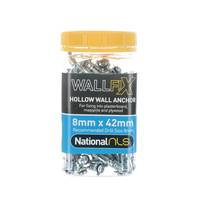
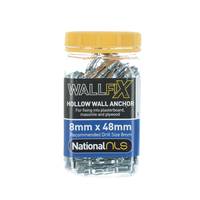
Sparky Direct stocks anchors, wall plugs, and related fixings for trade and contractor use, with Australia-wide delivery. The product range includes nylon nail-in anchors, plasterboard fixings, hollow wall anchors, and screws sold in bulk quantities suited to commercial projects.
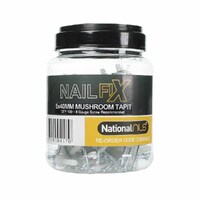
Most anchor products at Sparky Direct are available in jar, box, or bucket quantities. Nylon nail-in anchors from NLS come in boxes of 100. Screw bucket packs provide high-volume quantities suitable for ongoing project use. Bulk purchasing reduces per-unit cost and minimises the risk of running short on site. For large commercial or industrial projects, contact Sparky Direct to discuss volume pricing.
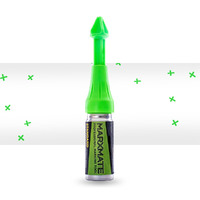
Electricians have specific anchor requirements that differ from general construction. Conduit saddle fixings, surface-mounting screws for accessories, and plasterboard anchors for equipment installation are the most common. The anchor category at Sparky Direct covers these needs, with products from established brands including Gripit, Marxmate, Hobson Engineering, and NLS. Related categories such as screws and fixings and self-drilling screws complement the anchor range for full site coverage.
Sparky Direct delivers to addresses throughout Australia, including metropolitan, regional, and rural locations. Orders are dispatched from Australian stock. Delivery timeframes vary by location. Check the Sparky Direct website for current delivery options and estimated lead times for your area.
Sparky Direct backs its products with standard Australian Consumer Law protections. If a product is faulty or not as described, it can be returned for a replacement or refund. For technical queries about anchor selection, load ratings, or product suitability, contact the Sparky Direct team directly. The team has trade experience and can help match the right product to your application.
Watch Gripit AUGTVKIT | TV Bracket Fixing Kit | Holds up to 60KG video
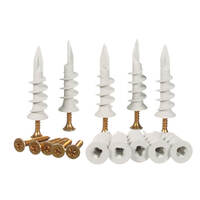
Watch MACSIM 52WNG10-7G30 | Wallmate style Plasterboard Nylon Anchor with Clipsal 7G 30mm Screw 10 Pack video
Watch NLS 30223 | Nylon Nail In Anchors Flat Head 6.5mm x 40mm | Box of 100 video

These are great for those situations where a screw in plaster isn't really gonna cut it, but you don't need a whole lot more. Worth having in the kit. Use them often.
Bought an assortment of the Gripit devices for future use when required and to share with friends when required. They appear good quality and have high weight rating.
You could pay more for another brand but they won't work any better than these.... NLS is a trusted brand and delivers great quality
Quality products in stock • Fast Australia-wide delivery • Competitive trade pricing
Browse Anchor Screws → Get Expert Advice →In many cases anchor screws can be reused, provided they are not damaged and the fixing hole remains sound.
Sparky Direct supplies anchor screws Australia-wide, offering reliable electrical trade products from a trusted supplier.
Anchor screws are shipped as packaged fasteners and are suitable for standard courier delivery.
Unused anchor screws are usually eligible for return in line with the seller’s returns policy.
Warranty coverage depends on the manufacturer and typically covers defects in materials or workmanship.
Anchor screws are commonly sold in packs, with pack sizes varying by brand and screw size.
Once installed correctly, anchor screws generally require little to no maintenance unless exposed to harsh environments.
Certain anchor screws are designed to resist vibration, making them suitable for machinery and equipment mounting.
The correct length depends on the thickness of the fixture being mounted and the required embedment depth in the base material.
Some anchor screws are rated for overhead applications, but load ratings and installation requirements must be carefully checked.
Anchor screws are commonly used to secure cable trays, brackets, and enclosures, but electrical work must be carried out by a licensed electrician.
Installation typically requires a drill with the correct masonry bit and a suitable driver or socket.
When installed correctly using the recommended hole size and spacing, anchor screws are designed to minimise the risk of cracking.
Anchor screws are used to fix materials into concrete, masonry, brick, or stone, providing a secure mechanical fixing without the need for plugs or chemical anchors.
Anchor screws are straightforward to install with the correct tools, but care must be taken to drill accurately and follow manufacturer guidance.
Anchor screws are a good choice when you need a stronger fixing in concrete or masonry without using separate plugs.
Some anchor screws are rated for structural use, but structural applications should always be assessed and approved by a qualified professional.
Yes, anchor screws require a correctly sized pre-drilled hole to ensure proper fixing and load performance.
Anchor screws are available in a range of diameters and lengths to suit different load requirements and fixing depths.
Anchor screws can be used outdoors if they are made from stainless steel or have an appropriate corrosion-resistant coating.
Yes, most anchor screws can be removed, which makes them suitable for temporary or adjustable fixings.
Load ratings vary depending on the screw size, material, embedment depth, and base material. Always refer to the manufacturer’s load data for accurate information.
Many anchor screws are tested to relevant AS/NZS standards for mechanical fasteners, but suitability should always be confirmed against the product specifications.
Yes, anchor screws are specifically designed for use in concrete, brick, block, and some types of stone when installed according to manufacturer instructions.
Anchor screws are commonly made from carbon steel or stainless steel, with various coatings for corrosion resistance depending on the application environment.