
Search Results:
Search Results:
Search Results:
Search Results:
A bench top power point is a socket outlet designed to deliver power at bench height rather than from a wall. Australian buyers call them benchtop GPOs, pop-up outlets, or recessed island sockets. The unit is fitted into the surface of a kitchen island, breakfast bar, workstation, boardroom table, or trade bench. Fixed wiring runs underneath the bench and connects to the unit through a sealed enclosure. Installation, relocation, and replacement of any fixed-wiring socket outlet in Australia must be carried out by a licensed electrician.
Wall-mounted GPOs work well for appliances against a splashback. They become impractical for kitchen islands, free-standing workbenches, and meeting tables where no wall is in reach. Bench top units sit closer to the user, cut down on cable clutter, and keep leads off the floor. Wall outlets stay cheaper and easier to wire. Bench top units cost more, need careful cut-out planning, and reward the buyer with a cleaner finish and faster access to power on the work surface.
Kitchens and island benches use pop-up units to power kettles, blenders, and air fryers without breaking the splashback. Breakfast bars, offices, and reception counters use them to charge phones and laptops on customer-facing surfaces. Boardrooms and meeting tables run laptops, screens, and presentation kit through recessed modules. Workshops, labs, and trade benches favour surface-mount sockets for test gear, chargers, and bench lights. Retail counters and EFTPOS stations use them for terminals, scanners, and printers. The category also covers USB Powerpoint models with integrated charging ports.
Open-plan kitchens and flexible workspaces have moved the action away from walls. People now cook, charge devices, and run small appliances in the middle of the room. Phones, tablets, and laptops need power on the surface where they are used, not three metres away. Integrated USB-C ports reduce the number of adapters on the bench. Hidden cable runs and pop-up mechanisms keep the surface clean and the design uncluttered, which suits modern kitchen and office layouts.
Choosing the right format matters before comparing price or brand. The main options are pop-up, surface-mount, pull-up or slide-out, and integrated USB and data units. Each suits a different bench, budget, and user expectation. The descriptions below cover how each format sits in the bench, what it suits, and what to weigh up before specifying it. Browse the full Electrical Power Points range to compare formats side by side.
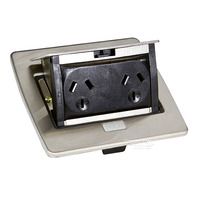
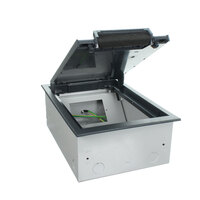
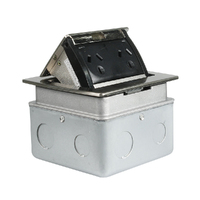
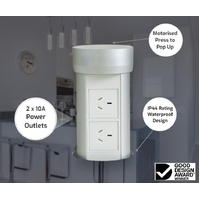
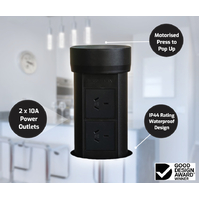
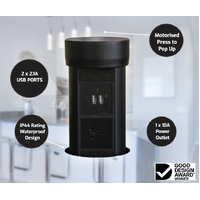
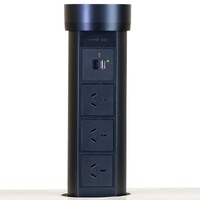
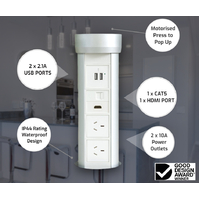
Pop-up units sit flush with the bench when closed. A push or twist action raises the sockets above the surface when power is needed. The body of the unit recesses into the benchtop, so the surface stays clean and clear when not in use. Pop-up units suit kitchen islands, boardroom tables, reception areas, and premium workspaces where finish matters. The bench must be cut to the correct dimensions, and the unit needs clearance underneath for the mechanism and cabling.
Surface-mount units bolt onto the top of the bench rather than recessing into it. The enclosure stays visible at all times. This format suits workshops, garages, laboratories, utility benches, and retrofit work where cutting the bench is not practical. Surface-mount sockets are usually cheaper and faster to install than pop-up units. They also handle knocks and rough use better than recessed mechanisms, which makes them a sensible choice for trade benches and high-traffic work areas.
Pull-up and slide-out designs hide the sockets inside the bench until needed. Some lift on a hinged lid, others slide forward from the edge of the bench. These formats suit reception counters, executive desks, and bench areas where appearance is critical and pop-up cylinders are not preferred. The mechanism takes more under-bench space than a basic pop-up unit, so cabinet planning matters at the design stage.
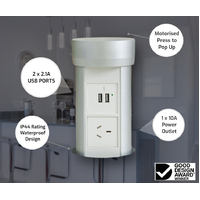
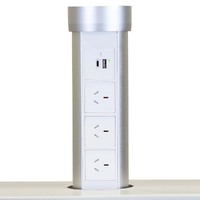
Many bench top units now combine 240V sockets with USB-A, USB-C, Cat6 data, and HDMI ports. USB-C ports often support USB Power Delivery for faster phone, tablet, and laptop charging. Mixed-use modules suit boardrooms, classrooms, hot-desks, and customer-service counters where users plug in phones, screens, and presentation gear from one outlet. Check the USB output rating on the datasheet, as not every port delivers the same wattage. USB-integrated bench top modules and the Data and Phone Accessories range cover the connectivity side of the build.
Bench top power points are part of a fixed electrical installation. They sit under the Australian Wiring Rules and the same product approval framework as wall sockets. Buyers, specifiers, and end users should plan around these rules before purchase, not after the bench is cut. Installation, relocation, and replacement of fixed-wired socket outlets in Australia must be completed by a licensed electrician. The four areas below cover the most common compliance touchpoints for benchtop installations.
The Australian and New Zealand Wiring Rules set out where socket outlets may sit in kitchens and other wet areas. Clearance from sinks, cooktops, and splash zones is part of the rules. Benchtop height, cable route, and adjoining cabinetry also affect placement. State and territory variations may apply, so the licensed electrician confirms the final position on site. Plan the cut-out and outlet location during the kitchen design stage to avoid rework after the bench is fabricated.
Socket outlet circuits in Australian homes and most commercial spaces need residual current device protection. RCD protection may sit at the switchboard, the circuit, or the device itself. The licensed electrician chooses the right method based on the installation, the board layout, and the AS/NZS 3000 requirements current at the time of the work. Discuss RCD coverage with the electrician before the unit is ordered, especially on heritage boards that may need an upgrade.
The Regulatory Compliance Mark shows that an electrical product meets Australian and New Zealand safety and EMC requirements. Buyers should check that any bench top unit carries the RCM and is supplied through a reputable Australian electrical wholesaler. Uncertified imports from online marketplaces may look similar but lack the testing, traceability, and supplier support needed for a compliant fixed installation. Stick to RCM-marked products from named brands held by Australian distributors.
An IP rating describes how well the housing resists solid objects and water. Most bench top units sit in dry zones away from sinks and cooktops, so basic ratings are fine. Outlets near splash zones, food prep areas with heavy rinsing, or commercial kitchens with daily wash-down cleaning may need a higher rating. Some pop-up units include internal seals that limit liquid ingress when closed. Match the IP rating to the actual exposure, not to a worst-case scenario.
A practical decision framework keeps the selection process simple. Work through format, socket count, USB and data needs, finish, durability, and budget in that order. The right unit suits the bench, the user, and the installation environment first. Premium finish and brand sit further down the list. Electricians, builders, renovators, and commercial fit-out managers can apply the same framework to a single kitchen or a multi-site project.
Pop-up and recessed formats suit kitchens, boardrooms, and customer-facing surfaces where finish is the priority. Surface-mount formats suit workshops, labs, and back-of-house benches where speed of installation and toughness matter more. Pull-up and slide-out designs sit between the two, with concealed sockets and a slightly different mechanism profile. Match the format to how the bench is actually used day to day, not to the most expensive option on the page.
Bench top units come in single, double, triple, quad, and multi-outlet configurations. Count current and likely future appliances before specifying the size. A kitchen island may run a kettle, toaster, blender, and phone charger at once. A boardroom table may need power and USB-C at every seat. Allow spare outlet capacity where future appliances or device chargers are likely. Larger modules from the Quad Power Points and Double Power Points ranges may apply.
USB-C is now the standard connector for newer phones, tablets, and many laptops. Modern bench top modules include USB-C as well as USB-A ports. USB Power Delivery and fast-charging support vary between models, so the wattage rating on the datasheet matters. A 60W USB-C port can charge a laptop. A 5W port will only trickle-charge a phone. Check the output rating against the devices the user actually owns before specifying the unit.
Bench top units come in stainless steel, brushed aluminium, matte black, gloss white, and brass-look finishes. Match the finish to the tapware, cabinetry hardware, appliances, and worktop material. Low-profile and concealed units suit minimalist designs where the bench surface should stay uninterrupted. The finish also affects cleaning, fingerprint visibility, and long-term appearance, so consider how the kitchen or workspace will look in five years, not just on handover day.
Workshops, schools, hospitality kitchens, and commercial benches see hundreds of plug cycles a week. Robust housings, smooth pop-up mechanisms, strong plug retention, and easy cleaning all matter for these environments. Cheaper consumer units may fail early under daily trade use. Specify commercial-grade products from established brands for fit-outs where downtime and replacement cost outweigh the upfront price difference. Browse trusted ranges from Clipsal, Legrand, and HPM.
Kitchen renovations are the most common project for bench top units. Homeowners, builders, cabinet makers, renovators, and electricians all need to agree on the unit, location, and cut-out before the bench is fabricated. The detail below covers planning for islands, breakfast bars, and bench materials. It does not replace site-specific advice from a licensed electrician. Treat this section as planning support that helps the trade and the homeowner speak the same language.
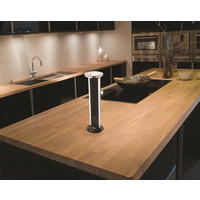
Kitchen islands rarely sit against a wall, so wall outlets are not practical for appliances used on the island surface. A bench top unit gives direct power for kettles, mixers, slow cookers, and phone chargers without long leads trailing across the floor. Pop-up and concealed designs keep the island surface clean for food prep and entertaining. Choose a location that suits how the family or staff actually use the island, then confirm clearances with the electrician.
Stone, engineered stone, quartz, laminate, timber, and stainless steel each behave differently when cut. Engineered stone and granite need the cut-out marked and machined by the fabricator before the bench is installed, as on-site cutting is rarely practical. Laminate and timber accept on-site cut-outs but still need accurate marking. Bench edge profiles, depth, and overhang all affect where the unit can sit. Coordinate the cut-out size and centre point with the cabinet maker, the stonemason, and the electrician early in the project.
Bench top sockets should sit clear of cooktop heat, sink splash, and zones cleaned with aggressive chemicals. Steam from kettles and rice cookers can also affect mechanisms over time. Plan the unit at least the minimum distance specified by AS/NZS 3000 from sinks and cooktops, and discuss safe positioning with the licensed electrician. Wipe spills quickly, avoid harsh solvents on the housing, and keep liquids from pooling around the seal. The bench installer and electrician should coordinate position during design, not after the bench is fitted.
Commercial use is the second-biggest application for the category. Offices, meeting rooms, retail counters, and trade benches all need accessible power on the work surface. Cable management, device charging, and presentation kit drive the demand. The choice of unit affects how tidy the space looks, how quickly staff can plug in, and how reliable the power access is over time. The points below cover the main commercial scenarios.
Boardrooms and meeting tables need a mix of 240V power, USB-A, USB-C, HDMI, and Cat6 data at every seat or every second seat. Discreet pop-up or recessed modules keep the table surface clean between meetings. Hinged lids and flush profiles suit executive rooms where appearance is critical. Confirm the connector mix with the AV integrator before specifying the unit, as room standards vary between organisations.
Customer-facing desks and counters benefit from neat, accessible power. Reception areas use bench top units for visitor laptop charging and EFTPOS terminals. Retail service counters run barcode scanners, label printers, monitors, and payment devices through one well-placed module. Staff workstations use the same approach for laptop chargers, monitors, and personal devices. Cable presentation matters in customer-facing spaces, so a tidy bench top unit beats a power board on the floor every time.
Workshop benches and trade workstations need power for test equipment, battery chargers, soldering stations, bench lights, and small tools. Surface-mount units handle the rough use these environments produce. Circuit planning by a licensed electrician matters here, especially where multiple high-draw tools run from the same bench. Robust housings, strong plug retention, and easy access for cleaning keep the bench working reliably year after year.
Direct comparison helps buyers evaluate products and suppliers without falling into a lowest-price trap. The three comparisons below cover format choice, fixed outlets versus trailing leads, and the gap between budget and premium models. Each one carries different cost, install, and reliability trade-offs. Use these comparisons alongside the decision framework above to land on the right unit for the bench and the user.
Pop-up units look cleaner, hide away when not in use, and suit premium kitchens and meeting rooms. They cost more, need a cut-out, and depend on a mechanism that may wear over time. Surface-mount units are cheaper, faster to install, and tougher in heavy-use environments. They stay visible at all times, which suits workshops but not show kitchens. Cost, install complexity, and maintenance all favour surface-mount for back-of-house work. Appearance, premium finish, and clean surface design all favour pop-up units.
Trailing extension leads and bench-top power boards may seem cheaper than a fixed unit. They also create trip hazards, clutter the bench, and leave plug tops exposed to spills. Fixed bench top outlets remove the lead from the floor, give a clean visual finish, and put power exactly where it is used. The upfront cost is higher, but the long-term result is safer, neater, and more practical for daily use in kitchens, offices, and workshops.
Price differences come from housing material, mechanism quality, USB-C wattage, IP rating, finish, brand, and warranty. Budget units use lighter housings and simpler pop-up mechanisms. Premium units use heavier metals, smoother actions, higher USB output, and longer-tested designs. Installation labour and benchtop cutting often cost more than the unit itself, so spending a little more on a reliable model usually pays back in fewer service callouts. Factor in long-term reliability, not just the sticker price on the box.
Online ordering suits this category well. Buyers can compare formats, finishes, brands, USB ratings, and prices side by side without leaving the site. Datasheets, photos, and specifications are easier to review online than in a trade counter rush. Sparky Direct supplies bench top units across the country with stock held in Australia. Builders, electricians, and homeowners all use the site to plan and order for kitchen, office, and commercial fit-out work.
Confirm the socket count, current rating, cut-out size, finish, USB output, IP suitability, and RCM compliance before placing the order. Check the product datasheet for exact dimensions, especially the under-bench depth needed for the mechanism. Match the finish to the rest of the kitchen or office hardware. Confirm with the electrician that the chosen unit suits the circuit and the location. Order spare units for projects with multiple identical benches so finishes match across the build.
Installation labour and benchtop fabrication often outweigh the cost of the unit itself. A cheap pop-up that fails after eighteen months is far more expensive in the long run than a quality unit installed once. Local Australian stock, manufacturer warranty, and supplier support all matter when something does go wrong. Best value usually means a reliable model from a known brand, bought from an Australian wholesaler that can replace or service the unit if needed.
Project work needs consistency. Builders, electricians, and fit-out managers ordering for multiple kitchens, offices, or sites need matching models, matching finishes, and reliable supply across the project timeline. Bulk orders also benefit from trade pricing and coordinated delivery. Speak to Sparky Direct directly about project-scale orders, model availability, and lead times. Consistent specification across a multi-site build keeps replacement parts simple in five years.
Installation and maintenance planning protects the warranty, the user, and the bench. The points below focus on what buyers and property owners should discuss with their electrician, how to keep the unit working, and when a fault means a service call. Fixed wiring work is for licensed electricians only. Cleaning and general care can be handled by the user, provided no liquid enters the socket and no harsh chemicals contact the housing.
Talk to the licensed electrician early in the project. Discuss the planned location, cable route, circuit capacity, RCD protection, cut-out size, and access for future servicing. The electrician confirms compliance with AS/NZS 3000 and the relevant state regulations. They also coordinate with the cabinet maker on under-bench clearance. Avoid step-by-step DIY wiring guides. The licensed electrician does the wiring; the buyer plans the location, finish, and feature set.
Wipe the visible surfaces with a damp cloth and a mild detergent. Avoid solvents, bleach, and abrasive pads that may damage the finish. Keep liquids away from the sockets at all times. For pop-up units, lift the mechanism occasionally and clear crumbs, dust, or debris from the recess so the action stays smooth. Do not spray cleaner directly into a power point. If a socket gets wet, switch off the circuit at the board and call a licensed electrician.
Loose sockets, sticky pop-up mechanisms, cracked housings, heat marks, unreliable USB charging, and signs of water ingress all point to a unit at the end of its useful life. Plug retention that has weakened over time can lead to arcing and warmth around the socket, which is a safety issue. Stop using the unit and arrange an inspection by a licensed electrician if any of these signs appear. Replacement is straightforward when the cut-out size matches a current model.
Club Clipsal is Australia's largest electrician community offering trade rewards, business support, and exclusive benefits. When you nominate Sparky Direct as your preferred wholesaler, we automatically apply your Clipsal spend points to your Club Clipsal account daily.
Entry-level offering coaching, mentoring, and training discounts
Unlock exclusive industry tools and networking events
Access Toyota fleet offers and business software discounts
Maximum benefits, including VIP experiences and rewards
1. Sign Up: Create your Club Clipsal account at clipsal.com/club-clipsal or via the iCat mobile app
2. Nominate Sparky Direct: Select Sparky Direct from the wholesaler dropdown menu in your profile
3. Add Email: Enter your Sparky Direct account email address in the membership number field
4. Start Earning: Every dollar spent on Clipsal products earns points automatically
Redeem points from the rewards store, including gift cards, tools, and experiences. Access business summits, product training, and industry networking events. Receive early access to new product launches and special promotions. Connect with fellow electricians via the Club Clipsal community app.

I absolutely love my pop up outlet. We have a small amount of tiles in our laundry room with a lovely pattern that I didn’t want disturbed. When I discovered that Sparky direct had these outlets, I was absolutely thrilled. They install very easily, they have a seal around the inside that prevents any water leakage. Where we live in Queensland, they have to be installed at a minimum 500 mm from a sink, which worked out perfectly. I use this outlet for my hidden ironing board. That’s underneath my counter in my laundry room. I would definitely buy another one if I were to do another pop-up outlet. Sparkys was excellent with their service and, as usual, very responsive and quick in their delivery of the product.
After using the point pod for a few years now I find it an excellent addition to the kitchen bench top, my only concern is because the mechanism is in a void in my cabinets it is a real pain to reset the overload button, I have mentioned to Cameron about a thermal overload that resets itself but I don't think that this has been changed.
Product is as described and will be ideal for our new kitchen renovation. Small and compact, unlike the alternative tall pop-up bench power outlets that require extra depth under the bench, restricting placement options.
Quality products in stock • Fast Australia-wide delivery • Competitive trade pricing
Browse Bench Top Power Points → Get Expert Advice →Yes. They are popular in modern kitchens and islands where functionality and design are important.
Bench Top Power Points are available from Sparky Direct, offering convenient Australia-wide delivery and access to compliant electrical solutions.
Consider the bench location, required features, and confirm suitability with your electrician before purchasing.
Returns depend on the seller’s return policy and whether the product is unused and in original packaging.
They usually include a manufacturer’s warranty, subject to correct installation and normal use.
Bench top power points are typically sold individually, allowing flexibility when planning an installation.
Yes. They are commonly installed in kitchen islands, subject to placement and wiring rules.
An electrician may recommend them based on layout, usage needs, and compliance requirements.
Yes. They are often included in renovation projects to improve functionality.
Yes. When installed correctly, they can be wiped clean as part of normal bench maintenance.
Many models are designed to sit flush or retract, maintaining a clean look when not in use.
Yes. They are commonly installed in desks and tables for laptops and devices.
Yes. Safety depends on correct installation, placement, and use by a licensed electrician.
Bench top power points are electrical outlets designed to be installed on or within benches and work surfaces, providing convenient access to power where it is needed.
Yes. They can help reduce trailing cords and improve workspace organisation.
They provide convenient power access on benches without relying on wall-mounted outlets.
Yes. They are used in commercial settings where accessible bench-level power is required.
Yes. Clearances and positioning must meet Australian wiring rules, which should be assessed by the installing electrician.
Some models include integrated USB charging ports, depending on the product design.
Yes. They are widely used in offices, meeting rooms, and workspaces for convenient access to power.
Yes. They are commonly used in kitchens, subject to correct placement and compliance with electrical safety requirements.
Most bench top power points are rated at 10 amps, suitable for general-purpose appliances.
They are designed for standard Australian mains supply of 230–240 volts AC.
Yes. Installation or replacement must be carried out by a licensed electrician in accordance with AS/NZS 3000 Wiring Rules.
Yes. Bench top power points are designed to comply with relevant Australian electrical requirements, including AS/NZS 3112, when installed correctly.