
Search Results:
Search Results:
Search Results:
Search Results:
Hearing protection devices (HPDs) work by creating a physical or electronic barrier between the ear canal and the surrounding noise environment. Earplugs seal the ear canal directly. Earmuffs create an acoustic seal over the entire outer ear. Electronic protectors do the same but pass safe sounds through while compressing or blocking peaks above a set threshold. All certified devices are rated against Australian Standard AS/NZS 1270, which defines the test methods used to measure attenuation performance.
The primary purpose of HPDs is to reduce the sound pressure level (SPL) reaching the cochlea. The cochlea contains thousands of tiny hair cells that detect vibration and convert it into nerve signals. These cells do not regenerate. Once damaged by high-intensity sound, they are gone permanently.
Noise-induced hearing loss (NIHL) results from mechanical damage to cochlear hair cells. Intense sound waves create physical stress that exceeds the structural limits of these cells. The damage is cumulative: each exposure above the safe threshold adds to the total. Early-stage NIHL often presents as a high-frequency notch at 4,000 Hz, which is why affected workers initially struggle to hear speech clearly in noisy environments before broader hearing loss develops.
Tinnitus (ringing in the ears) frequently accompanies NIHL and is itself permanent. Workers who experience tinnitus after noise exposure have already incurred inner ear damage. There is no clinical treatment that restores lost hearing or eliminates tinnitus. Prevention is the only effective strategy.
Key fact: The WHS regulations set an 8-hour time-weighted average (TWA) exposure limit of 85 dB(A) and a peak noise limit of 140 dB(C). Exposure above these levels without adequate hearing protection places both the worker and the employer in breach of duty of care obligations.
Consistent use of appropriate hearing protection prevents NIHL, reduces tinnitus risk, and maintains long-term hearing function. Workers who retain normal hearing in later life report significantly better quality of life and social engagement. For businesses, preventing hearing loss reduces workers compensation claims, avoids WorkSafe investigations, and demonstrates compliance with WHS duties. Well-fitted, comfortable HPDs also reduce fatigue on loud worksites by reducing the overall sensory load on the worker.
The 85 dB(A) threshold represents the level at which an 8-hour daily exposure begins to create measurable risk of hearing damage for most workers. Below 80 dB(A), extended exposure poses minimal risk for most people. Above 85 dB(A), risk increases with both level and duration. The relationship is not linear: every 3 dB increase in noise level halves the permissible exposure time. At 88 dB(A), safe exposure drops to 4 hours. At 91 dB(A), it falls to 2 hours.
Angle grinder: 100-105 dB(A). Rotary hammer drill: 95-105 dB(A). Circular saw: 95-100 dB(A). Reciprocating saw: 103 dB(A). Petrol generator: 90-100 dB(A). Air compressor: 85-95 dB(A). Nail gun: 100-115 dB(A). Each of these tools requires hearing protection for any non-trivial exposure duration.
Daily noise exposure accumulates over a working life. A worker exposed to 88 dB(A) for 4 hours per day, 5 days per week, without hearing protection will accumulate sufficient cochlear damage to produce clinically significant hearing loss within years, not decades. The damage typically goes unnoticed until hearing loss is substantial, because the auditory system compensates for gradual degradation. Audiometric testing is the only reliable way to detect NIHL before it becomes severe.
The highest-risk environments for tradies include construction sites with heavy machinery, concrete cutting and grinding operations, roofing and framing with nail guns, mechanical workshops with compressors and power tools, and manufacturing lines with continuous machinery noise. Electricians frequently work in noisy environments: panel shops, conduit bending rooms, and any site where demolition or concrete work is occurring nearby. Multi-environment workers need hearing protection that is portable and quick to fit between tasks.
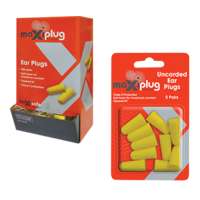
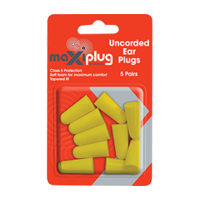
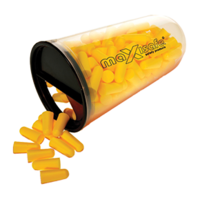
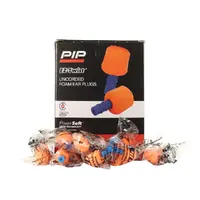
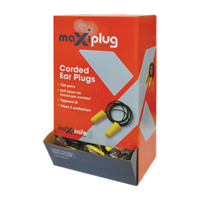
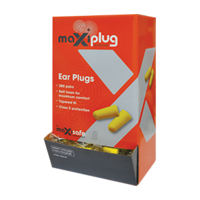
Disposable foam earplugs are the most common form of hearing protection on Australian worksites. They are made from slow-recovery polyurethane or PVC foam that is compressed, inserted into the ear canal, and allowed to expand to form an acoustic seal. When fitted correctly, foam earplugs achieve SLC80 Class 4 or Class 5 attenuation, making them suitable for very loud environments. They are low cost, individually wrapped for hygiene, and available in bulk quantities for site supply. Their limitation is fit consistency: incorrect insertion significantly reduces real-world attenuation.
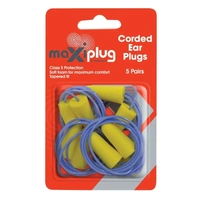
Reusable earplugs are made from silicone or thermoplastic rubber and can be washed and used multiple times. They offer similar attenuation to disposable foam when fitted correctly and are better suited to workers who need to insert and remove protection frequently during a shift. Banded earplugs use a lightweight headband to hold the plugs in position at the ear canal entrance. They are faster to fit than canal-insert plugs and remain around the neck when removed, reducing the risk of loss. Attenuation is typically lower than full-canal earplugs, making them better suited to moderate noise environments.
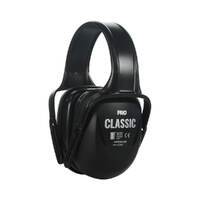
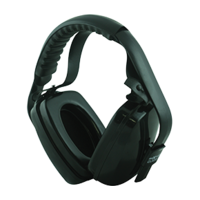
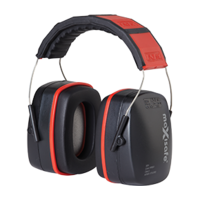
Earmuffs cover the entire outer ear with cushioned cups that create an acoustic seal against the skull. They are easier to fit correctly than earplugs, require no insertion technique, and are immediately effective when applied. They are available in standard headband, behind-neck, and hard-hat-mount configurations. SLC80 ratings range from Class 3 to Class 5 depending on the model. Earmuffs are less effective in very hot conditions, as the cups can become uncomfortable during extended wear in high ambient temperatures, and the seal can be broken by glasses frames, long hair, or other PPE.
Electronic or active hearing protection (AEHP) uses microphones, amplifiers, and speakers inside the cup to pass ambient sound through at a safe level while limiting peak sounds above a set threshold (typically 82 dB). This allows wearers to hear normal conversation and site communication while being protected from impulse noise such as nail guns, power saws, and angle grinders. Premium models include Bluetooth communication, radio integration, and digital level-dependent processing. Electronic protectors are significantly more expensive than passive devices but provide a meaningful safety and communication advantage in complex work environments.
Dual protection combines earplugs and earmuffs worn simultaneously. This is required when noise levels exceed what a single device can adequately attenuate, typically above 105 dB(A). The combined attenuation is not additive: the total protection of dual protection is approximately 5-10 dB greater than the higher-rated device alone. AS/NZS 1270 provides guidance on calculating dual-mode protection. Dual protection is standard practice in shooting ranges, near aircraft engines, and in some heavy industrial environments.
| Feature | Foam Earplugs | Earmuffs | Electronic Protection |
|---|---|---|---|
| Portability | Highest (pocket-sized, disposable) | Moderate (bulkier, headband) | Moderate to bulky |
| Fit ease | Technique-dependent (user error common) | Simple (cup over ear, seal automatically) | Simple (same as passive earmuffs) |
| Max SLC80 class | Class 5 (highest rated) | Class 3 to 5 | Class 3 to 5 (passive rating) |
| Communication | Blocked (speech muffled) | Blocked (speech muffled) | Pass-through (safe ambient level) |
| Heat tolerance | Good (no cup seal against skull) | Limited in hot conditions | Limited in hot conditions |
| Cost per use | Lowest (bulk disposable) | Low to medium (reusable) | High (battery, electronics) |
| Best for | High-noise tasks, bulk site supply | Intermittent noise, hard-hat compatibility | Communication-critical environments |
For high-noise continuous work such as concrete grinding or reciprocating saw use, foam earplugs at SLC80 Class 4 or 5 provide the best cost-to-protection ratio. For intermittent noise where workers need to communicate between tasks, earmuffs allow fast removal and replacement without hygiene concerns. For supervisors, safety officers, and workers who need to communicate on active sites, electronic level-dependent earmuffs justify their cost through the elimination of the compliance problem caused by workers removing passive protection to talk.
The Sound Level Conversion at 80th percentile (SLC80) is the Australian rating system defined in AS/NZS 1270. It represents the noise reduction achieved for 80% of users when the device is worn as tested. The SLC80 value is expressed in decibels and accounts for the statistical variation in how well different users fit the device. A higher SLC80 number indicates more attenuation. Australian workplaces use SLC80 as the primary rating for selecting hearing protection.
AS/NZS 1270 assigns devices to one of five classes based on their SLC80 value. Class 1 covers SLC80 values of 10 to 13 dB, suitable for environments up to 90 dB(A). Class 2 covers 14 to 17 dB, suitable up to 95 dB(A). Class 3 covers 18 to 21 dB, suitable up to 100 dB(A). Class 4 covers 22 to 25 dB, suitable up to 105 dB(A). Class 5 covers SLC80 of 26 dB or higher, suitable for environments above 105 dB(A). Most construction and trade environments require Class 4 or Class 5 protection.
To select the correct class, subtract the SLC80 value from the measured or estimated noise level. The result should fall below 85 dB(A). Example: environment is 100 dB(A), Class 3 device SLC80 = 21 dB. Result = 79 dB(A). This is below the 85 dB(A) limit, so Class 3 is adequate. For 105 dB(A) environments, Class 4 or Class 5 is required.
Laboratory SLC80 values are measured under controlled conditions with trained test subjects fitting the devices correctly. Real-world attenuation is consistently lower, often by 50% or more for earplugs, because workers do not always achieve the same depth and seal as test subjects. Safe Work Australia recommends applying a derating factor of 50% to foam earplug SLC80 values when estimating real-world protection. This means a Class 5 earplug with SLC80 of 28 dB should be treated as providing approximately 14 dB of actual attenuation in practice, unless fit testing is used.
Start with a noise assessment. If a formal assessment is not available, use the rule of thumb: if you must raise your voice to be heard at arm's length, the noise level is likely above 85 dB(A) and hearing protection is required. Once the approximate noise level is known, apply the class selection method above, using the 50% derating factor for real-world use. When in doubt, select one class higher than calculated.
For continuous high-noise tasks, comfort and rated attenuation are the primary selection criteria. For intermittent noise, fast fit and removal become important. Banded earplugs and hard-hat-mount earmuffs are well suited to work where protection must be put on and taken off multiple times per hour. Disposable foam earplugs are not practical for intermittent use because they require clean hands and correct insertion technique each time.
Earmuffs can interfere with hard hat suspension systems if the hard hat does not have muff-mount slots. Where both are required, use hard-hat-compatible earmuffs with the correct attachment hardware rather than attempting to use a standard headband muff under a hard hat. Safety glasses and goggle temple arms can break the acoustic seal on earmuff cups, significantly reducing real-world attenuation. Earplugs are the preferred solution when both eye and ear protection are worn simultaneously.
Over-protection occurs when the selected HPD provides more attenuation than the noise environment requires, resulting in an effective exposure level below 70 dB(A). At this level, workers may be unable to hear verbal warnings, equipment alarms, or approaching vehicles. Over-protection creates a different safety risk. Class 5 earplugs in a 90 dB(A) environment are not recommended; Class 2 or Class 3 is more appropriate and will maintain situational awareness.
Electricians move between quiet environments (ceiling spaces, conduit runs) and noisy ones (switchboard rooms with running equipment, sites with concurrent trades). This variation makes banded earplugs or compact earmuffs that hang around the neck the most practical choice. They can be worn instantly when entering a noisy area and stored quickly when returning to quieter work. Electricians working on large commercial or industrial sites alongside mechanical trades may encounter noise levels that require Class 4 protection for sustained periods.
Sparky Direct stocks hearing protection suitable for site and workshop use. You can also browse related safety glasses, safety goggles, and safety insulated gloves to build a complete PPE kit.
Construction sites represent the highest-risk category for NIHL. Multiple noise sources operate simultaneously: concrete saws, compactors, nail guns, and heavy plant. Workers on these sites are often exposed to sustained noise above 95 dB(A). Class 4 or Class 5 earmuffs or earplugs are appropriate, and dual protection should be considered for workers in close proximity to compaction or demolition equipment. Hard-hat-compatible earmuffs are practical for workers required to wear head protection simultaneously.
Workshop environments often have continuous background noise from machinery, compressors, and ventilation systems. Noise levels typically range from 85 to 100 dB(A). Class 3 to Class 4 protection is usually appropriate. Reusable earplugs or earmuffs are cost-effective for full-shift use. Workers who need to communicate with colleagues throughout the shift benefit from electronic level-dependent earmuffs, which allow normal conversation at safe levels while attenuating machinery noise.
Impulse noise from firearms reaches 140-165 dB(C) per shot. This is above the peak noise limit set in WHS regulations and can cause immediate permanent damage without protection. Shooting ranges require Class 5 passive protection or electronic protection specifically rated for impulse noise. Some industrial processes produce similar impulse noise levels. In these environments, dual protection (earplugs plus earmuffs) is standard. Electronic earmuffs designed for shooting applications provide Class 5 passive attenuation plus the ability to hear range commands clearly.
The single most important factor in real-world hearing protection performance is correct fit. An earplug that is not inserted to the correct depth provides a fraction of its rated attenuation. An earmuff with a broken seal because of a glasses frame or beard stubble is similarly ineffective. Fit testing using devices such as the 3M E-A-Rfit system measures real-world attenuation for individual workers and identifies fit problems that visual inspection cannot detect. Fit testing is not legally mandated in Australia, but it is best practice for workers in consistently high-noise environments.
Comfort is a compliance driver. Workers who find their hearing protection uncomfortable will remove it, defeating its purpose. Key comfort factors include foam density and recovery rate for earplugs, cup cushion softness and pressure for earmuffs, headband force (lower is better for long wear), and ventilation. Trialling multiple products and selecting based on worker feedback improves compliance more than mandating a single product that some workers find uncomfortable.
Earmuffs generate heat under the cups, which becomes a significant comfort problem in warm climates or hot indoor environments. Gel-filled cushions dissipate heat better than foam cushions. Some earmuff models incorporate ventilation channels. In very hot conditions, earplugs are generally more comfortable for extended wear. Sweat can also affect earplug foam, making it less compliant and reducing seal quality. Regular replacement of disposable earplugs during humid conditions is good practice.
Compliance with hearing protection requirements is a persistent challenge on Australian worksites. Strategies that improve compliance include providing multiple product options to suit individual preferences, using correct-fitting demonstrations during site induction, positioning hearing protection at the entry point to noisy areas so it is immediately accessible, and making non-compliance visible to supervisors. Workers who understand the permanent nature of NIHL are more motivated to wear protection consistently than those who receive only procedural instruction.
For earplugs, seal integrity depends on foam density, taper angle, and recovery speed. A correctly inserted foam earplug should create an airtight seal with no hissing or sensation of sound passing around the plug. For earmuffs, the cushion material and the cup-to-head pressure determine seal quality. Worn or hardened cushions, bent headbands, or cups that cannot fully conform to skull shape all reduce attenuation. Consistency means the same device achieves similar attenuation on repeated fittings. Shaped plugs and pre-moulded reusable plugs are less variable in attenuation than foam, because the shape is fixed rather than dependent on compression technique.
Earmuff cup construction quality determines how long the headband and cushions remain effective. Metal headbands outlast plastic in high-use environments. Cushion materials degrade over time: polyurethane foam cushions typically last 6 to 12 months under daily use before the foam hardens and the seal becomes unreliable. Liquid-filled or gel cushions are more durable. For earplugs, the foam formulation determines both attenuation and comfort. High-quality foam earplugs use slow-recovery PU foam that conforms precisely to the canal shape over several seconds.
All hearing protection sold in Australia for occupational use must meet AS/NZS 1270. Products should carry clear SLC80 and class labelling on the packaging. Brands with a track record in the Australian safety market, including 3M, Maxisafe, Volt Safety, and MMS Safety,, provide documentation and compliance support that lesser-known importers often cannot. Products without clear AS/NZS 1270 class labelling should not be used for occupational noise protection.
The most common failure mode for earplugs is insufficient insertion depth. Workers often insert the plug only partially into the canal, leaving a gap that allows sound to bypass the seal. The correct technique for foam earplugs is to roll the plug into a thin cylinder, reach over the head with the opposite hand to pull the ear upward and outward, insert the plug fully into the canal, and hold it in place for several seconds while the foam expands. Workers should not be able to see the bulk of the plug protruding from the canal when correctly fitted.
If workers regularly remove their hearing protection before the end of a noise-exposed shift, the product is either poorly suited to the individual or incorrectly sized. Earplugs are available in small, regular, and large canal diameters. Providing multiple sizes and allowing workers to select the best fit improves both comfort and attenuation. For earmuffs, adjusting the headband tension to the lowest effective pressure reduces fatigue during long shifts.
Workers who report variable noise reduction from session to session with the same product are usually experiencing inconsistent fit. For earplugs, this is almost always a technique problem that can be corrected with brief training. For earmuffs, inconsistent reduction often indicates damaged or compressed cushions, or interference from other PPE breaking the seal. Replacing cushions every 6 to 12 months restores the original sealing performance.
Earmuff cups crack if exposed to solvents, petroleum products, or excessive UV. Headbands lose their spring over time and cease to exert adequate pressure to maintain the seal. A simple test for headband integrity is to hold the cups against the palms and attempt to pull them apart: a functional headband should provide firm, consistent resistance. If the headband has visibly deformed or the cups no longer spring back when released, the device should be replaced.
Under the Work Health and Safety Act 2011 (Commonwealth) and equivalent state legislation, employers are required to eliminate or minimise noise hazards so far as reasonably practicable. The hierarchy of controls applies: elimination first, then substitution, then engineering controls (enclosure, isolation, damping), then administrative controls (job rotation, exposure limits), and finally PPE including hearing protection. Hearing protection is a control of last resort, not a replacement for engineering controls. However, in many trade and construction environments, engineering controls are not practicable, and hearing protection becomes the primary control.
Employers in Australia must monitor noise levels when there is reason to believe that workers may be exposed at or above 85 dB(A) TWA or 140 dB(C) peak. Noise assessments must be conducted by a competent person using calibrated equipment. Results must be documented and reviewed when processes or equipment change. Workers who may be affected must have access to the results of noise assessments.
Where workers are regularly exposed to noise at or above the standard, employers must provide audiometric testing. Initial testing should be conducted within 3 months of a worker commencing work in a noisy environment. Subsequent testing intervals depend on the noise exposure level, but biennial testing is common practice. Audiometric records must be retained and reviewed to detect early signs of NIHL. Workers showing measurable threshold shifts must be reviewed for adequacy of their current hearing protection.
Providing hearing protection is not sufficient; employers must also provide training on correct fitting, maintenance, and replacement. Workers must be informed of the noise hazard, the risk of NIHL, the controls in place, and how to use and care for their HPDs. Supervision must ensure that hearing protection is actually worn in designated areas, not simply available. Failure to enforce wearing requirements in known hazard zones exposes employers to liability in the event of a worker developing NIHL.
Reusable earplugs should be cleaned with mild soap and water after each use and allowed to dry fully before storage. They should be stored in the case provided, away from direct sunlight and chemical exposure. Earmuff cushions can be wiped with a damp cloth and mild disinfectant. The cups and headband should be inspected for cracks, deformation, or cushion hardening at each cleaning. Electronic earmuffs should have batteries replaced or charged per the manufacturer's schedule and the speaker grilles kept free of debris.
Disposable foam earplugs are single-use only. Reusable earplugs should be replaced when the material becomes stiff, discoloured, or shows surface cracking. Most manufacturers recommend replacement every 3 to 6 months for daily-use reusable plugs. Earmuff cushions should be replaced every 6 to 12 months under daily use, or sooner if the foam has hardened, the covering has split, or the liquid fill has leaked. Headbands should be replaced when they no longer exert consistent pressure. Continuing to use degraded equipment in a noise hazard area is a compliance breach and a safety risk.
Hearing protection should not be shared between workers without sanitisation. Ear canals are a pathway for infection, and sharing earplugs or earmuff cushions in poor hygiene conditions creates a cross-contamination risk. Where workers must use site-supplied hearing protection, disposable foam earplugs are the hygienic option. If reusable earmuffs are shared, cushions should be replaced or disinfected between users. Providing each worker with their own HPD assigned to them personally is best practice in high-risk environments.
Disposable foam earplugs cost between $0.10 and $0.50 per pair in bulk quantities. For a worker using one pair per day over 250 working days, the annual cost is $25 to $125. Reusable earplugs cost $5 to $20 per pair and last 3 to 6 months with daily use, giving an annual cost of $10 to $80 per worker. Basic passive earmuffs cost $20 to $80 and have a service life of 2 to 5 years if cushions are maintained. Electronic earmuffs range from $80 to $400 or more. For high-volume site supply, disposable foam earplugs offer the lowest per-use cost and eliminate hygiene concerns.
Large sites with multiple workers benefit from bulk purchasing of disposable earplugs in boxes of 200 or more pairs. Sparky Direct supplies hearing protection to trade and commercial accounts with competitive pricing. Purchasing hearing protection through an electrical wholesaler alongside other site PPE such as clear safety goggles, smoke safety goggles, nitrile safety gloves, and lockout safety equipment consolidates ordering and reduces freight costs. Safety mats and other safety mats are also available.
The cost of adequate hearing protection is trivial compared to the financial and human cost of occupational NIHL. Workers compensation claims for hearing loss run into tens of thousands of dollars per case. Legal defence costs, WorkSafe penalties, and reputational damage add further exposure. For the individual worker, preventing hearing loss preserves quality of life, communication ability, and employability across a long career. The ROI on hearing protection is unambiguous: no legitimate cost-benefit analysis supports foregoing it.
Using hearing protection that is under-rated for the noise environment, worn incorrectly, or in poor condition provides false assurance. Workers who believe they are protected may behave differently than those who know they are not protected, spending longer in high-noise areas or skipping precautionary actions. Inadequate protection that still allows exposure above 85 dB(A) TWA accumulates damage at a slower rate than no protection, but the damage still occurs and will still result in NIHL over time.
Only hearing protection certified to AS/NZS 1270 provides the performance data needed to make an informed protection decision. Uncertified products sold at retail or general merchandise outlets may carry informal noise reduction claims that are not based on standardised testing. These products cannot be relied upon for occupational hearing protection and should not be used in environments where WHS noise regulations apply.
Hearing protection is one component of a complete PPE system. On active construction and trade sites, workers typically need head protection, eye protection, hand protection, and high-visibility clothing in addition to hearing protection. Selecting products that are compatible with each other and with the work task ensures the full PPE system functions as intended. Incompatibilities such as earmuffs that cannot be worn with hard hats, or earplugs that interfere with respiratory protection, reduce the effectiveness of the overall system.
Duty of care for noise-induced hearing loss extends across the supply chain: principal contractors who control worksites, employers whose workers attend those sites, and labour hire companies all have obligations. In the event of a NIHL claim, regulators will examine whether noise assessments were conducted, whether appropriate controls were implemented, whether adequate HPDs were provided, and whether workers were trained and supervised in their use. Documentation of all these activities is essential for demonstrating compliance.
Hearing protection is stocked by both dedicated safety equipment suppliers and electrical wholesalers. Electrical wholesalers like Sparky Direct offer the convenience of purchasing PPE alongside cables, tools, and electrical components in a single order. This is practical for electricians, contractors, and site managers who are already purchasing supplies from an electrical trade supplier. Dedicated safety suppliers carry a wider range but often at higher price points and with separate logistics.
A reliable supplier of hearing protection will stock products certified to AS/NZS 1270 with clear class labelling, provide accurate product specifications including SLC80 values, offer bulk pricing for commercial quantities, and be able to supply documentation for compliance purposes. Sparky Direct provides full product specifications on all safety equipment listings, allowing buyers to confirm the SLC80 class before ordering.
Sparky Direct ships Australia-wide, with stock held domestically for fast dispatch. Trade accounts are available for businesses purchasing regularly. Bulk quantities of disposable earplugs can be ordered online with delivery direct to site or depot. For product selection assistance or trade pricing enquiries, the Sparky Direct team can be contacted through the contact page. You can also browse related safety categories including safety glasses and LINQ Height Safety products.
Watch Maxisafe EBR331 | Eye Protection - Texas Smoke Safety Glasses video
Watch Maxisafe EDE307 | Eye Protection - Denver Smoke Lens Safety Glasses | Black Frame video
Watch Class 0 Insulated Gloves 1000v 360mm ASTM [Size: 10] | GLOVE0AS-10 video

Great value gloves. Exactly what I needed at a great price and speedy delivery! Having used insulated gloves a lot in my career, I can recognise value! Cheers and thanks!
Awesome range of specialized electrical items on their catalogue. Rare find these days and a reasonable price for items purchased.
Sparkie direct were a great online buying option with quick turn around for delivery and I will most definitely us again
Quality products in stock • Fast Australia-wide delivery • Competitive trade pricing
Browse Ear Protection → Get Expert Advice →Quality earplugs are designed for comfort, but correct fit is essential.
Sparky Direct supplies hearing protection Australia-wide, offering reliable ear protection solutions for trade and everyday use.
Hearing protection products are lightweight and delivered via standard courier services.
Unused hearing protection is generally eligible for return according to the seller’s returns policy.
Warranty coverage varies by manufacturer and typically covers defects in materials or workmanship.
Hearing protection is available individually and in multi-pack options.
Reusable products should be cleaned and inspected regularly for wear.
Lifespan depends on product type, usage, and care.
Yes, hearing protection is suitable for DIY tasks such as drilling, cutting, or grinding.
Some products reduce noise while still allowing speech to be heard at safe levels.
Disposable earplugs should not be shared, while reusable protection must be cleaned between users.
Many earmuffs are adjustable to ensure a secure and comfortable fit.
Hearing protection reduces noise to safer levels but does not eliminate sound completely.
Hearing protection is used to reduce exposure to harmful noise levels and help prevent hearing damage in loud environments.
Earmuffs are easier to fit correctly, while earplugs are lighter and cooler for extended wear.
Choose based on noise level, comfort, duration of use, and whether communication is needed.
They are commonly used to protect against noise from tools and equipment, but electrical work must be carried out by a licensed electrician.
Hearing protection is required where noise levels exceed safe limits, in line with workplace safety regulations.
Yes, hearing protection is designed to be compatible with helmets, safety glasses, and other PPE.
Yes, reusable earplugs are designed for repeated use and easy cleaning.
Disposable earplugs are generally designed for single use or short-term use to maintain hygiene.
Yes, both are commonly used in construction, electrical, and industrial environments.
The SLC80 rating indicates the level of noise reduction provided and helps determine suitability for different noise environments in Australia.
Many hearing protection products are tested and rated to relevant AS/NZS standards for noise reduction.
Common types include earplugs, earmuffs, reusable plugs, disposable plugs, and banded hearing protection.