

TPS Cable Flat | Twin & Earth Cable
Learn all about the best TPS Cable here at Sparky Direct [ Read More ]



What Is TPS Cable and How Does Twin and Earth Wiring Work?
Table of Contents
- Understanding TPS Cable
- TPS Cable Sizes and Current Capacity
- Choosing the Right TPS Cable for Your Application
- Derating Factors and Real-World Performance
- Compliance and Australian Standards
- Applications of TPS Cable
- Installation Requirements and Best Practices
- Performance, Safety and Longevity
- Pricing, Value and Buying Considerations
- Practical Buying Guidance for Electricians
- Product Videos
- What Sparky Direct Customers Say
- Quick Summary (TL;DR)
- Frequently Asked Questions about TPS Cable
Understanding TPS Cable
TPS is the most widely installed fixed-wiring cable in Australia. It sits inside the walls, ceilings, and roof spaces of nearly every residential and commercial build. Licensed electricians specify it for general lighting and power circuits because it is flat, compact, and easy to run between studs and joists.
What Is TPS Cable (Twin and Earth)?
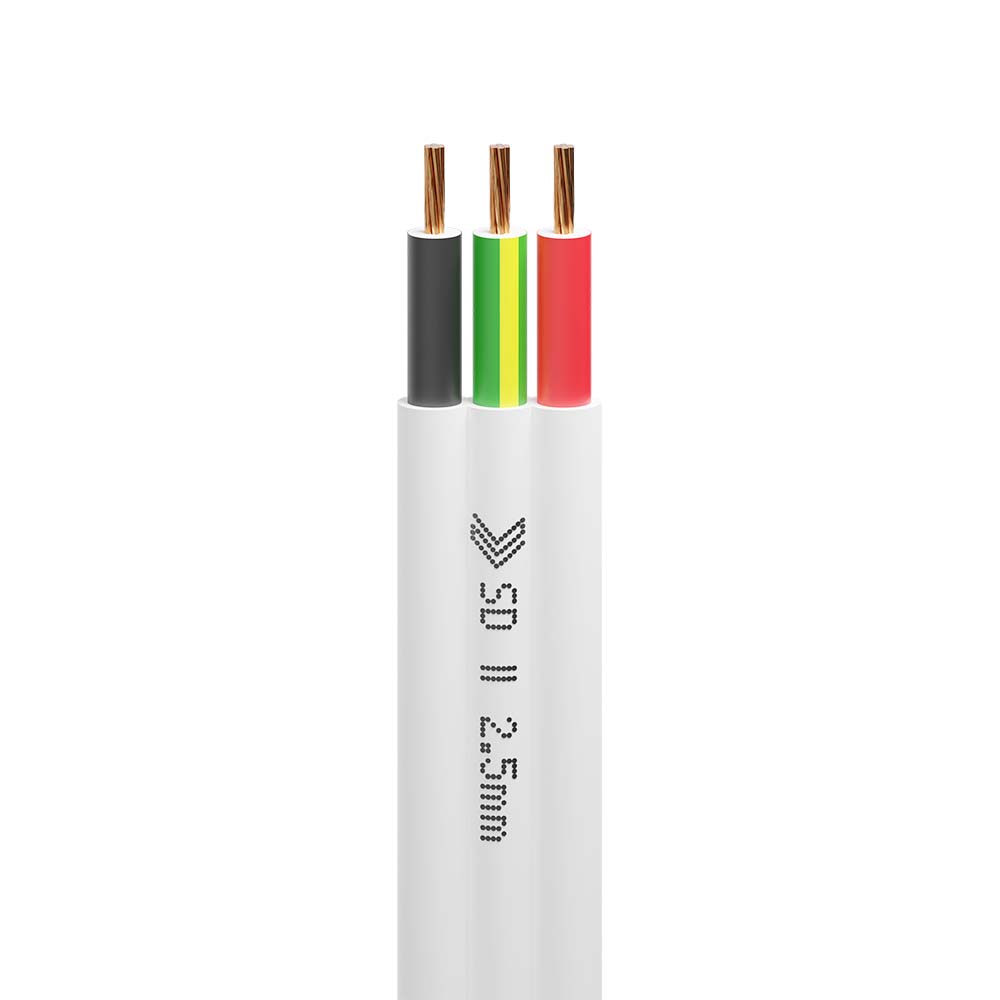
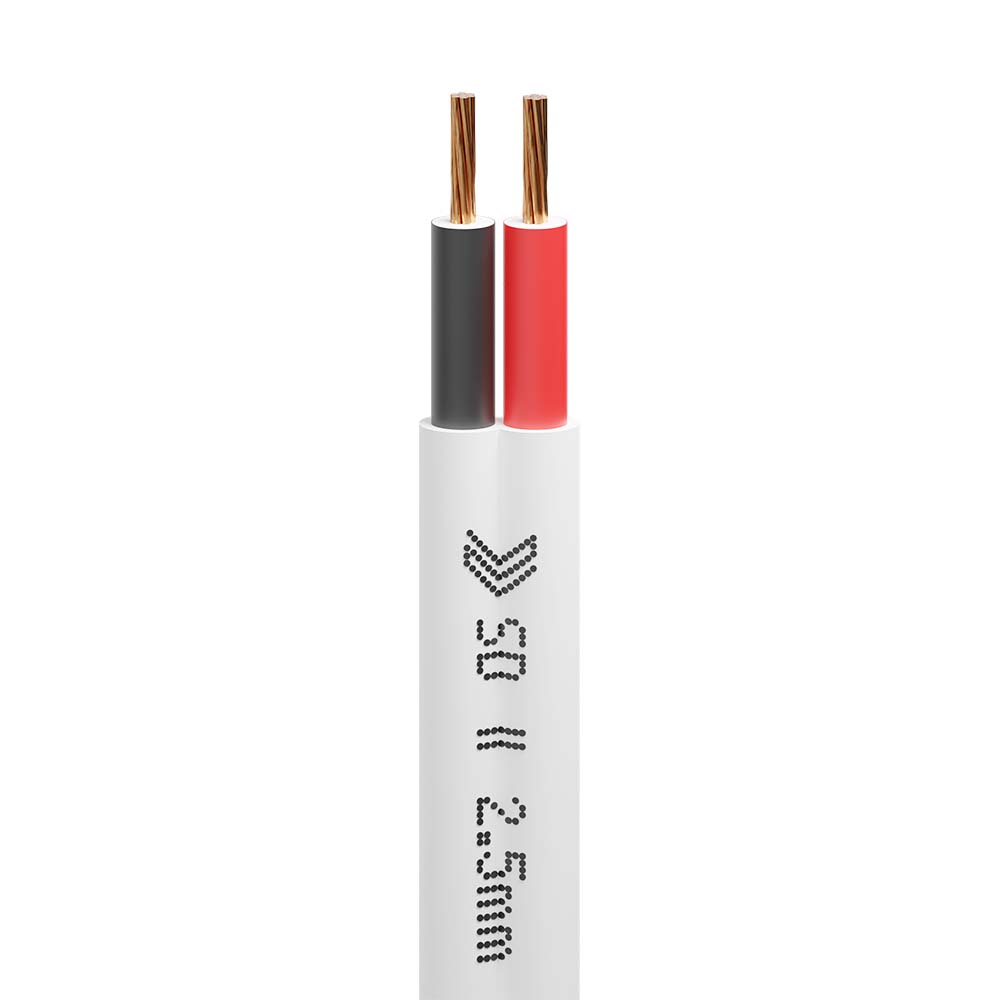
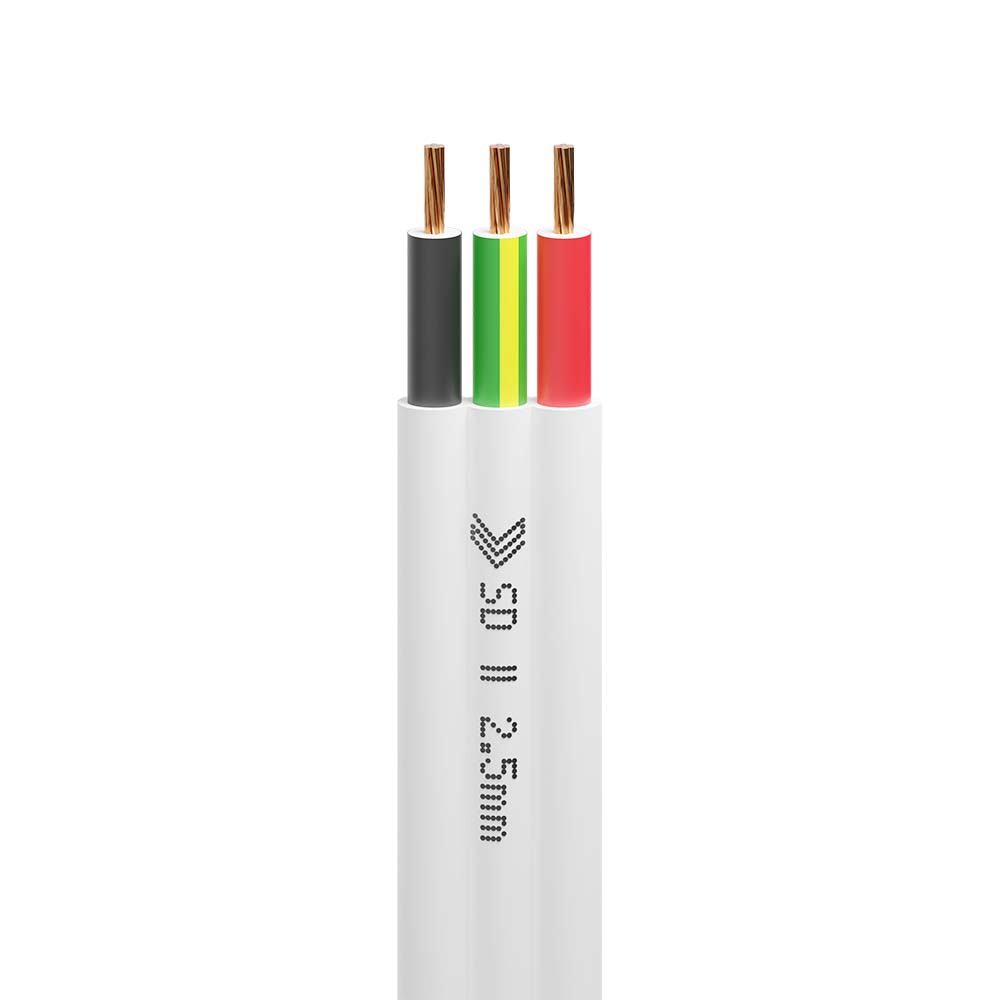
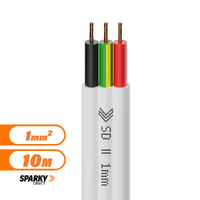
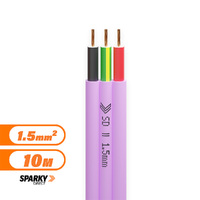
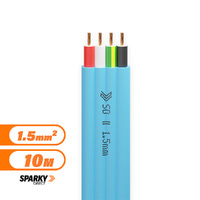
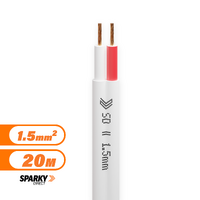
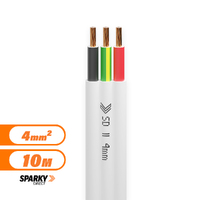
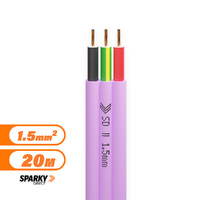
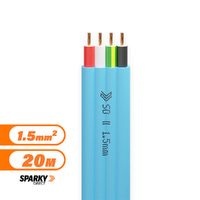
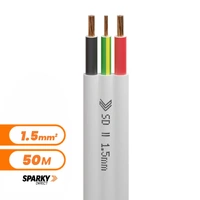
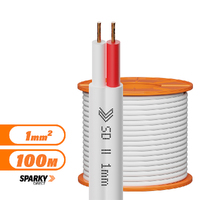
TPS stands for Thermoplastic Sheathed. The name describes the construction: PVC (polyvinyl chloride) insulation around each conductor, and a second PVC sheath around the whole cable. "Twin and earth" refers to the three conductors inside: an active, a neutral, and an earth. The flat profile distinguishes it from round orange circular cables used for sub-mains and orange circular cable runs.
How TPS Cable Is Constructed
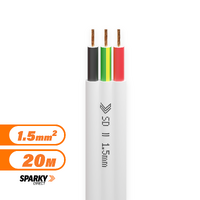
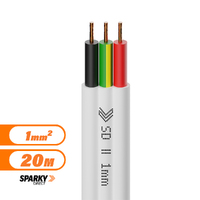
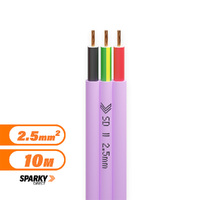
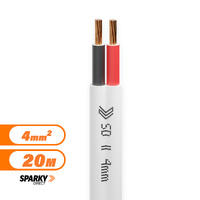
Each TPS cable has three layers that work together. The innermost layer is stranded or solid copper conductor. Around each current-carrying conductor sits coloured PVC insulation: brown for active, blue for neutral. The earth conductor is bare copper with no colour coding. An outer white PVC sheath binds all three conductors together and protects them from abrasion and UV exposure during installation.
The Role of Active, Neutral, and Earth Conductors
Each conductor has a defined job in the circuit. The active carries current from the switchboard to the load. The neutral returns current back to the switchboard to complete the circuit. The earth provides a safe fault path that trips the protective device if a fault occurs between the active and any exposed metal part. Together they form the foundation of a compliant single-phase circuit.
TPS Cable vs Other Australian Cable Types
TPS is not the only option, but it is the default for fixed indoor wiring. For outdoor or underground runs, electricians reach for orange circular cable. For sub-mains and consumer mains, single or double insulated building wire is often used in conduit. Flexible leads to appliances use separate cord types. TPS fills the general-purpose gap: fixed, concealed, and mechanically protected by building materials.
TPS Cable Sizes and Current Capacity
Cable size is not a guess. It is calculated against circuit current, voltage drop, and installation conditions. Oversizing wastes money; undersizing causes overheating. Getting the size right is the single most important decision on any new circuit.
Standard TPS Cable Sizes in Australia
Five sizes cover the vast majority of domestic and light commercial work. Sparky Direct stocks 1mm twin and earth, 1.5mm twin and earth, 2.5mm twin and earth, 4mm twin and earth, and 6mm twin and earth. The size number refers to the cross-sectional area of each current-carrying conductor in square millimetres, not the cable's overall width.
Current-Carrying Capacity by Cable Size
Every cable has a maximum continuous current rating known as its ampacity. The rating depends on the conductor size, the insulation type, and the installation method. AS/NZS 3008.1 tables set the benchmark figures. Higher cross-sectional area means lower resistance, less heat, and higher current capacity.
| Cable Size | Typical Use | Indicative Current Rating | Common Circuit Application |
|---|---|---|---|
| 1mm | Lighting circuits | Up to around 13A | Small lighting runs, low-load switches |
| 1.5mm | General lighting | Up to around 16A | Most residential lighting circuits |
| 2.5mm | GPO (power) circuits | Up to around 20A | General power outlets, appliance points |
| 4mm | Sub-circuits, stoves | Up to around 27A | Cooktops, instant hot water, high-load appliances |
| 6mm | Heavy sub-circuits | Up to around 34A | Large ovens, air conditioning, workshop outlets |
Important: These figures are indicative only. The final current rating depends on the installation method, ambient temperature, grouping with other cables, and the overcurrent protection fitted. Always refer to AS/NZS 3008.1 tables or apply manufacturer-published ampacity data for the specific installation conditions.
Voltage Drop Considerations for Long Runs
Current capacity is not the only sizing factor. On long runs, voltage drop becomes the limiting constraint. AS/NZS 3000 requires that total voltage drop between the point of supply and any point of use stays within 5 percent. A 1.5mm cable rated for 16A may be perfectly legal for current, yet fail the voltage drop check over 30 metres. Electricians routinely upsize cables on long lighting or GPO runs for this reason.
Common Sizing Mistakes and Risks
Two mistakes come up repeatedly on domestic jobs. The first is using 1.5mm where 2.5mm is required, typically where a lighting circuit gets repurposed into a power circuit during a renovation. The second is ignoring derating: installing 2.5mm in a hot roof space bundled with four other cables, then protecting it with a 20A circuit breaker. Both mistakes produce cables that run hot, age prematurely, and can fail under fault conditions.
Choosing the Right TPS Cable for Your Application
Cable selection is a three-step decision: load, length, and installation conditions. Skip any one of these and the result is either an over-specified cable you paid too much for, or an under-specified cable that creates a safety risk.
Matching Cable Size to Load Requirements
Start with the connected load in amps. A 10A socket circuit on a standard 20A breaker sets the minimum at 2.5mm. A 15A single-phase oven on a 20A dedicated circuit also sits comfortably on 2.5mm for short runs. A 32A three-phase induction cooktop needs much larger conductors than standard TPS can provide. Match the cable to the circuit protection first, then check everything else.
Lighting vs Power vs Appliance Circuits
Different circuit types have different conventions. Lighting circuits are almost always 1mm or 1.5mm, protected by a 10A or 16A breaker. General power circuits use 2.5mm on a 20A breaker. Dedicated appliance circuits such as hot water systems, wall ovens, or ducted air conditioners step up to 4mm or 6mm depending on the rated current and run length.
Lighting Circuits
- 1mm or 1.5mm TPS
- Typical breaker: 10A or 16A
- Low continuous load
- Voltage drop usually not critical
General Power (GPO)
- 2.5mm TPS standard
- Typical breaker: 20A
- Variable load, high diversity
- Check voltage drop past 25m
Dedicated Appliances
- 4mm or 6mm TPS
- Breaker sized to rated load
- Often continuous-duty loads
- Derating frequently critical
Residential vs Commercial Applications
Residential work is dominated by 1.5mm and 2.5mm. Commercial fit-outs often use 2.5mm for GPOs, 4mm for kitchen equipment points, and larger sizes for dedicated plant. Commercial sites also push into higher cable counts per tray or ceiling void, which changes the derating calculation significantly.
When to Upgrade to Larger Cable Sizes
Four signals indicate an upgrade is warranted: run length beyond 30 metres, grouping with five or more other loaded cables, ambient temperatures above 40 degrees, or anticipated future load growth. Upgrading one size at the time of rough-in is cheap. Re-pulling a wall two years later is not.
Derating Factors and Real-World Performance
Cable ratings in AS/NZS 3008.1 assume a specific set of reference conditions. Real installations almost never match those conditions exactly. Derating is the process of adjusting the published rating to reflect what the cable actually experiences in the installed environment.
Ambient Temperature Effects (Roof Spaces, Heat)
Australian roof spaces reach 50 to 60 degrees in summer. PVC insulation has a continuous operating ceiling of 75 degrees. Once ambient rises above 30 degrees, the cable's current rating drops sharply. By 55 degrees, a 2.5mm TPS cable may carry only 75 percent of its nominal rating. This is not a theoretical concern; roof-space cable failures trace directly back to ignored temperature derating.
Cable Grouping and Bundling Impacts
Cables bundled together cannot shed heat to the surrounding air as effectively as a single cable can. A tight bundle of six 2.5mm cables might each carry only 60 to 70 percent of their individual rating. This becomes critical in conduit risers, cable trays, and tight ceiling penetrations where multiple circuits converge.
Installation Method (Clipped, Enclosed, Insulated)
Where the cable sits determines how well it cools. Three categories cover most domestic work: clipped direct to a surface with free air on at least one side, enclosed in conduit or trunking, and buried in thermal insulation. A cable surrounded by insulation batts loses almost all convective cooling and must be derated significantly. Clipped installation is the most generous; insulated installation is the most punishing.
Real-World Example
A 2.5mm TPS cable has a reference rating of 27A. Install it in a roof space at 45 degrees, bundle it with four other loaded cables, and partially cover it with insulation, and its genuine continuous rating may drop to 16A or less. Protecting that same cable with a 20A breaker leaves no safety margin for fault conditions.
Why Derating Matters for Safety and Compliance
Derating is not a discretionary step. It is a direct compliance obligation under AS/NZS 3000 and AS/NZS 3008.1. Skipping it produces installations that may pass visual inspection but run hot under load. Over years, heat accelerates PVC degradation, insulation hardens and cracks, and the risk of arcing faults climbs. Proper derating at design time prevents these outcomes.
Compliance and Australian Standards
Australia has some of the strictest cable standards in the world. That strictness exists for a reason: substandard cables have caused fires, electrocutions, and major recalls in recent years. Buying compliant cable is the first line of defence.
AS/NZS 5000.2 Cable Requirements
AS/NZS 5000.2 is the primary standard governing thermoplastic insulated electric cables for voltages up to and including 450/750V. It defines the construction, marking, dimensions, and test performance that TPS cable must meet. Compliant cable carries the manufacturer's name and the standard reference printed on the outer sheath at regular intervals.
AS/NZS 3000 Wiring Rules Considerations
AS/NZS 3000, the Wiring Rules, governs how the cable is installed. It specifies minimum burial depths, support spacing, protection through building elements, segregation from other services, and termination requirements. Buying compliant cable is necessary but not sufficient; installation must also meet the Rules.
Identifying Compliant TPS Cable
Compliant TPS cable shows three things on the outer sheath: the manufacturer's name or registered trademark, the standard reference (typically AS/NZS 5000.2), and the conductor size. Recognised Australian suppliers such as Electra-Cables, Garland Cables, and Conductor Hub print all required markings at regular intervals along the sheath. Some brands also print metre markings for easy measurement during installation. Absence of any of these markings is a red flag.
Regulatory note: Non-compliant cable has been the subject of multiple ACCC product recalls in Australia since 2011. Significant quantities were installed in homes before the recalls were issued. The lesson for electricians is simple: only buy cable from known suppliers, and only buy cable that carries full standard markings on the sheath.
Risks of Using Non-Compliant Cable
Non-compliant cable typically fails in one of three ways. Conductors may be undersized below the marked rating, causing overheating at legitimate currents. Insulation may not meet the temperature rating, degrading and cracking within a few years. Sheath materials may not be flame-retardant to the required level, contributing to fire spread. All three outcomes are serious and all three are documented in recall histories.
Applications of TPS Cable
TPS cable is the workhorse of Australian electrical installations. Its specific strengths, flat profile, easy stripping, and wide size range, make it the default choice for the vast majority of fixed wiring scenarios.
Residential Wiring Applications
In a typical Australian home, TPS handles every lighting point, every GPO, every smoke alarm, and most appliance connections. 1.5mm wires the downlights. 2.5mm wires the bedroom and living area power. 4mm or 6mm runs to the hot water system and the oven. The flat profile allows neat runs through stud walls and along rafters without the bulk of circular cable.
Commercial and Light Industrial Use
Commercial offices, retail fit-outs, and light industrial sheds use the same sizes but in much higher quantities. GPO circuits, general lighting, and emergency lighting all run on TPS. Heavier machinery circuits step up to 4mm and 6mm, or move to circular cable for the largest loads. Cable duct and conduit systems often carry these cables through plant rooms and risers.
HVAC and Appliance Circuits
Split system air conditioners typically pull 10 to 15 amps on a dedicated 2.5mm circuit. Ducted systems often need 4mm. Instant hot water units run from 4mm or 6mm depending on the heater rating. The rule of thumb is to size for the nameplate current plus a generous voltage drop margin on any run longer than 20 metres.
Where TPS Cable Should Not Be Used
TPS is a fixed-wiring cable. It is not rated for direct burial, permanent submersion, or use as a flexible lead. It should not be used outdoors exposed to weather without additional mechanical protection such as conduit. It is also unsuitable for solar DC circuits, which require purpose-designed solar cables with UV-stable insulation. Using TPS outside its designed envelope invalidates the installation.
Installation Requirements and Best Practices
Compliant cable poorly installed is still a compliance failure. AS/NZS 3000 prescribes how TPS must be supported, protected, and terminated. Good trade practice layers additional habits on top of the minimum requirements.
Safe Installation Methods for TPS Cable
TPS is installed clipped to structural members, drawn through conduit, or laid in cable trays. Fixing direct to timber with purpose-made cable clips is the most common method in residential rough-in. Spacing between clips varies by cable size and orientation; the Wiring Rules set the minimum spacings for vertical and horizontal runs.
Supporting and Securing Cable Runs
Cables must be supported often enough that they do not sag under their own weight. For 1.5mm and 2.5mm on horizontal runs, clip spacing of around 300mm is typical trade practice. Vertical runs can take slightly wider spacing. Cables must also be supported within a short distance of every entry into an enclosure, switchboard, or point.
Protecting Cable Through Studs and Walls
Where TPS passes through a timber stud, a metal grommet or nail plate is required at the drilling point. This prevents a future fixing nail from being driven through the cable. Holes through studs must be drilled in the centre of the stud, away from the edges where fixings are likely to land. These small details separate compliant work from a callback waiting to happen.
Common Installation Mistakes to Avoid
The same installation errors appear on callback after callback. Overtightening cable clips crushes the sheath and damages the insulation beneath. Tight bending radius at corners stresses the conductors. Running TPS through metal studs without grommets invites nail strikes. Bundling too many cables together without recalculating the derated rating creates slow-cooking faults. None of these are complex to avoid; they just need discipline.
Performance, Safety and Longevity
A correctly specified and correctly installed TPS cable should outlast the building it is installed in. Getting to that outcome depends on the cable quality, the operating conditions, and the installation workmanship.
How Cable Quality Affects Performance
Quality differences between brands are real, even though all compliant TPS cable meets the same minimum standard. Better brands use softer, more flexible PVC that strips cleanly. Conductors are more uniformly stranded, reducing resistance hotspots. Sheath markings are legible through the life of the cable. These differences show up during installation and over decades of service.
Heat, Load, and Insulation Degradation
PVC insulation ages as a function of temperature over time. Every 10-degree rise in operating temperature roughly halves the expected service life. A cable run at a steady 60 degrees will degrade much faster than an identical cable run at 40 degrees. This is why derating is not an academic exercise: it is the tool that keeps the cable inside its design temperature window.
Preventing Electrical Faults and Fire Risk
Most cable-related fires trace to one of three root causes: loose terminations producing heat at the joint, undersized cable overheating under continuous load, or mechanical damage to insulation that eventually arcs. Careful termination, correct sizing with derating applied, and mechanical protection of vulnerable runs address all three.
Expected Service Life of TPS Cable
Properly specified TPS cable installed inside a dry, temperature-controlled building envelope commonly delivers 40 to 50 years of reliable service. Cables in hot roof spaces, or cables running at high continuous load, typically age faster. The honest answer is that service life is dominated by operating conditions, not by the cable itself.
Pricing, Value and Buying Considerations
TPS cable pricing varies more than most trade supplies. The range between the cheapest and most expensive cable of the same size can exceed 40 percent. Understanding why those differences exist helps buyers pick value rather than just price.
TPS Cable Prices in Australia
Price drivers are three: copper content (which scales with conductor size), PVC quality, and the supplier's freight and handling model. 100m drums are the most economical format per metre. Short cut lengths cost more per metre but suit small jobs and maintenance work. Live prices for every size sit in the relevant Sparky Direct category pages.
Bulk Buying vs Per-Metre Purchasing
A 100m drum of 2.5mm twin and earth typically delivers the best per-metre rate. Drums also eliminate the need to order multiple cuts for larger jobs. Per-metre or short-cut purchasing suits maintenance electricians who only need 10 or 20 metres at a time and do not want cable sitting in the van for six months.
Cheap vs Premium Cable Differences
At the bottom of the market, some cables meet the standard but only just. At the top, established brands such as Electra-Cables invest in higher-grade PVC, more consistent stranding, and better sheath marking. The midrange covers most jobs adequately. The important distinction is between compliant and non-compliant, not between midrange and premium.
Trade Suppliers vs Retail Channels
Trade suppliers like Sparky Direct run trade pricing, proper product descriptions, and stock that is sized for commercial quantities. Generalist retail channels often list single-length cable at a premium and do not carry the 100m drum sizes that trade customers need. For anything beyond a small home job, trade supply is the better route.
Fast Delivery and Availability
Sparky Direct holds deep stock across every common TPS size. Orders placed before the cut-off typically ship the same business day, with cable arriving in metropolitan areas within 1 to 3 working days. Regional delivery times extend by a day or two. Click and collect is available from the Morayfield location in Queensland for trade buyers in the local area.
Practical Buying Guidance for Electricians
Knowing the theory is only half the job. The other half is applying it quickly when quoting a job, ordering the right quantity, and picking the size that will still be correct three circuit modifications from now.
Matching Cable to Circuit Requirements
Work backwards from the circuit breaker. A 20A breaker needs a cable rated for at least 20A in the final installed conditions, not in the reference conditions. Apply the derating factors relevant to the site, check the voltage drop, then pick the cable. The whole calculation takes five minutes with the AS/NZS 3008.1 tables open.
Common Buyer Mistakes to Avoid
Three mistakes dominate. First, ordering only what the current job needs and running short, forcing a second delivery. Second, specifying the smallest cable that passes the compliance check, leaving no margin for future load growth. Third, buying cable without checking the sheath markings, and finding out later that it came from a non-compliant batch.
Planning Cable Runs and Quantities
Measure each run, add 10 percent for terminations and routing, and round up to the nearest sensible length. For rough-in work, 100m drums of 1.5mm and 2.5mm are the minimum stock a working van should carry. For complete house rewires, multiple drums of each size are typical. Quality cable cutters pay for themselves within a month of serious rough-in work.
Where to Buy TPS Cable Online
Sparky Direct carries the full range of electrical cables including every standard TPS size, both in 100m drums and in cut lengths from 10m upwards. Live stock levels display on each product page, trade pricing applies automatically at checkout for registered trade customers, and delivery tracking is included on every order.
Product Videos
Watch 1.5mm Twin & Earth Flat Cable | Pvc / Pvc | 7-050-2ERB | 10mtr Cut video
Watch NLS 30363 | 12mm Cable Clips to Suit 2.5mm Twin & Earth | 500 Jar video
Watch NLS 30422 | 10mm Cable Clips to Suit 1.5mm Twin & Earth | 500 Jar video
What Sparky Direct Customers Say

2.5 twin and earth might just seem like cable and it is but the insulation material is better. It feels better and can strip easier. Marking the active cable on the outer Sheath is a bonus. Again good value for money good cable. As a multi strand conductor still give a heavier cable flex. Definitely recommend for the product and the cost
Time management is critical. None more so when you are a small operation with limited human resources. Being able to research products, order and then have prompt reliable delivery, well that's a critical support resource. Additionally, all prices are more than fair and reasonable, including delivery. Total cost is consistently equal to or less than that available from my local supplier. As an added bonus cost saving specials are consistently sent to my in box.
Good quality cable with the red active line down the casing. Easy to strip and pull though frames
- TPS (Thermoplastic Sheathed) is the flat three-conductor cable used for almost all fixed wiring in Australian homes and commercial sites.
- Five sizes cover most work: 1mm and 1.5mm for lighting, 2.5mm for general power, 4mm and 6mm for heavy appliance circuits.
- Current ratings depend on installation conditions. Derating for ambient temperature, bundling, and insulation coverage is mandatory under AS/NZS 3008.1.
- All cable must comply with AS/NZS 5000.2 and show manufacturer, standard reference, and size printed on the sheath.
- 100m drums deliver the best per-metre price; cut lengths from 10m upwards suit maintenance and small jobs.
- Sparky Direct stocks the full TPS range with same-day dispatch and trade pricing for registered trade buyers.
Shop TPS Cable at Sparky Direct
Quality products in stock • Fast Australia-wide delivery • Competitive trade pricing
Browse TPS Cable → Get Expert Advice →TPS Cable Frequently Asked Questions
Can TPS cable be installed inside walls and ceilings?
Yes. TPS cable is commonly installed within wall cavities, ceilings, and roof spaces when correctly supported and protected.
TPS cable near me
TPS cable is available from Sparky Direct, offering access to compliant electrical products with Australia-wide delivery.
Is delivery available for TPS cable?
Delivery options depend on the supplier and location, with availability across metropolitan and regional Australia.
Can TPS cable be used for new builds and upgrades?
Yes. TPS cable is suitable for new construction, renovations, and electrical upgrades.
Is TPS cable covered by warranty?
Warranty coverage depends on the manufacturer and supplier, with conditions applying to correct use and installation.
What should I consider before buying TPS cable?
Consider the required cable size, number of cores, application, compliance markings, and electrician recommendations.
Is TPS cable suitable for residential and light commercial use?
Yes. TPS cable is widely used in both residential and light commercial electrical installations.
Is TPS cable flexible enough for tight spaces?
TPS cable offers enough flexibility for routing through building cavities while maintaining structural integrity.
Can TPS cable handle modern electrical loads?
Yes. When correctly sized, TPS cable is suitable for modern household electrical demands.
Does TPS cable require maintenance?
TPS cable itself does not require maintenance but is inspected during electrical safety checks.
Can TPS cable be used in renovations?
Yes. TPS cable is commonly used for new circuits and upgrades during renovations.
Is TPS cable visible after installation?
In most cases, TPS cable is concealed behind walls, ceilings, or other building structures.
Does TPS cable last a long time?
When properly installed and not exposed to damage, TPS cable can provide many years of reliable service.
What is TPS cable?
TPS cable, or thermoplastic sheathed cable, is a type of electrical cable commonly used for fixed wiring in residential and light commercial buildings.
Is TPS cable easy to work with?
TPS cable is designed for professional use and is easier to handle and install for trained electricians.
Why is TPS cable commonly used in homes?
TPS cable is flexible, reliable, and well suited to concealed wiring, making it a practical choice for residential installations.
Is professional installation required when using TPS cable?
Yes. Installation of TPS cable must be carried out by a licensed electrician to ensure safety and compliance.
Is TPS cable fire resistant?
TPS cable has a thermoplastic sheath that meets specific safety requirements, but fire resistance depends on the cable rating and installation method.
Can TPS cable be used for single-phase and three-phase power?
Yes. TPS cable is available in configurations suitable for both single-phase and three-phase electrical systems.
Is TPS cable suitable for indoor use only?
TPS cable is primarily designed for indoor use or protected locations and is not intended for direct exposure to weather or sunlight.
What sizes are available for TPS cable?
TPS cable is available in a range of conductor sizes and core configurations to suit different electrical loads and applications.
Does TPS cable comply with Australian standards?
Quality TPS cable supplied in Australia is manufactured to comply with AS/NZS electrical and safety requirements.
Where is TPS cable commonly used?
TPS cable is commonly used for power circuits, lighting circuits, and general fixed wiring inside walls, ceilings, and roof spaces.
Is TPS cable suitable for Australian electrical installations?
Yes. TPS cable is widely used in Australia and is designed to meet relevant AS/NZS electrical standards when installed correctly.
What does TPS cable consist of?
TPS cable typically consists of insulated copper conductors enclosed within a flat or circular thermoplastic outer sheath.