
Search Results:
Search Results:
Search Results:
Search Results:
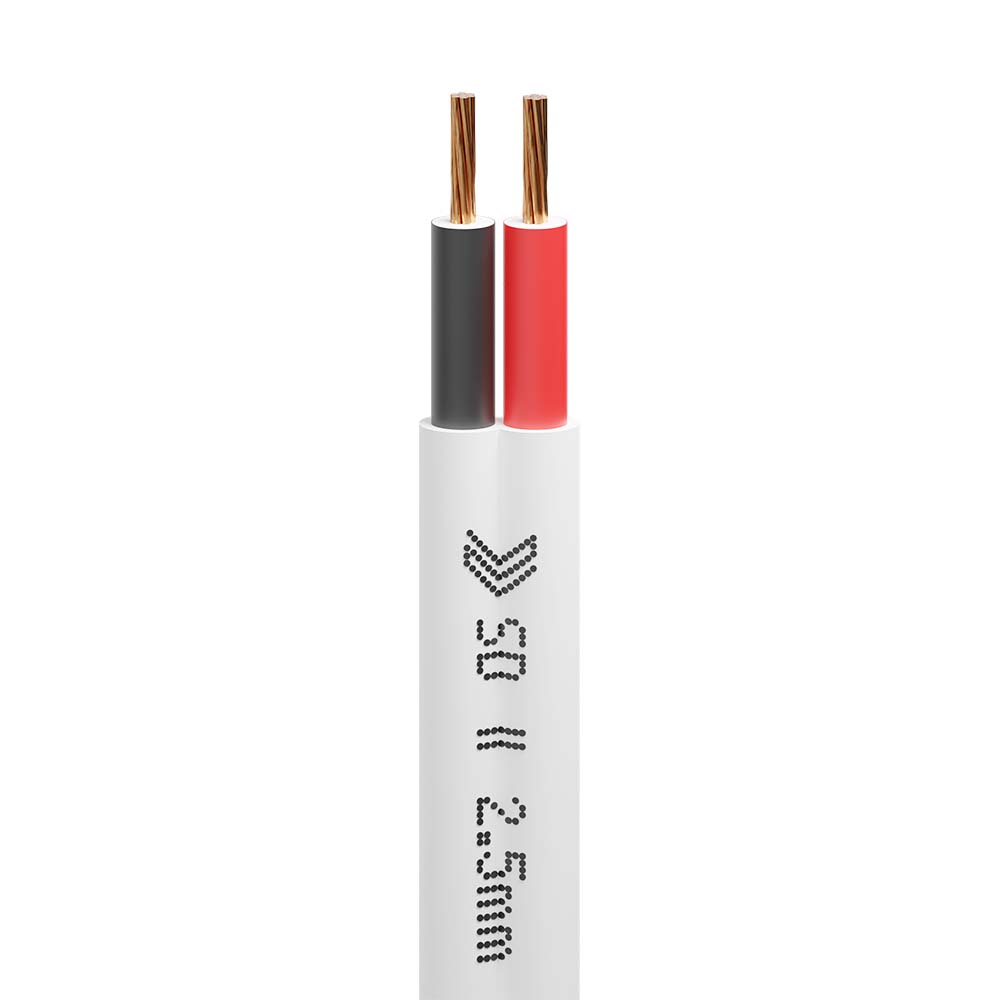
Twin cable refers to any electrical cable that contains two insulated conductors inside a common outer sheath. In Australian wiring practice, the term almost always refers to flat thermoplastic sheathed (TPS) cable, commonly supplied with an additional bare earth conductor. This configuration is known as twin and earth, or T+E. Sparky Direct stocks the full range of electrical cables used for fixed wiring in homes, offices, and light commercial sites.
A standard twin and earth cable has three conductors inside a flat PVC sheath. The two insulated conductors are the active (red or brown) and neutral (black or blue), with a bare copper earth running between them. The insulation is typically V-90 PVC rated for continuous conductor temperatures up to 90 degrees Celsius. The outer sheath is a tougher grade of PVC, colour coded white for most modern supply. Quality cables mark the active side of the sheath with a printed line, which helps electricians identify polarity at a glance during rough-in and termination.
The active conductor carries current from the switchboard to the load. The neutral returns that current to the supply, completing the circuit. The earth conductor is a protective bonding path that ensures exposed metal parts cannot remain live if a fault occurs. Earth continuity is not optional, it is what makes residual current devices work correctly and what trips a circuit breaker safely when a short to earth occurs. Every twin and earth cable sold for fixed wiring in Australia must carry all three conductors sized to comply with AS/NZS 3008.
Single-core building wire carries one conductor per length and is typically pulled into conduit. Multicore cables such as three core and earth (used for two-way switching or air conditioning) carry more conductors in the same sheath. Twin cable sits between these two, offering a compact, pre-bundled wiring solution suitable for almost all standard residential lighting and power circuits. For applications where an additional switched active is needed, TPS cable is also available in three core and earth configuration.
Twin and earth flat cable is the workhorse of Australian fixed wiring. The standard format is 7 stranded copper, rated 450/750 volts, V-90 PVC insulated and V-75 PVC sheathed. Stranded copper is preferred over solid for flexibility during rough-in, particularly when pulling through timber frames, bored studs, and ceiling penetrations. The flat profile makes the cable easy to staple to joists and battens without twisting.
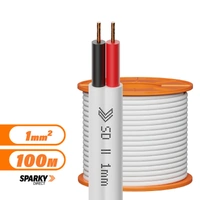
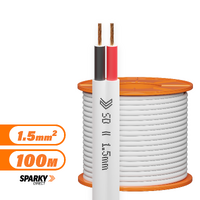
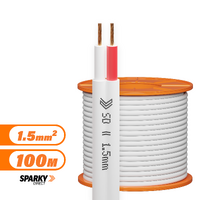
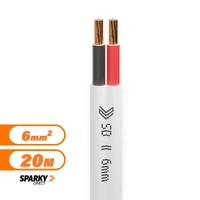
The most common sizes stocked at Sparky Direct are 1mm, 1.5mm, 2.5mm, 4mm, and 6mm. Lighting circuits typically use 1.5mm twin and earth cable. General power outlets and most 20 amp circuits use 2.5mm twin and earth cable. Larger loads such as hot water, air conditioning, and sub-mains step up to 4mm twin and earth or 6mm twin and earth cable.
Australian-compliant twin cable uses high-conductivity copper conductors. Quality varies between manufacturers in three practical ways: the copper purity, the evenness of the strand diameter, and the thickness of the insulation walls. Cheap imported cable sometimes undersizes the copper, selling 6mm² product that is closer to 5.2mm² in actual cross-sectional area. This matters because current ratings and voltage drop calculations assume nominal cross-section. Reputable suppliers such as Electra-Cable and Garland Cables maintain full nominal sizing under AS/NZS 5000.1.
Standard flat TPS twin and earth is PVC over PVC, rated V-90 on the inner conductor insulation and V-75 on the outer sheath. Low smoke zero halogen (LSZH) variants are available where building codes or risers require reduced smoke emission under fire. For outdoor or underground runs, a different cable class such as orange circular cable or SDI cable is specified instead. Standard flat TPS is not rated for direct burial.
Twin cable sizes refer to the nominal cross-sectional area of each current-carrying conductor, measured in square millimetres. The earth conductor is often sized one step smaller, in line with AS/NZS 3008 requirements for protective earthing. The most common Australian sizes are listed below.
Current-carrying capacity, often referred to as ampacity, depends on cable size, installation method, ambient temperature, and proximity to other cables. Published ratings under AS/NZS 3008.1.1 assume a reference installation method and a reference temperature. Actual ratings after derating can be noticeably lower than the headline figure, which is where sizing mistakes commonly originate. The table below shows indicative ratings for twin and earth at 30 degrees Celsius ambient, clipped direct to a surface. Always verify the final figure against the wiring rules and the specific install conditions on site.
| Cable Size | Conductor Strands | Typical Clipped Direct Rating | Typical Circuit Protection |
|---|---|---|---|
| 1.0mm² | 7 / 0.44mm | Approximately 14 amps | 10A MCB |
| 1.5mm² | 7 / 0.53mm | Approximately 18 amps | 16A MCB |
| 2.5mm² | 7 / 0.67mm | Approximately 25 amps | 20A MCB |
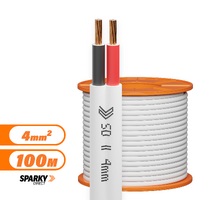
| 4mm² | 7 / 0.85mm | Approximately 32 amps | 25A MCB |
| 6mm² | 7 / 1.04mm | Approximately 41 amps | 32A MCB |
Voltage drop becomes the governing factor on long runs, well before the cable reaches its thermal limit. AS/NZS 3000 limits total voltage drop to 5 percent from the point of supply to the final point of use. On a 20 amp circuit run in 2.5mm twin and earth, voltage drop reaches the 5 percent limit at around 35 to 40 metres depending on the load profile. For longer runs, the cable size must be increased one step to keep voltage drop within specification. This is why a long shed sub-main is often run in 6mm even when the current could be carried in 4mm.
The most frequent sizing mistake is ignoring derating. A 2.5mm cable rated for 25 amps clipped direct can drop below 20 amps once bundled in a bank of six cables in ceiling insulation. Sizing from the clipped-direct figure alone means the cable runs hotter than design temperature, which accelerates insulation ageing and can cause nuisance tripping on warm days. The second common mistake is ignoring voltage drop on long circuits, which leads to motors stalling, LED flicker, and reduced appliance performance at the end of the run.
Sizing check: Current rating, voltage drop, and installation method must all be calculated before the cable is pulled. The smallest of the three calculated sizes is the minimum that complies. Never size on current rating alone.
Lighting circuits in most Australian homes are wired in 1.5mm twin and earth on a 16A MCB. Power circuits for general-purpose outlets are wired in 2.5mm twin and earth on a 20A MCB. Dedicated appliance circuits, such as an electric oven or a fixed air conditioning unit, are sized to match the nameplate rating of the appliance, typically 4mm or 6mm. Running a dedicated circuit removes the shared load concern and gives the appliance a clean supply.
Residential wiring uses flat twin and earth almost exclusively for general circuits. Commercial wiring uses the same cable for final sub-circuits but often transitions to circular conductors, orange or grey circular cable, for sub-mains and risers. The transition point is usually the distribution board. Twin and earth is still widely used in small commercial fit-outs where the sub-circuit runs are short and the loads are modest.
The cable must be able to carry the full load of the circuit continuously under the worst-case installation condition. The correct approach is to start with the design current, apply the installation derating factors, compare to the published ampacity, and then check voltage drop on the calculated run length. If any one of these checks fails, the cable size is stepped up. This sequence is set out in AS/NZS 3008 and is the standard design method expected on any electrical installation certificate of compliance.
Upgrade one step whenever the calculated voltage drop exceeds 4 percent on the planned run length. Upgrade if the cable runs through insulated bulk or shares a bank of four or more cables. Upgrade if ambient temperatures exceed 35 degrees, such as in a hot roof space. Upgrade if future load growth on the circuit is likely. An upgrade from 2.5mm to 4mm on a kitchen power circuit adds little to the material cost but provides significant thermal and voltage headroom.
Installation method has the largest single effect on cable ampacity. Clipped direct to a surface in free air is the reference condition and gives the highest current rating. Cable pulled through cable duct or conduit is rated lower because heat cannot dissipate as effectively. Cable buried in thermal insulation sees a further reduction, with factors as low as 0.5 on a single cable fully enclosed in bulk insulation. The reference tables in AS/NZS 3008.1.1 list every combination in full.
When cables run in groups, heat from each cable adds to the others and the whole bundle runs hotter. A group of three touching cables carries roughly 80 percent of a single cable rating. A group of six touching cables carries roughly 57 percent. This is why a tight bundle of power circuits feeding a kitchen from the switchboard needs careful thermal calculation, particularly if part of the run passes through insulated wall cavities.
Published ratings assume 30 degrees Celsius ambient. Australian roof spaces routinely reach 45 degrees or higher in summer. A 2.5mm cable rated at 25 amps at 30 degrees drops to about 21 amps at 45 degrees. For roof-mounted solar inverter feeds and rooftop air conditioning cabling, this temperature correction is not optional. Cable specifications and datasheets list the temperature correction factors side by side with the base current ratings.
Every derating factor reflects a real-world thermal condition. Ignoring derating means the cable operates above its design temperature. That accelerates insulation ageing, increases the risk of cracking, and over time raises the likelihood of a short circuit or an earth fault inside the wall. The cable may still look fine from the outside while the insulation degrades internally. Correct sizing keeps the cable within its thermal envelope for the full service life of the installation.
AS/NZS 5000.1 is the product standard that covers low-voltage building wires, including twin and earth flat TPS. It specifies the copper conductor quality, insulation materials, testing regime, marking, and voltage rating (450/750V). Any twin cable sold legally for fixed wiring in Australia must carry a certification mark demonstrating compliance. The certification mark is printed on the outer sheath, along with the cable type, size, and manufacturer identification.
AS/NZS 3000, commonly called the Wiring Rules, governs how cable is selected, installed, protected, and tested. Clause 3.4 covers current-carrying capacity and cross-references AS/NZS 3008 for ampacity tables. Clause 1.5 covers identification and colour coding. The wiring rules are a mandatory document under state electrical safety legislation, enforced through licensing and inspection in every Australian jurisdiction.
Compliant twin cable carries clear sheath printing that includes the cable type, conductor sizes, voltage rating, applicable standard, certification mark, and manufacturer identification. If any of these markings are missing, illegible, or partially obscured, the cable should not be installed. Regulators accept the sheath marking as the primary evidence of compliance during inspection.
Non-compliant cable is sometimes sold online at prices well below genuine product. The typical issues are undersized copper, thin insulation that fails rotation and bend tests, and fabricated certification marks. Installing non-compliant cable exposes the licensed electrician to insurance problems, compliance prosecution, and liability for any fault or fire that follows. The tested, certified, and properly supplied route is the only defensible choice.
Confirm the sheath marking on every drum or coil. Check it against the order. Keep a photograph or offcut as evidence of compliance for the Certificate of Electrical Safety file. This takes two minutes and protects the licensed electrician on every job.
Lighting circuits use 1mm or 1.5mm twin and earth. The cable runs from the switchboard to a junction or ceiling rose, then on to switches and luminaires. Modern LED lighting draws a fraction of the load of old incandescent fittings, so the 1.5mm size provides generous headroom for any realistic future lighting layout. Cable is secured with 1.5mm cable clips sized to match the cable profile.
Power circuits for general-purpose outlets use 2.5mm twin and earth on a 20 amp MCB, typically with RCD protection either at the board or at the outlet. A single 2.5mm circuit serves a group of socket outlets in a kitchen, laundry, or living area. The circuit layout is generally limited to keep voltage drop within specification, which is why larger homes are wired with multiple power circuits rather than one long loop.
Fixed appliances with high continuous loads are wired on dedicated circuits. Electric ovens, heat pumps, ducted air conditioning, pool pumps, and fixed workshop equipment each run on their own dedicated circuit. Cable size is matched to the nameplate rating. Hot water heaters commonly use 4mm twin and earth on a 25 amp MCB. Large electric ovens use 6mm twin and earth on a 32 amp MCB. Check the specific appliance datasheet for the manufacturer cable recommendation.
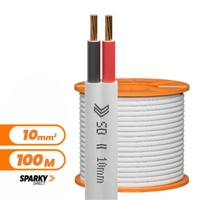
Sub-mains feed a secondary distribution board from the main switchboard, typically for a granny flat, separate garage, workshop, or shed. 6mm or 10mm twin and earth handles sub-mains loads in most small residential settings. For longer runs or higher loads, circular cable or building wire in conduit is used instead. Always check voltage drop on sub-main runs, as these are often the longest cables in the installation.
Fixed wiring in Australia must be installed by a licensed electrician. This is a requirement under the Electrical Safety Act in every state and territory. Unlicensed installation is a criminal offence and voids building insurance. A licensed electrician issues a Certificate of Electrical Safety or Certificate of Compliance after testing, which is the legal record that the work meets AS/NZS 3000.
Cable is routed to avoid mechanical damage. Horizontal and vertical runs in walls follow predictable paths so that subsequent trades and future homeowners can anticipate where the cable is. Cable passing through studs runs through bored holes in the centre of the stud, clear of the nail and screw zone. Where cable passes through metal framing, a grommet or bush prevents the metal edge cutting into the sheath. Outside the wall cavity, cable is supported at intervals and protected against solar UV and impact.
Terminations are made in accessible enclosures using approved terminal blocks, WAGO connectors, or the clamp terminals of the fitting itself. Strip length is set to expose exactly enough copper for a full clamp without leaving bare conductor outside the terminal. Over-stripping creates an exposed fault path inside the enclosure. Under-stripping leaves insulation under the clamp, which loosens over time and causes hot joints. A correctly stripped and fully seated conductor is the foundation of a long-life termination.
Three mistakes come up repeatedly on twin cable installations. The first is stapling too tight, which crushes the sheath and damages the inner insulation over years. The second is running cable across the top of ceiling joists in the roof space. That route exposes the cable to foot traffic during any future work in the roof. The third is combining too many circuits in a single bundle without applying derating, which leads to cables running hotter than design. Correct installation practice covers each of these points explicitly.
Quality twin cable performs to its full published current rating, meets voltage drop calculations, and terminates cleanly without crumbling insulation. Cheap cable often fails on copper cross-section, meaning the cable runs hotter than design at rated load. Over a 20 year service life, the accumulated thermal stress separates quality cable from cheap cable. This is why specifying the correct cable up front is the single best investment on any new installation.
Electrical fire risk in twin cable installations comes from three main sources: overloaded circuits, loose terminations, and damaged insulation. Correct sizing removes the first. Proper termination removes the second. Careful routing and mechanical protection remove the third. RCD and MCB protection catches the faults that do develop before they cause damage. The combined approach is what keeps modern Australian homes safe.
PVC insulation ages through heat and UV exposure. At 90 degrees Celsius continuous conductor temperature, V-90 insulation is rated for a nominal 20,000 hours service life, roughly 20 years of typical domestic use. Above rated temperature, service life drops rapidly. This is why derating is critical: every degree above rated temperature shortens the cable life. A correctly sized cable runs well below rated temperature and lasts decades.
Twin and earth cable installed correctly to AS/NZS 3000 is expected to last the life of the building. When operated within its thermal envelope, the outer sheath typically lasts 40 to 50 years and the conductor insulation lasts 30 plus years. Replacement is usually driven by renovation or circuit changes rather than cable failure. The economic case for quality cable is straightforward: the incremental cost at install is tiny compared with the cost of rewiring.
Twin and earth cable is sold by the metre on cut lengths, or by the drum for 100 metre and larger rolls. Pricing reflects the live copper market, so prices move with copper futures. At current copper pricing, 2.5mm twin and earth sits in the middle of the range, 1.5mm is noticeably cheaper per metre, and 6mm is roughly three times the per-metre price of 2.5mm. Trade buyers purchasing 100 metre drums pay significantly less per metre than cut length buyers.
Sparky Direct sells twin and earth cable in cable cuts from 10 metres up to 100 metre drums. For a single small job, a 10 or 20 metre cut is the most cost-effective choice, avoiding leftover cable that might never be used. For trade buyers running multiple projects, the 100 metre drum is the standard stocking size because the per-metre rate is substantially lower and the drum spins cleanly during rough-in.
The practical differences between cheap and premium twin cable are copper cross-section, insulation quality, sheath toughness, and active-side marking. Cheap cable sometimes lists 2.5mm² but measures closer to 2.1mm². The insulation may strip unevenly and crack under a bend test. Premium brands such as Electra-Cables and Garland maintain full nominal cross-section, consistent stripping, and clear printed markings. The price gap per metre is small. The quality gap over a 20 year life is large.
Dedicated trade suppliers offer per-metre cut lengths, commonly stocked sizes, bulk drum rates, and genuine product with correct certification marks. Retail and hardware chains sometimes carry twin cable but typically at higher prices and with a more limited size range. For licensed electricians, the trade supplier route is faster, cheaper, and safer on compliance.
Sparky Direct ships Australia-wide on standard and express carriers. Most common twin and earth sizes are held in stock for same-day dispatch on weekday orders. Larger drums and less common sizes may be built to order and ship the next business day. Pickup from the Morayfield warehouse is available for trade buyers who need same-day collection.
Start the buying process from the circuit schedule: list every circuit, its design current, its run length, and its installation method. From that schedule, the cable size and quantity for each circuit fall out directly. Add 10 to 15 percent for waste on complex routing. For smaller jobs, a working rule of thumb is two to three metres per GPO plus the point-to-point distances for lighting and sub-main runs.
The most common buying mistake is sizing on nominal current alone, which ignores derating and voltage drop. The second is ordering short and having to pay freight on a second drum. The third is buying from a source with unclear certification, which creates compliance risk at inspection. All three are avoidable with a clear schedule and a reputable trade supplier.
Plan the cable routing before ordering quantities. Straight vertical drops from ceiling to GPO boxes are short. Horizontal runs through studs add up quickly on a wide wall. Roof space runs between central ceiling roses and distant rooms can be surprisingly long. Walk the plan with a tape before locking in the order. A 100 metre drum of 2.5mm covers roughly 15 standard GPO circuits of average length.
Sparky Direct ships twin and earth cable, twin core cable, and the full range of supporting accessories Australia-wide. The product range covers every common size from 1mm up to 6mm in cut and drum formats. Supporting accessories such as cable clips and wire strippers are stocked alongside the cable so a trade buyer can complete a full order in one pass. Pricing is listed clearly and updated to reflect the current copper market.
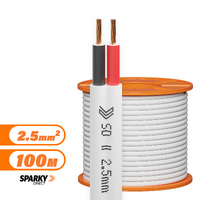
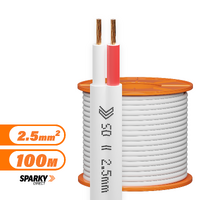
Watch 2.5mm Twin & Earth Flat Cable | Pvc / Pvc | 7-067-2ERB video
Watch NLS 30422 | 10mm Cable Clips to Suit 1.5mm Twin & Earth | 500 Jar video
Watch NLS 30445 | 14mm Cable Clips to Suit 4.0mm Twin & Earth Electrical Cable | 250 Jar video

Time management is critical. None more so when you are a small operation with limited human resources. Being able to research products, order and then have prompt reliable delivery, well that's a critical support resource. Additionally, all prices are more than fair and reasonable, including delivery. Total cost is consistently equal to or less than that available from my local supplier. As an added bonus cost saving specials are consistently sent to my in box.
2.5 twin and earth might just seem like cable and it is but the insulation material is better. It feels better and can strip easier. Marking the active cable on the outer Sheath is a bonus. Again good value for money good cable. As a multi strand conductor still give a heavier cable flex. Definitely recommend for the product and the cost
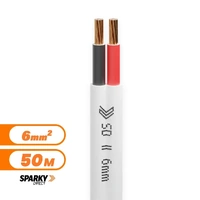
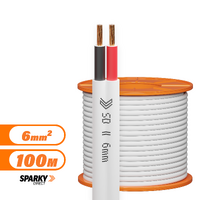
Double insulated, good quality, PE sheathed twin core, is actually 6mm2 unlike some on eBay. Fast delivery as always.
Quality products in stock • Fast Australia-wide delivery • Competitive trade pricing
Browse Twin Cable → Get Expert Advice →In most cases, twin core cables are concealed within walls, ceilings, or electrical enclosures.
Twin core cables are available from Sparky Direct, offering access to compliant electrical products with Australia-wide delivery.
Delivery options depend on the supplier and location, with availability across metropolitan and regional Australia.
Yes. Twin core cables are suitable for new construction, renovations, and electrical upgrades.
Warranty coverage depends on the manufacturer and supplier, with conditions applying to correct use and installation.
Consider conductor size, insulation type, compliance markings, application requirements, and electrician recommendations.
Yes. When compliant products are installed by licensed electricians, twin core cables are safe and reliable.
Yes. When correctly sized, twin core cables are suitable for modern electrical demands.
Yes. They are designed to allow routing through building cavities while maintaining insulation integrity.
Twin core cables do not require routine maintenance but are checked during electrical inspections.
Yes. Twin core cables are used in both residential and light commercial electrical installations.
Yes. Twin core cables are commonly used during electrical upgrades and renovations.
When correctly installed and protected, twin core cables can provide many years of reliable service.
Twin core cables are electrical cables containing two insulated conductors, typically used for single-phase power and control circuits.
Twin core cables are designed to be flexible enough for installation in walls, ceilings, and conduits by trained professionals.
Twin core cables provide a simple and reliable solution for applications requiring two conductors.
Yes. Installation must be carried out by a licensed electrician to ensure safety and compliance with Australian regulations.
Yes. Twin core cables feature insulated conductors and an outer sheath for protection and safety.
Yes. Twin core cables are commonly used in single-phase electrical systems.
Yes. Twin core cables are commonly used in lighting circuits where appropriate earthing arrangements are provided.
Yes. Twin core cables are available in a range of conductor sizes to suit different electrical loads and applications.
Twin core cables typically use copper conductors due to their conductivity, strength, and reliability.
Yes. Twin core cables are widely used in residential electrical wiring when specified by a licensed electrician.
Quality twin core cables supplied in Australia are manufactured to meet relevant AS/NZS electrical and safety standards when installed correctly.
Twin core cables are commonly used for lighting circuits, power connections, and fixed wiring applications where two conductors are required.