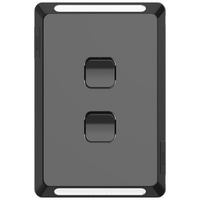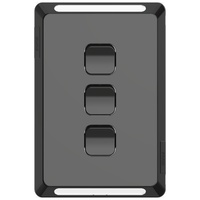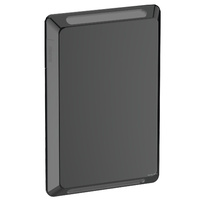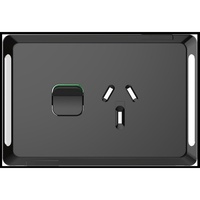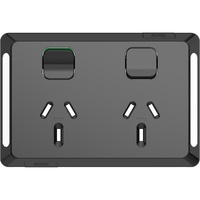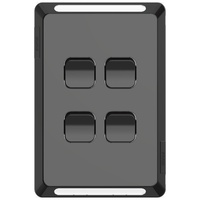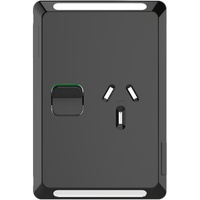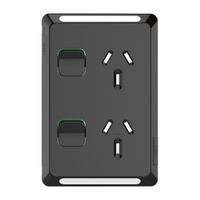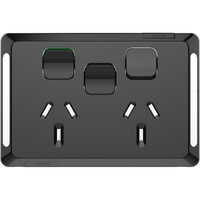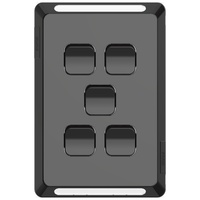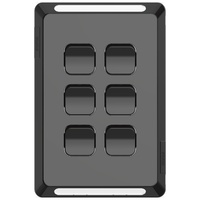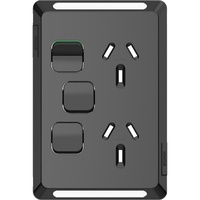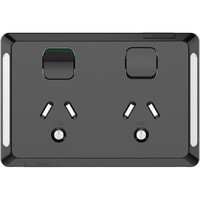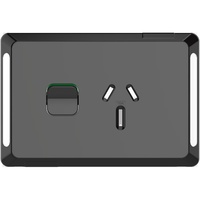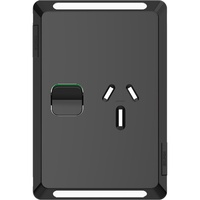

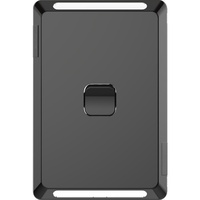

PRO Cover Only
Clipsal Pro Series P3041C-BK | 1 Gang Skin Switch Cover Only (No Mech or Grid Plate)| Black
$3.61
$3.28 ex. GST
Search Results:
Search Results:
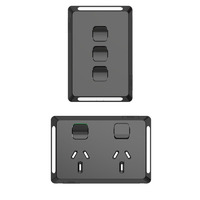
Find Black Light Switch Covers & Black Power Point Cover Plates from the Clipsal Pro series at Sparky Direct [ Read More ]

Black faceplates have moved from a niche choice to a core specification item in many Australian residential and commercial fitouts. The trend reflects how interior detailing is now planned, not just decorated.
For decades, white was the default colour for switch and outlet hardware, but contemporary interiors have changed that across industrial, minimalist, Scandi and Japandi schemes. Designers now specify black during electrical planning rather than treating it as a late-stage detail. Homeowners use these faceplates to coordinate with darker cabinetry, feature walls and matte joinery. Common application zones include kitchens, feature walls, dark cabinetry, home offices, hospitality venues and boutique retail fitouts. The shift sits alongside a broader move toward darker, layered interiors in kitchen electrical fittings and renovation work.
Black faceplates offer strong visual contrast on lighter walls and a coordinated, calm appearance on darker ones. They sit naturally alongside black tapware, matte door hardware, dark lighting trims and contemporary appliance finishes. The benefit is practical: a consistent finish across switching, power and other visible fittings. Many buyers choose this colour to avoid the visible interruption that white plates can cause against dark walls, making the decision design-led rather than performance-led.
The electrical performance of a black faceplate matches the same product in another colour. Rating, switching capacity and circuit suitability are set by the mechanism behind the plate, not by the finish. Practical benefits include clear visual presence, consistent room detailing and strong compatibility with darker interior schemes. Colour alone does not improve safety, durability or compliance. Buyers should select on configuration, range and rating, then choose the colour that suits the project.
Faceplates are part of a layered system. Understanding that system helps avoid mismatched orders and reduces confusion during renovations or replacements.
The visible skin sits over the electrical mechanism, providing a finished face that hides wiring and clip points. It does not change circuit capacity, switching function or outlet rating, since those properties are set by the components inside the wall box. Three concepts are worth keeping separate: decorative finish, mechanical fit and electrical component compatibility. Buyers tend to confuse them when ordering replacements.
Clipsal Pro Series uses a modular layout where the grid (or mechanism plate) and the skin are selected as compatible components. Electricians can fit grids during rough-in or fit-off, then install the visible skin at the finishing stage, which reduces surface damage during construction. A matching skin clips onto the Pro Series grid without any wiring changes. The grid handles the structural and electrical fit, while the skin handles the visible finish.
Finish, colour and visual effect change. Electrical performance stays the same when the product range, configuration and rating match. Skins are available in gloss, matte and slimline profiles, depending on the range. Equivalent products within the same range should be selected by configuration, rating and compatibility first, then by colour. That sequence avoids ordering plates that look right but do not fit the installed grid.
Clipsal Pro Series is one of the most widely specified ranges in this category. It supports a clear, modular selection process for residential and commercial work.
The range covers switch skins, power point skins, blank plates and combination plates. Switch options run from single gang through to multi-gang configurations, while outlet variants cover single and double GPO formats, with horizontal and vertical orientations where applicable. The platform pairs with Pro Series switch plate covers and the Pro Series power point range, all sharing the same mechanism interface.
Several practical factors drive the decision. The range is modular with consistent dimensions across configurations, and Australian stock availability is reliable. Setup is predictable across single, double and multi-gang options, and trade familiarity runs high since most electricians have fitted it before. Clipsal is a recognised Schneider Electric brand, supported by the broader Pro Series mechanism ecosystem. It works well alongside other Pro Series light switches in the same fitout.
"Best" is not a single product. The most useful interpretation combines correct fit, compliance, durability, finish consistency and project suitability. The clearest test is whether the plate matches the existing grid and the rest of the room layout. A premium-looking skin that does not fit the installed grid is not a good purchase. Assess compatibility before colour, then weigh range continuity across the project, lead time and availability of common configurations.
This category covers several functional types. Matching the type to the application is the first step in a clean order.
These cover the visible face of a light switch mechanism. A "gang" refers to the number of switch positions on one plate. Common formats include one, two, three, four, five and six gang layouts. Hallways and bedrooms often use one or two gang options, while living areas, kitchens and offices may use three, four or five gang versions for grouped switching. Commercial switch zones sometimes use six gang plates or multiple side by side. The Clipsal Iconic switch skin range shows how the same gang logic applies across multiple finishes.
Outlet skins fit over a general-purpose outlet (GPO) mechanism. Variants include single GPO, double GPO, switched formats and versions with an extra switch position. Most domestic outlets are 10 amp power points, while higher-load circuits may use 15 amp power points for specific appliances. Circuit, appliance and rating requirements should be confirmed by a licensed electrician. Horizontal and vertical double-outlet formats are both stocked in black, depending on the range.
Blank plates close off unused mechanism positions, decommissioned outlets and clean wall finishing. They are useful where switches or sockets have been removed but the wall box remains. Combination plates allow a switch and outlet position to share one face, and some variants include indicator windows, USB charging ports or extra switch positions. The USB power point range and Pro Series blank grid options illustrate these layouts.
"Slimline" usually refers to a lower-profile, cleaner appearance rather than a different electrical function. The faceplate sits closer to the wall and reduces the visual depth of the fitting, which suits modern interiors, kitchens and feature walls where a flush look is preferred. Slimline power points should still be checked against the selected range and mounting grid before ordering.
The most common ordering mistake is buying a skin that looks right but does not fit. A short pre-order audit prevents most of these errors.
Confirm the installed range before ordering a replacement skin, since Pro Series skins are designed to match Pro Series grids of the same configuration. Black product codes commonly use a finish suffix such as -BK, where applicable. Reading the existing product code on the back of the current skin is the most reliable check. If the existing plate is unmarked, a licensed electrician can identify the range during a site visit.
Single, double and multi-gang skins must align with the gang count of the installed grid. A common mismatch is fitting a two-gang skin over a three-gang grid, or the reverse, which leaves the face unseated or the mechanism partly exposed. Audit each switch and outlet position before placing a project order, and note the gang count and any extra switch positions in each room.
Orientation matters as much as gang count. Double power points come in both horizontal and vertical formats, with kitchen benches, offices, narrow wall sections, entertainment units and commercial fitouts often dictating which suits the space. The visible plate must match the installed grid and the mounting direction. Swapping a horizontal grid for a vertical skin is not possible without changing the underlying grid as well.
Before ordering, confirm device type, gang count, mounting orientation, finish, rating, product range and quantity. Allow extra project lead time for less common variants. Order spares on larger jobs where finish consistency matters across rooms or stages, since they also help when a plate is damaged during later trade work such as painting, tiling or kitchen install.
Finish choice affects how the faceplate looks and how it ages in everyday use. Gloss and matte each have practical strengths.
Gloss has a reflective surface that shows dust and fingerprints more readily but wipes clean easily, making it a sensible choice for high-touch areas such as kitchens. Matte has a softer, less reflective surface that suits calmer, layered interiors, though it can show marks depending on surface texture and use. Both finishes hold up well under normal handling. The choice is design-led, with practical maintenance differences to factor in.
Most modern faceplates use polycarbonate or similar engineered plastics, which give good impact resistance, dimensional stability and resistance to everyday handling. Durability depends on the range, correct fit and normal use conditions. Faceplates forced onto the wrong grid are more likely to crack or warp later. Cracked, loose or damaged units should be replaced promptly.
Use a soft dry cloth, or a lightly damp one, to wipe the visible face. Avoid abrasive cleaners, scouring pads and solvents that may dull the finish. Do not open the fitting, remove the cover or contact internal parts as part of cleaning. Damaged or loose installations should be assessed by a licensed electrician rather than tightened or refitted by the user.
This product family suits a wide range of project types. Each application has its own selection rhythm and quantity logic.
Kitchens with dark benchtops, black appliances, feature splashbacks or black cabinet hardware often benefit from matching outlet skins, since the face disappears into the joinery line rather than interrupting it. Practical placement points include splashback visibility, benchtop outlet zones and finish consistency across visible faces. Wet areas and appliance circuits carry specific compliance requirements, so a licensed electrician should confirm placement, rating and circuit suitability for each position.
An existing home can be modernised quickly when new skins match compatible grids. Audit every existing switch and outlet before ordering replacements, since older ranges may not accept newer skins and compatibility must be confirmed before purchase. Where a full range change is needed, both grid and skin are replaced together. Pairing renovated rooms with consistent finishes gives a unified result across the home.
A new build needs a full switch and outlet schedule before ordering. The schedule lists every position by room, gang count, orientation and rating. Room-by-room quantity planning makes ordering predictable and reduces site delays. Order a small allowance of spares for finish damage, late changes and future replacement. Electricians and builders benefit from using consistent product codes across the whole project.
Cafes, bars, boutique retail, hotels and offices often select darker interior schemes. Practical factors include high-contact durability, future replacement availability and consistent appearance across multiple rooms or sites. Multi-site operators benefit from selecting ranges with strong long-term stock support, which keeps replacements visually consistent with the original install years later.
Comparison helps clarify why black is the right choice for a given project, and which black range to use.
White remains the default in many Australian homes and is widely stocked. Black offers stronger visual contrast on light walls and a cleaner blend on dark walls. Maintenance appearance differs: white can yellow over time in some materials, while black shows dust more visibly between cleans. Equivalent products in the same range provide the same electrical function. The choice is primarily design-led, provided compatibility and compliance requirements are met. White switches and black switches are both available in matching configurations.
Brushed metal, stainless steel and coloured faces are common alternatives. Brushed metal suits industrial and commercial corridors. Stainless steel suits hospitality and high-traffic environments. Coloured options suit specific design schemes such as heritage or boutique retail. Brushed aluminium light switch covers and silver light switch covers are common alternatives in the same project category. Black polycarbonate sits between these on cost and weight, with a softer visual presence.
Decision criteria include range breadth, modular grid compatibility, product availability, finish consistency, price, lead times and electrician familiarity. Pro Series scores well on all of these in the Australian market. Worthwhile alternatives include the HPM range, Legrand Excel Life, Hager, PDL and the SAL Lighting Pixie range. Each suits specific project types. Avoid mixing ranges within one wall cluster: clip systems and face dimensions differ between brands.
Useful supplier criteria include product code clarity, available configurations, trade pricing options, bulk availability, delivery coverage, returns clarity and support for compatible components. A supplier that lists the grid alongside the skin reduces ordering errors. Stock visibility helps trade buyers commit to project timelines. Transparent product hierarchy across power point covers and switch covers makes range selection faster.
These products are decorative components, but the work behind them is electrical. Australian compliance and licensing rules apply.
Electrical work in Australia must comply with AS/NZS 3000 and the applicable state or territory requirements. Installation, replacement or removal of electrical fittings should be handled by a licensed electrician where required by law. Buyers can select faceplates and other components, but the wiring itself should be completed by a qualified person. This separation keeps the installation legal and insurable.
This page does not provide step-by-step installation instructions. A safe planning sequence runs: select compatible products, confirm quantities, arrange a licensed electrician and fit faceplates after painting or surface finishing. The electrician confirms grid compatibility, flush mounting and correct seating at the fit-off stage. Installing visible parts last reduces the risk of paint damage, scratches and uneven seating against the wall.
A correctly fitted faceplate provides a finished barrier over the mechanism. It helps prevent contact with exposed components in normal use. Cracked, missing, loose or ill-fitting plates should be treated as a safety concern, not a cosmetic issue. Prompt assessment by a licensed electrician is the safe response. Forcing a plate, taping it in place or modifying it should be avoided.
Standard indoor faceplates are not suitable for exposed outdoor locations. Outdoor and exposed areas need suitably rated weatherproof products. Selection criteria include IP rating, exposure level, mounting location and overall product suitability. Weatherproof GPOs and weatherproof switches are designed for those environments. Garage, shed, patio and wet-area applications should be assessed by a licensed electrician, not retrofitted with indoor parts.
Online buying suits trade and informed retail buyers. The same selection logic applies whether the order is a single piece or a full project pack.
Choose suppliers that clearly list brand, range, gang count, orientation, finish, rating and compatible components. Product filters help narrow large ranges to the exact configuration needed. Stock visibility supports trade timelines. Delivery coverage and returns clarity are practical decision factors for larger or repeat orders. A clean category structure across light switch covers and outlet covers makes range selection faster.
The cheapest option is not good value if it does not match the grid, rating, orientation or finish. Total project value depends on accuracy as much as unit price. Confirm product codes, compatibility and stock availability before placing the order. A correctly matched skin avoids return shipping, site delays and trade callbacks. Affordability should be measured against project completion, not against catalogue price alone.
Bulk purchasing suits new builds, multi-room renovations, commercial fitouts and ongoing property maintenance. Group products by room, gang count and device type before ordering. Some lines come in cartons, packs or multi-unit formats. Pack structure varies by range and configuration, so confirm what is in stock at the order quantity needed. Volume buying typically improves unit pricing on common configurations.
Take-offs, spare skins, lead times and consistent finish across all areas matter for larger jobs. Electricians, builders and maintenance teams often need repeatable product codes and predictable availability. Check unusual variants early in the project: less common gang counts and orientations may have longer lead times. A small spare allowance protects against trade damage and late layout changes.
Compare value using brand, material, compatibility, warranty position, stock availability and delivery cost. Avoid deal-specific claims unless live pricing is shown on the product page. Compare like-for-like products within the same range. A discounted item from a different range is not a true price comparison if the grids are incompatible. Range continuity protects long-term replacement consistency.
A short awareness of common mismatches saves time and reduces returns. Most issues come from configuration mismatches rather than product faults.
Counting visible switch positions is the first step. Note the orientation of each double outlet: horizontal or vertical. Confirm the product range before ordering. Where there is any uncertainty, check the existing grid or ask a licensed electrician. A two minute audit per room prevents most returns.
Faces from one range are not automatically compatible with another brand or product family. Similar-looking parts may use different clip systems or dimensions. Mixing ranges within a single wall cluster usually results in uneven seating, gaps or skins that will not clip on. Match brand, range and configuration when ordering replacements.
Gaps or looseness can indicate an incorrect skin, damaged clips, uneven wall surface or grid alignment issue. Do not force a part that does not seat correctly. Do not modify it to fit. Replacement or licensed electrician assessment is the safe response for damaged, loose or ill-fitting units.
Common triggers include visible damage, finish wear, project upgrades, mismatched room finishes, renovations and changes to switch layout. Any work involving the electrical fitting itself should be completed by a licensed electrician. Replacing the visible face only, without changing the grid, is a smaller job that still benefits from professional fitting on damaged or loose installations.
Club Clipsal is Australia's largest electrician community offering trade rewards, business support, and exclusive benefits. When you nominate Sparky Direct as your preferred wholesaler, we automatically apply your Clipsal spend points to your Club Clipsal account daily.
Entry-level offering coaching, mentoring, and training discounts
Unlock exclusive industry tools and networking events
Access Toyota fleet offers and business software discounts
Maximum benefits, including VIP experiences and rewards
1. Sign Up: Create your Club Clipsal account at clipsal.com/club-clipsal or via the iCat mobile app
2. Nominate Sparky Direct: Select Sparky Direct from the wholesaler dropdown menu in your profile
3. Add Email: Enter your Sparky Direct account email address in the membership number field
4. Start Earning: Every dollar spent on Clipsal products earns points automatically
Redeem points from the rewards store, including gift cards, tools, and experiences. Access business summits, product training, and industry networking events. Receive early access to new product launches and special promotions. Connect with fellow electricians via the Club Clipsal community app.
Watch Clipsal 3044C-XW | Iconic 4 Gang Switch Cover | Extra White | (SKIN ONLY) video
Watch Clipsal Iconic 3043G | 3 Gang Switch Grid Plate Only video
Watch Clipsal Iconic Arctic White Essence Skin Socket Switch Horizontal Double | E3025C-AW video

Have been purchasing off Sparky Direct any time I need electrical fittings and fixtures to do the job. Very helpful with great delivery times. Sparky Direct prices are very affordable to make sure you have the competitive price when quoting. Highly recommend
I purchased these new covers to upgrade the basic White one. Very easy to swap over and they look very Hamptonish with the timber edging. They have made a very nice change to the basic White cover plate.
Great product, I always spec the clipsal iconic range. Huge range of options and look so much better than everything else in the price range.
Quality products in stock • Fast Australia-wide delivery • Competitive trade pricing
Browse Black Cover Plates → Get Expert Advice →Yes, they can be wiped clean with a soft, dry cloth.
You can find Clipsal Pro Series Black Skin Plate Covers at Sparky Direct, offering genuine products and Australia-wide delivery.
Yes, Australian regulations require a licensed electrician for removal or replacement of electrical wall plates.
Confirm compatibility with Clipsal Pro Series mechanisms and the required plate configuration.
Yes, they are available through authorised electrical suppliers and online electrical retailers.
Yes, they are typically supplied with a manufacturer’s warranty covering defects under normal use.
Yes, they are built to maintain appearance and performance over time.
Yes, they are commonly chosen to complement dark or feature wall finishes.
Yes, they are designed for regular handling and long-term use.
Yes, they are often used across multiple rooms for a consistent finish.
Yes, they maintain the clean, low-profile look of the Pro Series range.
Yes, they are popular in modern, architectural, and minimalist interiors.
Yes, one of the key benefits is the ability to change colours without replacing the mechanism.
Clipsal Pro Series black skin plate covers are interchangeable outer covers designed to fit Clipsal Pro Series mechanisms, allowing a black finish without changing the internal switch or power point.
Some marks may be visible, but regular gentle cleaning keeps them looking sharp.
They offer a modern, bold appearance that suits contemporary and industrial-style interiors.
Yes, removal and refitting should be carried out by a licensed electrician to maintain compliance.
Yes, skin plates are interchangeable, allowing colour changes without altering the mechanism.
They are designed to be durable and suitable for everyday use in residential and commercial environments.
They fit standard Australian wall boxes when installed with compatible Clipsal Pro Series mechanisms.
Yes, they are suitable for light commercial environments where the Clipsal Pro Series is used.
Yes, they are commonly used in Australian residential installations.
No, skin plate covers are cosmetic outer plates only and do not include switching or socket mechanisms.
They are designed specifically for Clipsal Pro Series switch and power point mechanisms.
Yes, when used with compatible Clipsal Pro Series mechanisms, they are designed to meet relevant AS/NZS electrical safety and performance requirements.