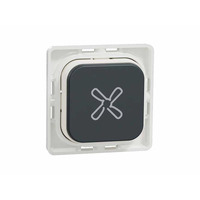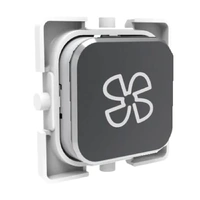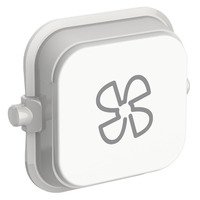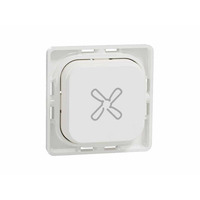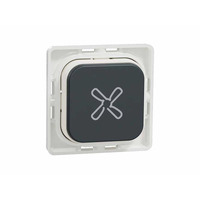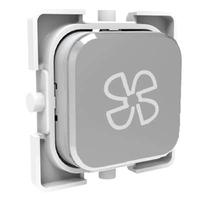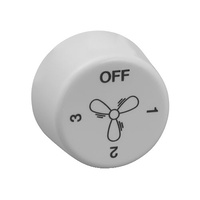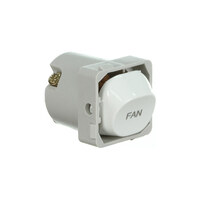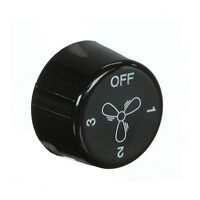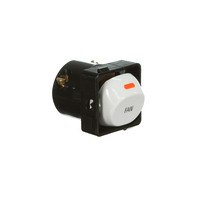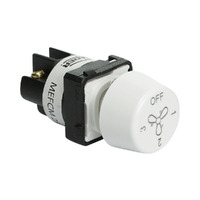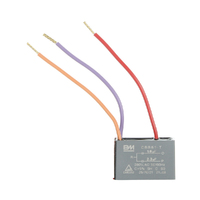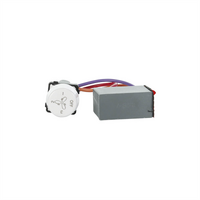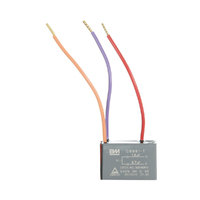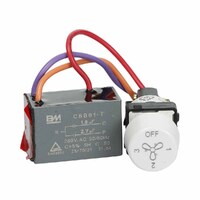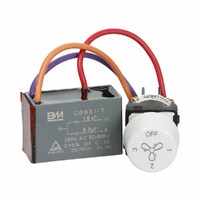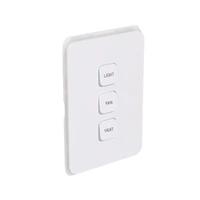


Push Button Only
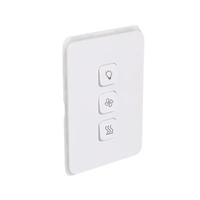
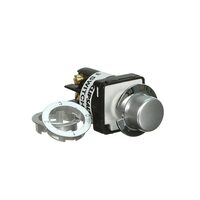
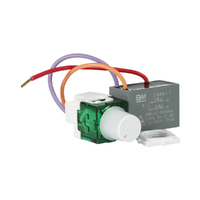
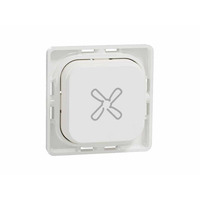
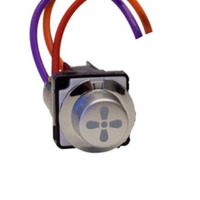
Clipsal Iconic E40APBF-AW | Iconic Fan Push Button Assembly | Arctic White | Single Buy
$2.82
$2.56 ex. GST
Search Results:
Search Results:
Find the best ceiling fan switches here at Sparky Direct [ Read More ]
A ceiling fan switch is a wall-mounted or remote device that controls a fan motor. It sets the speed, turns the motor on or off, and in some models reverses the direction of rotation. A ceiling fan switch is rated for inductive loads. It is engineered to handle the starting surge and steady current drawn by a fan motor without overheating or failing.
These controls come in several different physical formats and electrical topologies. Rotary mechanisms sit inside a standard Clipsal or Legrand wall plate system. Remote control kits replace or supplement the wall switch with a handheld transmitter and canopy receiver. Smart units integrate with Zigbee or Wi-Fi home automation platforms. The Sparky Direct catalogue stocks options across the full range of light switches and the dedicated range of fan speed controllers.
A standard rocker light switch is designed for resistive loads. Incandescent globes, heaters, and most LED drivers fall into this category. A ceiling fan motor is an inductive load, which behaves differently. When an inductive load is switched, the motor coil generates a back-EMF spike that can pit the contacts of a non-rated switch.
Using a standard light switch on a fan typically causes three problems. First, repeated contact arcing progressively shortens switch life and eventually welds the contacts closed. Second, motor speed cannot be stepped down, so the fan runs only at its full design speed. Third, the capacitor inside the fan motor receives no speed control signal and simply stays idle. A purpose-built fan speed controller provides the tapped output voltage or phase-cut waveform that the motor windings expect during normal operation.
Most AC ceiling fans use a multi-tap capacitor arrangement to set each available speed. The fan controller selects which tap is energised through a rotary switch or slider mechanism. Each capacitor tap feeds a different voltage to the motor windings, producing a correspondingly different rotational speed. A typical Australian rotary mechanism offers four selectable positions: off, low, medium, and high.
DC ceiling fans operate on a fundamentally different control principle. The fan contains an internal driver board that accepts a low-voltage signal or radio-frequency command from the controller. A compatible remote or smart controller sends the appropriate command, and the onboard driver converts mains power into a precisely variable DC voltage delivered to the motor coils.
The category covers five main formats. Each suits a different fan type and user preference.
Capacitor speed control remains the most common method for AC fan installations across Australia. The controller switches different capacitor values in series with the primary motor winding. A larger capacitance permits more current through the winding, thereby running the motor at a correspondingly faster rotational speed.
Each rotary position taps a fixed capacitor, giving three to four discrete speeds. Capacitor controllers are simple, robust, and relatively quiet. They do not produce the electrical buzz that triac controllers sometimes generate at lower speeds.
Triac controllers chop the incoming mains waveform electronically. They pass only part of each half-cycle to the motor, reducing the average delivered voltage and slowing the fan. This method delivers smooth variable speed rather than a fixed number of discrete steps.
The main trade-off with triac control comes from harmonics. Some fan motors hum or buzz audibly when running on a phase-cut controller at lower speed settings. Manufacturers specify which fan models are triac-compatible in their technical product data sheets.
DC ceiling fans use pulse-width modulation inside the fan canopy. The external controller sends a command, and the onboard driver rapidly turns the DC supply on and off. By varying the on-time ratio, the driver sets motor speed.
PWM gives six or more speed steps in most DC fans. It also runs cooler and draws less standby power than AC capacitor control. DC fans from brands like Ventair and Mercator ship with their own matched remotes.
AC and DC fans are not interchangeable at the controller. An AC fan speed controller supplies mains voltage at different levels. A DC fan expects a signal to its internal driver, not a variable mains voltage. Using the wrong controller can damage the fan motor, the driver board, or both.
Always match the controller to the fan type stated on the fan label. If the fan came with a remote, keep that remote as the primary controller and do not hard-wire a rotary switch downstream of the receiver.
Fan speed controllers carry a VA or watt rating on their product data sheet. Common values are 75VA, 100VA, and 150VA across the Australian trade range. The rating must equal or exceed the fan motor load, not the separate lamp load on any combined unit. A typical 1200mm AC ceiling fan draws 60 to 75VA continuously, so a 75VA controller sits right at the upper limit of its design envelope.
For any controller feeding multiple fans on a single circuit, simply sum the individual motor VA figures before selecting hardware. As an illustrative example, running three fans at 65VA each requires a controller rated at 200VA or higher to avoid thermal overload.
Standard fan wiring typically uses 1.5mm twin-and-earth or three-core-plus-earth flexible cable. A three-core cable becomes necessary when the wall switch controls both the fan speed mechanism and a separate integrated light on the fan itself. The active, neutral, earth, and switched fan-active conductors must all terminate correctly at the canopy termination block inside the fan housing.
All fixed wiring must comply with AS/NZS 3000:2018, the current Wiring Rules. Installation is licensed electrical work in every Australian jurisdiction. Refer to the ceiling rose range for compliant fan-connection accessories and cable-management hardware.
Universal fan controllers, such as the Trader Meerkat rotary range, work with most 240V AC ceiling fans. They are useful where the original controller has failed, and the fan brand is unknown or out of production.
Brand-specific controllers match a particular mounting plate and colour range. The Clipsal Iconic fan controllers range fits only the Iconic plate system. Brand-matched controllers look neater on a multi-gang plate where other mechs share the same aesthetic.
Always start the selection process with the fan compliance label. The label clearly states whether the motor is AC or DC, the continuous power draw in watts, and whether a proprietary factory remote is required for operation. Match the controller type carefully to these three fundamental electrical specifications.
For a standard AC fan without a factory remote, a four-position rotary switch on the wall is the simplest choice. For a DC fan, use the supplied remote or a compatible replacement from the same brand family.
Wall switches provide a fixed, reliable, and always-findable control point on the room perimeter. They suit common areas and rooms where multiple occupants operate the fan throughout the day. Rotary and slider mechanisms do not require batteries and rarely fail within their rated mechanical lifespan.
Remote controllers add significant convenience in bedrooms and lounge rooms. They let the user change fan speed or direction without leaving the couch, bed, or workstation. The main practical downside is battery replacement every one to two years, plus the ever-present risk of a misplaced or damaged handpiece.
Multi-speed controllers offer three or four predefined fixed operating steps. They are predictable and match the rotational speeds the motor was originally tuned for during factory calibration. Variable speed controllers provide a continuous adjustment range from minimum to maximum without discrete intermediate positions.
For AC fans, fixed-step capacitor control usually runs quieter than continuous triac control. For DC fans, the onboard driver produces six or more smooth steps via PWM regardless of the external control format.
Motor hum at low speed is the most common complaint with fan controllers. Capacitor-based mechs are the quietest option on AC fans. Cheap triac units can produce an audible buzz at low speeds.
If a fan starts humming on a phase-cut dimmer-style controller, switch to a capacitor-based rotary mechanism instead. The unwanted motor noise usually disappears immediately after the swap. The dimmer range is not interchangeable with fan controllers, despite superficial similarity in appearance and form factor.
A smart fan controller is a wall mech that connects to a home network. It uses Zigbee, Wi-Fi, or a proprietary protocol to accept commands from a phone app or voice assistant. Clipsal Iconic Connected and Major Tech models lead this segment in Australia.
These controllers still provide physical buttons on the wall for manual override. The smart function sits on top of normal operation, so the user never loses direct control.
Most smart fan controllers integrate with Google Home, Amazon Alexa, and Apple HomeKit. Some also support Matter, the new cross-brand standard. Zigbee units need a hub such as the Wiser Gateway, whereas Wi-Fi units connect directly to the home router.
Check the smart solutions range for compatible hubs and sensors. A temperature sensor paired with a smart fan can automate cooling based on room conditions.
Scheduling lets the fan turn on before occupants arrive home. A summer schedule might run the fan at medium speed from 3 pm to 11 pm. A temperature trigger adds another layer: the fan starts only when the room exceeds a set threshold.
Energy savings from smart controllers come from two independent sources. Ceiling fans consume far less electrical power than air conditioning when maintaining a comparable comfort level in a given room. Automation also stops fans running needlessly in empty, unoccupied rooms during the day. Combined together, these two effects typically cut cooling energy consumption by 15 to 30 per cent across Australian summer months.
Ceiling fan controller installation constitutes restricted electrical work in every Australian state and territory jurisdiction. Only a suitably licensed electrician may legally connect a fan controller to the mains supply wiring. This rule covers rotary mechanisms, canopy-mounted remote receivers, and smart Zigbee or Wi-Fi controllers alike.
Do-it-yourself installation by unlicensed persons is strictly illegal and automatically voids home insurance policies. It also creates a serious risk of electrical fire, lethal electric shock, and permanent damage to the fan motor assembly.
AS/NZS 3000:2018, the Wiring Rules, governs all fixed electrical installations in Australia and New Zealand. Fan controllers must be installed within the rules for final subcircuits, isolation, and conductor sizing. The circuit must have RCD protection in line with the current edition.
Enclosure ingress-protection rules apply specifically in bathrooms, laundries, and wet areas. Zone ratings defined in the Wiring Rules determine whether a given controller can safely be mounted near a bath, basin, or shower enclosure. When uncertainty arises on a specific job, check the safety switches range for a compliant residual current device protection suitable for the installation zone.
Three mistakes recur in fan controller jobs. The first is an undersized VA rating, which causes the controller to overheat and fail within months. The second is using a light dimmer on a fan motor, which damages both devices.
The third is reversing the active and switched active at the fan canopy. This leaves the fan motor energised when the switch is off, creating a shock hazard during any later servicing.
Replace a fan controller when speed steps begin failing, when the mechanism buzzes audibly at all positional settings, or when the fan runs visibly slower than it previously did on the same nominal setting. A gradually failing capacitor inside the controller is the most common underlying cause of this progressive speed loss over time.
Physical damage to the knob or wall plate is cosmetic only in most cases. The internal mech itself can usually be kept in service, with only the damaged knob or surround replaced. The switch mechanisms range covers mech-only replacements compatible with most Clipsal and Legrand wall plate systems.
An upgrade to a smart fan controller adds automation without replacing the fan. The old rotary mech pops out of its plate, and the smart mech clicks in. Wiring is typically identical: active, neutral, earth, and switched fan-active.
Zigbee upgrades typically require a dedicated gateway hub on the home network. Wi-Fi upgrades connect directly to the router but consume a separate Wi-Fi device slot per controller installed. Plan the hub location and network capacity carefully before beginning any physical installation work.
Take a photo of the existing plate and mech before ordering a replacement. The plate grid, surround, and mech need to match if only one element is being changed. Clipsal Iconic, Saturn, and 2000 series plates are not interchangeable.
For older fans without a factory-supplied remote, a universal rotary mechanism is the fastest practical swap. For fans already equipped with a canopy-mounted receiver, order the matching handset from the same original manufacturer. Mixing brands on receiver-based fan systems usually fails due to incompatible radio pairing protocols.
Entry-level rotary mechanisms start below $30 at wholesale trade pricing. These are perfectly suitable for low-traffic rooms and rarely adjusted fan installations. They use a basic capacitor-switching topology and a standard rotary dial interface.
Premium mechs from Clipsal Iconic or Saturn run $60 to $120. They offer better plate finishes, smoother action, and compatibility with smart surrounds. The mechanical life is longer, typically 50,000 cycles versus 20,000 for budget units.
For trade customers doing multiple fits, the sweet spot sits with Clipsal 30CSFM, Clipsal Iconic 40CSFM, and Legrand EM3FCWE. These units are stock standard across domestic fan installs and carry the brand support electricians trust.
Buying in multipacks through Sparky Direct cuts per-unit cost. Cable is a separate line item, covered in the accessories category alongside compatible switch plates and mechanisms.
A fan controller typically lasts 10 to 15 years in normal use. Annualised, the difference between a $30 unit and a $90 unit is six dollars a year. The premium unit avoids one callback at $150 per hour of electrician time, so the total cost is usually lower.
Always factor motor wear into the total lifecycle calculation. A well-matched, correctly rated controller extends fan motor service life by delivering smoother low-speed current waveforms to the windings. A cheap, mismatched controller can effectively cut useful motor life in half through increased electrical and thermal stress.
Sparky Direct stocks fan controllers from major Australian brands: Clipsal, HPM, Legrand, Hager, Martec, Mercator, Ventair, and Trader. Full trade pricing applies to licensed electricians. Current stock is listed online with tech sheets and compliance marks on each product page.
Compatible ceiling fan remotes and ceiling fans are also available. Buying the fan and controller together avoids mismatch issues.
Check five essential items before placing any order. The VA rating must meet or exceed the continuous fan motor load with adequate headroom. The mounting format must match the wall plate system already installed on the premises. The controller colour must match the existing plate aesthetic, or be accompanied by a full plate replacement package.
The AC or DC motor designation must exactly match the target fan type. The Australian approval number should also be clearly visible on the product data sheet, confirming full compliance with the applicable electrical safety certification marks.
Sparky Direct ships Australia-wide from warehouses stocked for fast dispatch. Most orders placed before early afternoon go out the same day. Regional customers typically receive stock in two to four business days.
Bulk trade orders can be pre-staged on request for large-site rollouts and multi-residence projects. Brisbane, Sydney, and Melbourne metropolitan deliveries are usually next-business-day. Real-time stock availability levels are visible directly on each individual product page within the catalogue.
If the fan stays off at all controller positions, check three points. First, test the circuit breaker at the switchboard. Second, confirm that the controller receives mains voltage at its input terminals. Third, verify that the switched active reaches the fan canopy.
If a controller tests operational across all positions but the fan fails to run, the internal controller capacitor has most likely failed electrically. Replace the entire mech unit immediately. Never attempt to repair or substitute the internal capacitor component on the bench.
A humming fan on low speed usually indicates a mismatch between the controller topology and the motor design. Swap a triac-based unit for a capacitor rotary mechanism, and the acoustic noise typically stops immediately. Grinding or scraping noise points to motor bearing failure inside the fan itself, not the external controller.
Slow speed across all settings suggests a weak capacitor in either the controller or the fan canopy. Test with a known-good controller before condemning the fan.
For RF remote kits, replace the remote batteries first. If the light on the handpiece lights but the fan does not respond, check that the remote and the canopy receiver are paired. Most units have a dip-switch or learn-button pairing process in the installation sheet.
For smart Zigbee controllers, always check the hub connectivity status first. A disconnected gateway breaks communication with all associated connected devices simultaneously. Re-pairing after a hub reset or firmware update is usually straightforward through the manufacturer's mobile application.
Club Clipsal is Australia's largest electrician community offering trade rewards, business support, and exclusive benefits. When you nominate Sparky Direct as your preferred wholesaler, we automatically apply your Clipsal spend points to your Club Clipsal account daily.
Entry-level offering coaching, mentoring, and training discounts
Unlock exclusive industry tools and networking events
Access Toyota fleet offers and business software discounts
Maximum benefits, including VIP experiences and rewards
1. Sign Up: Create your Club Clipsal account at clipsal.com/club-clipsal or via the iCat mobile app
2. Nominate Sparky Direct: Select Sparky Direct from the wholesaler dropdown menu in your profile
3. Add Email: Enter your Sparky Direct account email address in the membership number field
4. Start Earning: Every dollar spent on Clipsal products earns points automatically
Redeem points from the rewards store, including gift cards, tools, and experiences. Access business summits, product training, and industry networking events. Receive early access to new product launches and special promotions. Connect with fellow electricians via the Club Clipsal community app.
Watch Clipsal Iconic 40CSFM-VW | Fan Speed Controller, 4-Position Off-1-2-3, 250V, 75VA video
Watch Clipsal Iconic 41ECSFWMZ-VW | Connected AC Fan Controller | Zigbee video
Watch MERCATOR FRM97 | Non-Dimmable LCD RF Remote Controller video

Would definitely recommend the company Sparky Direct for all your electrical component needs. They have a large range, especially for items that are hard to find. We were looking specifically for a black fan controller and we found it instantly on the website. The website was so easy to use, especially finding the product.
I just bought a replacement Clipsal switch for my ceiling fan. The store is just 15 mins away so I arranged to pick it up today (no postage!) and even, not the handyperson at all, had no trouble replacing it! My fan is working just fine again. Thank you!
Designed for the Clipsal Iconic plate, no more pushing mechs in and out and wearing down the tabs, the sliding latch holds it secure. Looks great, works well. 1000% better than installing the fan controller that comes with the fan these days.
Quality products in stock • Fast Australia-wide delivery • Competitive trade pricing
Browse Ceiling Fan Switches → Get Expert Advice →Fan controllers themselves are typically quiet, with noise more dependent on the fan motor.
Sparky Direct supplies fan controllers with fast Australian delivery to support reliable ceiling fan control solutions.
Yes, fan controllers must be installed by a licensed electrician under Australian regulations.
Warranty coverage varies by manufacturer and usually applies to manufacturing defects.
Check fan compatibility, motor type, control style, and installation requirements.
Yes, fan controllers are available in a range of styles to match common wall switch designs.
Fan controllers generally require minimal maintenance beyond normal electrical checks.
Yes, provided the controller is compatible with the fan and installation environment.
When correctly installed and used within rated limits, fan controllers are designed for safe operation.
Like all electrical components, fan controllers may wear with use and may need replacement eventually.
Yes, they are commonly used in bedrooms for convenient fan speed control.
Some fans use either wall controllers or remotes, while others support both depending on design.
Yes, many fan controllers are designed to fit standard wall plates with other switches.
Fan controllers are used to control the speed and operation of ceiling fans, allowing adjustment of airflow to suit comfort needs.
Yes, fan controllers allow quick adjustment between speed settings.
Most fan switches are designed for simple and intuitive everyday operation.
Yes, installation of fan controllers must be completed by a licensed electrician.
Yes, smart fan controllers allow app-based or smart home system control, depending on compatibility.
Yes, they can be installed in both new builds and retrofits, subject to wiring suitability.
Some controllers are designed for AC fans, while DC fans often require manufacturer-specific controllers.
Yes, most fan controllers offer multiple speed settings to adjust airflow.
Compatibility depends on the fan motor type and controller rating, so manufacturer specifications should be checked.
Common types include rotary switches, push-button controllers, slide controls, remote controls, and smart fan controllers.
Fan controllers supplied in Australia should comply with relevant AS/NZS electrical safety standards.
Yes, fan controllers are specifically designed for motor loads, while light dimmers are designed for lighting circuits.