
Search Results:
Search Results:
Search Results:
Search Results:
Emergency and exit lighting are critical safety systems designed to illuminate escape routes and exit locations during power failures or emergency situations such as fires. These systems operate automatically when normal power supply fails, ensuring building occupants can safely evacuate in darkness or smoke-filled conditions.
Emergency lighting activates automatically when mains power drops below 87% of normal voltage. The battery backup ensures continuous illumination for the duration required by building classification and occupancy type.
The primary Australian Standard governing emergency lighting is AS/NZS 2293 - Emergency escape lighting and exit signs for buildings. This standard comprises three parts that define design, installation, maintenance, and product requirements.
Part 1 specifies where emergency lighting must be installed, minimum illumination levels, battery duration requirements, and wiring system classifications. Emergency lighting circuits require a WS4X wiring system rating to ensure fire protection during emergencies.
Part 2 outlines mandatory inspection and testing schedules. Licensed electricians must conduct monthly visual inspections, six-monthly functional tests, and annual battery discharge tests to verify system reliability.
Part 3 defines product performance standards, including battery capacity, light output, charging systems, and durability requirements. All emergency lighting products sold in Australia must comply with this standard.
Important: Emergency lighting falls under AS/NZS 2293, which is separate from AS 1319 (Safety signs for occupational environments). Exit signs inside buildings must comply with AS/NZS 2293.1, not AS 1319.
Emergency lighting systems are categorized by their operating modes and power arrangements. Understanding these distinctions helps select appropriate products for specific applications.
Each self-contained emergency light includes an integral battery, charger, and lamp within a single housing. These units are the most common solution for small to medium buildings due to their simplicity and lower installation costs.
Self-contained units connect to a dedicated emergency lighting circuit that remains permanently energized. When mains power fails, the internal battery automatically powers the LED lamp for the required duration.
Central battery systems use a single battery bank (typically in a dedicated plant room) to supply power to multiple emergency luminaires throughout the building. This arrangement offers advantages for large facilities including centralized monitoring, easier battery replacement, and potentially lower lifecycle costs.
| Type | Operation | Typical Applications |
|---|---|---|
| Maintained | Operates continuously using mains power; switches to battery during failure | Public venues, cinemas, theatres, 24-hour facilities |
| Non-Maintained | Only operates during power failure using battery power | Offices, warehouses, retail stores, schools |
| Sustained | Part of normal lighting circuit but has battery backup capability | General lighting that must remain on during emergencies |
Exit signs identify the location of exits and the direction of egress routes. AS/NZS 2293.1 specifies exact requirements for exit sign placement, size, color, and illumination.
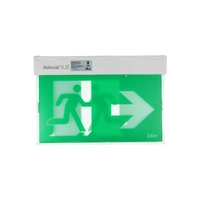
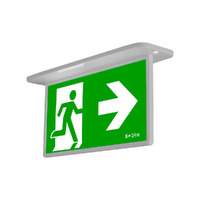
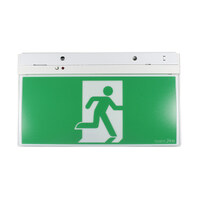
Australian exit signs feature the international pictogram of a running person toward a door, typically with directional arrows. The standard color scheme uses green background with white pictogram and text.
Exit signs are available in multiple mounting configurations to suit different building designs and ceiling types.
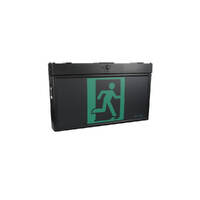
The 4.5W surface mount LED exit installs directly onto walls or ceilings with visible mounting hardware. Ideal for solid surfaces and retrofit applications.
Flush installation within ceiling cavities provides a clean, streamlined appearance. The slim recessed LED exit sign suits modern commercial interiors.
Suspended signs hang from ceiling-mounted brackets, providing visibility from multiple directions. Commonly used in large open areas and retail spaces.
Double-sided signs project perpendicular from walls, visible from both directions along corridors and hallways.
Proper installation of emergency and exit lighting ensures compliance with the National Construction Code (NCC) and AS/NZS 2293.1. Licensed electricians must follow specific wiring and circuit requirements.
Emergency lighting circuits must be wired according to AS/NZS 3000:2018 (Australian Wiring Rules) with specific fire protection ratings.
Only licensed electricians may install emergency lighting systems. In Queensland, electrical mechanics holding Licence Class EC (Electrical Contracting) or RE (Restricted Electrical) can perform this work, provided they understand AS/NZS 2293 compliance requirements.
After installation, emergency lighting systems must undergo commissioning tests to verify compliance. These tests include:
Professional Consultation: Complex emergency lighting designs require input from electrical engineers or fire safety consultants to ensure compliance with building classification and occupancy requirements. Contact a qualified professional for buildings with multiple levels, high occupancy loads, or special hazard areas.
Modern LED emergency lights and exit signs offer significant advantages over traditional fluorescent and incandescent technologies, making them the preferred choice for new installations and retrofits.
LED technology draws substantially less power than fluorescent lamps, allowing smaller, lighter batteries to achieve the required 90-120 minute duration. This reduces replacement costs and simplifies installation.
LED lamps typically last 50,000+ hours compared to 8,000-15,000 hours for fluorescent tubes. This longevity dramatically reduces lamp replacement frequency and associated labor costs over the system's lifespan.
LEDs withstand vibration, impact, and temperature variations better than fragile fluorescent tubes. They reach full brightness instantly without warm-up time, crucial during emergency situations.
LED emergency lights consume 60-80% less energy than equivalent fluorescent units during both normal operation (maintained mode) and battery operation. This efficiency reduces electricity costs and extends battery capacity.
| Feature | LED Emergency Lighting | Fluorescent Emergency Lighting |
|---|---|---|
| Lamp Life | 50,000+ hours | 8,000-15,000 hours |
| Power Consumption | 2-8W typical | 8-36W typical |
| Start-up Time | Instant | 1-3 seconds |
| Durability | High (solid-state) | Low (glass tubes) |
| Operating Temperature | -20°C to +50°C | 5°C to +35°C optimal |
AS/NZS 2293.2 mandates specific inspection and testing schedules to ensure emergency lighting remains operational. Building owners and facility managers bear legal responsibility for maintaining these critical safety systems.
Competent persons must conduct visual checks of all emergency lighting and exit signs monthly. This inspection verifies:
Every six months, simulate a power failure to verify all emergency lights activate correctly. Test each unit for:
Once yearly, conduct full battery discharge tests to verify each unit achieves the required 90 or 120 minute duration. This comprehensive test identifies aging batteries requiring replacement before they fail during actual emergencies.
Maintain detailed log books recording all inspections, tests, repairs, and battery replacements. These records demonstrate due diligence and compliance during inspections by building surveyors or fire safety officers.
Emergency lighting batteries typically require replacement every 4-5 years, depending on usage, ambient temperature, and battery technology. Modern lithium batteries may offer extended service life up to 10 years in optimal conditions.
Selecting appropriate emergency lighting products requires consideration of building classification, occupancy type, mounting locations, and aesthetic requirements.
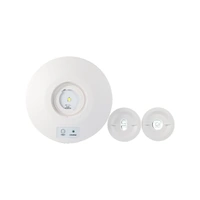
Spitfire emergency lights feature one or more adjustable lamp heads that can be directed to illuminate specific areas. The dual-lens configuration is particularly effective for corridors and stairwells where directional lighting is required.
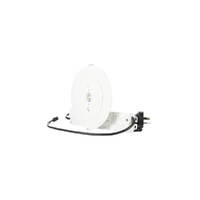
The NLS 20258 EMXFIRE Emergency 3W LED Spitfire combines an illuminated exit sign with twin 3W LED emergency lamps, providing both wayfinding and illumination in a single, compact unit suitable for residential and light commercial applications.
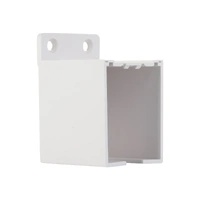
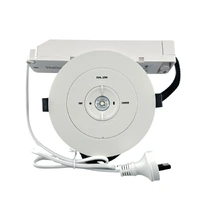
Quickfit mounting systems simplify installation and removal for maintenance. These units feature plug-in or twist-lock connections that allow rapid lamp and battery replacement without disconnecting wiring.
Sparky Direct stocks a comprehensive range of emergency and exit lighting.
Browse our complete emergency lighting range online with detailed product specifications, installation guides, and compliance information. Secure checkout with multiple payment options.
Fast freight to all Australian states and territories via trusted carriers. Regional and remote areas are serviced with trackable shipping and delivery notifications.
Sparky Direct has supplied the Australian electrical trade since 2005, earning a reputation for quality products, reliable service, and technical expertise. Our emergency lighting range includes products from leading manufacturers, ensuring compliance with AS/NZS 2293 and reliable performance.
Compare specifications and pricing across our full emergency lighting range at sparkydirect.com.au
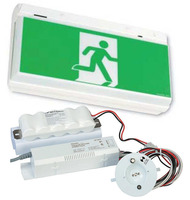
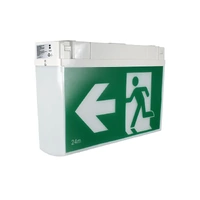
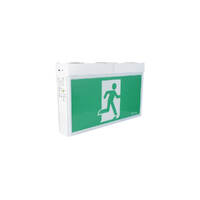
Learn more by watching our NLS 20259NLS-LEDEXIT | Maintained Emergency Quickfit LED Exit Light video.
Learn more by watching our NLS 20258 | EMXFIRE Emergency 2W LED Spitfire | Dual Lens video.
Learn more by watching our XLED XEX24SML-B | 4.5w surface mount led exit | Black video.

Excellent quality. Easy to fit, great value.
This Bright LED Exit/Running Man Emergency Light is fantastic for the price. It is so easy to install and maintain. I recommend this great product from Sparky Direct as a replacement for old emergency lights or as a new installation.
Quickfit was easy to install, and nice clean finish
Trusted brands • Expert advice • Fast Australia-wide delivery
Shop Emergency and Exit Lighting →Get Expert Advice →Yes. All signs come with manufacturer warranties that usually cover the fitting and electronics.
Make sure they meet AS 2293, check how long the battery lasts, look at the mounting type, and confirm the warranty. Our product pages have all the key info.
Yes. We stock a wide range of signs ready for use in commercial and trade settings across Australia.
Yes. LED signs are made to stay bright and easy to see, even during a blackout.
Above exits and along escape routes, based on your building’s layout and safety rules.
No. If it's connected to mains power, a licensed electrician must do the job under Australian law.
Batteries often last several years. Regular testing helps spot any that are failing early.
Regular testing is required under AS 2293. A licensed electrician or building manager usually handles it.
Some stay on all the time (maintained). Others only turn on when the power goes out (non-maintained).
Exit signs show where to go. Emergency lights brighten up spaces like stairs and hallways during a blackout.
Exit Sign & Emergency Exit Signs show people where to go during power outages or emergencies. They’re a key part of safety lighting in commercial buildings.
You can mount them on ceilings, walls, or suspend them, whatever fits your space best.
Many models come with a test button or automatic self-test feature. Check the product datasheet for details.
Absolutely. They’re made for offices, shops, schools, warehouses, and any site needing compliant emergency lighting.
Yes. Maintained signs are always on. Non-maintained signs only turn on during a power failure.
By law (AS 2293), these signs must stay on for at least 90 minutes if the power goes out.
Most signs run on mains power with a built-in battery that turns on during blackouts. Battery type depends on the model.
Yes. Most systems today use LED signs because they use less power, last longer, and are easy to see.
Yes. All Exit Signs sold by Sparky Direct meet AS 2293 standards when installed and maintained properly.