
Search Results:
Search Results:
Search Results:
Search Results:
Understanding the mechanics behind halogen globes helps tradespeople and buyers specify the right lamp for each application and explain product characteristics to end users.
A standard incandescent globe loses tungsten from the filament as the metal evaporates at high temperature. That tungsten deposits on the glass, darkening it and gradually thinning the filament until it fails. Halogen globes add a small quantity of halogen gas, typically iodine or bromine, to the sealed quartz capsule. At operating temperature, the halogen reacts chemically with tungsten vapour and carries it back to the filament surface. This process is known as the halogen regenerative cycle.
The practical result is a filament that maintains its diameter over a longer service life and a lamp that remains optically clear throughout its rated hours. Because the filament can run hotter than in a standard incandescent, a halogen globe produces more lumens per watt and a whiter light output for a given physical size.
The halogen cycle only works above approximately 250 degrees Celsius. Standard glass softens at these temperatures, so halogen lamps use quartz or hard borosilicate glass, which can withstand the heat without deforming or cracking. This is also why halogen globes must not be handled with bare hands: skin oils contaminate the quartz surface, creating hotspots that cause premature failure.
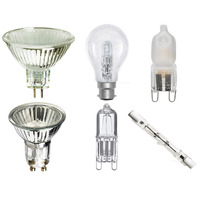
Halogen globes are manufactured in two main physical configurations. Single-ended globes have both electrical connections at the same base. This covers capsule globes used in pendant and table lamp fittings, and reflector types such as MR16 and GU10 used in downlight and accent lighting applications.
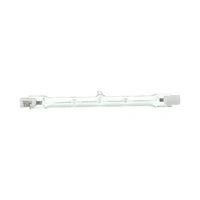
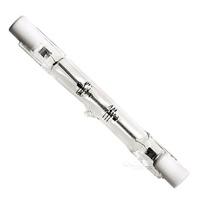
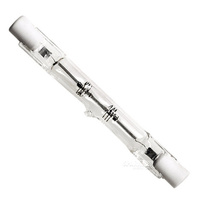
Double-ended linear halogen lamps have a connection at each end of the tube. These are designed for floodlight housings, security lights, outdoor area luminaires, and architectural fittings where a long, narrow light source is required. The R7s cap is the most common base type for double-ended linear lamps. Both configurations are available through the light globes range at Sparky Direct.
Halogen globes reach full brightness instantly and dim smoothly across their full output range. CFL globes require a warm-up period and perform poorly with most dimmer switches. LEDs are significantly more energy-efficient and last considerably longer than halogen, which is why LED has become the standard for new installations and retrofits.
Where halogen remains the preferred specification is in applications where colour accuracy is critical. Halogen produces a continuous visible spectrum with CRI values between 95 and 100. Most standard LED light bulbs achieve CRI 80 to 90, which is adequate for general lighting but may not meet the standard required in retail display, food presentation, art galleries, or photography environments. High-CRI LED products are available but carry a price premium over standard LED.
| Characteristic | Halogen | LED | CFL |
|---|---|---|---|
| CRI | 95 to 100 | 80 to 95+ (varies by product) | 70 to 85 |
| Instant full brightness | Yes | Yes | No (warm-up required) |
| Dimmable | Yes, with leading-edge dimmers | Yes, with compatible dimmers | Rarely |
| Rated lifespan | 1,000 to 5,000 hours | 15,000 to 50,000 hours | 6,000 to 15,000 hours |
| Energy efficiency | 10 to 15% of input as light | 40 to 60% of input as light | 20 to 30% of input as light |
| Colour temperature range | 2,700K to 3,200K | 2,700K to 6,500K | 2,700K to 6,500K |
Halogen globes are available in a wide range of shapes and cap types. Selecting the correct combination of these factors ensures the globe fits the fixture and produces the right light output for the application.
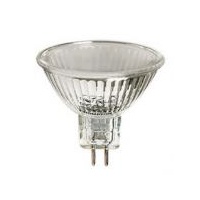
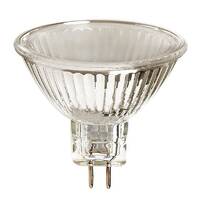
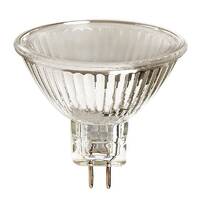
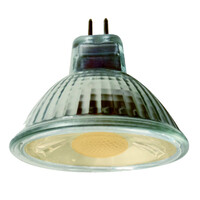
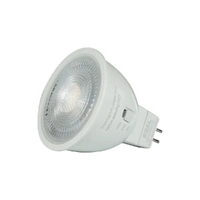
MR16 reflector globes have a 50mm diameter reflector with a GU5.3 pin base and operate at 12 volts. They are widely used in recessed downlight systems, display cases, and accent lighting where a directional beam is needed. MR11 globes use the same pin-base system at a smaller 35mm diameter, suited to compact fittings where space is limited.
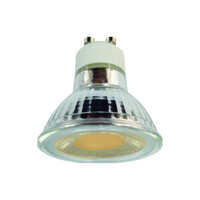
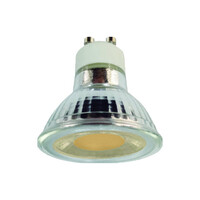
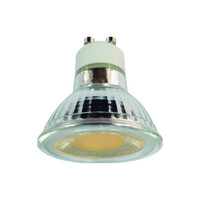
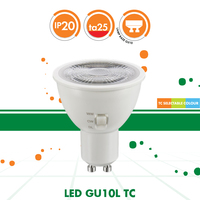
GU10 globes are mains voltage (240V) twist-lock lamps in a PAR16 reflector format. They are the standard fitting in most residential and commercial ceiling downlight housings manufactured since the mid-2000s. Capsule halogen globes are compact single-ended lamps used in pendant fittings, table lamps, and decorative luminaires. Double-ended linear lamps are used in outdoor floodlights, security lights, and architectural strip fittings.
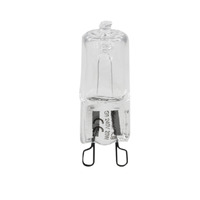
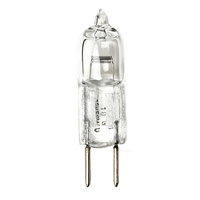
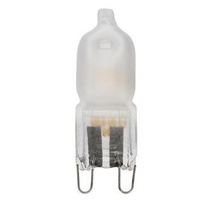
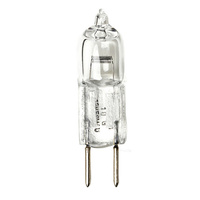
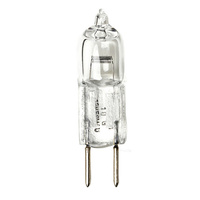
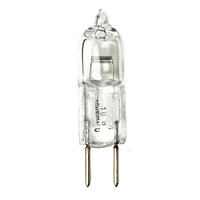
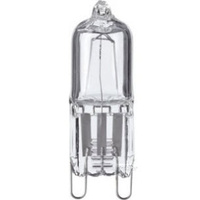
The cap type must match the fitting socket exactly. Bayonet cap (B22) and Edison screw (E27) bases appear on some halogen A-shape and reflector globes designed for domestic lamp holders. GU5.3 pin bases are the standard for MR16 low-voltage reflectors, and GU10 is the standard for mains-voltage twist-lock reflectors. G4 and G9 pin bases are used on capsule halogen lamps. R7s is the double-ended base used on linear halogen tubes.
Mismatched cap types are the most common cause of incompatible globe purchases. Always check the fitting socket and the globe specifications before ordering. The downlight transformer type in the circuit must also match the globe: MR16 12V lamps require either a magnetic or electronic low-voltage transformer, and the transformer must be sized correctly for the total lamp load connected to it.
Halogen globe wattages range from 10W capsule lamps through to 500W linear tubes. Lumen output scales directly with wattage: a 50W MR16 produces approximately 800 to 900 lumens, while a 300W linear lamp produces around 5,000 lumens. The wattage selected must not exceed the maximum rating printed on the fixture. Exceeding the rated wattage can cause heat damage to the fitting, surrounding insulation, or building materials.
Maximum wattage ratings: The maximum wattage for a fitting is a safety limit, not a recommendation. Fitting a globe that exceeds the rating voids the product warranty and may create a fire risk, particularly in enclosed or recessed installations. Check the label inside the fitting before specifying a replacement globe.
One of the most valued characteristics of halogen globes is their smooth, predictable dimming performance. This section covers how halogen responds to dimmer switches and what to consider when reviewing dimmer compatibility.
Halogen globes are inherently dimmable. Reducing the supply voltage through a dimmer switch lowers the current through the filament, which reduces its temperature and light output. As the filament temperature drops, the emitted light shifts to a warmer, more amber colour. This warm dimming effect closely matches the behaviour of a candle or firelight and is considered aesthetically superior to the dimming behaviour of most LED alternatives, which tend to maintain a fixed colour temperature as they dim.
Halogen globes are compatible with standard leading-edge (TRIAC) dimmer switches, which are the most common type installed in Australian homes. No additional equipment is required. The dimmer simply controls voltage to the fitting, and the globe responds accordingly. Dimmable LED globes are an alternative for energy efficiency, but dimmer compatibility must be verified carefully before specification.
When a halogen installation is retrofitted with LED globes, the existing dimmer must be checked for compatibility. Leading-edge dimmers are designed for resistive loads such as halogen filaments. Many of these dimmers perform poorly with the capacitive or electronic driver loads in LED lamps, causing flickering, buzzing, or incomplete dimming range.
Most leading-edge dimmers also have a minimum load requirement, typically 40W to 100W. Replacing a 200W halogen load with four 7W LED globes reduces the total load to 28W, which falls below the dimmer's minimum threshold. The result is flickering or the dimmer failing to switch off fully. In this case, replacing the dimmer switch with a trailing-edge or LED-compatible dimmer is the correct solution.
Hospitality environments including restaurants, bars, and hotel lobbies rely on halogen dimming to create consistent, controllable ambience. The warm dimming characteristic of halogen matches the aesthetic expected in these spaces and is difficult to replicate with budget LED products. Residential living rooms, dining rooms, and bedrooms benefit from the same quality, particularly in homes where the existing dimmer infrastructure is suited to halogen loads. Retail display and gallery lighting also continues to use halogen in applications where colour fidelity under variable light levels is the primary specification criterion.
Running a halogen globe at reduced output through dimming lowers the filament temperature, which slows the rate of tungsten evaporation and can extend lamp life measurably. Operating a 50W globe at 80% output is a common trade practice in applications where lamp replacement is difficult or frequent relamping is disruptive. The trade-off is reduced lumen output, which must be factored into the lighting design.
Colour temperature and colour rendering index are the two specifications that most clearly differentiate halogen from competing light sources. Both are important selection criteria in colour-critical applications.
Halogen globes emit light in the range of 2,700K to 3,200K. This is a warm white to neutral white light output that closely matches the appearance of traditional incandescent lighting. Standard capsule and reflector halogen globes typically operate at around 2,900K to 3,000K. Higher-wattage linear halogen lamps, which run at higher filament temperatures, tend to produce slightly cooler light in the 3,000K to 3,200K range.
The warm colour temperature of halogen light suits residential living areas, hospitality spaces, and retail environments where the goal is to create a comfortable, inviting atmosphere. It is less suited to task-critical environments such as laboratories or workshops where a cooler, more neutral light is preferred. For those applications, daylight LED downlights in the 5,000K to 6,500K range are more appropriate.
A light source with a CRI of 100 reproduces all colours exactly as they appear in natural sunlight. Halogen globes produce a continuous spectrum of visible wavelengths, which means no colour is under-represented or distorted. CRI values between 95 and 100 are typical across halogen product ranges.
The practical effect is that surfaces, fabrics, skin tones, and merchandise all appear true to their actual colour under halogen light. This characteristic makes halogen the preferred light source for retail display lighting, food presentation counters, art conservation and gallery lighting, and photography studios. When colour accuracy is the primary specification requirement, halogen remains the most cost-effective solution with no dimmer compatibility risk.
Standard LED globes typically achieve CRI 80 to 85. This is sufficient for general residential and commercial lighting where colour accuracy is not critical. High-CRI LED products with ratings of 90 to 95 or above are available but are priced at a significant premium compared to standard LED. At equivalent CRI, halogen remains competitive on upfront cost, particularly for low-hours-per-day applications.
Discharge lighting sources, including metal halide and high-pressure sodium lamps, produce a discontinuous spectrum with lower CRI values. These sources are unsuitable for colour-critical display work despite their high lumen output and long lifespan. For specialist applications requiring both high CRI and energy efficiency, high-CRI LED or ceramic metal halide are the appropriate alternatives to halogen.
Halogen globes consume more energy than LED for equivalent lumen output and have a shorter rated lifespan. These factors are central to any cost-of-ownership comparison between halogen and LED alternatives.
Halogen globes convert approximately 10 to 15 percent of electrical energy input into visible light. The remainder is lost as heat. This efficiency is marginally better than a standard incandescent globe but significantly lower than LED, which converts 40 to 60 percent of input energy into light.
For a typical 50W GU10 halogen globe producing around 700 to 800 lumens, an equivalent LED product producing the same lumen output consumes approximately 7 to 9 watts. In a residential home with ten downlights operating for six hours per day, replacing halogen with LED reduces globe energy consumption from 3,000 watt-hours to around 420 to 540 watt-hours per day. The energy cost difference is meaningful over a full year of operation.
Standard capsule and GU10 halogen globes have a rated lifespan of 1,000 to 2,000 hours. At six hours of daily use, this represents approximately six months to one year before relamping is needed. MR16 dichroic halogen globes with enhanced coatings may achieve ratings of 2,000 to 3,000 hours. Double-ended linear halogen lamps used in floodlights and security fittings typically carry ratings of 2,000 to 5,000 hours depending on wattage and operating conditions.
By comparison, quality LED globes typically carry rated lifespans of 15,000 to 50,000 hours. The longer replacement interval reduces labour cost for relamping, which is a meaningful consideration in commercial installations with a large number of fittings. Where access for relamping is difficult, such as high-bay industrial fittings or recessed architectural luminaires, the LED lifespan advantage is particularly significant.
In low-use applications such as display cabinets, feature lighting, and seasonal decorative fittings, the lower upfront cost of halogen globes makes them a practical option. A display globe used for two hours per day reaches its 2,000-hour rated life in approximately three years, during which time the energy cost difference over LED is modest.
Trade and commercial settings also continue to use halogen where existing fixtures are not compatible with direct LED retrofit globes, and where replacing the fitting is not immediately feasible. In these cases, halogen globes provide continued operation until a planned retrofit or fixture replacement can be scheduled. The special lamps range includes halogen types for applications where standard LED equivalents are not available. It is also worth noting that the light globes range at Sparky Direct covers both halogen and LED options, so trade buyers can source both from a single supplier.
Australia phased out most standard incandescent globes from 2009 onwards. Halogen globes in reflector formats (GU10, MR16) were not included in the initial phase-out and remain legally available and widely sold. Energy efficiency regulations continue to evolve, and it is advisable to check current Energy Rating Australia guidelines when specifying halogen for new commercial or residential installations.
Correct globe selection requires matching three key specifications to the fitting and the application: cap type, wattage, and beam angle. Errors in any of these lead to incompatible purchases or poor lighting outcomes.
Cap type is the starting point. The base fitting on the globe must match the socket in the luminaire. Confirm the existing cap type by inspecting the fitting directly or checking the lamp already installed. For MR16 fittings, confirm whether the circuit uses a magnetic transformer or an electronic driver, as some LED MR16 replacements require a specific transformer type to operate correctly.
Maximum wattage is printed inside the fitting or on the fitting's label. Never exceed this figure. For reflector globes, beam angle is the third critical specification. Narrow beam angles (10 to 25 degrees) concentrate light into a tight spot, suited to accent lighting, artwork illumination, and display cases. Wide beam angles (40 to 60 degrees) spread light across a broader area and are better suited to general illumination of a room or workspace. Selecting the wrong beam angle for a downlight application results in either harsh glare from an overly concentrated beam or inadequate illumination from a beam that is too diffuse.
Indoor residential applications typically use GU10 or MR16 reflector globes in downlight fittings, and capsule or G9 halogen globes in pendant and table lamp fittings. Outdoor and security applications require either linear R7s lamps in floodlight housings or sealed GU10 reflectors in weatherproof fittings rated for external use. Commercial and retail environments often specify 50W MR16 or GU10 globes with narrow beam angles for display lighting, and higher-wattage linear lamps for outdoor area lighting.
For buyers considering whether an existing halogen fitting can accept an LED retrofit globe, the key questions are whether the cap type is available in LED format (GU10 and MR16 are both well-supported in LED), whether the transformer is compatible with LED drivers in the case of MR16 fittings, and whether the existing dimmer is compatible with the LED load. LED downlights are a common route for full fixture replacement where a direct globe swap is not practical.
Trades and contractors typically purchase halogen globes in multi-pack quantities to reduce per-unit cost and ensure stock is available on-site throughout a project. Specifying a single globe type across an installation reduces the risk of mismatched colour temperatures or beam angles within the same space, which is a common cause of inconsistent lighting in completed projects.
Sourcing from an electrical wholesaler provides access to a broader product range than hardware retail, including less common wattages, beam angles, and base types. Sparky Direct supplies trades across Australia with competitive pricing on halogen globe ranges from brands including Philips, National Light Sources, and SAL Lighting.
Halogen globes require specific handling precautions that are not necessary with LED or CFL lamps. Correct installation practices also reduce the risk of premature failure and ensure compliance with Australian electrical safety requirements.
The natural oils present on human skin transfer to the quartz envelope when a halogen globe is handled without gloves. During operation, these oil deposits cause localised overheating on the quartz surface at the point of contact. The uneven thermal stress this creates can cause the globe to crack or shatter, either during operation or when the lamp is switched on after a period of cooling.
Always handle halogen capsule, MR16, and linear globes using a clean lint-free cloth, disposable gloves, or the globe's original packaging. If a globe is accidentally touched before installation, clean the affected area with isopropyl alcohol on a clean cloth and allow it to dry completely before fitting the globe. This removes the oil residue and eliminates the risk of hotspot damage.
Accidental contact with a halogen globe: If you touch the quartz envelope of a halogen globe, do not install it until the surface has been cleaned with isopropyl alcohol. Fitting a contaminated globe risks premature failure and, in some cases, globe fracture under thermal stress. Even a small fingerprint is sufficient to cause this problem on a high-wattage linear lamp.
Halogen globes generate significant heat in operation. The luminaire must be rated for the globe wattage and designed to dissipate that heat safely. In recessed downlight installations, adequate clearance above the fitting is required to prevent heat buildup in the ceiling space. AS/NZS 3000:2018 (Australian Wiring Rules) specifies clearance requirements for recessed fittings installed near insulation.
All electrical installation work involving hardwired fittings must be carried out by a licensed electrician. This includes replacing a ceiling fixture, modifying wiring to a downlight circuit, or installing a new dimmer switch. Replacing a globe in an existing accessible fitting is not electrical work and does not require a licensed tradesperson, but the globe must be correctly specified and the fitting must be switched off and allowed to cool before the old globe is removed.
For downlight retrofits involving transformer changes or dimmer upgrades, consult the interior lighting range and contact a licensed electrician for installation. The sensor light category covers occupancy and daylight sensing controls that can reduce operating hours and extend globe life in commercial applications.
Store halogen globes in their original packaging in a cool, dry location away from direct sunlight and moisture. The tungsten filament is fragile and can be damaged by vibration or physical impact before the globe is installed. Do not store globes in locations subject to heavy foot traffic, vibration from machinery, or temperature extremes. Rotate bulk stock on a first-in, first-out basis to ensure older stock is used before newer deliveries and that globes are not stored beyond their useful shelf life.
Watch SAL GU10L550TC | Non-dimmable 6W | 240V | GU10 LED | Tri Colour 3K/4K/6K video
Watch Philips 35 Watt 12Volt MR16 Halogen Lamp 3000k | 13112M video
Watch NLS 10433 | Linear Halogen Lamp 60w 78mm video

The SAL GU10 are a great little globe. We had some older Clipsal round mini fluros which are now not made anymore. Swapped them out in our kitchen to see how they performed. They throw a nice downward type light rather than a spread. Very easy on the eyes. They also have three settings. We run them on the middle one. They are bloody brilliant. Will eventually do the rest of the house. Sparky Direct have the best price on these and highly recommend this light.
I wouldn't even consider going to the local hardware store when I know I can get an item from Sparky Direct. Even when considering postage it's still better priced and I don't even have to leave my house to get the item! Thanks Sparky
I have looked at every wholesaler in SA and couldn't find these for my fan. The price, quality and availability of the item has been gold.
Quality products in stock • Fast Australia-wide delivery • Competitive trade pricing
Browse Halogen Globes → Get Expert Advice →Yes, they dim smoothly and consistently.
Sparky Direct supplies halogen globes Australia-wide, offering reliable replacement lighting solutions with convenient delivery.
Halogen globes are securely packaged and delivered via standard courier services.
Unused products are generally eligible for return according to the seller’s returns policy.
Warranty coverage varies by manufacturer and typically covers defects in materials or workmanship.
Halogen globes are available individually.
Yes, selecting the correct type ensures compatibility and safe operation.
They have a shorter lifespan compared to LED globes.
Some are suitable, but fitting specifications should always be checked.
Yes, they reach full brightness immediately.
Yes, they provide strong light output suitable for tasks.
Many people choose LED alternatives for energy efficiency, but halogen replacements are still needed.
Their warm light tone can create a comfortable and familiar atmosphere.
Halogen globes are incandescent-style light globes that use halogen gas to produce bright, clear light.
Yes, their clear and focused light makes them suitable for highlighting features.
They provide instant, bright light with natural colour appearance.
Yes, halogen globes generate more heat than LED alternatives.
They typically produce a warm white light with excellent colour rendering.
Yes, most halogen globes are dimmable with standard dimmers.
Yes, they are used in retail, hospitality, and commercial environments where bright light is required.
Yes, they are commonly used in homes for downlights, feature lighting, and task lighting.
Common bases include GU10, MR16, G9, R7s, and linear halogen formats.
Yes, halogen globes are still used, particularly as replacements in existing fittings.
Quality halogen globes are manufactured to meet relevant AS/NZS electrical and safety standards.
They heat a tungsten filament inside a halogen-filled capsule, producing light with improved efficiency over traditional incandescent globes.