
Search Results:
Search Results:
Search Results:
Search Results:
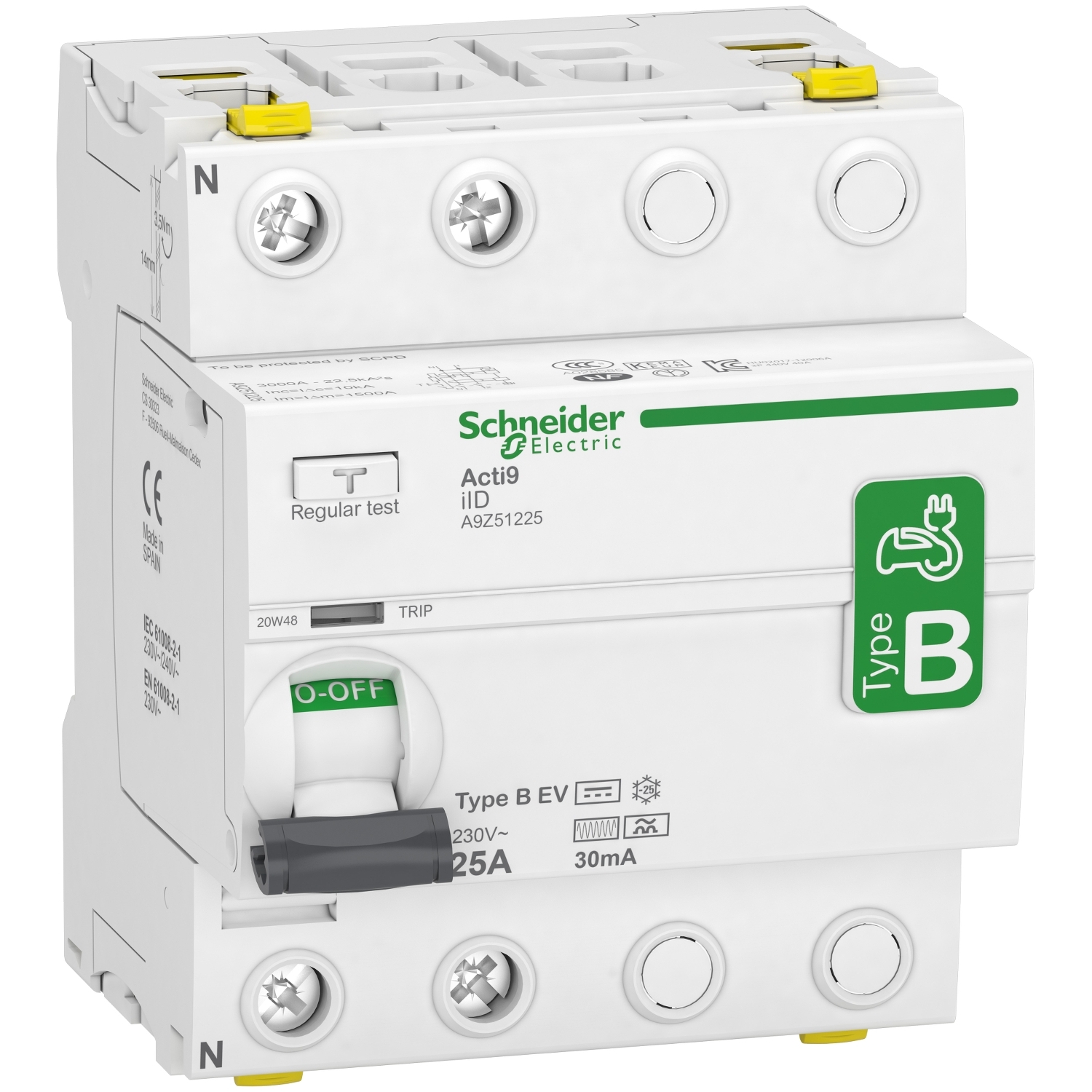
Find the best Type B RCD for EV Charger products here at Sparky Direct. [ Read More ]

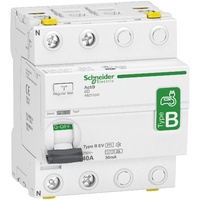
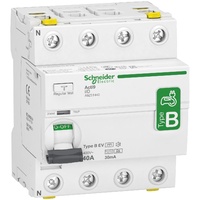
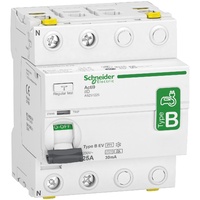
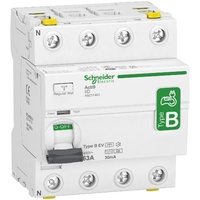
The Acti9 iID B EV Type is a residual current device designed to detect fault currents on electric vehicle charging circuits. It monitors the current flowing in and out of the EV charger circuit. If leakage current exceeds the rated trip threshold, the device disconnects the supply to reduce the risk of electric shock or fire.
This RCD is intended for dedicated EV charging circuits, not as a general-purpose safety switch for mixed loads. It pairs with a suitable upstream or downstream circuit breaker for overcurrent protection, since a standalone RCD does not interrupt overload or short-circuit faults. Selection, switchboard layout, and commissioning sit with a licensed electrician.
Australian residential safety switches are generally Type AC or Type A devices. Type AC detects AC residual current only. Type A also detects pulsating DC, which covers most household electronics. Type F adds tolerance to mixed-frequency leakage.
Type B sits at the top of this scale. It detects AC, pulsating DC, and smooth DC residual currents, and that smooth DC detection is the key distinction for EV charging. Standard household safety switches are not always suitable for an EV charger circuit, because EV charging electronics can produce DC leakage that a Type A device may fail to detect.
EV chargers convert AC supply to DC power for the vehicle battery. The internal power electronics can generate DC leakage currents under certain fault conditions. If smooth DC leakage reaches a Type A RCD's sensing core, the core can saturate and the device may not trip when it should.
This issue is known as RCD blinding. A Type B RCD addresses it by using a sensing design capable of detecting smooth DC residual current. Whether external Type B protection is required depends on the EV charger model, its built-in protection, and Australian installation requirements. The correct answer comes from the EV charger manufacturer's installation documentation, confirmed by a licensed electrician.
Common Australian use cases include 7.4 kW single-phase wallboxes, 11 kW three-phase chargers, and 22 kW three-phase chargers. The decision criteria stay the same across all three: confirm the protection the charger provides, then specify external protection to match.
AC residual current is the leakage profile produced by standard alternating current circuits. A Type AC RCD detects this and forms the baseline residual current protection.
Pulsating DC is unbalanced AC current that has been part-rectified by electronic components. It looks like a series of DC pulses rather than a smooth flow. Type A RCDs detect both AC and pulsating DC.
Smooth DC residual current is steady direct current leakage, with no pulses. It can be produced by power electronics inside EV chargers, inverters, and some industrial drives. Smooth DC leakage cannot be reliably detected by Type AC or Type A devices. EV charger circuits sit in this category because the charging electronics can produce more complex leakage profiles than standard household circuits, especially during charging cycles.
DC leakage protection for EV chargers depends on the RCD's sensing technology. Type A devices use a sensing core that responds to changing magnetic fields produced by AC and pulsating DC. Smooth DC produces a steady magnetic field. If that steady field reaches a certain level, it can saturate the core and dull the device's ability to detect any subsequent AC fault. The RCD may then fail to trip on a genuine fault.
This is not a sign that EV charging is unsafe. It is a protection selection issue. The fix is to specify protection rated for the residual current profile the circuit can produce.
Many modern EV chargers include built-in 6 mA DC residual current detection or Type B-equivalent protection inside the unit. Where a charger has compliant built-in detection, the upstream protection requirements may differ from a charger without it.
The wording in the installation manual is the deciding factor. Some manuals state that an external Type B RCD is required regardless of internal detection. Others permit an upstream Type A RCD where the charger handles DC fault detection internally. A few stop short of giving a clear answer and place the decision on the installer.
For every project, electricians should check the specific charger datasheet, the installation manual, and the relevant Australian compliance requirements before selecting the Acti9 iID Type B RCD or any other residual current protection.
The Acti9 iID B EV Type comes in 2-pole and 4-pole formats. 2-pole devices switch active and neutral, which suits single-phase circuits such as a 7.4 kW wallbox. 4-pole devices switch three actives and neutral, which suits three-phase circuits including 11 kW and 22 kW chargers.
Pole count is not a matter of preference. It follows from the supply type at the switchboard and the EV charger's rated input. An 11 kW charger generally needs a three-phase supply and a 4-pole RCD. A 7.4 kW wallbox can run on single-phase with a 2-pole device, subject to the charger specification. The licensed electrician designing the installation matches the RCD to the charger rating, supply type, and switchboard layout.
Current rating selection follows the EV charger circuit design. The RCD's rated current must match or exceed the circuit current, and the device sensitivity must suit the personal protection requirements for the installation.
30 mA is the common personal protection sensitivity for final sub-circuits in Australian residential and light commercial settings. Final selection depends on the installation design, the applicable standards, and the EV charger documentation. This page does not provide installation instructions or prescriptive DIY sizing, since circuit design must be carried out by a licensed electrician.
Acti9 iID devices mount on standard 35 mm DIN rail inside the switchboard. Practical purchase considerations include switchboard space, pole width in modules, upstream and downstream protection, labelling, and future serviceability.
The device works alongside standard circuit breakers, electrical enclosures, and main switches in a typical switchboard build.
Acti9 is Schneider Electric's modular protection platform used across residential, commercial, and light industrial installations. The range covers RCDs, RCBOs, MCBs, isolators, and accessories that share a common DIN-rail footprint and busbar system.
For electricians, the platform offers product traceability, a familiar trade brand, and compatibility within Schneider switchboard ecosystems. The Acti9 iID B EV Type sits inside this platform alongside the wider Acti9 circuit protection range.
| Specification | Detail |
|---|---|
| Product family | Schneider Electric Acti9 iID |
| RCD type | Type B (B EV Type) |
| Application | EV charger residual current protection |
| Pole options | 2P and 4P |
| Mounting | 35 mm DIN rail inside switchboard |
| Typical installation context | Dedicated EV charger circuit |
| Installed by | Licensed electrician only |
Type A residual current devices detect AC and pulsating DC residual currents. This makes them suitable for most household circuits, including lighting, general power outlets, and many appliance circuits. Type A is now the default standard for new residential safety switch installations in Australia.
The limit appears when the circuit can produce smooth DC leakage. Type A is not designed to detect it, so a Type A device alone may not be the right choice for every EV charging circuit.
Type B devices detect AC, pulsating DC, and smooth DC residual currents. This wider detection range covers the leakage profile that EV chargers, photovoltaic inverters, and other power-electronic equipment can produce.
Type B protection is generally specified where the connected equipment is known to produce DC leakage and the upstream protection needs to cover that risk. EV charger circuits are the most common Australian residential and commercial example.
Some EV chargers include integrated DC residual current detection at 6 mA. Where the manufacturer's installation documentation confirms this internal detection is compliant for the installation, upstream Type A protection may be acceptable. The decision belongs to the licensed electrician designing the circuit.
The reverse is also true. Where the charger does not include compliant DC leakage detection, an upstream Type B RCD is generally required regardless of preference. Substituting a Type A device into that circuit is a specification mistake, not a cost saving.
| Option | Detects | Overcurrent protection | Typical EV charger fit |
|---|---|---|---|
| Type A RCD | AC, pulsating DC | No (needs MCB) | Only where charger has compliant built-in DC detection |
| Type B RCD | AC, pulsating DC, smooth DC | No (needs MCB) | External protection for chargers without internal DC detection |
| Type B RCBO | AC, pulsating DC, smooth DC | Yes (built-in) | Combined RCD and MCB in one DIN module |
| Charger with built-in 6 mA DC detection | Smooth DC handled internally | Depends on charger | May permit Type A upstream, subject to manufacturer instructions |
An RCD does not provide overcurrent protection on its own. To protect the cable against short-circuit and overload, the circuit needs either a separate MCB upstream or an RCBO that combines both functions in a single module.
AS/NZS 3000 sets out the general installation requirements for electrical installations in Australia and New Zealand. EV charger circuits fall under these rules along with the wider switchboard, cable, and equipment provisions. The standard requires that protective devices be selected to suit the connected equipment, the supply type, and the installation environment.
For EV charging specifically, the standard requires that residual current protection match the fault current profile the equipment can produce. That principle is the practical reason Type B protection appears so often on EV charger specifications. The applicable clause numbers and amendments are confirmed at the design stage by the electrician, against the current version of the standard.
Before ordering protection for an EV charger project, electricians generally review:
This is a purchasing and compliance checklist, not a technical installation manual. Each item exists to confirm the right product is being ordered for a job that meets local requirements.
RCD testing, circuit verification, and compliance paperwork form part of professional EV charger installation. The electrician records device performance and produces a certificate of compliance as part of the handover.
Type B RCD testing requires test equipment capable of validating the correct residual current response across AC, pulsating DC, and smooth DC profiles. Standard RCD testers built only for Type AC and Type A devices may not provide a full Type B test. Suitable electrical test equipment sits alongside the device on the job.
Specifying the wrong RCD type carries practical risks. These include electric shock if a fault current is not detected, fire risk where DC leakage is not cleared, and nuisance tripping from a poor circuit design. The list also covers failed compliance inspection on handover, charger warranty issues, and insurance complications after an incident.
These risks are managed by following the manufacturer's instructions and the wiring rules, not by adding excess protection or by guessing.
Compliance reminder: EV charger circuits must be installed and tested by a licensed electrician. Always confirm the charger manufacturer's RCD requirements before selecting protection. Do not rely on a standard household safety switch unless the installation documentation confirms it is suitable for the connected EV charger.
An external Type B RCD is commonly required where the charger does not include suitable DC fault protection. This covers older wallbox models, basic EVSE units without integrated DC detection, and some commercial chargers that rely on external protection by design. In each case, the upstream RCD is doing the work the charger does not.
Many current EV chargers include built-in 6 mA DC leakage detection. The integrated circuit monitors smooth DC leakage and disconnects supply or signals a fault if the threshold is crossed.
External Type B protection may still be needed depending on the manufacturer's instructions, the wider circuit design, and local requirements. Some installations specify Type B upstream even when the charger has internal detection, to give defence in depth. Others permit Type A upstream where the documentation explicitly allows it. The choice should never be a guess.
EV charging across car parks, body corporate buildings, fleet depots, workshops, and small business sites brings additional considerations. Each charger circuit generally needs its own dedicated protection, clear labelling at the switchboard, and a layout that allows the circuits to be isolated and tested individually.
These projects often involve kilowatt hour meters for cost allocation, dedicated electric switchboards, and structured cable management to keep each EV circuit clean and traceable. Schneider's Acti9 platform is well suited to multi-circuit switchboards because the modules share a common busbar system.
Vehicle-to-grid (V2G) and vehicle-to-home (V2H) charging are emerging use cases that may create more complex fault current profiles. Bidirectional chargers can act as both load and source, which changes how residual current protection needs to behave.
Where a project may move to higher-power or bidirectional charging in the future, Type B protection is often a strong specification choice on day one, subject to the applicable standards and the eventual charger documentation. Future-proofing should still come from a documented design rather than a habit.
Single-phase and three-phase EV chargers need different RCD pole counts. A 7.4 kW single-phase wallbox running on a 32 A circuit generally pairs with a 2-pole Type B RCD. An 11 kW or 22 kW three-phase charger pairs with a 4-pole device.
The RCD's current rating must align with the circuit design. Oversizing wastes switchboard space and money. Undersizing causes nuisance tripping or, worse, failure to clear a real fault. The licensed electrician designing the circuit confirms the pole count, current rating, and sensitivity against the connected charger.
A short purchasing checklist before ordering:
Confirming these six items before ordering reduces returns and avoids on-site delays.
A standalone RCD does not provide overcurrent protection. The circuit needs a separate MCB sized for the cable, or an RCBO that combines RCD and MCB functions. Where switchboard space is tight, an RCBO often saves room. Where the design calls for grouped RCD protection across multiple sub-circuits, a separate RCD upstream of several MCBs can be more practical.
Coordination also covers the main switch, surge protection where fitted, and accurate labelling so the EV charger circuit can be identified at a glance. Existing switchboard enclosures may need review for free DIN module count and clearances before a Type B RCD is added.
Residential projects usually involve a single charger, often a 7.4 kW or three-phase wallbox at the homeowner's property. The buyer wants compliant protection, neat switchboard installation, and a clear handover.
Commercial projects can involve multiple charging circuits, longer cable runs, strata documentation, load management, and repeat product availability across the project. Trade buyers often plan for bulk ordering, consistent product ranges across stages of a build, clear model selection, and stock availability when work is scheduled. The Acti9 iID range is widely used in both contexts.
Schneider Electric, Hager, ABB, Doepke, and Bticino all produce Type B RCDs suitable for EV charger protection. The right pick for a job comes from criteria the electrician can verify on paper, not from brand loyalty alone.
Selection criteria worth checking:
Schneider is a trusted mainstream option used widely across Australian switchboards. That track record matters for serviceability years after the install. It does not automatically make Schneider the right pick for every job, and an honest comparison serves the customer better than overstatement.
The best Type B RCD for an EV charger is the one that matches the charger, complies with the installation requirements, is correctly tested, and is available when the job is scheduled. A perfectly specified device that is six weeks away from delivery is not the answer to a Friday installation.
Other buying factors include clear datasheets, accessible technical support, and a wholesaler that can confirm stock and dispatch before the order is placed. These details turn a brand comparison into a practical purchase decision.
Type B RCDs cost more than Type A devices because they include additional DC detection circuitry. 4-pole devices typically cost more than 2-pole models. These price gaps are normal across all brands, not a Schneider-specific premium.
For commercial EV projects, electricians generally confirm stock before quoting, since lead times on specialist DIN modules can change with global supply. Sparky Direct lists current stock and dispatch information against each product page in the Acti9 iID Type B EV RCD range, alongside related Acti9 protection and EV charging accessories.
RCD blinding is the practical problem behind the Type B specification. A Type A device exposed to enough smooth DC leakage can have its sensing core saturated. Once the core is saturated, the device may no longer respond reliably to an AC fault either. Type B sensing is designed to operate across the full fault current profile, so the device continues to clear faults as designed.
EV chargers can produce small leakage currents during normal operation, especially during charging cycles. These leakage levels are usually well below the trip threshold of a correctly specified RCD.
Nuisance tripping typically comes from other causes. Common ones include a long cable run accumulating capacitive leakage, an undersized RCD shared with too many sub-circuits, the wrong sensitivity for the application, or a charger drawing current outside its labelled rating. Each cause needs assessment by a licensed electrician rather than a hopeful reset. Repeated nuisance tripping is a signal to investigate, not a reason to remove the protection.
Common specification mistakes seen on EV charger circuits include:
This is troubleshooting and prevention guidance, not installation instruction. The fix in each case comes from the design and the licensed electrician implementing it.
Electricians use RCD testing equipment to confirm the device trips within the rated time at the rated residual current. Test results are recorded and form part of the compliance handover. For Type B devices, the test equipment must be capable of testing across AC, pulsating DC, and smooth DC residual currents. This page does not include detailed test procedures, which sit with the electrician.
Watch A9Z51240 Acti9 iID 2P 40A 30mA - B EV type | Residual Current Circuit Breaker | Schneider Electric video
Watch Schneider Electric A9SCO263 | 63A Changeover Switch Acti9 2P 415VAC video
Watch Hager CDA440T | 4 Pole 40A RCD 6ka 30ma video

Easy to navigate the website and find what I needed, and the item arrived very quickly to Perth WA. Well packaged and protected.
This type A breaker was exactly what I was after for my EV charger and it works perfectly. Installation was quick and easy and compliments my other breakers on my switchboard.
Bought for our 7.4Kw EV charger. Fast shipping, easy to deal with. Our electrician had no problem installing and we used it that night. Solid.
Quality products in stock • Fast Australia-wide delivery • Competitive trade pricing
Browse Acti9 iID B EV Type Range → Get Expert Advice →