
Search Results:
Search Results:
Search Results:
Search Results:
A tool bag keeps your most-used tools accessible and protected while you move through a job. For electricians, this means having cutters, strippers, screwdrivers, testers, and consumables all in one place rather than spread across a van floor or scattered through a site. A well-packed tool bag reduces the time spent searching for tools and limits the chance of leaving equipment behind at the end of a job.
Tool bags are designed around the reality of trade work: you often carry your bag from the van to a roof space, a switchboard, or a tight service corridor. Weight and ease of access matter as much as capacity.
Tool bags differ from tool boxes in several practical ways. Tool boxes are rigid and stackable, which makes them good for storage in a fixed location. Tool bags are flexible and easier to carry through tight spaces. A canvas or polyester tote-style bag fits into situations where a rigid box would be impractical. A backpack tool bag distributes the load across your shoulders, which is useful when climbing ladders or working on large sites where you cover significant ground on foot.
Tote bags are open-top designs with external pockets. They give fast access to frequently used items and are preferred by many electricians for hands-on installation work. Rolling tool bags suit heavier kit requirements where carrying weight by hand is not practical.
A tool bag that is properly organised for your trade reduces idle time. When each tool has a designated pocket or slot, you reach for it without looking. This matters on jobs where speed and accuracy are both required, such as a board fit-off or a fault-finding job where you are switching between instruments and hand tools repeatedly.
Organised storage also reduces tool loss. Electricians working across multiple floors or units find that a structured bag makes it easier to confirm everything is packed before moving on. Sparky Direct stocks electrician hand tools and compatible bags so you can build a complete kit from one supplier.
Open-top bags are the most common style for electrical work. The wide mouth lets you see and reach all tools without unzipping anything. External pockets on the sides and front hold smaller items like markers, voltage testers, and cable ties. These bags are compact enough to carry through a manhole or into a roof space. The trade-off is that tools can shift during transport, and the bag offers less structure than a zippered design.
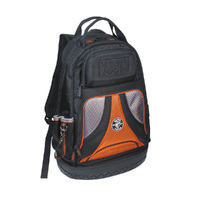
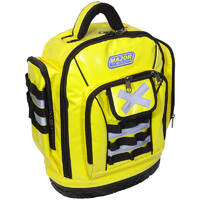
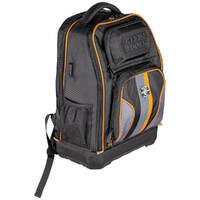
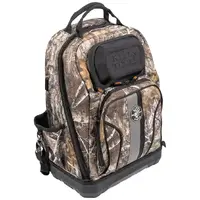
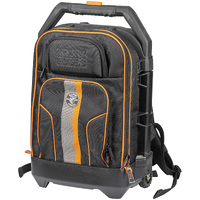
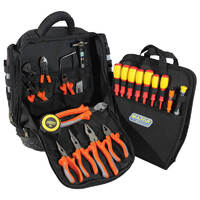
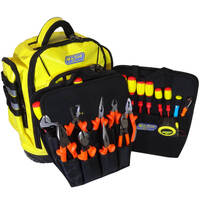
Backpack-style tool bags free your hands for ladders, scaffolding, and tight access work. They spread weight across both shoulders, which matters when you are carrying a full kit over a long shift. The Klein Tools Tradesman Pro backpacks are designed with 39 or more pockets arranged by category, so tools stay sorted even after a long day. Backpacks suit service technicians and electricians who work across large sites or multi-storey buildings.
Rolling bags have wheels and a telescoping handle. They work on flat surfaces and are suited to technicians who carry a large range of instruments and tools to each job. On uneven ground or building sites, rolling bags can be impractical. They are more common in service and maintenance roles than in installation trades.
Tote bags are a mid-point between open-top and zippered bags. They typically have a wide open top with a row of interior and exterior pockets and a reinforced base. They are versatile enough for most trade applications and are available in sizes from compact single-trade kits to large multi-trade carriers. Hand tools of all sizes fit comfortably in a well-designed tote.
The bag should fit your working kit, not your entire van. A bag that is too large becomes heavy and unwieldy. A bag that is too small leaves you making multiple trips or leaving tools behind. Most electricians working on residential installations find a medium-size open-top tote or a backpack with 30 to 40 pockets sufficient for a day's kit.
For heavy commercial work where you carry a broader range of instruments alongside hand tools, a larger tote or a rolling bag may be warranted. Always factor in the weight of a fully loaded bag before committing to a size.
Electricians benefit from bags with narrow side pockets that hold screwdrivers, strippers, and cable snips individually. Plumbers and maintenance workers often carry bulkier tools and fittings, so wider pockets and a larger base area are useful. Builders and carpenters typically need more volume for longer tools such as squares and chisels, which suits larger open-top totes or tote-and-tray combinations.
Service technicians doing fault-finding or commissioning work benefit from compact, well-organised bags that hold test instruments, leads, and documentation alongside basic hand tools.
A compact bag suits a focused tool kit for a specific trade task, such as a board fit-off or data cabling run. It is lighter, easier to carry through tight spaces, and faster to pack and unpack. A large bag suits all-day site work where you need a broader selection of tools available without returning to the van. The right answer depends on how you work, not on the bag's rated capacity.
Choose a bag with at least one dedicated slot for a voltage tester and individual pockets for common screwdrivers. Mixing loose tools in a single compartment damages edges and slows you down. Bags with a structured interior are worth the extra cost for daily trade use.
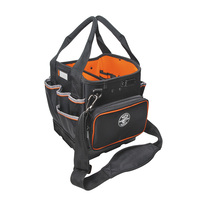
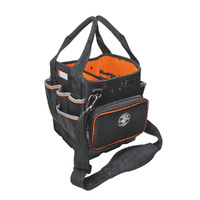
Pocket count is one of the most practical specs to assess when comparing tool bags. A bag with 30 to 40 pockets allows you to assign a fixed location to each tool. The Klein Tools Tradesman Pro Tote offers 40 pockets across its interior and exterior surfaces. This level of organisation is practical for electricians who carry a complete hand tool kit including strippers, cutters, pliers, screwdrivers, a knife, a torch, and a test instrument.
Bags with fewer pockets can still work if pockets are sized appropriately for your tool selection. Fewer, wider pockets suit plumbers or builders carrying bulkier tools.
Some bags have rigid or semi-rigid internal dividers that keep the bag upright and the contents separated. This is useful for open-top designs where tools would otherwise shift freely. Dividers also protect tool edges and prevent screwdrivers and cable snips from tangling. Look for dividers that are removable or adjustable if your kit changes between job types.
A good tool bag lets you identify tools at a glance. Bright interior lining, wide pocket openings, and logical pocket groupings all improve access speed. Backpack designs from Klein Tools use a lay-flat opening on the main compartment so the bag opens completely for full visibility when needed.
Most tool bags on site carry a mix of hand tools and consumables such as cable ties, saddles, connectors, and fixings. Keeping consumables in a separate zippered pocket prevents them from mixing with hand tools and slowing access. Some bags include a dedicated accessory pocket or a tool roll section for this purpose. Sparky Direct stocks screwdriver kits and associated accessories that are sized to fit standard tool bag pockets.
Most trade-grade tool bags use 600D or 1680D polyester, woven canvas, or ballistic nylon. Higher denier ratings indicate denser weave and greater resistance to abrasion and tearing. Canvas bags are traditional and durable, but heavier than polyester. Ballistic nylon, used in premium Klein Tools bags, offers high abrasion resistance with lower weight. Avoid thin polyester bags designed for light-duty or hobby use: they will not survive daily trade conditions.
The base of a tool bag takes the most punishment. Look for a reinforced base with a hard or semi-rigid panel, non-slip feet or rubberised strips, and double-stitched seams at the base corners. A bag that sags or collapses when set down is harder to unpack efficiently and wears out faster at the base seams. A rigid base also keeps the bag upright when set on an uneven surface, which matters in roof spaces and on site.
Heavy-duty zips with large pull tabs are essential for daily trade use. Lightweight zips fail quickly under repeated loading and unloading. Double-stitching at stress points, including handle attachment points, zipper ends, and strap anchors, extends bag life significantly. Handles should have a grip wrap or moulded rubber section to protect your hand under load.
Most polyester and ballistic nylon tool bags offer a degree of water resistance due to the fabric density and any applied coating. This is not the same as waterproofing. Heavy rain will eventually penetrate most fabric bags. If you regularly work outdoors or on exposed sites, look for bags with a coated interior base and water-resistant zippers. Keep sensitive test instruments in a separate sealed pouch inside the bag for added protection.
A padded or wrapped handle is one of the most underrated features on a tool bag. Carrying a heavy bag by a thin, unpadded handle causes hand fatigue quickly and can cause circulation issues during long walks across large sites. Look for a wide, padded grip that distributes load across the palm rather than concentrating it on finger joints.
Many open-top totes include a removable or adjustable shoulder strap. A padded shoulder strap is useful when carrying the bag over longer distances. For heavy loads, a single shoulder strap causes postural imbalance over time. Backpack-style bags with two padded shoulder straps and a sternum strap offer better load distribution for all-day carry. Waist belts on larger backpacks transfer weight to the hips, which reduces shoulder fatigue further.
A well-designed backpack tool bag has heavier tools positioned close to the back panel and lighter items in outer pockets. This keeps the centre of gravity close to your body, which reduces the forward-pulling effect that causes back strain. Backpacks designed with this load management principle, keeping the structural centre of the bag aligned with your spine rather than pulling away from it.
Fatigue from carrying tools is cumulative. A bag that is slightly heavier than necessary, or that concentrates weight in the wrong place, adds stress over the course of a shift. The right bag for your work reduces physical loading to the minimum. Consider the total weight of your packed bag before deciding on a style. If a fully loaded tote exceeds around 8 to 10 kg, a backpack or rolling bag may be more appropriate for all-day use.
Electricians working across residential and commercial sites will find the most value in a mid-size open-top tote or backpack bag with 30 or more individual pockets. Sparky Direct also stocks electrical test equipment including multimeters, voltage testers, and insulation testers that pair with a structured tool bag for a complete working kit. Hand tool brands stocked at Sparky Direct include Felo, Channellock, and Bordo.
| Feature | Tool Bag | Tool Box (Rigid) | Tool Backpack |
|---|---|---|---|
| Portability | High | Moderate | High |
| Access speed | Fast (open-top) | Moderate (lid) | Moderate (zippered) |
| Weight | Light to moderate | Heavier | Moderate |
| Organising capacity | Good (many pockets) | Good (trays/drawers) | Very good (structured) |
| Tight space access | Excellent | Poor | Good |
| Weather protection | Moderate | High (sealed lid) | Moderate to good |
| Best suited to | Daily trade carry | Van storage, workshop | Site travel, access work |
Choose a tool bag when you need to move tools between work areas frequently throughout the day. Choose a rigid tool box for your van base or workshop where tools stay in a fixed location. Choose a backpack when hands-free carry is a priority, such as on large sites or when climbing frequently. Many tradies use a combination: a tool bag for daily site carry and a tool box in the van for additional stock and less frequently used items.
Bags without a reinforced base or internal structure will sag when loaded. This makes the bag harder to unpack and causes tools to shift onto each other. The solution is to select a bag with a rigid base panel from the start. If your current bag sags, a cut piece of high-density foam or a plastic sheet fitted to the base can restore some structure temporarily. Long-term, a bag with a built-in rigid base performs better.
Zip failure is the most common reason tool bags are replaced prematurely. Zips fail when they are overloaded beyond their rated capacity, when the pull tab is used to yank rather than guide, or when cheap hardware corrodes. Buy bags with heavy-duty zippers and replace bags once zips begin to slip or bind: a bag with a failed zip loses most of its utility. Check stitching at handle attachment points and base corners regularly, as these are the highest-stress locations.
Overloading a tool bag stresses all load-bearing components: handles, straps, seams, and base. Most fabric tool bags are not rated for more than 15 to 20 kg of tools. Exceeding this regularly causes handle separation at the attachment point, which is usually the first failure. If your working kit regularly exceeds this weight, consider splitting it across two bags or upgrading to a rolling bag.
A bag with insufficient pockets for your kit leads to tools sitting loose in the main compartment. This causes damage to cutting edges, slows access, and increases the chance of tools being left on site. The remedy is either to select a bag with more pockets or to use a tool roll or pouch insert within the main compartment to create separation. Sparky Direct stocks screwdrivers and cutting pliers alongside tool bags, so you can build a matched kit from the start.
Budget tool bags under $40 are typically made from thin polyester with lightweight zips and minimal structure. They are adequate for occasional use but rarely survive daily trade conditions beyond 12 to 18 months. Trade-grade bags from brands like Klein Tools use heavier fabrics, reinforced bases, and industrial-grade hardware. The higher upfront cost is offset by longer service life and better daily performance.
When comparing bags at similar price points, prioritise: fabric denier rating, zip quality, base reinforcement, and number of usable pockets. A bag with 40 well-designed pockets is more useful than one with 50 shallow or awkwardly positioned pockets. Read user reviews from tradies in your specific trade where available: what works for a plumber may not suit an electrician's tool selection.
Electrical contracting businesses outfitting a team can save by purchasing the same bag model for all crew members. Standardising on a single bag model lets apprentices and tradespeople share a common organisation system, which simplifies tool auditing and reduces the time spent searching for borrowed tools. Contact Sparky Direct via the contact page for trade pricing on bulk purchases.
Mid-range bags in the $80 to $150 price bracket represent the best value for most electricians. At this price point, you can expect genuine ballistic nylon or heavy polyester, reinforced bases, quality zips, and a sufficient number of pockets for a standard electrical kit. Going beyond this price adds specialised features such as padded instrument compartments or rolling wheels, which may not be necessary for all applications.
Empty the bag fully before cleaning. Shake out debris from each pocket. Wipe the interior and exterior with a damp cloth and mild detergent. Avoid submerging fabric bags in water as this can saturate the base panel and cause it to delaminate or warp. Allow the bag to dry fully, open and unzipped, before repacking. Damp bags stored packed encourage mildew and accelerate fabric degradation.
Do not drag the bag across abrasive surfaces such as concrete or gravel. Set it down on a clean surface when possible. Remove sharp tools from exterior pockets before placing the bag in a confined space, as tool tips can punch through pocket fabric from the inside under pressure. Lubricate metal zips with a dry zip lubricant or a small amount of wax periodically to prevent corrosion and binding.
Replace the bag when: handles separate from the bag body, base seams fail and tools contact the ground directly, zips fail completely and cannot be repaired, or fabric tears at load-bearing points. Minor pocket tears and worn zip pulls can be repaired with adhesive fabric patches and replacement pulls. Major structural failures are not worth repairing on a working tool bag.
Note on tool care: The bag protects your tools but does not replace proper tool storage. Cutting tools stored loose in a bag should face inward or be capped to prevent damage to edges and injury during access. Keep test instruments, including multimeters and clamp meters, in their own pouches or pockets to protect calibration and screen integrity.
Watch Klein Tools 5541610-14 | Tool Bag, Tradesman Pro™ Tool Tote | 40 Pockets | 26 cm video
Watch Klein Tools 55421BP-14 | Tradesman Pro™ Tool Bag Backpack | 39 Pockets video
Watch Klein Tools 55421BP-14 | Tradesman Pro™ Tool Bag Backpack | 39 Pockets video

Tool bag is very well set out ,pockets are numerious and deep it handles the longer tools well it is well constructed zippered pocket zip stops half way down on both sides the bits and pieces dont fall out .Its great value for money
It's like I keep finding new pockets for my tools every day. Comfortable on your back. Zip tags fall off early though
I've always favoured glowing cable pullers and this one is certainly one of the brightest i've used. As with any phosphorous material it must be exposed to light for a short period in order to achieve the brightest luminance. If you expose it to sunlight even for a couple of minutes, you could read a book in complete darkness using only the glow of the cable puller. It's like a light saber in ceilings and wall cavities, very easy to find! Highly recommend - especially for the price.
Quality products in stock • Fast Australia-wide delivery • Competitive trade pricing
Browse Tool Bags → Get Expert Advice →Backpack tool bags distribute weight evenly, while shoulder bags offer quick access to tools.
Sparky Direct supplies tool bags Australia-wide, offering practical and durable storage solutions for trade and DIY users.
Tool bags are packaged securely and delivered via standard courier services.
Unused tool bags are generally eligible for return according to the seller’s returns policy.
Warranty coverage varies by manufacturer and typically covers defects in materials or workmanship.
Tool bags are available in a range of sizes to suit different tool collections.
Minimal maintenance is required beyond cleaning and checking for wear.
Lifespan depends on build quality, load weight, and frequency of use.
Yes, tool bags can also be used for DIY, hobby, or general storage needs.
Yes, tool bags are suitable for apprentices and experienced trades alike.
Some designs feature rigid or reinforced bases to help them stand upright.
Trade-rated tool bags are designed for daily use on job sites.
Yes, multiple compartments make it easier to find and store tools efficiently.
Tool bags are used to store, organise, and transport hand tools, power tools, and accessories safely and efficiently.
Quality tool bags feature padded handles or shoulder straps for improved comfort.
The right tool bag depends on the number of tools carried, preferred carrying style, and work environment.
Tool bags are not typically covered by AS/NZS electrical standards, but quality products meet general safety and durability expectations.
Many tool bags are designed to carry both hand tools and small power tools.
Some tool bags offer water-resistant materials or bases, but full waterproofing varies by product.
Many tool bags include pockets, dividers, and loops to help keep tools organised.
Yes, tool bags are commonly used by electricians to organise hand tools and test equipment.
Weight capacity varies by design and materials, and manufacturer specifications should be checked.
Yes, many tool bags are designed for trade use and built to withstand regular site conditions.
Tool bags are typically made from durable fabrics such as polyester, nylon, or canvas, often with reinforced bases.
Common types include open tool bags, zippered tool bags, backpacks, totes, and rolling tool bags.