
Search Results:
Search Results:
Search Results:
Search Results:
Tie down straps are available in several configurations. Each type suits different load profiles, vehicle setups, and tensioning requirements. Matching strap type to the job is the first step toward a secure, compliant load.
Ratchet straps use a mechanical ratcheting mechanism to incrementally increase webbing tension. The ratchet locks at each click, maintaining tension even under vibration and movement. This makes them the preferred choice for heavy or high-value cargo such as machinery, vehicles on trailers, generators, and large electrical switchboard components. Ratchet straps are available in a wide range of working load limits, commonly from 250 kg up to 5,000 kg for heavy transport applications.
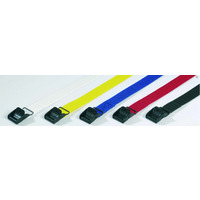
Cam buckle straps use a spring-loaded cam that grips the webbing when pulled through. Tension is applied by hand rather than by a mechanical lever. This makes them suitable for lighter, fragile, or soft loads where over-tightening would cause damage. Common applications include securing solar panels during transport, ladder racks, and delicate equipment in enclosed vans. Working load limits for cam buckle straps are typically 250 kg to 500 kg.
Winch straps are flat webbing loops designed to feed through stake pocket winches mounted on flatbed trailers and tilt-trays. They are a standard fitment in the freight and logistics industry. The flat profile resists twisting under tension and tolerates the abrasion involved in high-cycle loading operations. Winch straps are typically 75 mm to 100 mm wide and are rated for working load limits up to 5,000 kg or more depending on the grade.
Beyond the three main types, specialised tie down products address specific use cases. Motorcycle straps include soft loop tiedown anchors to protect chrome and painted surfaces. Roof rack straps are designed for quick release and weatherproof hardware. Marine straps use stainless steel hardware to resist saltwater corrosion. Kayak and boat straps include cam buckles with rubberised pads to prevent hull damage. For electricians and contractors transporting plant and equipment, hand tools and test equipment benefit from cam buckle or fasty-style straps that can be adjusted quickly on site.
Understanding load ratings is essential for legal compliance and safe transport. Using an undersized strap is a common cause of load failure and legal liability under Chain of Responsibility laws.
Working Load Limit (WLL) is the maximum load a strap is rated to restrain in normal use. It is expressed in kilograms and must be marked on the strap's label or certification tag. WLL is the figure you use for all compliance calculations. It is not the same as break strength, and the two must not be confused when selecting straps for a job.
Break strength is the force at which a strap will fail under a controlled laboratory test. It is always significantly higher than WLL. Australian standard AS/NZS 4380 requires that the break strength of a tie down strap be at least three times its marked WLL. This means a strap marked 1,000 kg WLL must have a minimum break strength of 3,000 kg. Never use break strength as the working figure in any load calculation.
The National Transport Commission's Load Restraint Guide (LRG) defines how many straps are needed for a given load. The basic principle: the combined WLL of all straps used must equal or exceed the total mass of the load being restrained. For loads subject to emergency braking, the LRG applies a forward force factor of 0.8 times the load mass. For example, a 500 kg load requires straps with a combined WLL of at least 400 kg in the forward direction. The LRG provides specific tables and calculation methods for different load types and configurations.
Multiple straps should be distributed evenly along a load to prevent concentration of force on any single point. Long or heavy loads require straps placed at intervals recommended by the LRG. Using more straps than the minimum provides a safety margin and compensates for any variation in strap condition or anchor point strength.
WLL is your working figure. Break strength is the laboratory failure point. AS/NZS 4380 requires a minimum 3:1 ratio of break strength to WLL. A 500 kg WLL strap must have a break strength of at least 1,500 kg. Use WLL only in all restraint calculations.
Load restraint is a legal obligation in Australia. Failing to comply with the relevant standards and regulations can result in fines, demerit points, vehicle defects, and liability for injuries or property damage caused by an unsecured load.
AS/NZS 4380 is the Australian and New Zealand standard governing the performance and testing of load restraint webbing slings and tie down straps. Compliant straps bear label markings showing WLL, strap dimensions, and manufacturer details. The National Transport Commission's Load Restraint Guide (Second Edition) provides the practical framework for applying these standards to real-world loading situations. Both documents should be familiar to anyone responsible for loading and transporting goods on public roads.
Chain of Responsibility (CoR) provisions under the Heavy Vehicle National Law (HVNL) apply to everyone involved in the transport chain, not just drivers. This includes business owners who direct loads, schedulers who set timeframes, and contractors who pack and secure cargo. If a load is inadequately restrained and a serious incident occurs, all parties in the CoR can face penalties. Electrical contractors transporting equipment on a ute or trailer are subject to these obligations. Using correctly rated, compliant straps and following the LRG is the primary way to demonstrate due diligence.
A compliant strap carries a label with WLL marked in kilograms, webbing dimensions, and a traceable manufacturer or importer identifier. Straps without visible WLL markings, or with markings that appear to have been added after manufacture, do not meet the standard and should not be used for load restraint on public roads. Straps purchased from reputable trade suppliers such as Sparky Direct's tie down range are sourced from compliant suppliers and carry the required labelling.
Legal note: Chain of Responsibility obligations under the HVNL apply to all parties in the transport chain, not drivers alone. Business owners, schedulers, and contractors can all face penalties if a load is found to be improperly secured. Always match strap WLL to load mass and comply with the Load Restraint Guide.
The webbing material and hardware used in a tie down strap determine how it performs over time, especially in the outdoor and transport environments common in trade work.
Polyester is the most common webbing material for load restraint applications. It has low stretch (typically 2-3% at WLL), high UV resistance, and minimal water absorption. These properties keep WLL predictable throughout the strap's service life. Nylon webbing has higher stretch (up to 10%) and is more susceptible to UV degradation. Nylon is better suited to shock absorption applications such as climbing or lifting rather than cargo restraint. For tie down straps, polyester is the correct material in almost all cases.
Tie down straps used on utes, trailers, and roof racks are exposed to UV radiation, rain, heat, and road grime. Polyester webbing resists UV degradation significantly better than nylon. Quality straps use UV-stabilised polyester that retains strength through repeated sun exposure. Straps should still be inspected regularly for signs of fading, stiffness, or surface fibre breakdown, all of which indicate UV damage and reduced strength.
Ratchet mechanisms, cam buckles, and hooks are typically made from steel, treated with zinc plating or powder coating to resist corrosion. Marine-grade applications require stainless steel hardware to withstand saltwater environments. J-hooks and flat hooks are the most common anchor fittings. Flat hooks offer a lower profile that reduces the risk of webbing abrasion at the anchor point. Inspect hardware regularly for rust, deformation, or cracking, particularly around weld points and pivot pins.
Quality tie down straps show tightly woven webbing with consistent thread density, no loose threads at edges, and clean stitching at the loop ends. Ratchet mechanisms operate smoothly without binding and lock positively at each increment. Hook springs retain their tension and do not sag when the hook is loaded. Labelling is sewn or heat-printed rather than glued. Glued labels detach with repeated use, removing the WLL marking required for compliance verification.
| Property | Polyester Webbing | Nylon Webbing |
|---|---|---|
| Stretch at WLL | 2-3% | Up to 10% |
| UV resistance | High | Moderate |
| Water absorption | Low | Higher |
| Typical application | Load restraint | Shock absorption, lifting |
| Recommended for tie downs | Yes | Not generally |
Strap selection depends on load weight, load shape, vehicle or trailer anchor points, and how frequently the straps will be used. Working through each factor before purchase avoids buying straps that are incorrectly rated, incompatible with anchor points, or impractical for the job.
Heavy, rigid loads such as generators, compressors, or steel conduit bundles require ratchet straps with WLL matching or exceeding the combined mass of the load divided by the number of straps. Soft or fragile loads such as appliances, solar panels, or rolled cable require cam buckle straps to avoid over-tensioning. Loads with irregular shapes benefit from multiple straps routed at different angles to prevent lateral as well as longitudinal movement.
Strap width affects WLL. Wider webbing carries higher loads. Standard widths are 25 mm, 35 mm, 50 mm, and 75 mm. A 25 mm strap typically carries 250-400 kg WLL, while a 50 mm strap may carry 2,500 kg WLL or more depending on grade. Length selection depends on the distance between the load and the anchor points plus the additional length required to loop through or around the load. Measure before purchasing: a strap that is too short cannot be safely connected, and excess length causes loose webbing that can flap and damage the load or the strap itself.
Anchor points on utes, trailers, and flatbeds have rated tie-down capacities. These capacities must match or exceed the strap WLL. Using a high-WLL strap on an under-rated anchor point transfers the compliance problem from the strap to the anchor. J-hooks are the most common fitting for standard rail and ring anchor points. Wire hooks are available for small-diameter anchor points. Flat hooks and endless loop straps are used with stake pocket winches. Confirm hook type against the vehicle's anchor points before ordering.
For electricians and trade contractors, a practical complement of tie downs typically includes two to four 50 mm ratchet straps for heavy plant and equipment, plus a set of cam buckle or fasty-style straps for lighter items such as tool bags, torches and work lights, and portable equipment. Recreational users carrying bikes, kayaks, or camping gear generally need cam buckle straps in the 25-35 mm range.
Not all tie down straps perform equally. Understanding what separates trade-grade from budget products helps justify the investment in quality, particularly for high-cycle use on commercial vehicles.
A quality ratchet strap maintains its set tension over long drives on sealed and unsealed roads. The ratchet mechanism should have a positive detent at each position. Under vibration, tension loss in a quality strap is minimal. Budget straps with loose-tolerance ratchet mechanisms can lose tension progressively, allowing loads to shift during transport.
Polyester webbing in a quality strap will show negligible stretch over thousands of cycles. The surface fibres resist abrasion from contact with loads and anchor hardware. Edges remain tight and do not fray for a significant service life. Budget straps may use lower-grade polyester or blended fabrics that stretch more at load, accumulate surface damage quickly, and fray at the edges within months of regular use.
Ratchet mechanisms on quality straps are machined or die-cast from hardened steel. The release lever operates smoothly and the internal pawl engages cleanly. Cam buckles on quality straps use a machined cam with a consistent spring return. Winch straps on quality products feature uniform webbing thickness that feeds evenly through the winch slot without bunching or jamming.
Established brands such as Fasty back their products with consistent quality control and clear WLL certification. Buying branded straps from a known trade supplier also means the product has gone through an importer's quality process before reaching the shelf. When purchasing tie down straps, check that the product label carries WLL, a traceable brand, and dimensions. Straps without this information should be treated as non-compliant regardless of price.
Most tie down strap failures result from incorrect use, inadequate maintenance, or purchasing straps with insufficient WLL for the load. Understanding the common failure modes helps prevent incidents before they occur.
Strap loosening during transport is almost always caused by one of three factors: ratchet mechanism wear, incorrect tensioning technique, or load compaction. In ratchet mechanisms, worn pawl teeth fail to hold under sustained vibration. The solution is to replace the strap. Incorrect tensioning occurs when the ratchet is not fully cranked to remove all slack before starting the journey. Load compaction occurs when soft loads (wrapped cables, foam-packed equipment) compress under transport vibration, effectively reducing the load volume and releasing strap tension. Check straps after the first 10-15 minutes of a journey when carrying compressible loads.
Fraying at strap edges is typically caused by contact with sharp edges on loads or anchor hardware without edge protection in place. Webbing that folds over a sharp corner under tension concentrates stress on the outer fibres. Premature wear over the full width of the strap is usually UV damage. Replace any strap showing edge fraying or surface fibre breakdown. The WLL of a damaged strap cannot be verified and should be treated as zero.
Hooks slip when they are not fully seated in the anchor point before tension is applied. A partially seated J-hook will rotate under load and disengage at the point of maximum tension. Always confirm the hook is fully over the anchor rail or ring, with the safety clip (if fitted) engaged, before applying any tension. Hooks that show distortion or spreading at the throat have been overloaded and must be replaced.
The primary causes of strap failure in service are: exceeding WLL, using a damaged strap, routing webbing over a sharp edge without protection, and heat damage from exhaust systems or brake drums on trailers. Inspect every strap before each use. Any strap with cut fibres, deep abrasion, chemical staining, or significant discolouration should be removed from service immediately.
Before each use, check: webbing for cuts, fraying, or discolouration; ratchet or cam mechanism for smooth operation; hooks for distortion or missing safety clips; stitching at loop ends for separation; WLL label for legibility. A strap that fails any of these checks must not be used.
Tie down straps are available across a wide price range. The decision between budget and trade-grade products has direct implications for compliance, longevity, and safety.
Budget straps sold through general merchandise channels often lack traceable WLL certification, use lower-grade polyester with higher stretch, and have cast-iron ratchet mechanisms that wear rapidly in commercial use. They may meet a basic WLL rating when new but degrade faster under repeated loading cycles and UV exposure. Trade-grade straps use consistent webbing quality, machined hardware, and clear compliance labelling. The cost differential over a multi-year service life is generally small when measured per use.
When comparing straps of similar WLL, evaluate webbing weight (grams per square metre), hardware finish (zinc-plated or powder-coated), stitching quality at loop ends, and whether the label is sewn or glued. Sewn labels indicate a manufacturer that expects the strap to outlast a glued label. Buying from a specialist trade supplier means access to product data and brand support that general merchandise channels do not provide.
Contractors running multiple vehicles benefit from purchasing tie downs in bulk to standardise the WLL range across the fleet and reduce the risk of mixed-specification straps being used on loads they are not rated for. Sparky Direct offers trade pricing on volume orders and fast Australia-wide delivery to reduce downtime when straps need replacing. Personal protective equipment and other site safety items can be ordered alongside tie downs to consolidate trade supply orders.
Using tie down straps correctly is as important as selecting the right strap. Incorrect technique can negate the WLL protection and create load movement risk even with a compliant product.
For ratchet straps: feed the webbing through the axle slot until there is no slack, then operate the ratchet lever through full strokes until the webbing is taut and the load is firm. Do not over-tension to the point that the load deforms or the webbing is fully wound onto the axle with no remaining thread. For cam buckle straps: pull the free end firmly until the load is snug, then press the cam to lock. Apply firm hand tension only; do not use a lever or bar to increase tension on a cam buckle strap.
Route straps to resist movement in all three axes where the load profile allows: forward/backward, lateral, and vertical. A single strap over the top of a load resists vertical movement but provides limited restraint against forward or lateral slide. Use at least two straps on any load, positioned near opposite ends, and angled slightly outward where anchor points allow. Where straps must cross the load at an angle, verify the angle does not reduce effective WLL below the required restraint force.
Always place edge protection between the webbing and any sharp or hard corner on the load or the vehicle structure. Edge protectors are available as plastic corner guards or rubber-coated clips. Without edge protection, a strap can fail at a fraction of its rated WLL when the webbing is compressed against a sharp edge under tension. Padding also protects the load surface from abrasion and indentation marks caused by tensioned webbing.
Wet webbing has marginally reduced strength but this is not the primary concern in rain. The main risk in wet conditions is that ratchet mechanisms can fill with mud or grit, preventing full engagement of the pawl. Rinse mechanisms after off-road use and apply a light spray lubricant to moving parts. In freezing conditions, ice can lock a ratchet mechanism in the released position. Inspect all mechanisms before loading if operating in sub-zero conditions.
Tie down straps are consumable items, but correct storage and maintenance significantly extends their serviceable life and reduces the frequency of replacement.
Rinse straps with fresh water after exposure to salt, mud, or chemical spills. Allow to dry fully before storage. Store in a dry, dark location away from direct sunlight and sources of heat. UV and heat exposure during storage degrades polyester fibres over time, reducing WLL before the strap has been used. Coil or fold straps loosely rather than tying them in knots, which creates permanent stress points in the webbing. Many users store straps in a dedicated tool bag to keep them accessible and protected.
Inspect the full length of the webbing, both sides, before attaching any strap to a load. Look for cuts, fraying, UV bleaching, chemical staining, mould growth, or stiffness. Check the mechanism for smooth operation and all hooks for distortion. If any defect is found, remove the strap from service. Tie down strap failure during transport can cause a serious incident. The cost of replacing a strap is negligible compared to the cost of an incident caused by a failed strap.
Replace straps immediately if: the webbing shows cuts or significant fraying, the WLL label is missing or illegible, the ratchet mechanism skips or fails to hold, hooks show distortion or spreading, or the webbing shows significant UV bleaching over more than 20% of its length. There is no fixed calendar replacement interval because service life depends entirely on use frequency, load cycles, and storage conditions. In high-cycle commercial use, annual replacement of the most heavily used straps is a reasonable baseline.
In practice, UV damage is the primary cause of premature webbing degradation for straps left on vehicles between jobs. Use covers or bags to protect straps left on roof racks or tray vehicles. Chemical exposure from solvents, acids, or hydraulic fluids can degrade polyester rapidly and is not always visible until the strap is under load. After any chemical contact, the strap should be treated as condemned regardless of visible condition.
Tie down straps are used across a broad range of trade, transport, and recreational contexts. For electrical contractors and tradespeople, the most relevant applications span site vehicles, transport, and equipment management.
Freight and logistics operators use ratchet and winch straps for all commercial load restraint on flat-tops, tilt-trays, and curtainsiders. The LRG specifies strap placement, quantity, and WLL for standard cargo types. Compliance is inspected by Transport for NSW, VicRoads, and equivalent bodies in other states. Inadequately restrained commercial loads are among the most common causes of infringement notices in roadside inspection programs.
Electrical contractors routinely transport conduit, cable drums, switchboard components, testing equipment, and tools on utes and trailers. Conduit bundles require two or more straps across the bundle at evenly spaced intervals. Heavy items such as distribution boards should be strapped using WLL-rated ratchet straps with additional dunnage to prevent lateral movement. Test equipment and electrician hand tools in cases or tool bags can be secured with cam buckle or fasty straps. Cable ties are a complement to tie downs for bundling and organising equipment on the vehicle.
Recreational users carry bikes, kayaks, roof tents, and camping gear on roof racks and trailers. Cam buckle straps and fasty-style straps are well suited to this application because of their speed of use and lower risk of over-tensioning soft or painted loads. Bike straps with soft loops protect paint and chrome. Kayak straps with rubber-lined buckles prevent hull abrasion. All recreational load restraint on public roads is subject to the same legal requirements as commercial transport.
Furniture, appliances, and household items in open trailers and utes require tie down restraint. Ratchet straps with soft webbing protectors are the preferred option for furniture to prevent surface damage. Always confirm the combined WLL of straps used meets or exceeds the total load mass regardless of the application.
Tie down straps are consumable items with a finite service life. Buying quality products and maintaining them correctly is the most practical way to reduce the volume of straps going to landfill.
Quality polyester webbing can remain serviceable for many years with correct storage and maintenance. The most common reasons for early replacement are UV damage from improper storage and contamination from chemical exposure. Both are preventable with basic storage discipline. Inspecting and cleaning straps after each job adds minutes to the workflow but meaningfully extends the useful service life.
Polyester webbing is a petroleum-derived product and is not readily biodegradable. Some manufacturers are trialling recycled polyester (rPET) webbing made from post-consumer plastic bottles. rPET webbing can meet the same strength and UV performance standards as virgin polyester. When this option is available at comparable quality and price, it reduces the virgin polymer demand associated with strap manufacturing.
Straps removed from service should be destroyed before disposal to prevent reuse. Cut the webbing at multiple points or remove and destroy the WLL label so that a condemned strap cannot be returned to service by another user. Polyester webbing can be placed in general waste. Steel hardware from ratchet mechanisms can be separated and taken to a metal recycler. Some trade waste services accept mixed load restraint hardware for metal recovery.
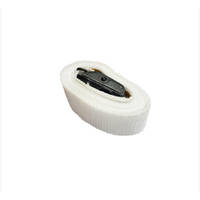
Watch FASTY STRAP | FAS121 White 100cm Fasty Strap 400Kg video
Watch CABAC Velcro Cable Strapping | 12mm x 50mtr VT12BK/50M video
Watch Class 0 Insulated Gloves 1000v 360mm ASTM [Size: 10] | GLOVE video

The Fasty Strap is a great product, it has the easiest buckle of all the different types of tie down I've used, excellent for ladders and outdoor equipment.
After owning 1 pair of these snips I have to say that they are as sharp as the teeth of the Black Panther they are named after. A great addition to the tool kit. I have cut tissue paper and light aluminium and tin with ease. A few of my coulagues have also purchased the snips after trying mine. I have also purchased a second pair of snips for the kitchen at home as they are stainless steel and very easy to clean. A great tool for many applications.
This has been an absolute lifesaver and game changer, doing constant apartments from start to finish this has helped save so much time for marking out/cutting out with multiple gpo's, tv, data outlets next to each other. You can have it either vertically or horizontal so also works great if you have a few light switches next to each other. A must have staple item for your kit and even comes with a hard protective case to keep safe!
Quality products in stock • Fast Australia-wide delivery • Competitive trade pricing
Browse Tie Down Straps → Get Expert Advice →Tie down straps are easy to use when the correct type and rating are selected.
Sparky Direct supplies tie down straps Australia-wide, offering reliable load restraint solutions with convenient delivery.
Tie down straps are packaged securely and delivered via standard courier services.
Unused tie down straps are generally eligible for return according to the seller’s returns policy.
Warranty coverage varies by manufacturer and typically covers defects in materials or workmanship.
Tie down straps are available individually and in multi-pack options.
They should be replaced if there is visible wear, fraying, or damage.
They should be stored clean, dry, and protected from sunlight when not in use.
Minimal maintenance is required beyond regular inspection and proper storage.
Yes, tie down straps are suitable for DIY and household transport tasks.
Yes, tie down straps are reusable if they remain in good condition.
Lifespan depends on usage and exposure, and straps should be inspected regularly.
Over-tightening or incorrect use can damage loads, so care should be taken.
Tie down straps are used to secure loads during transport, storage, or lifting to prevent movement and improve safety.
Ratchet straps offer higher tension and are better for heavy loads, while cam buckle straps suit lighter loads.
Choose a strap based on the load weight, size, and method of securing required.
Tie down straps are often used to secure electrical equipment during transport, but electrical work itself must be carried out by a licensed electrician.
Polyester straps have minimal stretch, helping maintain load security.
Yes, they are commonly used to secure tools, equipment, and materials during transport.
Yes, most tie down straps are designed for outdoor use, but UV and weather exposure should be considered.
Yes, tie down straps are commonly used in trade, transport, and construction environments.
Yes, tie down straps have a rated lashing capacity and breaking strength, which must be followed for safe use.
They are typically made from polyester webbing with steel or alloy buckles and hooks.
Many tie down straps are manufactured to comply with relevant Australian standards for load restraint, depending on the product.
Common types include ratchet straps, cam buckle straps, and light-duty tie downs for different load requirements.