
Search Results:
Search Results:
Search Results:
Search Results:
Find the best Air Conditioner Wall Brackets here at Sparky Direct. [ Read More ]
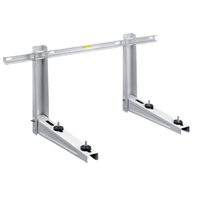
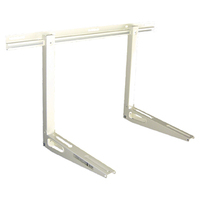
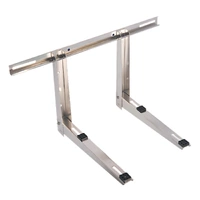
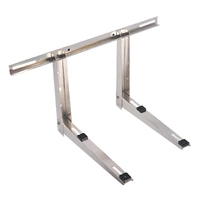
An air conditioner wall bracket is a welded or bolt-together steel assembly that projects horizontally from a wall. Two arms cantilever out from a vertical back rail. The outdoor unit sits on the horizontal arms and is bolted down through its mounting feet. Rubber or neoprene silent blocks sit between the unit and the arms to absorb compressor vibration. The whole assembly is typically powder coated for outdoor service.
Brackets are rated by static load in kilograms. Sparky Direct stocks the common trade sizes from the 120kg class up to the 220kg class, covering the full split system range sold through the split system air conditioner catalogue.
The load path runs from the compressor, through the silent blocks, into the horizontal arms, back through the vertical rail, and into the wall fixings. That path must stay rigid under both static weight and cyclic vibration from the compressor. A correctly specified bracket transfers the load to masonry or framing without deflection. The silent blocks decouple high-frequency vibration so it does not travel into the building structure as audible noise.
Wall mounting keeps the outdoor unit off the ground. This protects the condenser coil from lawn mower debris, flood water, and pets. It also lifts the unit above leaf litter that would otherwise block airflow and shorten the service life of the fan motor. For multi-storey buildings and narrow side passages, wall mounting is often the only practical option.
Ground mounting on a concrete slab is the alternative for most residential installs. Slabs are cheaper per unit but require level ground, clear access, and a soakage allowance. Wall brackets cost more up front but reclaim ground space and improve access to the condenser coil for cleaning. The decision usually comes down to site constraints rather than price.
Fixed brackets feature welded arm geometry with predetermined spacing dimensions, which produces a rigid installation when the outdoor unit's mounting feet match the arm configuration. Adjustable brackets incorporate sliding clamps or slotted rail systems, enabling precise arm spacing calibration directly on site during installation. Contractors managing multiple manufacturer installations benefit significantly from adjustable brackets, eliminating the inventory complexity associated with stocking multiple fixed bracket variants.
Outdoor condenser units for 7kW, 8kW, and larger split system installations typically weigh between 45kg and 65kg, depending on manufacturer and refrigeration capacity. After incorporating engineering safety margins for vibration cycling, wind loading, and occasional technician access loading, a standard 120kg bracket approaches its rated capacity limit. Specifying a 220kg bracket provides substantial capacity headroom and significantly improved long-term structural stability. The Complete Air AWBL bracket represents a commonly specified option within this heavier weight classification.
Universal adjustable brackets fit the outdoor units of all major brands sold through Sparky Direct, including Daikin, Fujitsu, Mitsubishi Electric, Haier, and Rinnai. The adjustable footprint window on these brackets covers roughly 350mm to 550mm across and 450mm to 800mm outward projection, which spans the compact and mid-size unit classes.
Salt air attacks the bracket, the fasteners, and the silent blocks. Standard powder-coated mild steel can start showing rust at cut edges within 12 to 18 months in coastal exposure. For sites within 1km of the beach, specify a bracket with a thicker powder coat, galvanised arms, and stainless A2 or A4 fasteners. Annual inspection of fixings is still required regardless of coating.
Read the unit weight off the manufacturer data plate. Add a realistic safety factor of at least 2x to cover dynamic loads from compressor start-up, wind on the unit body, and service technicians leaning on it. A 40kg unit needs a bracket rated 120kg minimum. A 65kg unit should sit on a 220kg bracket.
Two critical dimensions determine compatibility between an outdoor unit and its mounting bracket. First, the arm spacing must match the mounting foot centres stamped on the condenser base, because misaligned holes cannot accommodate the unit's captive fasteners. Second, the arm depth must exceed the unit base depth so the entire weight distributes across the supporting structure rather than cantilevering past the arm end. Most residential split systems fit within a 350mm to 550mm foot spacing window. Measuring before ordering prevents the common situation where a bracket appears correct but cannot physically bolt through.
Standard brackets use mild steel with polyester powder coat, which is adequate for most metro residential installations away from aggressive environmental conditions. Industrial or semi-rural sites exposed to airborne chemicals require a galvanised bracket for meaningful corrosion protection. Coastal environments demand both hot-dip galvanising and stainless steel fasteners to resist chloride attack. Specify the coating at order time, because retrofitting protection after corrosion appears is generally impractical and expensive.
Brackets are tested for static load, not weather. The weather protection comes from the finish. Direct western sun will degrade a poor powder coat within two years; a properly cured coat will last ten. Heavy rainfall is not a problem for the steel but can wash out fastener torque over time if the wall substrate softens. Coastal air is the hardest environment and drives the most failures.
Solid brick and concrete carry wall bracket loads well when fixed with chemical anchors or sleeve anchors sized for the load. Rendered cavity walls need the fixing to reach the inner leaf, not just the render. Timber or steel framing requires fixing through the cladding into studs or noggins, with through-bolts where load permits. Never rely on plasterboard anchors alone for this application.
Structural check first: Installations on lightweight cladding over cavity construction require substrate verification before proceeding. Confirm the actual construction by drilling an exploratory pilot hole to check backing material and embedment depth. Bracket pull-out failures can drop a 50kg condenser unit onto a walkway or garden area below, creating significant injury and property damage liability.
The bracket should sit at least 300mm above ground level, with the unit discharge clear of obstructions. Maintain the airflow clearances specified on the indoor and outdoor unit data sheets, typically 300mm at the rear and 600mm at the front for the condenser. Where two units share a wall, keep them at least 600mm apart to avoid short-cycling hot discharge air.
Each bracket ships with a manufacturer-specified fastener schedule covering anchor type, diameter, embedment depth, and recommended torque. Chemical anchors deliver the highest pull-out capacity in solid masonry because the resin bonds mechanically with the substrate. Sleeve anchors are suitable for concrete and solid brickwork where expansion forces generate adequate friction retention. Coach screws driven into timber studs require a correctly sized pilot hole matching the thread root diameter. Always torque fixings to the specified value, because over-torquing crushes the substrate and compromises the mechanical connection.
Condenser airflow drives heat exchange. Any obstruction within the specified clearance zone forces the unit to work harder, raises running current, and shortens compressor life. Plan the bracket position so fences, downpipes, and pergola beams sit outside the clearance zone. On retrofits, be ready to relocate obstructions rather than compromise airflow.
Condensers at ground level are exposed to lawn mower strikes, whipper snipper debris, splash damage during heavy rain, and pets marking the coil. Lifting the unit onto a wall bracket removes all of these risks in a single step. For rental properties and strata blocks, this pays back the bracket cost in one avoided condenser coil replacement.
Annual coil cleaning is easier when the unit is at waist height. Technicians can work around all four sides, check the fan blade clearance, and inspect the drain pan without kneeling. Pressure testing and refrigerant recovery work is also faster when the service ports are at a comfortable working height.
The silent blocks under the unit feet take care of most compressor vibration, but the bracket geometry also plays a role. Short, stiff arms transmit less vibration than long flexible ones. A correctly sized bracket with clean fixings is quieter than an oversized floppy one or an undersized unit sitting on a slab with no isolation.
Multiple wear mechanisms that typically shorten outdoor condenser unit operational life receive significant mitigation through wall bracket installation. These include electrochemical coil corrosion, fan motor bearing degradation from accumulated debris ingress, and progressive vibration fatigue affecting refrigerant joint integrity. A properly engineered wall bracket installation can reliably extend residential split system service life by approximately two to three years when directly compared against a compromised ground-level installation scenario.
The most frequently encountered installation failure involves specifying a 120kg-rated bracket for a 60kg outdoor condenser unit. The nominal engineering safety factor appears adequate at approximately 2x theoretical loading. However, actual operational conditions including continuous compressor cycling, aerodynamic wind loading on the unit housing, and periodic technician weight during servicing produce measurable bracket flexion. Cumulative flexion over multiple years progressively loosens structural fixings and eventually propagates fatigue cracks through welded joints. Specifying brackets with 3x rated capacity or greater provides substantially improved reliability.
Rust usually starts at drilled holes, cut edges, and weld seams where the powder coat is thinnest. Catching it early and dressing the spot with a cold galv primer buys years of extra life. Ignoring it leads to section loss, loose fixings, and in the worst cases a bracket that fails under snow or wind load. Inspect annually on coastal sites.
A bracket that is not level will sit the unit at an angle. This can pool condensate in the drain pan, stress the refrigerant joints, and cause oil migration problems in the compressor. Check level in both axes before tightening fixings. Use packers behind the bracket where wall render is uneven rather than twisting the frame flat.
Brackets fitted too close to a fence, too close to another unit, or tucked under a roof eave create airflow restriction. The result is reduced cooling capacity on hot days, higher running cost, and shorter compressor life. Clearance rules are easy to ignore during install and painful to correct afterwards. Measure twice, fit once.
| Mounting Option | Typical Cost | Service Access | Best Application |
|---|---|---|---|
| Wall Bracket | Mid-range | Excellent | Residential splits, tight side passages, flood-prone sites |
| Concrete Slab | Low (DIY) to mid (poured) | Good | Open ground, clear access, flat site |
| Roof Mount | High | Poor (access equipment needed) | Commercial, no ground or wall option |
| Ground Feet Only | Lowest | Fair | Temporary or very compact units |
Slabs are the default where the site permits. They cost less, cope with any weight, and need no structural approval. Wall brackets win where space is tight, where ground is sloped or prone to flooding, and where service access matters. In multi-unit residential, wall brackets also avoid ground-level acoustic reflection that can amplify compressor noise for neighbours.
Roof mounting is a specialist option for commercial sites and for homes with no available wall or ground space. It requires engineer sign-off, waterproofed penetrations, and often a dedicated access platform for service. Cost is substantially higher than wall brackets. For the vast majority of residential splits, wall mounting is the right tool.
Reach for a wall bracket when the side passage is narrow, when flooding is possible, or when the ground is sloping or loose. Use one when service access matters, or when aesthetics demand the unit be lifted clear. These conditions cover a large share of suburban Australian sites. For split system installations on residential blocks, wall mounting is usually the first option to consider.
Wall bracket installations require a structurally competent wall substrate capable of transferring combined static and dynamic loading into the building frame. Lightweight cladding materials, asbestos-era fibro sheeting, and double-glazed architectural panels cannot reliably carry the sustained loading these brackets impose. Wall-mounted installations also transmit residual compressor vibration into the adjacent building structure, which matters significantly for bedrooms, offices, and acoustically sensitive rooms directly behind the mounting position. For window/wall mount units, an entirely different mounting methodology applies.
Trade pricing for Australian AC wall brackets generally segments into three bands based on capacity, finish quality, and adjustability. Entry-level 120kg powder-coated brackets occupy the lower price tier and suit residential installations with lighter outdoor units. Mid-tier brackets rated between 150kg and 180kg with improved silent block isolators and adjustable arm geometry cover the middle segment. Heavy-duty 220kg brackets and coastal-specification assemblies with galvanised arms sit at the premium end. Always confirm current pricing and specifications on the individual product page before placing an order.
The price gap between a budget 120kg bracket and a 220kg heavy-duty bracket is usually in the order of 40 to 60 percent. For a single-unit residential job, the heavy-duty option is often worth it purely for the vibration headroom and better fasteners. For fleet work across dozens of similar installs, the saving on the lighter bracket can be significant. Match spec to application.
Licensed refrigeration and electrical contractors can register a trade account with Sparky Direct for volume pricing on brackets, air conditioner installation kits, and pair coil copper. Trade channel buying also gives access to back-to-back stock on Daikin, Fujitsu, and Mitsubishi outdoor units so brackets and units ship from one order.
Wall brackets are stocked inventory that ships Australia-wide from the Sparky Direct warehouse. Next-business-day despatch applies to metropolitan postcodes for orders placed before the published daily cut-off time. Regional and remote delivery typically takes between 2 and 5 business days depending on carrier routing and location. For time-critical installation schedules, verify current stock availability on the individual product page before travelling to site.
Begin with the outdoor unit manufacturer data plate, which consolidates the specifications required for correct bracket selection. Record the wet operational weight, the mounting foot spacing dimensions, and the overall condenser footprint before comparing options. Cross-reference these numbers against the bracket's rated static capacity and adjustable geometry range. Contractors managing multi-brand installation fleets should consider stocking one or two versatile SKUs that accommodate common split system dimensions, rather than maintaining separate brackets for each manufacturer.
Buying to the unit weight without a safety factor, forgetting to check foot spacing, ordering a residential-grade coating for a coastal job, and skipping silent blocks are the four most common mistakes. Each one is avoidable with a checklist at quote stage. Each one is expensive to correct after install.
Before ordering, walk the site. Note the wall substrate, the clearance available, the proximity to bedroom windows, the likely afternoon sun exposure, and any risk of water splash from roof gutters. The bracket choice follows from the site survey, not the other way round.
Sparky Direct stocks the full range of Complete Air and Freddox wall brackets, across 120kg and 220kg classes, with powder-coat and corrosion-resistant options. Pricing is trade-competitive, despatch is next business day for metro, and technical support is available by phone or email for spec questions on larger jobs.
They are steel frames that bolt to an external wall and carry the outdoor condenser unit of a split system. The bracket keeps the unit off the ground, level, and clear of airflow obstructions.
The bracket transfers the weight of the outdoor unit and the dynamic load from the compressor into the wall fixings. Rubber silent blocks between the unit and the bracket absorb vibration so it does not travel into the building.
Wall mounting protects the unit from ground-level damage, improves airflow, makes service access easier, and reclaims floor space. It is often the only practical choice in narrow side passages and flood-prone sites.
As a working rule, select a bracket rated at least twice the dry weight of the outdoor unit, and preferably three times. A 40kg unit suits a 120kg bracket. A 60kg to 70kg unit suits a 220kg bracket.
Fixed brackets are cheaper and faster to install when the unit footprint matches the arm spacing. Adjustable brackets cover a range of unit footprints from one SKU, which suits trade installers working across multiple brands.
Confirm the wall substrate, then mark and drill fixing holes to the fastener spec. Fit the bracket with the correct anchors and check level in both axes. Torque all fixings, fit silent blocks, set the unit onto the arms, and bolt down through the mounting feet. Always follow the bracket manufacturer fastener schedule.
Watch Rinnai HSNRA80 | 8.0 KW Reverse Cycle Split System Air conditioner | R410A video
Watch Mitsubishi Electric Air Conditioner Split System 2.5 KW Cooling - 3.2 Kw Heating | MSZ-AP25VGD video
Watch Daikin FTXV25WVMA-KIT | 2.5KW Reverse Cycle Split System Air conditioner R32 video

product exactly as described, all parts where included even the silent blocks, quality and price are outstanding, spirit level is already mounted on the rail, easy to install, for a few bucks you'll get it even faster, if you don't want to install the horizontal rail you can install the vertical only...great product
Excellent Service. Excellent Communications. Ordered online and went down to pick up next day when email received. Busy on pickup at Warehouse got got dealt with straight away superfast service. Thank You Team
Good quality solid construction. Easy install. Only downside is the design of the rubber cushions for under the compressor feet is not ideal, but workable.
Quality products in stock • Fast Australia-wide delivery • Competitive trade pricing
Browse Air Conditioner Wall Brackets → Get Expert Advice →Yes, but they are typically positioned neatly under the outdoor unit and designed to be unobtrusive.
Air conditioner wall brackets are available from Sparky Direct, offering access to quality mounting solutions with Australia-wide delivery.
Yes. Air conditioner wall brackets are typically sold as a matched pair with mounting hardware.
Yes. Wall brackets are commonly available for delivery to residential and commercial locations.
Warranty coverage varies by manufacturer and supplier, with conditions applying when used as intended.
Consider the outdoor unit’s weight, size, mounting surface, corrosion resistance, and installer requirements.
Yes. Wall brackets are commonly used when upgrading or relocating outdoor units.
With quality materials and proper installation, wall brackets can last many years in outdoor conditions.
Correctly installed wall brackets support proper airflow around the outdoor unit, helping maintain performance.
Wall brackets can be used on suitable wall structures when assessed and installed by licensed professionals.
When correctly installed with vibration dampers, wall brackets should not add noticeable noise.
In many cases, wall-mounted units provide easier access for servicing compared to ground-mounted installations.
Yes. Raising the unit allows better drainage and reduces pooling of water around the outdoor unit.
Air conditioner wall brackets are used to securely support and mount the outdoor unit of a split system air conditioner off the ground.
Yes. Elevating the unit can reduce the risk of water damage, dirt buildup, and accidental impact.
Wall mounting keeps the unit off the ground, improving airflow, reducing exposure to debris, and helping prevent corrosion.
Yes. Installation must be carried out by licensed professionals to ensure safe mounting and compliance.
Yes. Wall brackets can be fixed to suitable wall surfaces when installed by licensed professionals using appropriate fixings.
Yes. Air conditioner wall brackets are used in both residential and light commercial installations.
Many wall brackets include rubber feet or vibration dampers to help reduce noise and vibration during operation.
Yes. Corrosion-resistant or heavy-duty coated brackets are recommended for coastal or high-exposure environments.
Weight capacity varies by design and model, so brackets must be selected to match the outdoor unit’s weight and size.
Air conditioner wall brackets are commonly made from galvanised steel or powder-coated steel for strength and corrosion resistance.
Quality air conditioner wall brackets supplied in Australia are designed to meet relevant AS/NZS material and safety requirements when installed correctly.
Wall brackets are available in different sizes and load ratings to suit a wide range of split system air conditioners.