
Search Results:
Search Results:
Search Results:
Search Results:
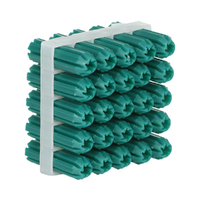
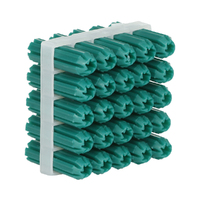
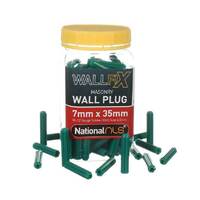
A green nylon wall plug is a slotted cylindrical anchor insert used to fix screws into masonry substrates that cannot grip a screw thread directly. The plug fills a pre-drilled hole; when a screw is driven in, the slots in the plug body force the sides to expand outward, generating friction against the hole wall. This converts axial screw force into radial grip force, creating a holding anchor in an otherwise unsuitable substrate.
Nylon is the preferred material because it is resistant to moisture, chemically inert against standard masonry compounds, and flexible enough to deform uniformly during expansion without cracking. Green is the colour coding used in Australian trade practice for the standard plug size covering most general-purpose fixing applications. Red and white variants cover smaller and larger size ranges respectively.
Nylon wall plugs are a mandatory consumable in Australian electrical installation work. Licensed electricians fix conduit saddles, cable clips, mounting brackets, sensor housings, smoke alarm bases, and switch plates to masonry surfaces daily. In each case, the fixing must remain secure under vibration, thermal cycling, and sustained load without corroding or causing galvanic issues with adjacent metalwork.
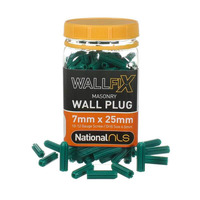
Nylon satisfies all of these requirements at a cost point that makes bulk purchasing practical. The wall plugs available through Sparky Direct include NLS-branded options supplied in jars of 25, 140, and 200 units, suited to trade volume requirements. Having sufficient plugs on the van prevents delays caused by running short mid-job.
Compared to direct masonry screws without a plug, nylon wall plugs provide a more controlled and reliable grip in softer or variable-density substrates such as render over brick or aged concrete. Compared to metal anchors, nylon plugs are lighter, non-corrosive, easier to handle in quantity, and significantly lower in cost per unit. For most electrical trade fixing applications up to medium loads, nylon plugs are the correct choice. Metal anchors are generally reserved for structural or heavy mechanical loads beyond the scope of standard electrical work.
Green nylon wall plugs are available from both trade electrical wholesalers and online suppliers. Trade counters carry them, but pricing is typically retail-oriented and stock on hand may not include bulk jar sizes. Online ordering through a specialist supplier such as Sparky Direct allows trade buyers to purchase in volume, compare size variants side by side, and have product delivered directly to a depot or site address.
For electricians running multiple jobs simultaneously, online ordering removes the need for separate supply runs and allows stock to be managed more predictably. Sparky Direct supplies wall plugs alongside the broader conduit saddle and cable clip ranges that are frequently used alongside wall plugs in the same installation, making it practical to consolidate ordering.
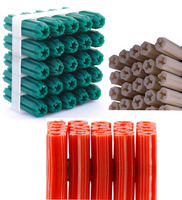
A reliable supplier for consumables like wall plugs should carry multiple size variants in both small packs and bulk quantities, have clear size and specification information on product listings, and maintain consistent stock so repeat orders are fulfilled without delay. Products should be from known brands with a track record in the Australian market. National Light Sources (NLS) is a supplier widely used in the Australian electrical trade, and their wall plug range is available through Sparky Direct in the standard green, red, and white colour variants.
Wall plugs are consumed at high rates on residential and commercial electrical jobs. Purchasing in jar quantities of 140 or 200 units reduces the per-unit cost substantially compared to small packs. Sparky Direct offers Australia-wide delivery, including to regional and remote areas, making it practical for contractors in locations without convenient trade counter access. Ordering in bulk also reduces the frequency of reordering, which lowers the administrative overhead on small contracting businesses.
Keeping 25mm and 35mm green plugs on the van covers the majority of electrical fixing applications. Top up from bulk jars at the depot to reduce job-site delays. Red plugs (for smaller holes) and anchor variants are worth carrying for plasterboard and hollow wall situations encountered on the same job.
Standard green nylon plugs cover the most common fixing scenarios encountered in electrical work: attaching conduit saddles to brick walls, securing mounting brackets in rendered masonry, and fixing switch and outlet plates in solid-wall construction. The 25mm plug suits shorter screws used in lightweight fixtures. The 35mm plug is used where greater embedment depth is required for heavier items or where wall surface material is softer. Both lengths are available in individual packs and bulk jars through the Sparky Direct wall plugs range.
Where fixing loads exceed what a standard nylon plug can sustain, heavier options are available. These include larger-diameter plugs with longer barrel lengths designed for larger-gauge screws and deeper hole embedment. Anchor screws represent a step up in holding capacity for applications such as meter box enclosures, subboard mounting frames, and heavy conduit runs. The correct selection depends on the substrate condition and the weight or stress the fixing must sustain.
Standard green nylon plugs are not suitable for hollow substrates such as plasterboard. They require a solid backing material to expand against. For plasterboard applications, nylon toggle anchors and wallmate-style plugs are the correct choice. These anchor types are available separately and are designed to expand behind the plasterboard face, gripping the back of the sheet. The anchor range at Sparky Direct includes both standard and tri-tip nylon wallmate variants in jar quantities suited to trade use.
Green nylon plugs perform reliably in solid brick, dense block, and formed concrete when drilled correctly. Aged or soft brick may require a slightly larger plug or additional embedment depth. Hard concrete typically responds well to standard plug sizes provided the hole is drilled cleanly with a sharp masonry bit and the hole diameter matches the plug specification. Oversize holes reduce grip; undersize holes prevent full plug insertion. Either condition undermines holding performance.
The barrel of a nylon wall plug contains one or more longitudinal slots cut into its length. When a screw is driven into the plug, the screw thread advances through the nylon material, and the tapered tip of the plug is forced to splay outward. The slots allow the barrel to open, increasing its effective diameter beyond the diameter of the drilled hole. This creates compressive contact between the outer plug surface and the hole wall, generating the friction force that holds the screw assembly in place.
The process is progressive: the further the screw is driven, the greater the expansion and the higher the grip force, up to the design limit of the plug material and the substrate strength. Driving the screw too far can strip the nylon or fracture soft masonry around the hole, reducing holding capacity below the intended rated value.
The grip strength of a nylon wall plug depends on four factors: the contact area between the expanded plug and the hole wall, the coefficient of friction between nylon and the substrate, the compressive strength of the substrate material, and the correct match between plug diameter and hole diameter. Longer plugs provide greater contact area and higher load ratings. For this reason, a 35mm plug installed correctly in sound brick will outperform a 25mm plug in the same substrate.
Load ratings are given by manufacturers as guidelines under ideal conditions. Site conditions (aged or crumbly mortar, drilled-out or over-reamed holes, dusty holes) reduce effective grip. Installing into the brick face rather than the mortar joint typically gives better results because the brick body is denser and more uniform than mortar.
Dense concrete gives the best plug performance because the material is hard, homogenous, and resists deformation under plug expansion forces. Solid brick performs well for typical electrical fixing loads. Rendered masonry requires attention: if the render layer is soft or poorly bonded, the plug may grip only the render and not the underlying brick, giving a false sense of security. Engineers' brick and high-density block are excellent substrates. Lightweight aerated block is softer and may require larger plugs or anchor variants to achieve adequate grip for medium-load applications.
Solid brick, concrete, and masonry block: standard green nylon plugs in 25mm or 35mm lengths. Rendered walls: use 35mm plugs to ensure the plug reaches into the masonry behind the render. Plasterboard: do not use green nylon plugs; use wallmate-style anchors or toggle anchors instead. Hollow concrete block: use wallmate or hollow-wall anchor variants. Metal stud framing with plasterboard cladding: self-drilling cavity fixings or appropriate structural fixings, not standard nylon plugs.
Green nylon wall plugs in both 25mm and 35mm lengths are designed for No. 10 to No. 12 gauge screws and require a 6.5mm diameter drill hole. The plug packaging or product listing confirms the screw gauge and drill bit diameter for each product. Using a screw that is too fine for the plug results in poor expansion and inadequate grip. Using an oversized screw may strip the nylon plug or prevent full insertion. Always match screw gauge to plug specification and drill hole diameter to plug diameter.
Drill Bit Size: The drill bit diameter must match the plug's specified hole diameter precisely. Plugs drilled undersize will not seat fully. Plugs drilled oversize will spin and cannot grip. Check the plug specification before drilling.
Light duty (cable clips, conduit saddles): 25mm green plugs in sound masonry are adequate. Medium duty (switch plates, sensor housings, small junction boxes): 35mm green plugs or heavier variants depending on substrate condition. Heavy duty (distribution board enclosures, large conduit runs, structural cable trays): step up to heavy-duty anchor types and consult the fixing manufacturer's load data for the substrate. Do not extrapolate light-duty ratings to heavy applications.
Plug length must not exceed the depth of solid material available in the wall. If a cavity brick wall has a 110mm face skin and the drill breaks through into the cavity before the plug is fully inserted, the plug cannot expand and will fail. In this situation, use a shorter plug or a cavity wall anchor. For solid masonry, the plug should be fully embedded with no portion protruding from the hole before the screw is driven.
Green nylon wall plugs for Australian electrical trade use are commonly available in 25mm and 35mm barrel lengths. The 25mm variant suits standard-depth fixings such as cable clips and light conduit saddles. The 35mm variant provides greater embedment where longer screws are used or where the substrate requires more gripping length. NLS supplies both lengths through Sparky Direct in pack sizes of 25 units and bulk jars of 140 and 200 units. Size selection should be driven by the screw length required for the specific fixture, not by personal preference or habit.
As a general guide, the screw should penetrate the plug by at least two-thirds of the plug length to achieve full expansion. A 25mm plug typically suits screws of 30mm to 40mm total length, allowing for the thickness of the item being fixed. A 35mm plug suits screws in the 40mm to 50mm range for most electrical fixture thicknesses. Both lengths use a 6.5mm drill hole and accept No. 10 to No. 12 gauge screws. Where the fixture has a significant standoff from the wall, adjust screw length accordingly, keeping the embedment depth within the plug as the primary consideration.
Green nylon plugs are compatible with standard pan-head, bugle-head, and countersunk screws in the gauge ranges specified by the plug manufacturer. They are used with PVC conduit saddles, half saddles, cable clips, surface socket outlet mounting plates, bracket fixings, and enclosure mounting feet. They are not designed for use with self-drilling screws, coach screws, or threaded rod. Use the fastener type specified by the plug manufacturer for each application.
| Plug Length | Drill Hole Size | Screw Gauge | Typical Electrical Use |
|---|---|---|---|
| 25mm | 6.5mm | No. 10 to No. 12 | Cable clips, light saddles, sensor plates |
| 35mm | 6.5mm | No. 10 to No. 12 | Conduit saddles, mounting brackets, box fixings |
In trade usage the terms "plastic" and "nylon" are sometimes used interchangeably, but there is a practical distinction. Generic plastic plugs may be made from polypropylene or recycled mixed plastics with lower tensile strength and less uniform expansion than purpose-manufactured nylon. Nylon provides better elongation under load, resists deformation at higher temperatures, and maintains consistent grip across a wider range of substrate conditions. For electrical trade use, nylon-grade plugs from a reputable supplier are the preferred choice over generic plastic alternatives.
Metal anchors, including sleeve anchors and bolt anchors, offer substantially higher load ratings than nylon plugs and are suitable for structural fixings, seismic applications, and heavy mechanical equipment. However, they are more expensive per unit, require more installation time, and introduce the risk of corrosion or galvanic interaction in wet or chemical environments if the wrong metal type is selected. For the load ranges encountered in standard electrical installation work, nylon plugs are appropriate and the higher cost of metal anchors is not justified. Hobson Engineering and Macsim supply fastener and anchor products through Sparky Direct for applications requiring heavier duty solutions.
Toggle anchors and hollow wall anchors are designed for plasterboard and other hollow substrate applications. They cannot be substituted with green nylon plugs in these situations. Nylon plugs require solid material to expand against. If used in plasterboard without backing, they will spin in the hole and provide no grip. Conversely, toggle anchors are overspecified for solid masonry work and more costly. Selecting the correct anchor type for the substrate is always the first step, not an afterthought.
Before drilling into any wall, confirm the location of concealed cables, pipes, and structural elements. Use a cable and pipe detector where required. Drilling through a live cable is a serious safety hazard and a compliance failure under AS/NZS 3000:2018. Mark all fixing positions before drilling. Check that the fixing position is accessible for the fixture and that it does not place screws over mortar joints where grip will be reduced. Wear safety glasses when drilling masonry; masonry dust and chip fragments are a significant eye hazard.
Use a hammer drill with a sharp, correctly-sized masonry bit for the plug diameter specified. Dull bits create oversize, rough holes that reduce plug grip. Drill perpendicular to the wall surface. An angled hole causes uneven plug expansion and reduces load capacity. After drilling, clear debris from the hole using a puffer or compressed air. A hole full of dust acts as a lubricant and reduces friction between the plug and the hole wall. Insert the plug into the clean hole and tap it flush with a hammer if needed.
The plug should seat fully in the hole with its end flush or slightly recessed from the wall surface. Do not leave plug material protruding above the surface as this prevents the fixture from seating flat. Drive the screw at a controlled speed. High-speed power driving can melt or strip nylon plugs. Apply firm, steady pressure and reduce speed as the screw seats. Stop driving when the fixture is snug against the wall and the screw head is flush. Overtightening strips the plug and reduces grip to near zero.
After installation, apply a firm manual pull test to confirm the fixing is sound. For critical applications such as smoke alarm bases, mounting brackets, or conduit saddles carrying significant cable weight, a brief load test before completion of the installation is good practice. Any fixing that shows movement or produces a hollow sound when tapped should be refixed. Do not rely on a failed fixing to hold under long-term service load.
A plug that spins when the screw is driven indicates one of three conditions: the hole is oversize, the substrate around the hole has failed (crumbled or fractured), or the plug was not seated fully before driving the screw. To correct a spinning plug, remove the screw and plug, clean the hole, and fill with a repair mortar or two-part epoxy compound. Allow full cure before re-drilling and reinstalling. Alternatively, shift the fixing point by 50mm or more to undisturbed material.
A plug that pulls partially out of the wall without the screw has typically been installed in failed or crumbling substrate. Reinstalling the same plug in the same hole will not resolve the problem. The substrate must be assessed and either repaired or the fixing relocated. In aged masonry with soft mortar or spalled brick faces, use a longer plug with a larger drill diameter where permitted by the plug manufacturer's specification. GripIt anchor products are available through Sparky Direct for difficult hollow or damaged wall applications.
Cracking around the hole during plug insertion or screw driving indicates that the substrate material is too soft or brittle to sustain the expansion force. This can occur in aged lime plaster, poorly mixed render, or aerated block. Reduce the screw driving torque, use a shorter plug, or switch to a hollow-wall anchor type suited to the substrate. Pre-drilling a pilot hole at a smaller diameter before the full drill size can also reduce the shock loading on brittle surfaces during the drilling phase.
To remove an embedded plug, drive a screw partially into the plug and use it to lever and extract the plug body. Alternatively, drill out the old plug with a bit slightly larger than the plug diameter. After removal, the hole will typically be oversize for a standard replacement plug. Fill the hole with repair mortar, allow full cure, then re-drill at the standard size for a new plug installation. Do not attempt to re-use extracted nylon plugs; the material deforms during initial installation and will not expand reliably a second time.
In brick, the most common failure mode is installation into the mortar joint rather than the brick face. Mortar is softer and less dense than brick, particularly in older buildings where lime mortar has lost cohesion over time. The plug cannot grip soft mortar adequately under sustained load. Relocate all fixings to the solid brick face. In plasterboard, failure occurs simply because the material is hollow behind the face sheet; standard nylon plugs have nothing to expand against. Always use the anchor type matched to the substrate.
Slippage in soft substrates typically results from the compressive force of plug expansion exceeding the local strength of the masonry, causing the material around the hole to crumble progressively under load. Solutions include using a wider plug to distribute the load over a larger contact area, choosing a two-part epoxy anchor system that chemically bonds to the substrate, or relocating the fixing to a stronger section of the wall. If the wall is generally degraded, specialist structural repair may be required before any fastening work is attempted.
Wall plug failure through overloading occurs when the applied load exceeds the rated holding capacity of the plug in that substrate. For electrical work, the most common overloading scenarios are: conduit saddles carrying heavier cable runs than originally planned, mounting brackets for equipment added after initial installation, and fixings shared between new and existing fixtures without recalculation. When load requirements increase, always reassess the fixing specification before adding weight to an existing installation.
Nylon wall plugs are single-use items. Once expanded in a hole, the deformed plug body cannot be returned to its original profile. Attempting to reuse a removed plug results in unpredictable grip and reduced holding capacity. Nylon does not exhibit significant time-based fatigue under normal service conditions, but prolonged exposure to elevated temperatures (above approximately 90 degrees Celsius) or concentrated UV can degrade the material. For most concealed electrical installation environments, neither condition applies and plug life in a correctly installed fixing is effectively indefinite.
Nylon is resistant to water absorption and does not swell, corrode, or degrade in high-humidity environments such as bathroom and laundry installations. This makes green nylon plugs suitable for fixing exhaust fan mounting brackets, heated towel rail brackets, and wall-mounted electrical accessories in wet areas. The screw used with the plug should also be corrosion-resistant in these environments; a nylon plug is not compromised by moisture, but a steel screw will corrode and may seize or fail over time in continuously damp conditions. Use stainless or zinc-plated screws in wet area installations.
Standard nylon plugs are suitable for outdoor applications where they are protected from direct UV exposure by the fixture mounted over them or by the depth of embedment in the substrate. Prolonged direct UV exposure can cause surface degradation in nylon, though the embedded portion of the plug is unaffected. For marine environments, the salt-air resistance of nylon is significantly better than steel anchors, which can corrode rapidly in coastal locations. Pair nylon plugs with stainless steel or marine-grade screws for outdoor and coastal applications.
Nylon is chemically neutral and does not react with standard masonry compounds, brick, concrete, mortar, or stainless steel. It does not cause galvanic corrosion when in contact with dissimilar metals because it is an electrical insulator. This makes nylon plugs appropriate in environments where metal-to-metal contact must be avoided. The screw remains the component requiring corrosion management; match screw material to the service environment and load requirement, not to the plug.
A correctly installed nylon wall plug in a sound substrate in a typical indoor environment has a service life that effectively matches the life of the building. The material does not degrade, creep, or lose holding force over time under normal service conditions. No routine maintenance is required. The screw may need re-torquing if the fixture attached to it is subject to repeated manual load cycles, but the plug itself does not require attention once installed.
Standard green nylon plugs are not rated for the point loads generated by large wall-mounted televisions or heavy cabinetry. These applications require anchor products with verified load ratings that match or exceed the applied weight, including the dynamic loads generated during normal use. GripIt anchor systems, available through Sparky Direct, are designed for high-load plasterboard applications and come with rated holding capacity data. For solid masonry, sleeve anchors in the appropriate size are the correct choice for heavy structural fixings.
For electrical installation work, green nylon plugs are used to fix PVC conduit saddles, full saddles, 1.5mm cable clips, 2.5mm cable clips, 4mm cable clips, and similar masonry surface-mounted accessories. The plug spacing for conduit saddles is typically 600mm to 900mm depending on conduit size and run orientation, as governed by AS/NZS 3000:2018. Follow the wiring rules spacing requirements when determining fixing quantity for a run.
Overhead fixings are subject to gravity-assisted pull-out forces that differ from vertical wall fixings. Green nylon plugs are used overhead in solid concrete or block ceilings for cable runs and light conduit, but the hole must be drilled correctly and the plug fully seated. The screw must be driven to full engagement without overtightening. For heavier overhead loads, specifically for suspension systems, cable trays, or heavy conduit, rated mechanical anchors are required. Do not use standard nylon plugs for overhead heavy-load applications.
Green nylon plugs are not suitable for hollow doors, thin metal studs, or light steel framing. These substrates require purpose-designed self-drilling metal fixings or toggle-type anchors. Attempting to use masonry-type nylon plugs in these situations will result in immediate fixing failure. Where an electrical conduit run passes across a lightweight framed wall, fixings should be made to the structural framing members rather than through the cladding material.
The unit cost of green nylon wall plugs varies with pack size and brand. Small packs of 25 units carry a higher per-unit price than bulk jars of 140 or 200. The difference between a trade-grade nylon plug from an established supplier and an unbranded alternative primarily comes down to material consistency and dimensional accuracy. Inconsistent plug dimensions lead to installation problems: plugs that are out of spec may not fit cleanly in the drilled hole, may not expand correctly, or may fail under lower loads than expected. Purchasing from a reputable supplier through Sparky Direct ensures dimensional consistency across the batch.
For licensed electricians running multiple jobs, bulk jar quantities reduce per-unit cost and ensure availability throughout the job without mid-project supply stops. A jar of 140 or 200 green plugs at the start of a commercial fit-out or residential building project provides enough stock for the entire job in most cases. Purchasing in bulk also simplifies job costing: the entire plug requirement for a project can be ordered and invoiced as a single line item.
When comparing wall plug pricing across suppliers, assess the total landed cost: product price plus freight. An apparently lower product price offset by high freight costs may be less economical than a slightly higher product price with efficient delivery. For trade buyers in Australia, Sparky Direct combines competitive trade pricing with Australia-wide delivery, making it practical to order consumables like wall plugs alongside other electrical accessories in a single order.
Nylon (polyamide) is a petroleum-derived polymer. Recycled-content nylon products are available in some manufacturing sectors, though trade-grade wall plug products have not generally moved to recycled content at the time of writing. The environmental impact of nylon wall plugs per installation is low given the small mass involved and the long service life of a correctly installed fixing. Reusing fixings is not appropriate from a performance standpoint, but minimising over-ordering reduces material waste at the consumable level.
Buying in bulk jars rather than individual small packs reduces packaging waste per unit. A single jar of 200 plugs generates substantially less packaging material than 200 individual packs or eight packs of 25. For contractors managing multiple projects, bulk purchasing from a single supplier also reduces the number of deliveries required, which has a secondary reduction in transport-related environmental impact.
Nylon wall plugs that are removed from walls during renovation or demolition work should be disposed of with general construction waste. Nylon is not recyclable through standard municipal recycling streams. Nylon plugs that remain in the wall when a building is demolished are an insignificant material fraction in the demolition waste stream. No special handling or disposal procedure is required for nylon wall plugs under current Australian waste management regulations.
Watch NLS 30451 | Wall Plug Green 35mm | Pack of 25 video
Watch NLS 30453 | Wall Plug Green 25mm | (200 buy) Jar video
Watch NLS 30454 | Wall Plug Green 35mm | (140 buy) Jar video

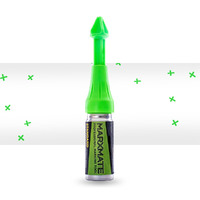
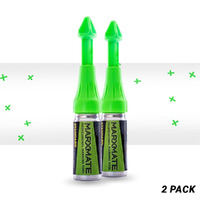
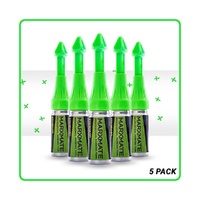
Thought i would splash out and buy one of these as I always struggled to mark recessed mounting holes in lights, outlets and various other stuff. I've ruined so many sharpies and permanent markers in the past trying to pullout the tip in order to mark out mounting holes. This works surprisingly really well, definitely worth the money.
This unit makes marking drill guide holes easy on all surfaces even if they are uneven and especially on black speckled bricks where traditional black sharpies won't work as they blend in. This is a time saver and a real game changer and allows for speedier installation time.
The amount of times I've pulled out the felt of a marker to mark those holes that are a little too deep I couldn't count. These things are absolutely fantastic. Holes are marked faster and more accurately than ever before.
Quality products in stock • Fast Australia-wide delivery • Competitive trade pricing
Browse Wall Plugs → Get Expert Advice →Correctly selected and installed wall plugs help screws stay secure in materials that would otherwise not grip well.
Sparky Direct supplies wall plugs Australia-wide, offering a wide range of fixing solutions with reliable delivery.
Wall plugs are lightweight and delivered via standard courier services.
Unused wall plugs are generally eligible for return according to the seller’s returns policy.
Warranty coverage depends on the manufacturer and typically covers defects in materials or workmanship.
Wall plugs are available in various pack sizes, from small packs to bulk quantities.
Once installed, wall plugs generally do not require maintenance.
Specialised wall plugs designed for poor-quality or crumbly materials are recommended in these cases.
Heavy items require wall plugs that are specifically rated for higher loads and suitable wall materials.
Installation usually requires a drill, the correct drill bit, and a screwdriver or driver.
Yes, but moisture-resistant wall plugs are recommended for wet areas.
Improper installation or over-tightening can cause damage, but correct installation helps minimise wall damage.
Wall plugs are easy to install when the correct size drill bit and screw are used.
Wall plugs are used to secure screws into materials such as masonry, brick, concrete, or plasterboard where a screw alone would not hold securely.
Most wall plugs are not designed to be reused once removed, as their holding strength may be reduced.
Choosing the right wall plug depends on the wall type, screw size, and the weight of the item being fixed.
Wall plugs are commonly used for mounting electrical accessories, but electrical work must be completed by a licensed electrician.
Yes, most wall plugs require a correctly sized pre-drilled hole for proper installation.
Some wall plugs have load ratings, which vary depending on wall material, plug type, and installation method.
Specialised hollow wall or plasterboard plugs should be used for plasterboard installations.
Yes, certain wall plugs are designed specifically for solid materials like concrete and brick.
Wall plugs are available in a range of sizes to suit different screw diameters and load requirements.
Many wall plugs are manufactured in line with relevant AS/NZS standards, but suitability depends on the specific product and intended use.
Yes, wall plugs are designed specifically for solid walls, hollow walls, plasterboard, and masonry to ensure a secure fixing.
Wall plugs are commonly made from nylon, plastic, or metal, depending on the application and load requirements.