
Search Results:
Search Results:
Search Results:
Search Results:
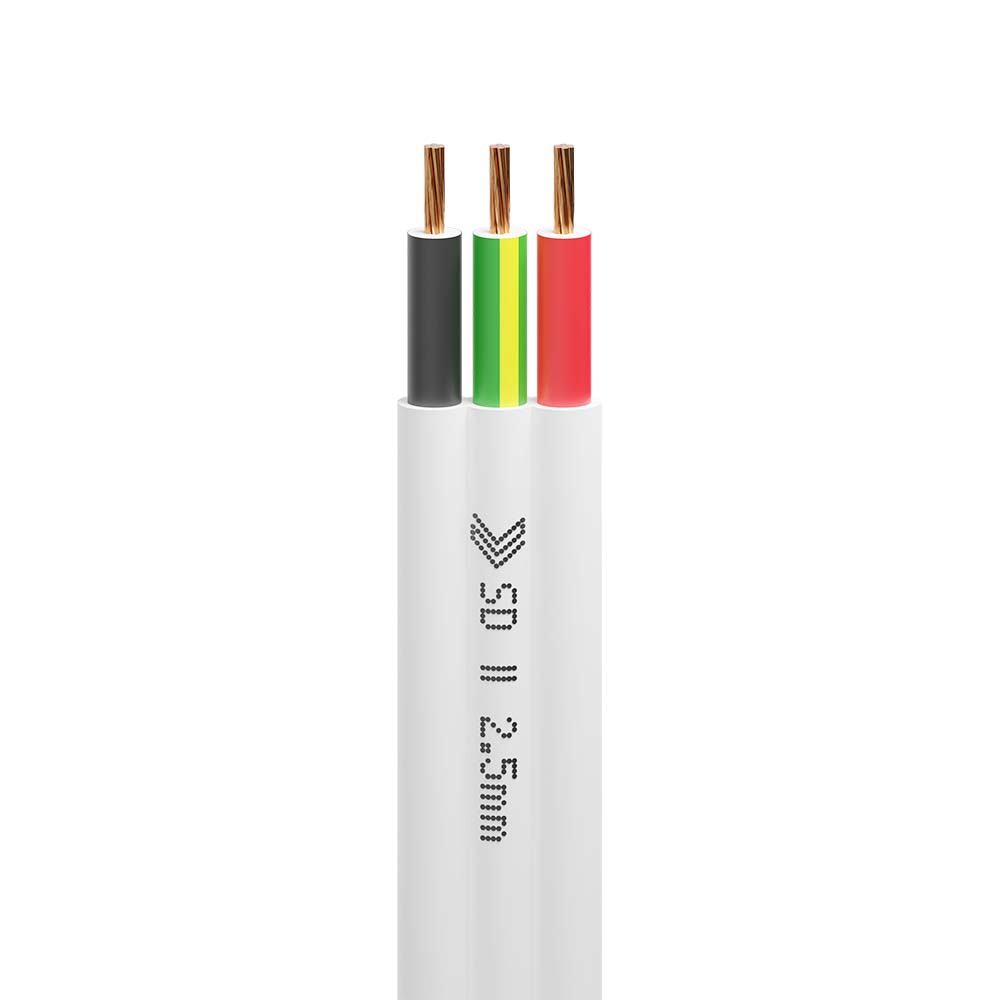
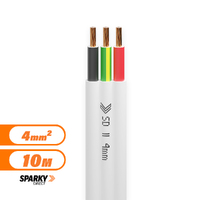
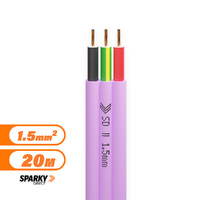
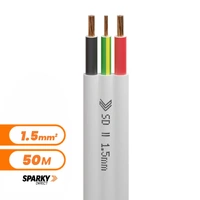
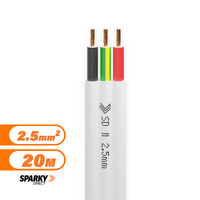
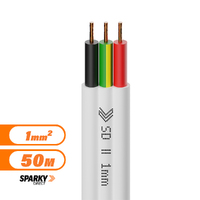
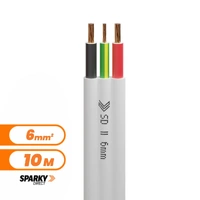
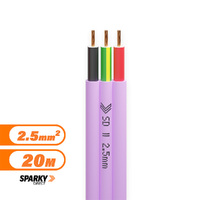
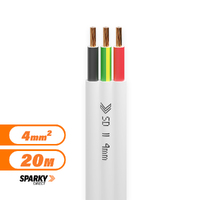
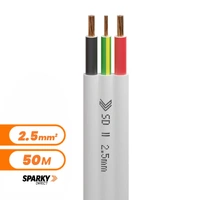
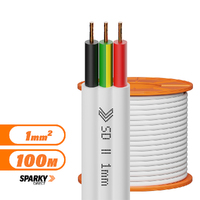
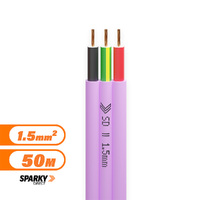
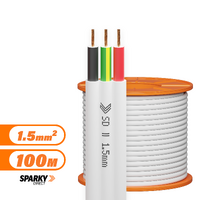
Twin and earth cable (TPS or T+E) is the flat, three-conductor cable designed for fixed electrical wiring in Australian buildings. The name refers to its layout: two insulated current-carrying conductors, active and neutral, plus a separate bare copper earth conductor. All three sit inside a single PVC outer sheath that gives the cable its characteristic flat profile.
This cable type is the backbone of residential and light commercial wiring. Electricians use it for almost every lighting circuit and general power point installation in stud-frame, brick-veneer, and masonry construction across Australia.
The cable is built in three layers. The two current-carrying conductors are solid or stranded copper, each covered in coloured PVC insulation (typically red for active, black for neutral). The earth sits between them as a bare copper wire with no coloured insulation. A tough PVC outer sheath encloses all three, giving the cable its flat shape and mechanical protection. Quality cables use annealed copper for conductivity and PVC rated to 75°C or 90°C.
Each conductor has a distinct job. The active carries current from the switchboard to the load. The neutral returns current to the supply, completing the circuit. The bare earth conductor provides a low-impedance fault path back to the switchboard, tripping protective devices if a live part contacts exposed metalwork. Without a working earth, an appliance fault could leave metal surfaces at mains voltage.
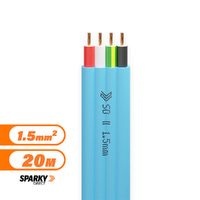
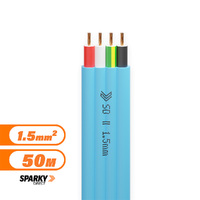
Twin and earth is one member of a wider family of electrical cables. Flat TPS is the default for fixed building wiring. Orange circular cables are used where the cable runs through suspended ceilings or needs more physical robustness. SDI cable is used inside switchboards and for sub-mains. Twin core cables without an earth are used only where double insulation is already in place, such as certain lighting fixtures.
Sparky Direct stocks twin and earth cable across all the sizes used in Australian installations. Each size suits a different load range and installation type.
Most domestic lighting in Australia runs on 1.5mm² twin and earth, protected by a 10A or 16A miniature circuit breaker. Designers sometimes use 1mm² on smaller circuits in single-storey homes where the total load stays well under the protective device rating. On long lighting runs, a step up to 2.5mm² helps keep voltage drop within the 5 percent limit set out in AS/NZS 3000.
2.5mm² is the default for general power point (GPO) circuits on a 20A MCB. It handles the typical mix of household loads, including kettles, toasters, microwaves, and power tools. Dedicated appliance circuits step up to 4mm² or 6mm² depending on the rated current. Hot water, air conditioning, and induction cooktops often need their own dedicated runs.
Larger sizes of twin and earth are used for sub-mains that feed secondary distribution boards, detached garages, and granny flats. 10mm² and 16mm² runs are common on these circuits. For very long sub-mains, or where derating is severe, electricians often switch to orange circular cable or SDI cable for better mechanical protection.
Cable sizing starts with the design load. Every conductor has a current-carrying capacity listed in the AS/NZS 3008 tables, adjusted for the installation method. The cable must safely carry the full circuit load without overheating, under the worst-case conditions expected in service.
A rough rule of thumb: 1.5mm² handles most lighting circuits, 2.5mm² handles general power points, 4mm² handles dedicated appliance circuits, and 6mm² handles large fixed loads. These defaults still need to be confirmed by calculation on every real installation.
The cable size must match the upstream protective device. An MCB that allows too much current through an undersized cable will let the conductor overheat before tripping, risking insulation breakdown and fire. Residual current devices (RCDs) must also be rated correctly for the circuit, with sensitivity set to 30mA for final sub-circuits as required under AS/NZS 3000. Safety switches, circuit breakers, and earth leakage circuit breakers must all be selected to protect the cable they feed.
AS/NZS 3000 caps total voltage drop at 5 percent from the point of supply to the furthest point of use. On long cable runs, this limit is reached long before the thermal current rating is exhausted. A 40-metre run of 1.5mm² supplying a 10A load drops around 3 percent on its own, leaving little headroom for the upstream mains. For long runs, step up one size.
The most common sizing errors are undersizing long runs, ignoring grouping derating when multiple cables share a conduit, and installing cable rated for open air where it actually runs through insulation. Each of these can push a cable beyond its real capacity. An undersized or over-protected cable is a fire risk, and it will fail a pre-commissioning insulation resistance test well before causing visible damage.
The same cable can carry very different currents depending on how it is installed. AS/NZS 3008 lists separate current tables for cables clipped direct to a surface, buried in thermal insulation, pulled through conduit, or run in a cable tray. Conduit installations reduce the current-carrying capacity because heat cannot escape as easily. Buried or insulation-surrounded cables derate even further.
When several cables run side by side, each one heats the others. AS/NZS 3008 applies a grouping factor to account for this. Six cables clipped together in a bundle may derate by 30 percent or more compared with a single cable in open air. The same applies when twin and earth is covered by bulk insulation in a ceiling: the surrounding material holds heat against the sheath and the cable must run cooler to stay within its temperature limit.
Queensland roof spaces often reach 60°C or higher in summer. Standard PVC-insulated twin and earth is rated for a 75°C conductor temperature, so every additional degree of ambient heat eats into the current the cable can safely carry. In hot climate zones, electricians frequently step up a cable size on long ceiling runs to restore the margin. High-temperature variants, such as 90°C V90HT cables, are designed for these conditions.
Derating is not optional. It is a compliance requirement under AS/NZS 3000 Clause 3.4. Using the table value for an open-air installation when the cable actually runs through ceiling insulation is one of the most common causes of failed inspection. The correct method is to start with the open-air rating, apply every relevant derating factor, and use the lowest result as the real current capacity.
AS/NZS 5000.1 sets the construction and performance requirements for PVC-insulated flat cables used in fixed wiring. It covers conductor size tolerances, insulation thickness, minimum breaking strain, and ageing resistance. Every compliant twin and earth cable sold in Australia must meet these requirements and carry the appropriate RCM (Regulatory Compliance Mark).
AS/NZS 3000, the Australian/New Zealand Wiring Rules, governs how cable is selected, installed, and protected. It sets out the rules for cable sizing, voltage drop, protective device coordination, routing, support, and earthing. It is the document every licensed electrician in Australia must work to, and every installation is inspected against.
Genuine compliant cable carries the RCM mark on the outer sheath, together with the manufacturer name, size, and the cable standard (AS/NZS 5000.1). The marking must be legible and consistent along the full length of the cable. Missing, illegible, or inconsistent marking is an immediate warning sign, because it can indicate counterfeit or non-compliant product.
Non-compliant cable often uses undersized copper, thin insulation, or substandard PVC that ages quickly. The risks include insulation failure under normal load, premature cable breakdown, failed inspection, voided warranty on the wider installation, and personal liability for the licensed electrician who signed it off. Buying from a trade wholesaler that only stocks certified product removes this risk.
In Australia, installing or modifying fixed electrical wiring is restricted work. Only a licensed electrician may cut in, run, or terminate twin and earth cable on a domestic or commercial premises. Licensing is managed state by state through bodies such as Queensland's Electrical Safety Office, Fair Trading NSW, and Energy Safe Victoria. DIY installation of fixed wiring is illegal and uninsurable in every Australian state and territory.
Cable runs must be supported at regular intervals with the correct-sized clips. Sparky Direct stocks the full range of cable clips, including 1.5mm cable clips and 2.5mm cable clips for the two most common conductor sizes. Runs inside stud walls must avoid zones where future nails or screws could penetrate the cable. Where mechanical damage is likely, the cable must be sleeved in conduit or enclosed in a stud protector.
Standard flat twin and earth is not rated for direct burial. Underground runs use either orange circular cable in conduit, or a purpose-built direct-burial cable. External runs exposed to sunlight need UV-resistant sheaths, because standard PVC becomes brittle after prolonged UV exposure. Cables entering a switchboard or weatherproof enclosure from outside must use a sealed cable gland to maintain ingress protection.
Every termination must be mechanically secure and electrically sound. Strip the insulation to the correct length using proper wire strippers (not a knife), land the copper fully under the terminal screw, and torque to the manufacturer specification. Leave enough conductor length in the enclosure for future re-termination. The earth conductor must be sleeved in green or green/yellow insulation before entry into terminal boxes.
Flat twin and earth is the dominant format in Australian residential wiring. Its shape makes it easy to clip neatly against a flat surface and pull through stud cavities. Circular cable, including orange-sheathed TPS, is used where extra mechanical protection is needed or where the installation runs through a suspended ceiling or plant room. Flat and circular cables of the same conductor size carry similar currents, but the circular sheath is tougher.
| Property | PVC Insulation (V75/V90) | XLPE Insulation (X90) |
|---|---|---|
| Conductor temperature rating | 75°C or 90°C | 90°C (higher overload tolerance) |
| Flexibility | Good | Slightly stiffer |
| Cost | Lower | Higher |
| Typical use | Residential and general fixed wiring | Commercial and high-load circuits |
| Halogen content | Contains halogens | Halogen-free options available |
Genuine compliant twin and earth cable uses pure annealed copper conductors. Copper-clad aluminium (CCA) cable looks similar and costs less, but it is not compliant with AS/NZS 5000.1 for fixed wiring. CCA has a higher resistance, runs hotter at a given load, and fails insulation resistance testing earlier. Any cable sold with a suspiciously low price per metre should be checked for genuine copper content before use on a job.
Standard 75°C PVC cable suits most indoor installations. 90°C high-temperature variants (V90HT) are designed for roof spaces in hot climate zones, enclosures with reduced ventilation, and runs grouped with other heat-producing cables. The higher temperature rating does not increase the current capacity automatically. The derating tables must still be applied, but the cable survives in warmer environments without accelerated insulation ageing.
Well-installed compliant cable is safe for the full design life of the building. Faults almost always trace back to one of four causes. These are mechanical damage during installation, overheating from under-sized cable or blocked heat dissipation, poor terminations that generate arcing, and ageing PVC exposed to heat or UV for too long. Sound installation practice addresses all four.
Genuine compliant cable from a known manufacturer typically lasts 40 to 50 years in service. The main degradation mechanism is slow plasticiser loss from the PVC insulation. Quality cable ages slowly and predictably. Non-compliant cable can fail in under five years, particularly in hot or UV-exposed locations.
Every 10°C increase in conductor temperature roughly halves the remaining life of PVC insulation. This is why derating matters so much. A cable consistently run at 20°C above its rated temperature loses most of its design life in a few years. The effect is cumulative and invisible from outside, until the insulation resistance drops enough to trip an RCD or cause an earth fault.
Correctly installed twin and earth cable in a temperate indoor environment should last the lifetime of the building. Cables in hot roof spaces, enclosed luminaires, or areas with UV exposure have shorter practical lifespans and should be checked during any major renovation. Any cable showing cracked, discoloured, or brittle insulation must be replaced, regardless of age.
Twin and earth cable is priced per metre or per drum. Drum sizes at Sparky Direct are typically 100 metres, which is the standard working length most electricians order. Smaller cut lengths are also available from the cable cuts range for small jobs and repairs. Larger conductor sizes cost more because they contain more copper, and copper prices drive the bulk of the variation over time.
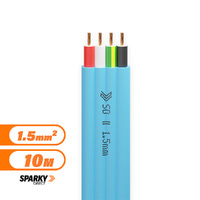
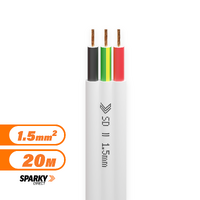
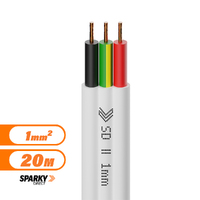
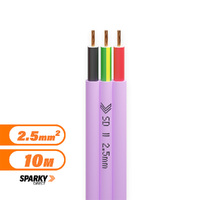
For a job measured in tens of metres, a 100-metre drum almost always works out cheaper per metre than multiple short cuts. For a single point replacement or an add-on circuit, a 10- or 20-metre cut removes the waste. The break-even point sits around 30 to 40 metres for most sizes. Keep offcuts from larger drums labelled, because they are often useful for the next job.
Premium compliant cable uses pure annealed copper, consistent insulation thickness, a tough outer sheath, and legible printed marking along the full length. Cheap imported cable often cuts costs on copper weight, PVC thickness, and quality control. The price difference per metre is usually 20 to 40 percent, but the cheaper cable can cost far more in rework, warranty claims, and liability if it fails. Licensed electricians are better off paying for certified stock.
Bricks-and-mortar trade counters hold stock for same-day pickup but charge a counter markup. Online wholesalers like Sparky Direct hold larger ranges, publish transparent pricing, and ship to site. The trade-off is a one- or two-day wait for delivery. For planned work, the online price usually wins. For urgent breakdowns, the local counter still has a place in the supply mix.
Sparky Direct ships twin and earth cable Australia-wide from stock. Common sizes (1mm, 1.5mm, 2.5mm, 4mm, 6mm) are held in 10-, 20-, 50-, and 100-metre options in white and orange sheaths. Orders placed before mid-morning typically ship the same day from the Morayfield warehouse in South East Queensland.
Start with the circuit schedule. Count each lighting, power, and dedicated circuit, apply the correct size to each, and add a 10 percent length buffer for routing changes on site. A small three-bedroom home typically needs 200 to 300 metres of 2.5mm² for power and 150 to 250 metres of 1.5mm² for lighting. Add targeted amounts of 4mm² and 6mm² for ovens, hot water, and air conditioning.
Accurate quantity planning starts with the floor plan. Measure each run from the switchboard to the furthest point and add 10 to 15 percent for routing around obstacles and into enclosures. Round up to the next standard drum size. For commercial fitouts, allow a further 5 percent for variations flagged during installation.
Sparky Direct is an Australian online electrical wholesaler based in Queensland. The full twin and earth range sits alongside the wider building wire catalogue, matching cable ties, cable cutters, and circuit protection gear. Licensed trade customers can also access the Electra-Cables range of Australian-compliant flat TPS. The site publishes transparent pricing, no hidden trade account gates, and ships Australia-wide.
Watch 1.5mm Twin & Earth Flat Cable | Pvc / Pvc | 7-050-2ERB | 10mtr Cut video
Watch NLS 30363 | 12mm Cable Clips to Suit 2.5mm Twin & Earth | 500 Jar video
Watch NLS 30445 | 14mm Cable Clips to Suit 4.0mm Twin & Earth Electrical Cable | 250 Jar video

2.5 twin and earth might just seem like cable and it is but the insulation material is better. It feels better and can strip easier. Marking the active cable on the outer Sheath is a bonus. Again good value for money good cable. As a multi strand conductor still give a heavier cable flex. Definitely recommend for the product and the cost
Time management is critical. None more so when you are a small operation with limited human resources. Being able to research products, order and then have prompt reliable delivery, well that's a critical support resource. Additionally, all prices are more than fair and reasonable, including delivery. Total cost is consistently equal to or less than that available from my local supplier. As an added bonus cost saving specials are consistently sent to my in box.
Buy this stuff in bulk and the response time from order to the shipment fulfillment is always top notch with no dramas at all, the products are always of the most excellent quality and the buying process is seamless.
Quality products in stock • Fast Australia-wide delivery • Competitive trade pricing
Browse Twin and Earth Cable → Get Expert Advice →Yes. They are commonly installed within wall cavities, ceilings, and roof spaces.
Twin & earth cables are available from Sparky Direct, offering access to compliant electrical products with Australia-wide delivery.
Delivery options depend on the supplier and location, with availability across metropolitan and regional Australia.
Yes. They are suitable for new construction, renovations, and electrical upgrades.
Warranty coverage depends on the manufacturer and supplier, with conditions applying to correct use and installation.
Consider conductor size, number of cores, compliance markings, application requirements, and electrician recommendations.
Yes. When compliant products are installed by licensed electricians, they provide a safe wiring solution.
Yes. When correctly sized, they are suitable for modern household electrical loads.
Yes. They are used in both residential and light commercial electrical installations.
The cables themselves do not require maintenance but are checked during electrical inspections.
Yes. They are commonly used for new circuits and upgrades during renovations.
When correctly installed and protected, twin & earth cables can last for many years.
In most cases, they are concealed behind walls, ceilings, or other building elements.
Twin & earth cables are electrical cables containing two insulated conductors and an uninsulated earth conductor, commonly used for fixed wiring.
They are designed for professional installation and are straightforward for licensed electricians to work with.
They offer a practical combination of power conductors and earthing, making them suitable for standard household wiring.
Yes. Installation must be carried out by a licensed electrician to ensure safety and compliance.
Yes. The active and neutral conductors are insulated, with an outer sheath providing additional protection.
Yes. They are suitable for both lighting and power circuits when correctly specified.
Yes. They are available in a range of conductor sizes to suit different electrical loads and circuit requirements.
Twin & earth cables typically use copper conductors for reliable electrical performance.
Yes. Twin & earth cables are widely used in Australian residential electrical installations.
The earth conductor provides a safety path to reduce the risk of electric shock in the event of a fault.
Quality twin & earth cables supplied in Australia are manufactured to meet relevant AS/NZS electrical and safety standards when installed correctly.
They are commonly used for lighting circuits, power outlets, and general fixed wiring in residential and light commercial buildings.