
Search Results:
Search Results:
Search Results:
Search Results:
LED strip connectors create a fast, reliable electrical join between two pieces of strip light, or between a strip and a power source. They replace the need for a soldering iron and flux. The connector body holds spring contacts or insulation-displacement teeth that grip the copper pads on the strip. Once clipped or clamped shut, the contacts complete the circuit through to the LED chips downstream.
Inside each connector is a set of metal contacts mounted in plastic housing. The contacts are positioned to align with the cut points and pads printed on standard 8mm, 10mm, and 12mm strips. When the strip is inserted and the lid is closed, the contacts press firmly against the copper pads. This creates a low-resistance path for current. No heat, no flux residue, and no risk of damaging the LED phosphor with a stray iron tip.
Connectors handle three main jobs on a strip lighting run. First, they extend a strip when one length is not enough. Second, they bridge gaps when a run needs to turn a corner or jump across a piece of timber. Third, they adapt the strip to power inlet leads or to a controller, so the wiring side and the LED side meet cleanly. Without connectors, every join would need solder, heat-shrink, and bench time.
A loose or oxidised contact is the most common cause of flicker in a strip run. The connector keeps spring tension on the copper pads and seals the contact area from air and dust. Good connectors hold their grip for years. Cheap units relax over time and start to misbehave, especially under thermal cycling.
Every join introduces a small amount of resistance. A high-quality connector adds far less resistance than a poor one. On long runs, that difference shows up as visible dimming at the far end. Using the right connector for the strip width and current load keeps voltage drop within acceptable limits across the full length.
A clip-on connector takes seconds to fit. A soldered join takes minutes once heat-shrink and clean-up are factored in. For installers running ten or twenty metres of strip in a kitchen, joinery shop, or retail fit-out, that time difference is significant. Solderless connections also make every join look the same, which matters when the strip sits inside an aluminium channel with a diffuser over the top.
Most categories cover a spread of these styles. The right choice depends on the layout. For long straight runs, clip-on strip-to-strip joiners are quickest. For installations where the strip ducks behind a panel, wire-lead connectors give the run more freedom. For corners, a fixed L-piece is neater than trying to bend the strip around a tight angle.
LED strips come in three common widths: 8mm, 10mm, and 12mm. The connector must match the strip width exactly. An 8mm connector will not seat on a 10mm strip, and a 12mm connector on an 8mm strip will leave the contacts misaligned with the copper pads. Check the strip width on the data sheet or measure across the strip with callipers before ordering.
Single-colour strips use 2-pin connectors, one for positive and one for negative. RGB strips use 4-pin, with separate channels for red, green, and blue. RGBW and RGBCCT strips need 5-pin or 6-pin connectors to handle the additional white channels. Pin count must match end to end, or some channels will simply fail to light.
| Strip Type | Pin Count | Typical Voltage | Use Case |
|---|---|---|---|
| Single colour (warm, cool, daylight) | 2-pin | 12V or 24V | Under-cabinet, accent, cove lighting |
| CCT (tunable white) | 3-pin | 12V or 24V | Adjustable colour temperature zones |
| RGB (colour change) | 4-pin | 12V or 24V | Feature lighting, retail displays |
| RGBW or RGBCCT | 5-pin or 6-pin | 24V common | Architectural lighting with white plus colour |
Connectors themselves are typically rated to handle either 12V or 24V low-voltage DC. The bigger compatibility issue is at the strip and driver level. A 12V strip will not run on a 24V driver without damage. Check the strip voltage and driver output before joining anything. Downlight transformers and LED drivers are not all interchangeable.
An IP65 or IP67 strip has a silicone coating over the LEDs. Some clip-on connectors will not close properly over a thick silicone jacket. For a waterproof strip, look for connectors designed with a wider opening or a dedicated waterproof series. The alternative is to trim back the silicone at the cut point, fit a standard connector, and seal the join with heat-shrink or potting compound.
Solderless connectors are fast, repeatable, and forgiving. They suit installers working on-site without bench access. They also suit anyone who wants to extend or modify a run later without rework. There is no heat applied to the LED, so no risk of damaging the chip or the phosphor coating during the join.
Soldered joins are the gold standard for long-term reliability and minimal voltage drop. For high-end architectural work, in-wall installations, or runs where access for future maintenance is difficult, a properly soldered and heat-shrunk join is hard to beat. The contact area is larger, and the resistance is lower than that of any clip-on alternative.
Speed and reliability sit on opposite ends of the same scale. A clip-on connector is fast but can loosen with vibration or thermal cycling. A soldered join is slow but will outlast the LEDs themselves. For most domestic and light commercial jobs, modern solderless connectors are reliable enough. For mission-critical or hard-to-reach installations, solder still wins.
If you are using solderless connectors on a job that needs to last, give each join a gentle tug after fitting to confirm the strip is fully seated. A connector that pulls free under light tension was never going to survive thermal cycling in a kitchen plinth.
Start with the run layout. Straight extensions need strip-to-strip joiners. Power feeds need wire-lead connectors. Corners need L-pieces or short flexible jumper leads. Sketch the run before ordering, mark every join, and count the connector types needed at each point.
Indoor dry locations like ceiling coves, kitchen plinths, and shelving accept the standard non-waterproof connector range. Bathrooms, outdoor eaves, and damp basements need waterproof or sealed units. The IP rating on the connector should match or exceed the IP rating on the strip itself.
Tight layouts with multiple corners and short jumps need flexibility. Clip-on connectors work fine for single, accessible joins. For complex runs with awkward access, plan to use wire-lead connectors and longer flying leads so each join can be made on the bench before the strip goes into position. Future serviceability matters too. If a section ever needs replacement, plug-and-play joins make it a five-minute swap rather than a stripping and re-soldering job.
LED strips have printed scissor icons or dotted lines marking valid cut points, usually every 25mm, 50mm, or 100mm depending on chip pitch. Cut only on these marks. Cutting between cut points removes a section of circuit and breaks the LED group on either side of the cut. Use a sharp pair of side cutters and make a single clean snip.
The two copper pads at each cut point must sit squarely under the connector contacts. Open the connector lid, slide the strip in until the pads are visible through the contact window, then close the lid until it clicks. The pads should make full contact with both metal teeth. A misaligned strip will either fail to light or run intermittently.
Once seated, the connector should not be free to slide back off the strip. If the run will sit inside an aluminium channel, the channel itself holds everything in place. For exposed runs, a small dab of silicone or a cable tie at the connector body keeps it firmly anchored. Avoid putting strain on the connector by routing the wires before sticking the strip down to the surface.
Compliance note: Although LED strip lights are extra-low-voltage on the strip side, the 240V supply feeding the driver must be installed by a licensed electrician under AS/NZS 3000:2018. Plug-in drivers fed from a standard outlet are user-installable; hard-wired drivers are not.
Fitting an 8mm connector to a 10mm strip is the most common sizing error. The contacts simply do not reach the copper pads. The second most common error is using a 2-pin connector on an RGB strip. Two of the four channels are then disconnected, and the colours behave unpredictably.
If the strip goes in skewed, only one of the two contacts touches its pad. The strip lights up dimly or not at all. Always check the pads through the connector window before closing the lid, and re-seat the strip if anything looks off-centre.
Pulling on the strip after the connector is closed is a fast way to break the join. Route and secure the wires first, then stick the strip to the surface. Leave a small slack loop near each connector so thermal expansion does not pull at the contacts over time.
Joining a 12V section to a 24V section through a connector is a recipe for damaged LEDs. Same for joining a 4-pin RGB strip to a 5-pin RGBW connector. Verify both sides of every join before powering up.
The contact area inside a connector is small. Anything that reduces the spring force, or contaminates the metal surface, reduces conductivity. Keep cut ends clean. Avoid touching the copper pads with bare fingers, since skin oils and salt accelerate oxidation. If a strip end has been sitting on a dusty bench, wipe the pads with isopropyl alcohol before fitting the connector.
Thermal cycling is the main enemy of plug-in connectors. Every time the strip warms up and cools down, the plastic housing expands and contracts a fraction. Over hundreds of cycles, that movement can relax the spring tension. Quality connectors use spring metals that hold tension better. Cheap units rely on plastic to hold the contacts in place, and that plastic creeps over time.
For runs over five metres, voltage drop becomes visible. The strip dims toward the far end. There are three main solutions. First, feed power from both ends of the run. Second, split the run into two shorter sections, each with its own driver. Third, step up to 24V strip, which carries less current for the same output. 5m LED strip kits usually arrive with the right gauge of supply lead pre-fitted to manage drop within the spec length.
Kitchen plinths, under-cabinet task lighting, wardrobe interiors, and stair-tread accents all rely on short strip runs with one or two joins. Solderless connectors are well suited here because the joins are accessible and the run length is short. 2m strip kits often suit a single cabinet run without further extension.
Retail fit-outs use strip lighting in shelves, channel letters, and display cases. The strips need to follow the geometry of the display, which means a lot of corners and short runs. Wire-lead connectors are essential for this kind of layout. RGB strip with 4-pin connectors is common for branding-driven colour effects.
Coves, perimeter ceilings, and stair handrails all use long, continuous strip runs. These benefit from the most reliable joins available, often soldered, with solderless connectors used only at access points where future maintenance is likely. Daylight, warm white, and tunable white strips dominate this space depending on the design intent of the room. Daylight LED strips work well in galleries and retail; warm white strips suit residential coves.
Outdoor and damp-area strips carry an IP rating from IP65 upward. Connectors on these strips must be rated to match. Some connectors arrive with a sealed silicone gasket built into the lid. Others are designed to be potted in compound after the strip is fitted. Read the IP rating on the connector packaging before assuming it suits the application.
Even on a covered eave, condensation can collect inside an aluminium channel overnight. Any uncovered metal contact will eventually corrode. For outdoor work, prioritise sealed connectors and consider potting the join in clear silicone for added protection. Avoid joining IP-rated strip with non-rated connectors and assuming the channel will keep water out, since it usually does not.
For permanent outdoor installations, gel-filled connectors are a strong option. The gel surrounds the contacts and keeps moisture and air away from the copper pads. Gel connectors are originally designed for low-voltage telecoms work but transfer well to outdoor LED applications. Match the IP rating on every component in the run, including driver, strip, channel, and connector.
Sparky Direct stocks a range of connectors alongside the LED strip range. Buying connectors and strip from the same supplier helps ensure compatibility, since the staff can confirm the strip width and pin count of the strip series being ordered. Trade pricing applies on bulk quantities.
Generic clip-on connectors are inexpensive and acceptable for short, accessible runs. Trade-grade units cost more but use better spring metals, more accurate moulding, and better electrical contact design. For installations behind plasterboard or inside built-in joinery, the trade option pays for itself the first time you avoid a callback.
Installers running multiple sites benefit from buying in jars or trade packs. The unit cost drops, and a stocked van or workshop avoids site delays when an unexpected join comes up. Plan ahead for a mix of 8mm and 10mm widths, plus 2-pin and 4-pin variants, since most projects use a combination across the run.
For LED strip kits, brands like SAL dominate the local trade market with full kits including driver, strip, and end connectors. For general-purpose splicing connectors that pair well with LED strip projects, WAGO compact splicing connectors are widely used to terminate the supply leads back to a junction. 4Cabling and CABAC also stock relevant low-voltage accessories for installers building out custom setups.
Flicker is almost always a contact issue. Open the connector, inspect the copper pads for oxidation or damage, and reseat the strip. If flicker persists after reseating, swap the connector for a fresh one. Persistent flicker on the same section after replacement points to a damaged section of strip rather than the connector.
If one end of the run is noticeably dimmer, voltage drop is the likely cause. Confirm the strip length is within spec for the driver. If it is, feed the strip from both ends or split into two driven sections. A weak connector in the middle of a run can also cause downstream dimming, since the resistance at that join eats into the voltage available to the rest of the strip.
If a section refuses to light, the first check is polarity. Strips are marked with a plus and a minus symbol at each cut point. The connector must pass these through end to end. The second check is pin count; an RGB strip joined through a 2-pin connector will not light correctly. The third check is voltage; a 12V strip on a 24V driver will fail almost instantly, often visibly.
When a section does not work, check polarity first, pin count second, voltage third, and contact quality last. Most LED strip faults trace back to one of these four points, in roughly that order of frequency.
Watch Wago 221-2411 | 4mm² 2-Way Inline Splicing Connector | Jar of 60 video
Watch Wago 221-612 | 6mm² 2-Way Compact Splicing Connectors | Jar of 50 video
Watch Wago 887-952 | 4mm² Splicing Connector Set | L-BOXX Mini - 221 Series video

Delighted with our Flexi Smart Strip Lights. Delivery was super quick and the quality excellent. We installed them ourselves and couldn't be happier.
Bought these strip lights to light up my office. Super bright led lights and easily dimmable with the app on my phone. Brightly recommended!
Brilliant idea and quality as well. Fast and effective terminations, a marine electricians best friend, no more BP connectors for me. I used them on both AC and DC terminations.
Quality products in stock • Fast Australia-wide delivery • Competitive trade pricing
Browse LED Strip Connectors → Get Expert Advice →Yes, they help keep connections organised and tidy.
Sparky Direct supplies strip connectors Australia-wide, offering reliable and compliant electrical connection solutions with convenient delivery.
Strip connectors are securely packaged and delivered via standard courier services.
Unused products are generally eligible for return according to the seller’s returns policy.
Warranty coverage varies by manufacturer and typically covers defects in materials or workmanship.
Yes, strip connectors are typically sold as individual strips or in packs.
Yes, correct sizing ensures safe and reliable connections.
Yes, they are commonly used when modifying or extending wiring.
They are usually concealed within an enclosure or fitting.
Yes, screw terminals help secure conductors firmly.
Yes, they are often used in appliance wiring and repairs.
Quality strip connectors are designed for reliable long-term use.
They are straightforward for licensed professionals to use correctly.
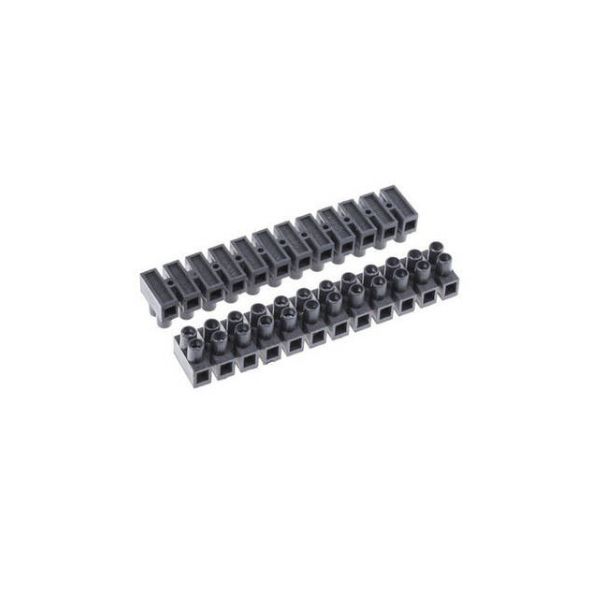
Strip connectors are electrical connectors consisting of a row of terminals used to join multiple conductors securely.
Yes, they are a widely used connector in many wiring applications.
They provide a safer, more secure, and compliant method of joining wires.
Yes, they are typically installed within junction boxes or enclosures.
Yes, they are commonly used for light fittings and basic wiring connections.
Yes, individual terminal sections can be separated as needed.
They are typically made from insulated plastic with internal metal terminals.
Yes, they are available to suit a range of cable sizes and current ratings.
Yes, they are suitable for residential, commercial, and light industrial applications.
Yes, they are commonly used in residential electrical installations.
Quality strip connectors are manufactured to meet relevant AS/NZS electrical and safety standards when used correctly.
They are used to connect, join, or extend electrical wires in lighting, appliances, and general wiring applications.