
Search Results:
Search Results:
Search Results:
Search Results:
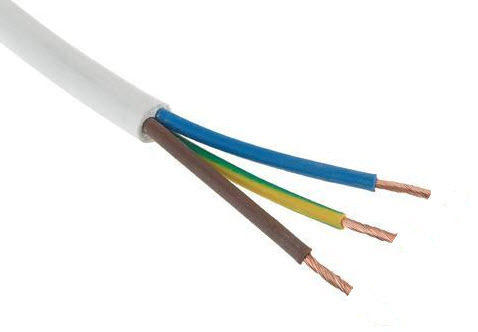
A 3-core cable is a single sheathed cable containing three insulated conductors: active, neutral, and earth. Each conductor performs a distinct role in the circuit, and the colour-coded insulation lets electricians identify and terminate each one correctly. The outer sheath provides mechanical protection and an additional layer of insulation between the conductors and the surrounding environment.
The active conductor (brown in modern Australian flexible cable) carries supply voltage from the source to the load. The neutral conductor (blue) provides the return path under normal operating conditions. The earth conductor (green/yellow) is bonded to the metal frame of any appliance or fixture and carries fault current to ground if the active makes contact with a touchable metal part.
Under normal operation, current flows out through the active and returns through the neutral. The earth sits idle. When a fault occurs, such as a damaged wire touching a metal enclosure, the earth provides a low-impedance path that lets enough current flow to trip the circuit breaker or RCD almost instantly. This is why earthing is non-negotiable on any Class I appliance.
3 core cable differs from twin and earth in both construction and use. Twin and earth (also called TPS cable) is a flat profile used in fixed wiring inside walls and ceilings. 3 core flexible cable has a round profile, finer stranded conductors, and a tougher sheath designed for movement, abrasion, and connection to portable appliances.
Selecting and installing the correct cable is not just about getting the appliance to work. The cable carries the consequences of every fault that occurs across the life of the installation, and Australian regulators take this seriously.
The earth conductor inside the 3-core cable is the primary means of automatic disconnection of supply (ADS) for Class I equipment. If insulation fails and the active touches a metal chassis, fault current flows through the earth back to the supply, raising the current high enough to operate the protective device. Without a continuous earth, the chassis remains live, and the user receives a shock.
Every cable installed in a fixed or portable application in Australia must comply with AS/NZS 3000:2018, the Wiring Rules. The Rules specify minimum conductor sizes for given loads, derating factors for grouped or buried cable, and termination methods. Cables themselves must carry an Australian approval mark indicating they meet AS/NZS 5000 or AS/NZS 3191, as relevant.
3 core cable shows up across virtually every category of single-phase electrical work where an earthed connection is required. The choice between flexible and fixed construction depends on whether the cable will move, flex, or simply sit inside a wall cavity for decades.
In homes, 3 core flexible is the standard for pendant lights, hardwired exhaust fans, and any luminaire mounted on a metal body. It also supplies fixed appliances such as range hoods and ducted units when an earthed flexible drop is required.
Flex and plug assemblies built from 3-core flexible cable are the most common way to connect Class I portable appliances to a power outlet. Sparky Direct stocks ready-made flex and plugs and rewireable assemblies for repair work.
Workshop machinery, server racks, and commercial kitchen equipment all rely on 3-core cable, often with heavier conductor sizes and tougher sheath compounds. Extension leads destined for industrial sites are another high-volume use case.
Not all 3 core cable is interchangeable. Construction, insulation chemistry, and conductor stranding all change the cable's suitability for a given environment.
Light-duty 3 core flexible has a thinner sheath and is suited to indoor low-stress work such as lamps and small appliances. Heavy-duty cable carries a thicker sheath, often with a tougher TPE or rubber compound, and is built for tools, leads, and equipment that gets dragged across a slab. Heavy-duty is also the right choice anywhere abrasion, oil, or impact is a daily reality.
Cable performance is governed by three numbers: conductor cross-sectional area, voltage rating, and temperature rating. Selecting on price alone, without checking these, is the single most common cause of failed inspections and overheated installations.
Conductor size is measured in square millimetres (mm²). Common 3 core flexible sizes are 0.75mm², 1.0mm², 1.5mm², and 2.5mm². Each size has a maximum current carrying capacity that depends on insulation type, installation method, and ambient temperature. Always derate when cables are bunched or run through insulation.
| Conductor CSA | Typical Current Rating | Typical Use |
|---|---|---|
| 0.75mm² | Up to 6A | Light fittings, small appliances |
| 1.0mm² | Up to 10A | General appliance leads |
| 1.5mm² | Up to 16A | Heavy appliance leads, extension leads |
| 2.5mm² | Up to 25A | Workshop tools, 15A and 20A circuits |
Ratings shown are indicative for unenclosed flexible cable at 30°C ambient. Always verify against AS/NZS 3008.1.1 for the specific install method.
Standard 3 core flexible carries a 300/500V rating, written as 0.3/0.5kV on the cable print. This is suitable for all single-phase 230V installations. Temperature ratings reflect the maximum continuous conductor temperature: 75°C for general PVC, 90°C for HR PVC, and higher for silicone or fluoropolymer compounds.
Voltage drop matters on long runs. AS/NZS 3000 limits voltage drop from the point of supply to the furthest outlet to 5% of nominal voltage. For appliance circuits, this means an undersized cable on a 30 metre run can drop more than the budget allows, particularly under inrush load. When in doubt, step up one conductor size for runs over 20 metres.
Choosing between cable types is rarely about preference. Each cable has a defined purpose under the Wiring Rules, and substituting one for another usually creates a non-compliant install.
Twin and earth has the same three conductors but a flat profile, solid (or coarse-strand) conductors, and a sheath designed for fixed wiring. It is laid in walls, ceilings, and floor cavities. 3 core flexible has a round profile, fine strands, and a sheath designed for movement. They are not interchangeable. Twin and earth cables remain the standard for fixed work.
"Flexible cable" is the broader category. 3 core flexible is one variant within it, alongside 2 core flexible (no earth, used for double-insulated appliances) and 4 or 5 core variants used for three-phase work or three-phase plus earth.
Multi-core control cable carries a higher count of small conductors at low voltage, typically for signalling, instrumentation, or motor control circuits. It is not rated for mains power delivery. 3 core power cable carries far fewer conductors at higher current and voltage ratings.
The right cable for a job is the one that meets the load, suits the environment, and complies with AS/NZS 3000. Three quick checks cover most decisions.
Start with the appliance nameplate or circuit design current. Apply derating factors for ambient temperature and grouping. Check the voltage drop on the proposed run length. The smallest conductor that satisfies all three checks is usually the correct choice.
Indoor dry use can use standard PVC. Outdoor or wet locations need UV-stabilised sheath and appropriate IP-rated terminations. Hot zones (near oven elements, halogen lamps) need HR PVC or silicone insulation. Cables run inside a conduit need consideration of the fill ratio and the bend radius.
Verify the cable's voltage rating matches the supply: 300/500V flexible is fine for 230V single phase but not for 415V three-phase distribution. Check the connector or termination accepts the cable's outer diameter using correctly sized cable glands.
Cable that is fit for purpose can still fail if it is installed badly. Installation quality is what separates a clean job from a callback.
Avoid sharp bends below the manufacturer's minimum bend radius. Keep cables clear of moving parts, sharp edges, and heat sources. Where cable passes through a metal hole or bulkhead, fit a grommet or gland to prevent abrasion against the edge.
Strip insulation cleanly without nicking conductor strands. Twist fine strands together before insertion into a screw terminal, or use a ferrule for the cleanest result. Tighten terminals to the manufacturer's torque spec, and tug-test every termination after assembly. Use proper wire strippers rather than a knife.
Fix runs at appropriate intervals using cable clips sized to the cable. Do not over-tighten cable ties as they can crush insulation and create a hot spot. Where cable runs along a structure, use a conduit saddle rather than a cable tie wherever practical.
Standards compliance is not optional. Inspectors check for it, insurers rely on it, and customers should be told to expect it.
AS/NZS 3000:2018 covers selection of cable size based on load, derating, voltage drop, and earth fault loop impedance. It also specifies installation methods, segregation from other services, and termination requirements. Every licensed electrician working on fixed wiring must comply.
The cable itself must comply with the relevant AS/NZS construction standard. AS/NZS 5000 covers TPS and similar fixed wiring cables. AS/NZS 3191 covers flexible cords and cables. Look for the standards reference printed on the sheath, along with the manufacturer name, conductor size, and voltage rating.
Newly installed cable must be tested for insulation resistance, polarity, continuity of the earth conductor, and earth fault loop impedance. Test results are recorded on the certificate of compliance. Periodic in-service testing of leads and cords is governed by AS/NZS 3760 in workplaces.
A well-chosen cable installed correctly should outlast the appliance it supplies. Failures usually trace back to cheap materials, mechanical abuse, or thermal stress that was foreseeable at install time.
Trade-grade cable uses high-purity electrolytic copper with consistent strand counts. Budget cable sometimes substitutes copper-clad aluminium (CCA), which has higher resistance, lower fatigue strength, and a shorter life. CCA is not compliant with AS/NZS 5000 or AS/NZS 3191.
Quality PVC compound retains flexibility for decades. Cheap compounds become brittle within years, particularly when exposed to sunlight or heat. Look for cables with a UV-stabilised sheath if any portion of the run sees daylight.
Keep cable away from sharp edges, hot surfaces, and chemical splash zones. Where this is unavoidable, sleeve the cable in flexible conduit or use a heat-resistant variant. A small amount of design effort at install time prevents most premature failures.
Most callouts on cable problems can be traced to one of three errors made at install time. Each is easy to avoid with a few minutes of design thought.
The most common mistake on appliance leads is fitting a cable that just meets the steady-state current and ignoring inrush. Motors, transformers, and electronic loads pull several times their nameplate current at switch-on. Step up one size when in doubt.
Running PVC flexible cable through a hot ceiling void or burying it directly in soil creates conditions the cable was never designed for. Match the cable type to the actual install environment, not the easiest cable on the van.
Loose terminations heat up under load. Heat damages insulation. Damaged insulation eventually arcs. Tug-test every termination, torque to spec, and re-check screw terminals after the first thermal cycle on heavy loads.
Where you buy matters as much as what you buy. Trade wholesalers stock cable that meets AS/NZS standards, prints those standards on the sheath, and arrives with provenance.
Sparky Direct ships cable Australia-wide and stocks the common 3-core flexible sizes alongside pre-cut cable lengths for smaller jobs. Trade pricing applies on full reels.
The price gap between budget and trade-grade cable is small once installed cost is factored in. The labour to swap a failed cable five years after a job dwarfs the savings on the original purchase. Buy once, buy right.
Full reels (typically 100 metre) carry the lowest cost per metre. For ongoing jobs, ordering full reels of common sizes is the most economical approach. Cable cuts are available for one-off jobs where a full reel is overkill.
When a 3-core circuit misbehaves, a structured diagnostic approach finds the cause faster than guessing.
Warm cable under normal load points to an undersized conductor or a long run. Measure the voltage at the appliance under load and compare to the supply voltage. A drop above 5% indicates the cable size is wrong for the load and distance. Replace with a larger CSA.
Visible cracking, melted spots, or exposed conductor mean the cable must be replaced. Patching with tape is not compliant and not safe. Test insulation resistance on suspect runs using an insulation tester at 500V DC.
Intermittent operation, flickering, or burning smell at a fitting usually indicates a loose terminal. De-energise, open the fitting, inspect each conductor for discoloration or burn marks, and re-terminate cleanly. Replace any damaged section of cable, never just the visible end.
Watch Wago 221-2411 | 4mm² 2-Way Inline Splicing Connector | Jar of 60 video
Watch Wago 221-613 | 6mm² 3-Way Compact Splicing Connectors | Jar of 30 video
Watch Klein Tools 32317-INS | 6-Piece Insulated Screwdriver Set (Orange and Graphite) video

Good quality plug and flex. Saves a lot of time and effort not having to wire the plug.
Fast delivery, great product and kept up to date the entire time during the ordering process. Exactly what we needed.
I recently had a need for 5 light fitting products to brighten our lives in these dark times. Luckily I'd had success with Sparky Direct before, so they were my go-to outlet. The items arrived in no time, at a great price & are better quality than eBay & other online sources.
Quality products in stock • Fast Australia-wide delivery • Competitive trade pricing
Browse 3 Core Cable → Get Expert Advice →Yes, they are a standard cable type used in many everyday electrical tasks.
Sparky Direct supplies 3 core flexible cables Australia-wide, offering compliant and reliable flexible cabling solutions with convenient delivery.
3 core flexible cables are securely packaged and delivered via standard courier services.
Unused products are generally eligible for return according to the seller’s returns policy.
Warranty coverage varies by manufacturer and typically covers defects in materials or workmanship.
They are commonly sold by the metre or in standard roll lengths.
Yes, correct sizing is important for safety, performance, and compliance.
They should be visually inspected occasionally for signs of wear or damage.
Yes, they are ideal for temporary and portable power applications.
They can be supplied in lengths suitable for the intended application.
Yes, heavy-duty versions are commonly used in workshops and garages.
Quality cables are designed to withstand regular bending and handling.
Yes, the third core provides an earth conductor for added safety.
3 core flexible cables are electrical cables containing three insulated conductors, typically active, neutral, and earth, within a flexible outer sheath.
Yes, their flexible design makes them easier to route and connect in many applications.
They allow movement and flexibility for appliances and portable equipment.
Yes, they are available in various colours depending on the cable type and application.
Yes, they are suitable for residential, commercial, and light industrial applications.
Yes, many types are designed for indoor applications.
They typically use PVC or rubber insulation designed for flexibility and durability.
Yes, they are commonly used to make extension leads when correctly specified.
Yes, they are widely used for appliance connections where flexibility is required.
They are available in a range of conductor sizes to suit different current and application requirements.
Quality 3 core flexible cables are manufactured to meet relevant AS/NZS electrical and safety standards when used correctly.
They are commonly used to connect appliances, tools, extension leads, and portable equipment to a power supply.