
Search Results:
Search Results:
Search Results:
Search Results:
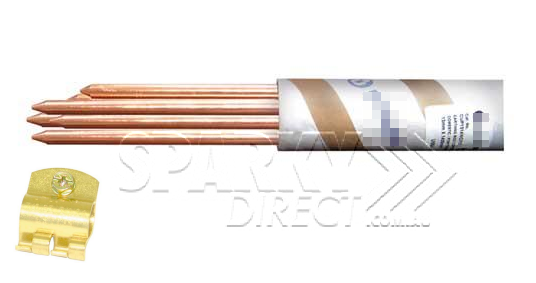
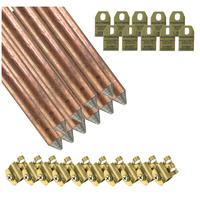
Find the best earth stake rods and clamps here at Sparky Direct. [ Read More ]
Every electrical installation in Australia needs a reliable connection to the general mass of earth, and earth stake rods and clamps are the components that physically make that connection at the property. The rod sinks vertically into the ground beside the switchboard or meter box, and the clamp ties the building's main earth conductor securely to the top of the rod where the cable terminates.
An earth stake rod (also called an earth electrode or earth rod) is a long metal rod driven into the soil. The body of the rod sits well below the surface and within consistently moist ground. Its job is straightforward: provide fault current with a path back to earth that has a low electrical resistance. When a fault sends current where it should not go, the rod lets that current dissipate safely into the soil instead of finding its way through a person.
An earth clamp grips the rod and holds the earth conductor against it under firm mechanical pressure for the life of the installation. The clamp must keep that contact tight even after years of weather exposure, soil movement, and slow surface corrosion. A loose or corroded clamp ruins the resistance value of the entire earthing system, no matter how good the rod beneath it is.
Without a working earth, a fault inside an appliance can leave its metal case sitting at full mains voltage, and anyone touching it then becomes the path to ground. A properly installed earth electrode and clamp pair gives that fault current a faster, lower-resistance path back to the supply. The protective device upstream then trips quickly and isolates the affected circuit before anyone is hurt.
Earthing is not optional under Australian wiring standards, and it is the foundation safety system behind every safety switch, every RCD, and every metal-cased appliance in the building.
The earth electrode gives fault current a low-resistance path back to the supply transformer. That low resistance allows the fault current to climb high enough that the upstream protective device trips within milliseconds. Without that path back through earth, the current trickles back through whatever it can find on its way to ground. That alternative route may include a person standing on damp concrete or holding a metal tap.
The earth provides the zero-volt reference for the entire installation. Sensitive electronics, communications gear, and three-phase equipment all rely on that stable earth potential to function correctly under normal operating conditions. A poor earthing connection causes nuisance tripping of safety switches, premature failure of expensive equipment, and unwanted electrical noise on data and communications lines throughout the site.
AS/NZS 3000 sets the minimum standards for earthing in every installation across Australia and New Zealand. The standard specifies acceptable electrode types, clamp materials, conductor sizes, and resistance limits in detail. Compliance is not just about ticking a box for the certifier; it is the legal baseline for a safe installation. It also protects both the licensed electrician and the property owner if anything ever goes wrong.
The rod and the clamp are two halves of one continuous safety system, and either part on its own does very little useful work. Together they form an unbroken metallic path that runs from the switchboard earth bar inside the building down through the main earth conductor and into the body of the soil at depth.
When fault current reaches the rod, it spreads outward into the surrounding soil in a roughly hemispherical pattern. The current density is highest right at the rod surface and falls off with distance from the electrode. Most of the resistance in the path comes from the soil within the first metre or so of the rod. That is why deeper rods, multiple rods, and conductive backfill all help to reduce the overall earth resistance reading.
Low earth resistance lets more fault current flow back to the source. That makes the upstream circuit protection trip faster and isolate the fault before damage occurs. The Australian standards typically call for the lowest practical resistance value at each installation. Specific maximum values depend on the type of installation and the protective devices in use upstream.
A high-quality brass or copper clamp keeps the joint resistance close to zero ohms, which preserves the low resistance achieved by the deep rod buried beneath it. A cheap or partly corroded clamp can add several ohms to the system on its own. That defeats the entire point of installing a deep, expensive electrode in the first place, so it always pays to invest in a quality clamp.
Different soil conditions and budgets call for different rod materials, and the right choice depends on how long the installation needs to last in the local ground. Stocked rod types at Sparky Direct cover the main options used in Australian installations, including products from Utilux and National Light Sources (NLS).
Copper-bonded steel rods are the most common choice for residential and commercial work across Australia, and the design combines two desirable properties in a single product. A steel core gives the rod the mechanical strength needed to be driven through hard or stony ground without bending. A thick layer of copper metallurgically bonded to the outside provides the excellent conductivity and corrosion resistance that earthing applications demand.
Stainless steel rods are the preferred option for highly corrosive soils, exposed coastal sites, and chemical processing plants where copper would be attacked too quickly to last. They cost more per metre than copper-bonded steel but they last decades longer in aggressive ground. Their conductivity is lower than that of copper, but the resistance values achieved are usually only slightly higher for the same rod length.
Galvanised rods are an economical option for less demanding sites and for installations that will be replaced or upgraded within a known period. The zinc coating slows corrosion for a number of years before it gradually wears away. The bare steel rod beneath will eventually corrode through in aggressive soil. Galvanised rods are most often seen on temporary installations and lower-cost residential renovation work.
Salty coastal soil eats galvanised rods far faster than the manufacturer's curve suggests, while acidic clay can attack copper-bonded rods if the wrong style of clamp is used at the connection. Rocky ground may bend a thin or low-grade rod before it goes deep enough to find conductive soil. It pays to match the rod material and grade to the actual site conditions rather than just defaulting to the cheapest item on the price list.
Earth clamps come in several distinct patterns to suit different applications across residential, commercial, and industrial earthing work. Stocked styles include rod-to-cable clamps for the main earth connection, rod-to-rod clamps for stacked or parallel arrays, pipe clamps for equipotential bonding, and heavy-duty industrial clamps for switchyards and exposed sites.
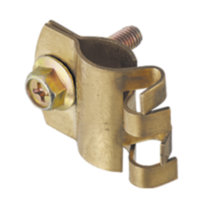
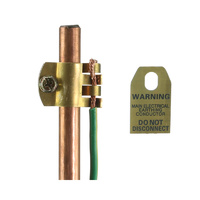
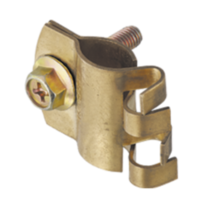
This is the standard clamp pattern used to connect the main earth conductor cable to the top of the earth rod inside or near the meter box. Brass and copper clamp bodies are strongly preferred for their conductivity and their resistance to corrosion in buried or exposed conditions. The 13mm brass clamp size is the most common fitting in Australian residential work.
When a single rod cannot achieve the required earth resistance value at the site, a second or third rod is added at an appropriate spacing to bring the reading down. Rod-to-rod clamps electrically join two rods together without needing a separate length of cable between them. That keeps the joint mechanically simple and electrically sound at the same time.
Bonding clamps tie the earth system to incoming metal water pipes, gas service pipes, structural steel, and any other large metal masses inside the building. This equipotential bonding stops dangerous voltage differences appearing between metal parts of the structure during a fault or surge event. Pipe clamps wrap securely around a pipe of a specified diameter while accepting the bonding earth conductor.
Industrial sites, electrical switchyards, and coastal installations all need clamps that hold up to harsh conditions for the full service life of the installation. Heavier brass castings, stainless-steel fasteners, and weatherproof protective coatings all extend the service life of the clamp considerably. It always pays to check the conductor size range that each specific clamp accepts before placing an order.
The choice between copper-bonded and galvanised rods comes up on almost every job. Each has clear strengths and clear weaknesses.
| Property | Copper-Bonded Steel | Galvanised Steel |
|---|---|---|
| Conductivity | Excellent (copper surface) | Good (steel core) |
| Corrosion resistance | High in most soils | Moderate; zinc layer wears |
| Typical service life | 30 years or more | 10 to 20 years |
| Coastal suitability | Suitable | Limited; corrodes faster |
| Cost | Higher upfront | Lower upfront |
Copper conducts electrical current substantially better than zinc-coated steel and resists corrosion in most types of Australian soil over the long term. Galvanised rods rely on the sacrificial zinc layer for their corrosion protection, which slowly depletes as the rod ages in the ground. Once that zinc layer is gone, the bare steel beneath corrodes at a much faster rate.
A copper-bonded rod typically gives reliable service for thirty years or more in normal Australian conditions, often outlasting the building it serves. Galvanised rods may need replacement at the ten-to-twenty-year mark depending on the local soil chemistry. That interval gets shorter again in salty coastal ground or acidic clay, so the longer-lived copper-bonded rod usually wins on lifecycle cost.
Galvanised rods cost less per unit at the wholesaler, which appeals to budget-conscious projects and rough-in pricing on competitive jobs. Copper-bonded rods cost a little more upfront but they rarely need replacement during the working life of the building. For any permanent installation, the copper-bonded option remains the standard recommendation across the trade.
The right earth rod for the job depends on the local soil conditions, the type of installation being earthed, and the resistance value the system needs to achieve at completion. Common rod sizes are stocked in depth at Sparky Direct to suit residential, light commercial, and heavier industrial applications.
The most common Australian earth rod is 1.4 metres long with a diameter of either 12mm or 14mm, which suits the majority of residential installations across the country. Longer rods at 1.8 metres or 2.4 metres are specified where deeper conductive soil is needed to achieve a low resistance reading. The rod diameter mostly affects the mechanical strength rather than the electrical performance of the finished installation.
Damp, conductive loam or clay soil at shallow depth lets a single 1.4-metre rod do the entire job comfortably. Dry, sandy, or rocky soil pushes the installer to drive the rod deeper to reach moisture. Extension couplings often allow two or three rods to be stacked end-to-end as they go down. An earth resistance test should always confirm the result after installation.
One rod is enough for most typical Australian homes connected to a normal LV supply network. Larger sites and high-fault-current installations may need a parallel array of rods spaced at least one rod-length apart from each other. Spacing rods too closely gives diminishing returns, because their hemispherical zones of influence in the soil begin to overlap each other.
The clamp is generally the weakest link in most earthing systems, and most field failures trace back to it rather than to the rod itself. Spending an extra dollar or two on a quality clamp at the time of installation can save a costly callback to the property in two or three years' time.
Each clamp is designed to suit a specific rod diameter and to accept a defined range of earth conductor cross-sections at the cable terminal. A 13mm brass clamp will not properly grip a 16mm rod, and an undersized terminal will not seat a heavier conductor securely. Always check the rod diameter first, then confirm the clamp accepts your earth conductor cross-section.
Mixing dissimilar metals at the earth connection invites galvanic corrosion, which slowly destroys whichever of the two metals is more electrochemically active. A steel clamp installed on a copper-bonded rod, or aluminium contacting copper at the terminal, creates a battery cell that eats one of the metals over time. It pays to stick with brass or copper clamps on copper-bonded rods as the safe default.
Salt-laden coastal air, industrial chemicals, and frequent moisture all attack the visible clamp far faster than they attack the buried rod itself. For these harsh environments, choose clamps specifically rated for the local conditions. Inspect them more frequently than the standard maintenance cycle would suggest, because the clamp is what fails first in these settings.
Earthing of electrical installations in Australia is governed by AS/NZS 3000, the wiring rules, and compliance with the standard is mandatory for every installation that comes under regulatory inspection. Several supporting standards cover specific aspects such as resistance testing, lightning protection, and bonding of structural metalwork on larger sites.
The wiring rules cover the minimum acceptable electrode type, the size of the main earthing conductor, the equipotential bonding requirements, and the location of the main earth connection within the installation. Section 5 of AS/NZS 3000 deals specifically with earthing arrangements and the related test and inspection requirements that apply at the time of installation.
The completed installation must achieve an earth resistance value low enough for the upstream protective device to operate within its required disconnection time under fault conditions. An earth resistance tester is used to confirm the value at the time of commissioning, and the result must be recorded and kept with the installation paperwork as evidence of compliance.
The test results, the certificate of compliance, and any subsequent inspection records all form part of the installation history that travels with the property. Many commercial and industrial sites are required to undertake periodic re-testing of the earthing system at defined intervals. It pays to keep all the records together in one accessible place for the next electrician on the site.
Earth resistance is the headline number for any grounding system, and it determines how quickly a fault current can flow back to the source through the earth path. The lower the resistance value at the rod, the better the system performs under fault and surge conditions throughout its working life.
Earth resistance is measured in ohms using a dedicated test instrument that injects a known current into the soil and measures the resulting voltage. Typical residential targets sit comfortably below 25 ohms, while substations, telecommunications sites, and large commercial installations often need values in the single digits or even less than one ohm to achieve satisfactory protection.
Dry soil has much higher electrical resistance than wet soil. Sandy and rocky ground both resist current more than damp clay or loam. Cold winter ground freezes the surface layer and pushes the resistance reading up further. Soil chemistry, mineral content, and the local water table all play a role in the final reading achieved at the site.
Drive the rod deeper to reach more conductive ground. Add more rods in parallel to spread the current over a wider area. Use a chemical earth treatment around the rod to enhance the local soil conductivity. In extreme cases, install a horizontal earth mat or ring electrode instead of, or in addition to, vertical rods. Always re-test the resistance after each change is made to the system.
A correctly installed earth rod gives decades of trouble-free service to the property and to the people who live or work there. A poorly installed rod, on the other hand, may fail inspection on the day. Worse still, it may fail silently many years later when a fault actually occurs and someone needs the protection it was supposed to provide.
Walk the proposed site before deciding where to drive the rod. Look for the most consistently moist, undisturbed ground available within reach of the meter box or switchboard. Avoid the bottom of slopes that are prone to erosion or seasonal flooding. Avoid spots where future excavation work might damage or expose the rod. Always check for buried services in the area before driving anything into the ground.
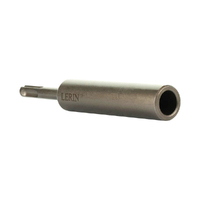
Drive the rod vertically into the ground using either a sledgehammer applied carefully to the rod head or, more commonly today, a dedicated driving tool fitted to a rotary hammer drill. An SDS-style rod driver attachment makes the job substantially faster and saves the operator's shoulders and elbows over the working day. The threaded top of the rod should be protected with a driving cap whenever extension couplers are being used to stack rods together.
Clean the rod's contact surface with a wire brush before fitting the clamp, removing any plating residue, soil, or surface oxide that would otherwise sit between the metal surfaces. Tighten the clamp bolt firmly to the manufacturer's stated torque but do not over-torque it, as that can crack the brass clamp body. Apply a suitable anti-corrosion paste to the joint if the rod will be buried or partly covered by soil after installation.
Lightning strikes and switching surges can dump tens of thousands of amps into the earthing system in just a few microseconds during a single event. The rod and clamp combination needs to be specified, sized, and installed to handle that brief but extreme energy without breaking down.
A surge protection device diverts dangerous voltage spikes from the supply down to earth before they can reach connected equipment. The earthing system underneath must handle the resulting surge current safely without rising to a dangerous voltage relative to true earth. A low-impedance earth path is what keeps the protected equipment safe in the moments after the surge arrives.
Sites that experience frequent lightning activity, exposed buildings on hilltops, and tall structures with large footprints often use multi-rod arrays connected in a ring around the building perimeter. This arrangement spreads the surge current across many rods at once and lowers the overall impedance to ground far below what any single rod could achieve on its own.
Mobile phone towers, radio communication sites, and modern data centres all require earth resistance values an order of magnitude lower than typical residential installations to protect their sensitive electronics. Equipotential bonding clamps connect every metal structure together at multiple points, ensuring all the metalwork at the site stays at the same electrical potential during a strike or surge event.
Most earthing failures come from a small list of repeat mistakes. Knowing the list helps an electrician avoid them on the next job.
The clamp must stay tight against the rod for the entire life of the system, not just on the day of installation. Vibration from nearby roads or machinery, slow soil movement around the buried rod, and thermal cycling between hot summer days and cold winter mornings all loosen fasteners over time. An annual visual inspection on commercial sites is a cheap and effective insurance policy.
A rod driven into dry, sandy fill or rocky ground gives a high resistance reading no matter how deep it is driven. No amount of tightening at the clamp will fix the underlying soil problem. Move the rod to a more conductive spot if one is available. Add water-retaining backfill or a chemical earth treatment around the rod, or use multiple rods spaced apart to spread the contact area over a larger soil volume.
Galvanic corrosion eats the wrong metal at the connection over time. The result is a green or white powdery residue and a high-resistance joint where there should be a clean low-resistance contact. Always choose clamps that are designed to be compatible with the rod material. When in doubt, brass clamps installed on copper-bonded rods is the safe default for most Australian residential and commercial installations.
An earthing system installed today must keep working reliably in twenty or thirty years' time, when the original electrician is long gone and the building is on its second or third owner. Quality components combined with sound installation practice both contribute substantially to that longevity, and skimping on either side of the equation rarely pays off in the end.
Use compatible metals throughout the connection. Apply a suitable anti-corrosion paste at every buried joint and clamp face. Keep the area around the visible clamp clear of disturbed soil, leaf litter, and other moisture-trapping debris. These small but consistent practices add many years to the working service life of the earthing system at very little extra cost on the day of installation.
The visible parts of the earthing system, including the clamp at the rod head and the main earth conductor entering the meter box, should be inspected at every routine electrical safety check. Tighten any loose fasteners encountered. Replace corroded clamps before they actually fail under load. Always keep the connection point accessible for future inspection rather than burying it under landscaping or paving.
Residential earthing systems are typically inspected at the time of any major electrical work being carried out on the property, such as a switchboard upgrade or solar installation. Commercial and industrial sites generally follow a documented inspection cycle that is often annual or biennial. Critical infrastructure such as hospitals, telecommunications hubs, and data centres may be tested far more frequently to meet their operational requirements.
Earth stakes appear in every type of electrical installation across Australia, from a single-storey suburban home through to the high-voltage substation that feeds an entire industrial estate. The underlying principles of earthing remain the same in every case; what changes is the scale of the system and the rigour of the testing and inspection regime that surrounds it.
A typical Australian home uses one 1.4-metre copper-bonded earth rod near the meter box, with a brass clamp connecting the main earth conductor cable directly to the top of the rod. The supplied Utilux rod-and-clamp kit covers most domestic builds and renovations across the country, while heavier industrial work calls for longer rods and trade-grade clamps that can handle the higher fault currents involved.
Larger sites use longer rods or arrays of multiple rods, heavier earth conductors sized for the available fault current, and clamps that are rated for sustained industrial conditions and exposure to weather. The earth bar inside the main switchboard serves as the central reference point for the entire installation, and every metal-cased item of equipment connects back to that earth bar through dedicated bonding conductors.
Sensitive electronic equipment in data centres, broadcast facilities, and modern telecommunications sites needs a stable, low-impedance earth reference that holds steady under all conditions. These specialised installations use ring electrodes around the building perimeter, parallel rods at multiple points, and dedicated bonding networks throughout the structure to achieve the very low earth resistance values that protect the equipment inside.
Sparky Direct stocks a complete range of earth stake rods, clamps, drivers, and accessories from trusted Australian and international brands at competitive trade pricing. Stocked items cover everything from single residential clamps right through to bulk packs and specialist industrial fittings for larger projects.
The full range is available from the earth stake category page, with stock from NLS, Utilux, LERIN, Sicame, and Volt Safety. Orders ship Australia-wide directly to the job site or trade premises, and most stocked items leave the warehouse within one business day of order placement.
Cheap rods and clamps may pass the initial inspection on the day they are installed, but they often need replacement well within the working life of the building they were fitted to. Trade-grade products from established brands cost a little more upfront at the wholesaler but they last for decades in service. The small price difference is tiny compared to the labour cost of returning to a site to fix a failed earthing system years later.
Contractors who are fitting out new housing estates or carrying out high-volume maintenance work can order earth stake clamps in 25-packs or larger trade quantities to suit the scale of the project. Bulk pricing applies to most stocked items in the earthing category, and trade customers can get in touch through the Sparky Direct contact page to discuss bulk pricing arrangements and account terms.
When the earth resistance tester reads higher than expected or the building's safety switch starts nuisance-tripping for no obvious reason, the earthing system itself is generally the first place to look. A methodical inspection of the visible parts of the system, followed by targeted testing, usually identifies the underlying cause within an hour or so.
An earth resistance reading above the design target value usually points to dry surrounding soil, a damaged or partly broken rod, a loose or corroded clamp, or some combination of those three faults working together. Inspect the visible parts of the system first. If the connection looks sound to the eye, then the issue is most likely below ground level. Driving an additional rod nearby in parallel is the usual fix in those cases.
A clamp that wiggles when touched, shows green or white powdery corrosion residue, or has a fastener that has clearly lost its torque needs to come off and be replaced before the next use. Clean the rod surface back to bright metal with a wire brush. Fit a new compatible clamp of the correct size and material. Re-test the earth resistance reading and apply anti-corrosion paste at the joint when refitting the conductor.
Visible corrosion at the clamp head almost always indicates hidden corrosion at the buried rod-to-clamp joint as well, even when only the visible part shows obvious damage. Excavate carefully around the rod and inspect the entire connection from end to end. Replace any damaged components with compatible new parts before backfilling the hole. Confirm the result with a fresh resistance test before signing the job off.
Watch NLS EC130 | Earth Stake Clamp 13mm Brass | Single Buy video
Watch LERIN LT-ERD001 | Earth Rod Driver Drill Socket SDS+ | Up to 17mm² video
Watch Area Bond Connector suit 12mm Maximum Rio Bar | WETCON video

Moved into a new home and the earth wire and clamp for the phone line was in the way. I manged to get the clamp off the earthing rod, but couldn't get the clamp undone due to a rusted on nut. Tried multiple options to release it, with the limited tools I had available, to no avail. I then had a light bulb moment - could I buy a new clamp? Sure can with Sparky Direct to the rescue. Less than $2 and my stress was gone.
These work great for Rio earthing. I place it near the bathroom Just bring cable up in the wall and extend back to switchboard, Earth bar ,done Price is very good as well
This was my first order and was very happy with the Earth Stake Clamps and the service. I will be dealing with you again.
Quality products in stock • Fast Australia-wide delivery • Competitive trade pricing
Browse Earth Stake Rods and Clamps → Get Expert Advice →An earth stake (also called an earth rod or earth electrode) is a long metal rod driven vertically into the soil to provide an electrical connection between an installation and the general mass of earth. It works by giving fault current a low-resistance path back to ground, so that when a fault occurs, the current dissipates safely into the soil instead of flowing through a person or damaging equipment. The most common Australian residential earth stake is 1.4 metres long with a 12mm or 14mm diameter, paired with a brass clamp at the top to connect the main earth conductor.
For most Australian homes, a 1.4-metre copper-bonded steel rod with a 12mm or 14mm diameter is the standard choice. Larger residential and light commercial sites often use 1.8-metre or 2.4-metre rods to reach deeper conductive soil and achieve a lower earth resistance reading. Industrial sites may need multiple rods stacked with extension couplings or installed in a parallel array. The best size for your job depends on the local soil conditions and the resistance value required by AS/NZS 3000 for your installation, so always test the resistance after installation to confirm the rod is doing its job.
A good earth clamp is made from brass or copper, sized correctly for the rod diameter and the earth conductor cross-section, and built to keep the joint resistance close to zero ohms for the life of the installation. The clamp body should be solid rather than thin pressed metal, the fastener should hold its torque under vibration and thermal cycling, and the metals should be compatible with the rod to avoid galvanic corrosion. The 13mm brass clamp is the standard choice for most Australian residential work. Spending a little more on a quality clamp at installation usually saves a callback to fix a failed earth years later.
Low earth resistance lets fault current flow quickly back to the supply, which makes the upstream protective device trip within milliseconds and isolate the fault before anyone is hurt. A high resistance value chokes the fault current and may stop the protective device from operating in time, leaving live metalwork exposed during a fault. Typical residential targets sit below 25 ohms, while commercial and infrastructure sites often need single-digit values or even less than one ohm. The earthing system also has to handle surge current safely during a lightning strike, and a low-impedance earth keeps protected equipment safe in those moments.
Residential earthing systems are typically tested at the time of any major electrical work on the property, such as a switchboard upgrade, solar installation, or change of ownership inspection. Commercial and industrial sites generally follow a documented inspection cycle that is often annual or biennial. Critical infrastructure such as hospitals, telecommunications hubs, and data centres may be tested far more frequently to meet their operational and compliance requirements. The earth resistance reading, the clamp condition, and any visible corrosion should all be recorded against the test, and the records kept with the installation paperwork for the next electrician on the site.