
Search Results:
Search Results:
Search Results:
Search Results:
RCBO stands for residual current circuit breaker with overcurrent protection. The device watches for current imbalance between active and neutral conductors, and it also reacts to thermal overload and short-circuit fault current. A single pole unit protects one active conductor on a final sub-circuit.
Australian switchboards rely on this combined function for individual circuit safety. Electricians fit Quicklag RCBOs on lighting, general power, wet area, and outdoor circuits where personal protection from earth leakage and cable protection from overcurrent are both required by the design.
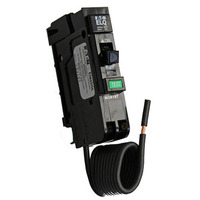
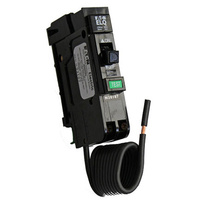
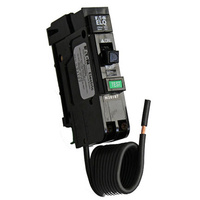
A Quicklag RCBO is a DIN rail mounted protection device from Eaton. It combines residual current sensing with miniature circuit breaker functions in one slim module. The residual current side reacts to leakage current that may pass through a person to earth. The breaker side reacts to overload current and short-circuit current that can damage cables or equipment.
These devices appear in residential switchboards, light commercial distribution boards, and switchboard upgrade projects across Australia. Each unit takes up DIN rail space similar to a standard MCB, which makes retrofitting onto an existing board practical when space is tight.
A standard MCB reacts to overcurrent only and cannot detect earth leakage. It cannot protect a person who touches a live conductor or a faulty appliance, which is why a Quicklag RCBO adds residual current sensing on top of the MCB function.
This matters for modern Australian installations, where wet areas, outdoor power, lighting circuits, and socket outlet circuits often need RCD protection under the wiring rules. Using an RCBO at the circuit position is one way to provide that protection at the individual circuit level.
Individual circuit protection keeps fault isolation tight, so if one circuit develops earth leakage, only that RCBO trips. Other circuits stay live, so a kitchen fault does not take out the lights or the freezer.
The compact DIN rail format suits residential board upgrades, new builds, small commercial boards, and retrofit work. The single module footprint helps when the enclosure has limited free way for added circuit protection.
Three protection functions operate inside one Quicklag module: residual current detection, thermal overload response, and magnetic short-circuit response. The trip mechanism disconnects the active conductor when any of the three thresholds is reached. A test button on the front allows routine checking of the residual current trip path.
| Fault Type | What It Means | What Trips the RCBO |
|---|---|---|
| Earth leakage | Current escaping to earth through a person or fault | Residual current sensor at 30mA threshold |
| Overload | Sustained current above the device rating | Thermal bimetal element after a time delay |
| Short circuit | High fault current between active and neutral or earth | Magnetic coil for near-instant disconnection |
The residual current side compares current flowing in the active conductor with current returning through the neutral conductor. When these values differ by more than the trip threshold, the device assumes leakage to earth is occurring and disconnects the circuit. A 30mA sensitivity is the standard personal protection threshold for general final sub-circuits in Australia.
Tripping happens within a fraction of a second, and this rapid response reduces the duration of an electric shock and lowers the risk of serious injury.
Thermal response handles sustained overload, with a bimetallic strip that heats up under prolonged overcurrent, bends, and releases the trip mechanism. Magnetic response handles short-circuit faults, with a coil that reacts to the sudden current spike and trips the device almost immediately.
Cable protection is the practical outcome of these two mechanisms. Selecting the correct current rating to match the cable size and circuit design current is essential, because oversizing the RCBO to silence nuisance tripping risks leaving the cable unprotected.
The test button creates a small artificial earth leakage current inside the device, and pressing it should cause the RCBO to trip. If it trips, the residual current path is operating; if it does not, the device needs further investigation by a licensed electrician.
Periodic testing is good maintenance practice for any RCBO in service. Formal commissioning, insulation testing, and earth fault loop impedance checks must be carried out by a licensed electrician with appropriate electrical test equipment.
Buying the right Quicklag RCBO depends on six core variables: amperage, residual current sensitivity, breaking capacity, operating voltage, trip curve, and compliance marks. Each must match the circuit design and the installation environment. The selection should always trace back to the switchboard schedule prepared by the designer or installing electrician.
Lighting circuits in Australian homes commonly use 6A or 10A devices, while general power circuits typically use 16A or 20A. Dedicated appliance circuits such as ovens, hot water units, or air conditioners may need 25A, 32A, or 40A units depending on the load. The rating must be selected by a licensed electrician based on cable size, circuit design current, and load type.
Asking "what current rating do I need for a Quicklag RCBO?" should always lead back to the circuit design. Cable cross-sectional area, cable length, ambient temperature, and grouping all influence the maximum permissible device rating, so never select by guesswork.
Type B trip curves suit low-inrush resistive loads such as lighting and basic heating. Type C trip curves suit moderate inrush loads such as general power, small motors, and many appliances. Air conditioning, pumps, and motors should be assessed against their inrush current before a trip curve is selected.
Do not upsize the rating or change the trip curve simply to avoid nuisance tripping, because the correct response is to investigate the cause. Nuisance tripping often signals an underlying issue with the load, the cable, or shared neutrals.
A 6kA breaking capacity covers most residential and many light commercial installations. The breaking capacity must equal or exceed the prospective fault current at the device location. Prospective fault current depends on the supply transformer rating, the impedance of the supply path, and the distance from the supply.
Installations with higher prospective fault current may need higher-capacity devices. The electrician should confirm fault levels before specifying the device.
RCBOs sold for use in Australian switchboards must meet AS/NZS 61009.1. They must carry the appropriate compliance marking, including the Regulatory Compliance Mark where applicable. Installation must follow AS/NZS 3000:2018, the Australian and New Zealand wiring rules. Switchboard work must be performed by a licensed electrician.
Australian-certified Eaton Quicklag RCBOs are designed to meet AS/NZS 61009.1 and carry the relevant compliance marking. Buyers should confirm the product on the listing is the Australian-certified version before ordering online, especially when comparing model numbers across regions. Imported variants intended for other markets should not be installed in Australian switchboards.
The compliance mark on the device front is the primary visual check, and the product data sheet provides the formal compliance declaration. Both should be available before installation, particularly when stocking new variants on a switchboard upgrade.
The wiring rules require RCD protection for many final sub-circuits in modern Australian installations. Socket outlet circuits, lighting circuits in many locations, wet area circuits, and outdoor circuits are common examples. The specific requirements depend on the type of installation, the location, and the date of the work.
RCBOs are one practical way to provide individual RCD protection on each circuit. Other valid approaches include front-end residual current devices or combined safety switch arrangements, and the right design depends on the installation.
Yes, installation or replacement in fixed wiring must be performed by a licensed electrician in Australia. This is a legal requirement under state and territory electrical safety legislation, and switchboard work requires safe isolation, testing before and after, correct cable termination, and proper device selection.
Compliance documentation, including a Certificate of Compliance or equivalent where applicable, must be issued after the work. This page does not provide wiring or installation instructions; the information here is for product selection, technical understanding, and procurement.
Choosing the correct Quicklag RCBO before ordering avoids returns and delays. The selection process follows the same framework whether the job is a single circuit replacement or a full switchboard upgrade. Rating, trip curve, sensitivity, compatibility, DIN rail space, stock availability, and documentation all play a role.
Each point on this checklist should be ticked off against the switchboard schedule or design before the order goes through. Working from a schedule rather than from memory reduces selection errors.
Older residential switchboards often have shared RCD and MCB combinations on the busbar. Upgrading to individual RCBOs gives one circuit per RCBO, which reduces nuisance outage when a fault occurs. Compatibility with the existing busbar arrangement is the first thing to check.
Limited rail space is common on older boards. A Quicklag RCBO compatibility check with older switchboards should include neutral arrangements, board condition, prospective fault current, and whether the enclosure itself needs replacement. The electrician should assess the whole board, not just the individual position.
Contractors often order multiple ratings together for housing projects, maintenance stock, or switchboard upgrade programmes. Ordering by switchboard schedule beats guessing, particularly on staged projects where the cable schedule is known but install dates vary.
Stock planning matters for electricians working across regional jobs. Supply delays can hold up a job for days, so allowing buffer stock of common ratings such as 10A, 16A, 20A, and 32A often pays off. Ordering through an Australian wholesaler such as Sparky Direct keeps the supply chain short.
Choosing between RCBOs and other circuit protection options depends on the design, the available board space, and the budget. The comparison below covers the three most common decisions: RCBO vs MCB, RCBO vs separate RCD and MCB, and Eaton Quicklag vs other RCBO brands.
An MCB protects against overload and short circuit only. It cannot detect earth leakage. An RCBO adds the residual current function on top. Where the design provides RCD protection at the front of the switchboard, an MCB at the circuit position may still be valid. Where RCD protection is required at the circuit level, an RCBO replaces the MCB.
Australian compliance depends on the whole circuit protection arrangement, not on any single device choice. The designer or installing electrician confirms which combination meets the wiring rules for the installation.
Separate RCD and single pole circuit breaker setups can still be valid, particularly where front-end RCD protection covers several MCBs in a group. The trade-off is that one earth leakage fault trips the whole group, taking out multiple circuits at once.
Individual RCBOs reduce nuisance outage across multiple circuits. They take up similar space to an MCB on the rail. Total installed cost should consider rail space, labour, and the cost of nuisance trips on the customer site, not just the unit price of the device.
Eaton Quicklag competes in the same Australian market segment as Clipsal RCBO ranges, Hager RCBO ranges, and other compliant brands. Selection between brands usually depends on certification, current rating availability, trip curve options, switchboard compatibility, spare stock at the wholesaler, and the installer's familiarity with the brand.
Brand-level comparison is not about superiority. It is about practical fit: does the brand match the board, the schedule, and the supply chain for this job? Many sparkies carry mixed stock from Clipsal, Hager, NLS, and Eaton for exactly that reason.
Tripping is the most common reason an electrician is called out to look at an RCBO. The cause is usually somewhere on the circuit, not in the device itself, but a faulty RCBO does occasionally occur. The information below covers the search intent without giving unsafe DIY repair guidance.
Repeated tripping points to one of several possible causes. These include a faulty appliance, insulation breakdown in the cable, or water ingress at an outlet or junction. Other causes include gradual earth leakage accumulation across several appliances, sustained overload, shared neutrals between circuits, damaged cable inside a wall, or equipment that is simply incompatible with a 30mA RCD.
Repeated tripping should never be bypassed or ignored. The RCBO is doing its job. Professional fault finding identifies the cause, which can then be repaired safely.
Formal diagnosis requires test equipment and switchboard inspection by a licensed electrician. Insulation resistance testing, earth fault loop impedance testing, and current measurement under load all help isolate the cause. Some Quicklag models include trip indication, which can give a starting point, but indication is not a substitute for proper testing.
Plain symptom patterns can hint at the type of fault. An RCBO that trips immediately on reset often points to earth leakage. An RCBO that trips after a few minutes under load often points to overload. These are starting points only.
Replacement may be required after mechanical failure of the trip mechanism or failed routine testing. Other triggers include signs of heat damage on the terminals or housing, physical damage from impact or water, and repeated inability to reset after the fault has been cleared. Replacement must match the original specification: amperage, sensitivity, breaking capacity, and certification.
The replacement device must be installed by a licensed electrician. Substitution with a higher rating to "fix" tripping is not appropriate and undermines circuit protection.
Online electrical wholesalers stock the full Eaton Quicklag range, including ratings that may not be on the shelf at a local trade counter. Stock visibility, fast dispatch, and product filtering by amperage and trip curve make online ordering practical for both single-circuit replacements and multi-board projects.
Online buying suits the situation where the required rating or trip curve is not available at the closest trade counter. Before placing an order, check the product title, the catalogue number, the certification statement, the rating, the trip curve, the stock level, and the delivery region. Each check reduces the chance of a return.
Fast delivery Australia wide matters for regional projects. Working out of remote sites or country jobs makes wholesaler dispatch times a real factor in planning the install date.
Compare total value, not just the unit price. A compliant product, the correct variant, reliable stock, fast delivery, returns support, and the availability of related switchboard components all matter. A cheap unit that arrives a week late, or in the wrong variant, costs more in lost site time than a slightly higher line price.
Small contractors benefit from transparent pricing without needing a large trade account structure. Visible stock counts and clear product specifications help avoid the back-and-forth that slows down quoting and ordering.
RCBOs rarely arrive on their own. A typical switchboard order also includes related items from the wider RCBO range, three phase RCBO combinations, and circuit breakers. Other common additions are earth leakage circuit breakers, electrical enclosures, surge protection devices, and Clipsal MAX9 components where the board uses that system.
Ordering related items together saves on freight and reduces the chance of a part being missed on a switchboard upgrade.
Watch HAGER ADC916T | 16Amp 6 kA Single Pole RCBO video
Watch NLS 30353 | 20 amp 6 kA Single Pole RCBO (Clearance Sale - No Returns) video
Watch Clipsal MX9R1106 | 6A MAX9 RCBO 1PN C | 10mA Type A SLIM video

Wanted to add another power circuit to my full distribution board. The NLS30784 RCBO helped achieved this as I could remove the 3ph RCD and 3 x 16amp CB taken up 7 spaces and replaced them all with 4 x NLS30794 RCBOs. Now giving me the extra circuit plus space for 3 more if ever needed. The extra bonus also is now each circuit has its own RCD, where before you would loss all power circuit with a single RCD trip. During installation I found the NLS30794 having the bottom offset terminal inputs are a good option for wiring multiple devices using a busbar comb, However I didn't require to use this option. If required in the future I will definitely use this device again.
Hager all the way! Especially in domestic, Hager offers the best circuit protection set up in my opinion. Single phase & three phase bus bar is so easy to install with this switch gear and these new RCBO’s that are suitable to test from the terminals are Great!!!
Super easy to install, looks real professional definitely worth extra $ for the look and ease of product. The shipping being all the way in Tassie was fast only 3 days and it was here
Quality products in stock • Fast Australia-wide delivery • Competitive trade pricing
Browse Single Pole RCBOs → Get Expert Advice →