
Search Results:
Search Results:
Search Results:
Search Results:
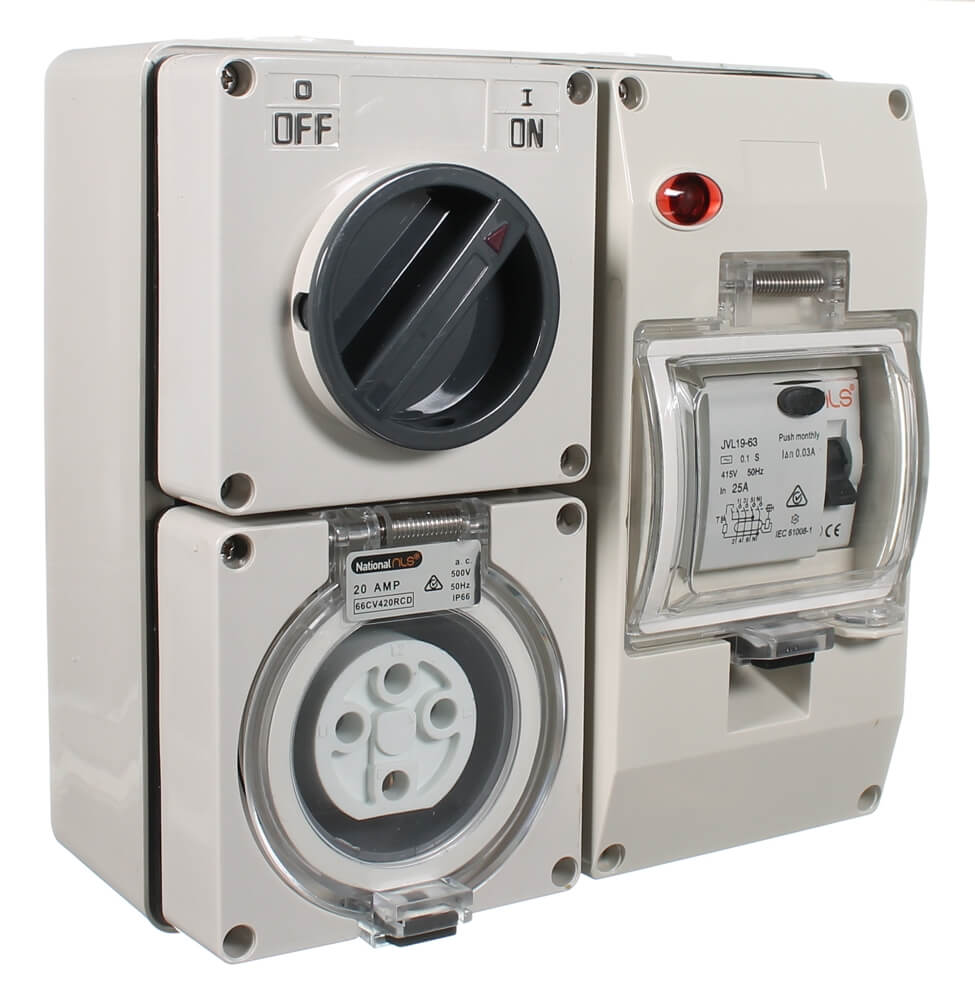
Find the best IP66 Switched Socket Outlet including RCD protection here at Sparky Direct. [ Read More ]
An IP66 switched socket outlet with integrated RCD protection brings together four functions in a single device. The unit pairs a dust-tight, water-jet rated enclosure with a local switch, a socket, and a residual current device that detects earth leakage. The combination delivers point-of-use safety where a standard weatherproof GPO would only address enclosure protection. Selection should reflect the actual environment, the connected load, the current rating, and the compliance framework that governs the installation.
This product class is most often specified for outdoor power points on commercial sites, workshop and pump bays, agricultural sheds, marine-adjacent buildings, and wet-area applications. In each setting, electricians need a single fitting that handles both the weather and the leakage protection. Fixed installation and replacement must be carried out by a licensed electrician under Australian electrical regulations.
The unit packages a socket, a switch, an enclosure rated to IP66, and an RCD into one fitting. The switch provides local isolation without pulling the plug. The enclosure resists dust ingress and powerful water jets. The RCD compares the current flowing in active and neutral conductors and trips supply when the imbalance indicates leakage to earth. Integrated RCD protection at the outlet adds a second layer of defence beyond circuit-level safety switches at the switchboard.
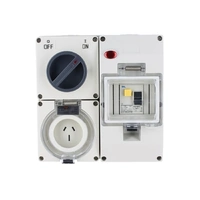
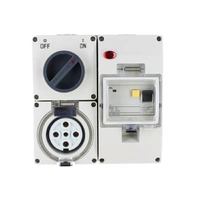
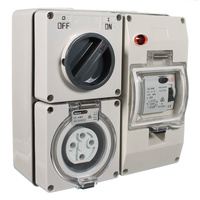
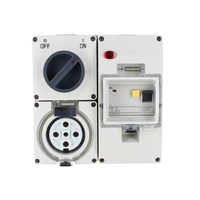
The enclosure handles dust and water jets from any direction. The switch isolates the connected load locally. The socket supplies power through a plug interface that matches the load type, whether 3 pin, 4 pin, or 5 pin. The RCD monitors leakage and trips the supply within milliseconds when a fault is detected. Compared with a weatherproof outlet without RCD protection, this combination handles both environmental and electrical risks at a single point. Browse 3 pin switched socket combinations, 4 pin combinations, and 5 pin IP66 combinations by application.
Buyers fall into a few clear groups. Licensed electricians and electrical contractors specify and install these products on residential, commercial, and industrial projects. Facility managers and maintenance teams buy them for ongoing replacement and refurbishment. Builders, pool contractors, and agricultural operators specify them on new builds and shed installations. Informed homeowners select compliant stock and arrange installation through a licensed sparky. Commercial buyers want repeatable, compliant product across multiple sites with predictable availability.
The IP rating defines what the enclosure resists. Choosing the right rating depends on real exposure rather than headline price. IP66 sits high on the dust and water resistance scale and suits exposed walls, washdown zones, pool equipment areas, and industrial bays. Lower ratings are appropriate for sheltered spots, while higher ratings are reserved for situations involving immersion. The completed installation only delivers its rated protection when seals, glands, conduit entries, and covers are intact and correctly fitted.
IP66 is dust-tight and protected against powerful water jets from any direction. It suits exposed outdoor walls, workshops, sheds, carports, washdown areas, pool equipment bays, agricultural sheds, and industrial facilities. IP66 does not mean the outlet can be permanently submerged. For temporary or prolonged immersion, higher ratings such as IP67 or IP68 should be considered.
The table below sets out where each rating fits in practical Australian conditions. Use it as a guide when matching enclosure protection to the exposure level on site.
| IP Rating | Dust Protection | Water Protection | Typical Application |
|---|---|---|---|
| IP44 | Solid objects over 1mm | Splash from any direction | Sheltered outdoor or covered areas |
| IP54 | Limited dust ingress | Splash protection | Light industrial or protected areas |
| IP65 | Dust-tight | Low-pressure water jets | Standard outdoor power points |
| IP66 | Dust-tight | Powerful water jets | Exposed outdoor and washdown zones |
| IP67 | Dust-tight | Temporary immersion to 1m | Flood-prone or temporary submersion |
| IP68 | Dust-tight | Continuous immersion | Submerged or continuous wet locations |
Unsealed conduit entries, damaged gaskets, poorly fitted covers, UV-degraded housings, and incorrect mounting can all compromise protection. The completed installation is only as weatherproof as its weakest seal, gland, or interface. Inspection becomes more important in coastal, agricultural, industrial, and high-traffic locations where damage and wear are more likely. Compatible cable glands and electrical conduit fittings support the rated protection when sized and sealed correctly.
An RCD watches the active and neutral conductors and trips the supply when leakage to earth is detected. A 30mA personal protection RCD is the standard reference for socket outlet circuits in Australian residential and commercial applications. RCDs reduce shock risk but do not replace correct installation, earthing, circuit protection, or safe work practices. The sections below cover how RCD protection works, when integrated outlets help, and what to do when an RCD keeps tripping. See the broader RCD residual current device range for switchboard-mounted options.
Under normal operation, the current in the active and the neutral conductors is balanced. When some of that current diverts to earth through a person, a damaged appliance, or a wet contact, the balance breaks. The RCD detects the imbalance and disconnects the supply within milliseconds. A 30mA trip threshold is widely used for personal protection on socket outlet circuits. Integrated RCDs in outdoor outlets add point-of-use protection on top of any switchboard-level safety switch already in place.
Switchboard RCDs protect entire circuits. Integrated RCD socket outlets protect at the point of use. Both have a place. Integrated RCD outlets suit remote outlets, outdoor equipment, sheds, workshops, temporary site power, pump bays, and commercial washdown points where local isolation and quick reset matter. The electrician assesses whether additional protection adds value or whether existing circuit protection is sufficient for the installation.
Common causes include water ingress into the outlet or conduit system, damaged appliance leads, moisture in connected outdoor equipment, accumulated leakage across multiple loads, ageing RCD mechanisms, and insulation breakdown in cabling. Repeated tripping is a signal that something is wrong, not a nuisance to bypass. Stop using the outlet, unplug the connected appliance if safe to do so, and arrange testing by a licensed electrician. Bypassing or disabling RCD protection removes a critical layer of safety.
The breadth of applications reflects the role of the IP66 rating and the RCD together. Residential outdoor settings, commercial washdown bays, construction sites, agricultural sheds, marine-adjacent installations, and industrial facilities all benefit from a sealed, locally protected outlet. The sections below cover the most common categories and the compliance considerations that come with them.
External walls, garages, garden sheds, patios, pool pump bays, carports, outdoor kitchens, and pergolas all benefit from sealed weatherproof construction. Exposure to rain, hose spray, and washdown makes the IP66 rating practical. RCD protection on outdoor socket outlets is required under Australian electrical rules, and integrated RCD outlets simplify compliance on remote outdoor circuits where switchboard upgrades would be more disruptive.
Dusty workshops, light manufacturing bays, commercial kitchens, cleaning zones, plant rooms, maintenance areas, and production lines all share the same demand profile: water-jet protection, impact resistance, UV resilience, and a robust switching mechanism. Food, beverage, and processing areas often need more frequent inspection because washdown chemicals and steady moisture exposure shorten service life. Compatible electrical enclosures and accessories help maintain the rated protection across the full installation.
Temporary site facilities, farm sheds, irrigation pumps, machinery bays, boat sheds, marinas, remote buildings, and off-grid systems put electrical fittings under heavy stress. Dust, salt air, UV exposure, mud, spray, and limited maintenance access make a durable IP66 RCD outlet a practical choice over multiple discrete components. Contractors typically prioritise fast replacement, compatible mounting, compliant documentation, and reliable delivery to remote sites.
Selection comes down to load, environment, and compliance. The framework below helps match a product to the application without relying on price alone. Current rating must match the connected load and the protective device. Enclosure material and hardware quality determine service life. Compliance marks confirm the product is suitable for sale and installation in Australia.
Australian socket outlet ratings of 10A, 15A, 20A, 32A, and 50A cover most plug-connected loads. The current rating must match the circuit protection, the connected load, and the plug type. Overloading the outlet causes overheating, nuisance tripping, premature failure, and potentially unsafe operation. Sizing must reflect continuous load duty rather than peak draw alone, particularly for compressors, pumps, and EV charging applications.
UV-stabilised polycarbonate, glass-reinforced plastics, corrosion-resistant screws, intact gaskets, robust hinge mechanisms, and a clear switching action all contribute to service life. IK ratings indicate impact resistance and matter most in public, commercial, workshop, and industrial environments. The lowest-priced outlet often costs more over time when UV degradation, corrosion, water ingress, or switch wear shortens replacement cycles.
The Regulatory Compliance Mark, the RCM, is the headline signal for products sold in Australia. Several standards underpin the design and use of these outlets:
Fixed installation must be carried out by a licensed electrician. Compliance documentation should be retained for inspection.
The choice between an integrated RCD outlet, a standard weatherproof GPO with switchboard-level protection, an unswitched outlet, or a higher-spec industrial fitting depends on use case and compliance. The sections below cover the practical trade-offs without leaning on price as the only factor.
Standard weatherproof socket outlets such as the single weatherproof GPO and double weatherproof GPO ranges deliver enclosure protection without integrated RCD function. Upstream RCD protection at the switchboard may already cover the circuit, depending on the design. Integrated RCD sockets add point-of-use protection and local test/reset access, which matters where remote outlets are used by people other than the electrician who installed them.
A switched outlet allows local control without pulling the plug. Switching reduces wear on plugs and sockets when equipment is cycled often. Switched IP66 RCD outlets suit pumps, workshop equipment, outdoor appliances, and maintenance-friendly installations where staff need to isolate the load before service.
Cheap means lowest upfront cost. Best value means compliant performance for the application at a reasonable price. Trade-grade means durability plus compliance documentation plus reliable availability. For electricians, best value usually combines correct current rating, recognised brand, reliable stock, compliant documentation, predictable installation performance, and a sensible price. Selecting on price alone often costs more over the life of the installation when failures, callbacks, and replacements stack up.
Installation, replacement, and testing must be carried out by a licensed electrician under Australian regulations. Mounting position, cable entry orientation, gland selection, gasket condition, and conduit sealing all affect the rated protection of the finished installation. RCD commissioning checks belong to the electrician, with handover guidance for the end user.
Fixed electrical work in Australia must be performed by a licensed electrician or electrical contractor. Correct installation addresses circuit protection, cable sizing, RCD testing, earthing, mounting position, and environmental exposure. Work may require certificates of compliance or similar documentation depending on state and territory rules. Customers should verify their electrician holds the relevant licence and lodges the right paperwork.
Cable entries should be downward or otherwise protected from running water where the application allows. Conduit and gland selection must match the cable size and the IP rating target. Gaskets must be intact and seated correctly. UV-resistant fittings extend service life in exposed locations. Covers must close properly around the connected plug if the product is intended to maintain weather protection during use. Compatible straight gland conduit fittings and conduit glue help maintain a continuous seal.
Electricians should test RCD operation with suitable test equipment and verify trip times against applicable requirements. Routine use of the on-board test button is an operational check, not a substitute for proper testing with calibrated equipment. Handover should include guidance on how to test, how to reset, when to report repeated tripping, and how to identify visible damage.
Outdoor and industrial outlets need regular checks. Inspection intervals, visible damage assessment, RCD test button use, and clear thresholds for replacement all reduce failures and downtime. The advice below stays within safe end-user actions and points to the electrician for everything else.
Look for cracked enclosures, loose covers, damaged hinges, degraded gaskets, corrosion on hardware, discolouration, water staining, damaged cable entries, stiff switch action, and unreliable RCD reset. Inspect more often in coastal, agricultural, construction, washdown, and high-UV locations. Even IP66-rated equipment has a finite service life under sustained harsh exposure.
Common causes include a faulty appliance, moisture inside connected equipment, water ingress into the outlet or conduit, damaged extension leads, accumulated leakage across multiple loads, and an ageing RCD mechanism. Safe response is straightforward: do not bypass the RCD, stop using the outlet if tripping repeats, and arrange inspection by a licensed electrician. The trip is information, not a fault to disable.
Replace the unit when the enclosure is brittle, cracked, heat-damaged, corroded, or no longer seals properly. Replace when the RCD fails testing or will not reset reliably after a fault has been cleared. A compromised weatherproof outlet is a safety risk and a source of nuisance tripping, equipment downtime, and compliance issues.
Safety note: Repeated RCD tripping is a warning. Do not bypass the RCD, do not disable the protection, and do not continue using the affected outlet. Arrange testing and repair through a licensed electrician.
Online ordering covers most of the practical demand for these outlets, from single replacements through to bulk procurement for sites and projects. The points below cover what to confirm before ordering, how to plan bulk purchases, and how to compare suppliers without leaning on price alone.
Confirm current rating, socket configuration, IP rating, RCD rating, mounting type, enclosure material, brand, compliance marks, and stock availability before checkout. Check whether accessories are needed, including 20mm cable glands, mounting hardware, labels, or compatible plugs. Cross-check specifications against the job requirements rather than against the price tag.
Standardising across a project reduces installation variation and simplifies spare parts holdings. Stock depth, consistent product families, delivery speed, transparent online ordering, and trade-friendly pricing all matter for projects and contracted maintenance work. Allowance for spares is sensible on remote, agricultural, construction, and maintenance-heavy sites where return trips are expensive. Browse National Light Sources electrical products, Clipsal, HPM, Hager, GEN3, 4Cabling, and PDL for project-grade stock options.
Compliance documentation, product range, dispatch reliability, stock availability, support, warranty handling, and suitability for Australian conditions all sit alongside price in a real comparison. Value comes from getting the right product quickly with confidence in compliance and compatibility. The Easy56 range from Easy56 switched socket combination outlets and complementary IP66 key lockable isolator switches offer trade-grade options for project standardisation.
Club Clipsal is Australia's largest electrician community offering trade rewards, business support, and exclusive benefits. When you nominate Sparky Direct as your preferred wholesaler, we automatically apply your Clipsal spend points to your Club Clipsal account daily.
Entry-level offering coaching, mentoring, and training discounts
Unlock exclusive industry tools and networking events
Access Toyota fleet offers and business software discounts
Maximum benefits, including VIP experiences and rewards
1. Sign Up: Create your Club Clipsal account at clipsal.com/club-clipsal or via the iCat mobile app
2. Nominate Sparky Direct: Select Sparky Direct from the wholesaler dropdown menu in your profile
3. Add Email: Enter your Sparky Direct account email address in the membership number field
4. Start Earning: Every dollar spent on Clipsal products earns points automatically
Redeem points from the rewards store, including gift cards, tools, and experiences. Access business summits, product training, and industry networking events. Receive early access to new product launches and special promotions. Connect with fellow electricians via the Club Clipsal community app.
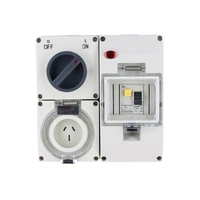
Watch NLS 66CV315FRCD | 3 Pin Flat 15Amp Switched Socket Outlet Earthleakage Protected IP66 | 30644 video
Watch NLS 66CV332RCD | 3 Pin 32Amp Switched Socket Outlet Earth leakage Protected IP66 | 30645 video
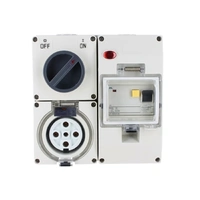
Watch NLS 66CV420RCD | 4 Pin 20Amp Switched Socket Outlet Earth Leakage Protected IP66 video

Easy to navigate the website and find what I needed, and the item arrived very quickly to Perth WA. Well packaged and protected.
Well made and the price was half that of the big name brands used to charge our mdl 3 tesla overnight
Very good quality and very reasonably prices happy with delivery time and iteam quality
Quality products in stock • Fast Australia-wide delivery • Competitive trade pricing
Browse IP66 RCD Switched Sockets → Get Expert Advice →Yes, they are a popular choice for outdoor and industrial installations.
Sparky Direct supplies IP66 switched socket outlets with RCD protection Australia-wide, offering robust and safe power solutions with convenient delivery.
They are securely packaged and delivered via standard courier services.
Unused products are generally eligible for return according to the seller’s returns policy.
Warranty coverage varies by manufacturer and typically covers defects in materials or workmanship.
Yes, they are typically sold as individual socket outlet units.
Yes, correct placement ensures accessibility, safety, and compliance.
Yes, they are widely used in commercial and industrial facilities.
RCDs should be tested periodically as part of normal safety practices.
They are usually clearly labelled and designed for visibility in work areas.
Yes, they are commonly used in workshops, garages, and utility areas.
Quality units are built to withstand dust, moisture, and harsh conditions.
Yes, the combination of RCD protection and a switch improves overall safety.
It is a power outlet designed for harsh environments, combining a weatherproof IP66 enclosure with an integrated switch and residual current device (RCD) for added electrical safety.
Yes, when correctly installed, they are designed to operate safely in outdoor conditions.
It provides enhanced safety, weather resistance, and convenience in demanding environments.
Yes, they are typically surface mounted for easy access and protection.
Yes, they are designed for industrial and commercial environments requiring robust protection.
Yes, they are available in common current ratings to suit various applications.
The switch allows power to be turned on or off at the outlet for added control and safety.
Yes, the IP66 rating makes them suitable for outdoor and exposed locations.
Quality products are manufactured to meet relevant AS/NZS electrical and safety standards when installed correctly.
They are commonly used in outdoor areas, workshops, factories, wash-down zones, and commercial environments.
RCD protection helps reduce the risk of electric shock by quickly disconnecting power if a fault is detected.
IP66 means the outlet is fully protected against dust and strong water jets, making it suitable for outdoor and industrial use.