
Search Results:
Search Results:
Search Results:
Search Results:
An exhaust fan uses a motor and impeller to create negative pressure in the room. That low-pressure pocket draws humid or contaminated air toward the fan, through the duct or wall outlet, and discharges it to the outside, while replacement air enters from gaps, vents or open doorways. Without that active extraction, steam and odours linger long enough to settle on surfaces and cause damage.
Moisture is the silent damage driver in most Australian bathrooms. A 10-minute shower can release several litres of water vapour into the air. If that vapour is not removed quickly, it condenses on ceilings, walls, mirrors and roof timbers. Repeated cycles drive mould growth, paint failure, peeling cornices and rusting fixings. A correctly sized bathroom exhaust fan removes that vapour before it can settle.
In a bathroom or ensuite, the fan strips out shower steam and toilet odours. In a laundry, it extracts heat and humidity from the dryer or wash cycle. In a kitchen, it pulls out cooking vapour, grease and smells. In a separate toilet, even a modest fan handles odour control without the noise of a larger unit.
Light commercial spaces use the same principle at higher duty cycles. Office bathrooms, change rooms, childcare amenities and hospitality back-of-house all rely on continuous or run-on extraction to maintain indoor air quality.
Mould needs moisture, time and a cool surface, so effective ventilation cuts the moisture window short. The fan has to extract air quickly enough to stop water vapour reaching the dew point on cold surfaces like ceilings and tiles. Duct path, run time and fresh makeup air all matter. An undersized fan, or one ducted into the roof cavity instead of outside, may run continuously but still fail to control mould.
Run-on timers and humidity sensors extend extraction past the trigger event. The fan keeps running for 5 to 30 minutes after the light switches off or the humidity drops. That clears residual vapour from cold surfaces and lifts long-term mould resistance.
Opening a window relies on wind, temperature differences and luck, while mechanical extraction is repeatable and predictable. Modern Australian homes are also better sealed than older builds, which reduces passive air exchange. Where the National Construction Code requires mechanical ventilation, an open window does not meet the rule, but a compliant exhaust fan does.
Airflow exhaust fans come in several physical configurations, and each suits a different room layout, ceiling access situation and noise tolerance. The right choice depends on whether the room has external wall access, accessible ceiling cavity, a long duct run, or noise constraints.
| Fan Type | Best For | Key Consideration |
|---|---|---|
| Ceiling-mounted | Standard bathrooms with roof cavity access | Requires ducting to external vent |
| Wall-mounted | Rooms with an external wall | Backdraft shutter recommended |
| Window-mounted | Retrofits without ceiling access | Limited to single-pane installations |
| Inline | Quiet ensuites, long duct runs | Motor sits in the duct, away from the room |
| Ducted square / commercial | Higher airflow requirements | Needs 150 mm or larger ducting |
| Fan, light and heater combo | Small bathrooms and renovations | Needs adequate circuit capacity |
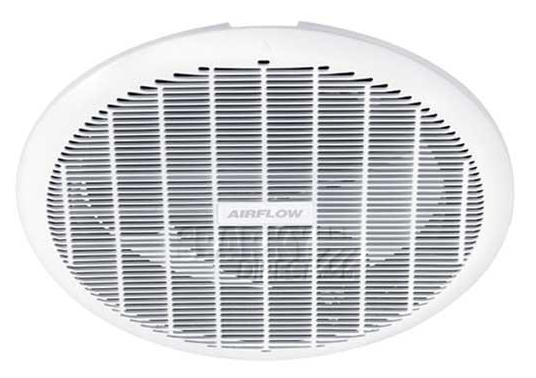
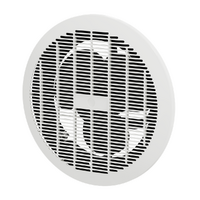
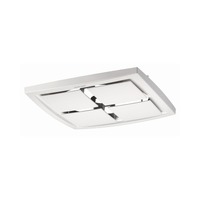
Ceiling-mounted units are the default for standard bathrooms and ensuites with accessible roof space. Common opening sizes include 200 mm and 250 mm cut-outs. The fan sits in the ceiling, ducting runs through the roof cavity, and the duct terminates at an external wall vent or roof cowl. Single-storey homes and upper floors usually suit this configuration well.
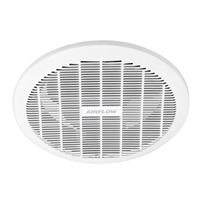
Performance varies with fan capacity, duct length and grille type. The Clipsal Airflow 6220-0 and CE200 series are common ceiling-mounted choices for residential bathrooms.
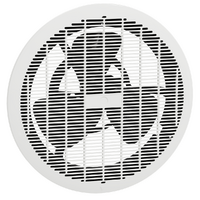
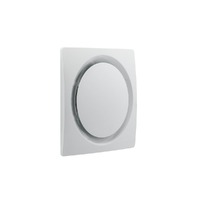
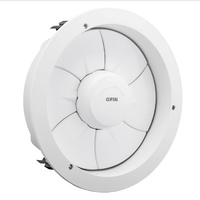
Wall-mounted units extract straight through an external wall, which avoids roof cavity work entirely. They suit ground-floor bathrooms, laundries and rooms beneath upper storeys. Airflow wall mount exhaust fans like the 7106A and 7108A are popular for direct-through-wall installations.
A backdraft shutter or external louvre is important on wall installations. The shutter blocks reverse airflow when the fan is off, keeping out cold air, insects and dust. Coastal sites should also consider corrosion-resistant external grilles to handle salt-laden air.
Inline fans separate the motor from the room itself, locating the noise source away from the occupied space. The grille sits in the ceiling, but the fan body is mounted further along the duct run. That distance, plus the surrounding insulation, drops the perceived noise at the grille significantly. Inline fans suit master ensuites, premium fit-outs, apartments and any space where night-time noise is a factor.
Inline designs also handle longer duct runs better than ceiling units. The motor has more torque to overcome the static pressure of bends and length, which means the fan still moves rated air at the grille.
Three-in-one units combine extraction, lighting and radiant heat in a single ceiling unit. They are popular in small bathrooms and renovations where ceiling space is tight and a separate heater is impractical. Heat lamps draw significant current, so the circuit capacity and switching arrangement must be confirmed by an electrician before purchase. Browse the full bathroom heaters and 3-in-1 unit range for current options.
Axial fans move air in a straight line along the motor shaft, with simple, compact and cost-effective construction. Axial designs suit short, low-resistance duct runs and direct wall or window installations where the air path is brief.
Centrifugal and mixed-flow fans use a different impeller geometry that handles higher static pressure and sustains airflow through longer ducts and multiple bends. For long runs, multi-storey installations or any duct path with significant resistance, a centrifugal or mixed-flow unit usually outperforms a budget axial fan. Specifying by duct length and static pressure, not just grille size, is the trade-aware approach.
Correct fan sizing is the single biggest predictor of real-world performance. An undersized fan runs constantly but fails to clear moisture. An oversized fan is noisier than necessary, may draw conditioned air out of the home and can create draughts. Sizing is a balance of room volume, ducting losses and intended use.
Two units are used for fan capacity, and both describe the same flow rate in different time bases. Cubic metres per hour (m³/h) describes how much air the fan moves in an hour, while litres per second (L/s) describes the same flow in smaller time units. Manufacturers usually publish both, and the conversion is straightforward: 25 L/s is approximately 90 m³/h. Compare products in the same unit, and check whether the rating is at zero static pressure or with realistic ducting in place.
The standard sizing formula uses room volume and air changes per hour (ACH). Multiply room length by width by ceiling height to get the volume in cubic metres. Multiply that volume by the target ACH to get the required extraction rate in m³/h.
A bathroom typically targets 10 to 15 air changes per hour. A 2 m by 2.5 m bathroom with a 2.4 m ceiling has a volume of 12 m³. At 12 ACH, the required fan capacity is 144 m³/h. Always select the next fan size up where the duct run is long, has multiple bends or terminates in a high-resistance external vent.
| Room Type | Typical Extraction Rate | Suggested ACH |
|---|---|---|
| Separate toilet | 50 to 90 m³/h | 6 to 15 |
| Small ensuite | 100 to 150 m³/h | 10 to 15 |
| Standard bathroom | 150 to 250 m³/h | 10 to 15 |
| Large bathroom or master ensuite | 250 to 350 m³/h or inline fan | 15 to 20 |
| Laundry with dryer | 150 to 250 m³/h | 10 to 15 |
| Kitchen (general extraction) | 250 m³/h or higher | 15 to 30 |
These ranges are guidelines rather than fixed targets, and product specifications, project documents and local compliance requirements take precedence. For new builds and apartments, the consulting engineer or designer should specify the rate.
Oversizing has real downsides that compound over the life of the fan. Larger fans usually generate more noise at the grille, even at part load, and they extract conditioned air faster than necessary, which raises heating and cooling costs in winter and summer. In tightly sealed homes, a very high extraction rate may struggle to draw enough makeup air, causing back-drafting at flues or noisy door whistling. The aim is correct sizing, not maximum sizing, balanced against ducting and noise constraints.
Exhaust fan installation in Australia touches several compliance regimes that work together. The National Construction Code sets ventilation performance requirements for wet areas, and AS/NZS 3000 (the Wiring Rules) governs the electrical work. Permanent, hardwired and wet-area installations must be completed by a licensed electrician, since DIY fixed wiring on a bathroom fan is unlawful in every Australian state and territory.
The NCC sets minimum mechanical exhaust expectations for moisture-producing rooms. A commonly referenced minimum for bathrooms is 25 L/s, equivalent to about 90 m³/h, where mechanical ventilation is required and openable windows do not meet the deemed-to-satisfy provision. New builds, apartments and commercial fit-outs often have higher project-specific rates. Always confirm the current requirements with the project documents, the building surveyor or the relevant state body before specifying a fan.
Hardwired exhaust fans must be installed by a licensed electrician. The electrician assesses circuit suitability, switching arrangement, wet area zoning, isolation, IP rating and final test results. They confirm the unit is mounted correctly, the duct path is sound and the termination is compliant. Plug-in window fans without fixed wiring sit in a different category, but anything ducted, ceiling-mounted, wall-mounted or wired into a switch needs a licensed installer.
IP ratings describe a product's resistance to solids and water ingress. Fans in or near showers and baths fall into specific bathroom zones with minimum IP requirements. The electrician matches the fan's IP rating to the relevant zone, with reference to the manufacturer's installation instructions and AS/NZS 3000. Check the compliance label on the fan body and the published wet area zone before purchase.
Ducting into the roof cavity is one of the most common installation defects in Australian homes. It dumps warm, moist air directly into the roof space, where it condenses on cold timbers and insulation. The result is mould, rotting battens, sagging insulation and stained ceilings. All exhaust ducting must terminate at an external wall vent, eaves vent or roof cowl. Backdraft prevention and pest screens at the external termination are standard.
The fan is one part of a ventilation system, not the whole story. Ducting, grilles, external vents and accessories carry as much of the performance burden as the fan itself. Specifying the right duct diameter, minimising bends and choosing the correct external termination determines whether the rated airflow shows up at the grille. Browse the full range of exhaust fan accessories for compatible parts.
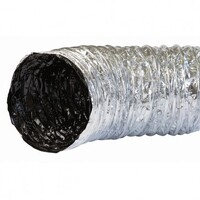
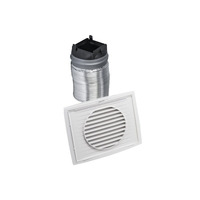
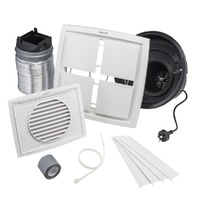
A ducting kit is needed whenever the fan cannot discharge directly outside, and ceiling-mounted fans almost always need ducting. Wall-mounted fans through an external wall usually do not require a separate kit. Typical kits include a length of flexible duct, hose clamps, a ceiling or wall grille, an external cowl and a backdraft damper. The kit must match the fan's outlet diameter, the duct run length and the installation path.
Undersized ducting is one of the most common causes of weak extraction. A 100 mm duct strangles a fan rated for 150 mm output, and the loss compounds with every bend. For higher airflow fans, longer runs or multi-bend paths, 150 mm ducting is generally preferred. Each 90-degree bend adds significant equivalent length to the run. Three or four bends can effectively double the duct's resistance, so the fan must be specified with that loss in mind.
Fan covers and grilles serve two roles: they are the visible finish in the room and they protect the impeller from dust and lint. A blocked or damaged grille reduces effective airflow and lifts noise, but cleaning the grille at routine intervals restores performance without touching the wiring. Match replacement covers to the exact fan series, size and model, since generic covers may fit physically but block more airflow than the original part.
Backdraft shutters stop reverse airflow when the fan is off. That blocks cold draughts in winter, hot air ingress in summer, and stops insects and dust drifting back through the duct. External cowls protect the duct termination from driving rain, and coastal or exposed sites should select corrosion-resistant grades to handle salt and moisture exposure. For laundries and outdoor-adjacent spaces, exhaust fans with light options also include integrated grilles and louvres.
Once airflow capacity is locked in, noise and efficiency become the next decision points. A quiet fan that runs efficiently is more likely to be used as intended, which means better moisture control and lower long-term maintenance. Buyers should compare beyond price and rated m³/h to find the right balance.
Several factors shape perceived noise, and motor quality and balance set the baseline. Blade design influences the tone, with optimised impellers producing less turbulence at the grille. Mounting quality matters too, since a poorly seated fan transmits vibration into the ceiling. Inline fans are inherently quieter at the grille because the motor sits away from the room. Look for published dB(A) or sone ratings when comparing models. A quiet fan can still become noisy if the duct is undersized, kinked or terminated badly.
AC motors are common, durable and cost-effective, with a long service record in Australian homes, and AC units offer simple wiring and broad replacement availability. DC motors are typically more energy-efficient, often quieter at part load and support variable-speed controls. The energy savings depend on fan size and daily run time. For low-use spaces, the payback period on a premium DC fan can be long, while high-use commercial amenities accumulate savings quickly.
Timer and sensor controls extend the fan's effective work without manual intervention. A delay-off timer keeps the fan running for a set period after the light switch is turned off, which clears residual moisture. A humidity sensor activates the fan when relative humidity rises above a threshold and switches off once it drops. Bathroom light interlock, separate fan switches and smart-home controls are all common control scenarios. Pair with electrical timers and Clipsal Iconic fan controllers for switched configurations.
Efficiency on a fan is the product of motor draw and run time. Smart controls cut unnecessary run time, which delivers most of the real-world saving. Family bathrooms, rentals, apartments and commercial amenities all benefit from sensor or timer controls. High-use laundries and back-of-house spaces in hospitality see the strongest payback on efficient motors and intelligent switching.
Different rooms have different priorities, and the best fan for a master ensuite is rarely the best fan for a laundry. Group selection by use case, not by brand or price tier, to land on a unit that actually suits the room.
Clipsal Airflow is widely recognised by Australian electricians, but it is not the only option. Specifying by performance rather than brand alone gives the best outcome. Some applications call for specialised commercial extraction; others suit a straightforward residential unit.
Ceiling-mounted units depend on roof cavity access and an external duct termination. Wall-mounted units depend on an external wall and a clean cut-out. Ceiling installations give more flexibility for grille placement but add ducting complexity. Wall installations are faster and simpler but visible on the exterior of the building. The decision usually comes down to the building's geometry, not preference.
Standard ceiling and wall fans are cost-effective and quick to install. Inline systems cost more upfront and need more duct work, but they deliver lower noise at the grille and better performance through long runs. For premium ensuites, apartments with strict acoustic requirements and any installation where the duct path is long, the inline upgrade usually justifies its cost.
Cheap fans can be adequate for small, low-use rooms like a separate toilet or a rarely used guest bathroom. They tend to fail earlier, have less consistent airflow ratings and limited replacement part availability. For high-use rooms, mid-tier and premium units usually deliver better long-term value. Motor reliability, accurate airflow rating, grille quality, available spares and electrician familiarity with the brand all factor into the decision.
Several established brands service the Australian market, each with a different strength. Clipsal Airflow units are widely specified for residential bathrooms and ensuites, while Fantech covers wall, window and commercial extraction. Martec and Mercator Lighting offer residential combination and ceiling-mount units. HPM serves residential applications, and Ventair covers ceiling and inline ranges, while Blauberg Ventilation supplies grilles and accessories for ducting completion. Compare specifications, not just labels, when matching a brand to a project.
Buying exhaust fans online works well when the specifications are clear and the delivery is fast. Trade buyers need consistent stock, accurate cut-out dimensions and matching accessories on the same order. Retail buyers benefit from clear product photos, published airflow ratings and an upfront view of compatible covers and ducts.
Confirm the fan type (ceiling, wall, window, inline), the cut-out size, the duct outlet diameter, the airflow rating in m³/h, the IP rating, the available controls, the grille style and the matching accessories. For replacement jobs, match the exact existing model or confirm the new model's adapter compatibility. Discuss the installation location with the electrician before placing the order to avoid return trips.
Contractors usually compare across electrical wholesalers on unit price, stock availability, freight cost and delivery speed. Bulk packs and project quantities can be more cost-effective than single-unit orders. In-stock items dispatched same-day matter more on tight job timelines than a marginal price difference. Sparky Direct stocks the full Airflow exhaust fan range alongside compatible covers, ducts and accessories.
Filters by fan diameter, m³/h, ducted versus non-ducted, LED option, heater option, ceiling versus wall, brand and accessory compatibility help contractors land on the right unit fast. Clear specifications shorten the path from search to checkout and reduce installation delays. Trade buyers placing repeat orders also benefit from saved order history and consistent stock visibility.
An exhaust fan is a low-maintenance product, but it does need attention. Cleaning the grille, checking airflow at intervals and noting changes in noise behaviour catches problems early. Anything involving wiring, motor replacement or duct repair should go to a licensed electrician.
Clean the visible grille and any accessible covers every 6 to 12 months in residential settings. High-dust environments, laundries and commercial bathrooms benefit from more frequent cleaning. Lint and dust restrict airflow, raise noise and shorten motor life. Soft brushes and a damp cloth handle most of the cleaning load. The circuit should only be isolated by, or under direct instruction from, a licensed professional.
Common warning signs fall into a few groups that point to specific causes. Steam lingers in the bathroom after a shower, or mould returns despite a running fan. Suction at the grille feels weak, or the unit rattles, grinds or produces a burning smell. The circuit may trip, the backdraft shutter may break, or the cover may crack. Each points to a likely cause: blocked grille, poor ducting, failing motor, undersized fan or incorrect external termination. A licensed electrician can diagnose the issue and confirm whether the fix is a clean, a repair or a replacement.
Replacement makes sense when the motor has failed, the airflow has dropped well below original spec, the covers are damaged with no available spares, or the unit is no longer compliant with current installation requirements. Bathroom renovations, tenancy upgrades and building compliance works are natural points to upgrade an older fan. Modern units are usually quieter, more efficient and easier to control than 15-year-old equivalents.
Club Clipsal is Australia's largest electrician community offering trade rewards, business support, and exclusive benefits. When you nominate Sparky Direct as your preferred wholesaler, we automatically apply your Clipsal spend points to your Club Clipsal account daily.
Entry-level offering coaching, mentoring, and training discounts
Unlock exclusive industry tools and networking events
Access Toyota fleet offers and business software discounts
Maximum benefits, including VIP experiences and rewards
1. Sign Up: Create your Club Clipsal account at clipsal.com/club-clipsal or via the iCat mobile app
2. Nominate Sparky Direct: Select Sparky Direct from the wholesaler dropdown menu in your profile
3. Add Email: Enter your Sparky Direct account email address in the membership number field
4. Start Earning: Every dollar spent on Clipsal products earns points automatically
Redeem points from the rewards store, including gift cards, tools, and experiences. Access business summits, product training, and industry networking events. Receive early access to new product launches and special promotions. Connect with fellow electricians via the Club Clipsal community app.
Watch Clipsal Airflow 6220-0 | Performance Ceiling Mounted Exhaust Fan 254mm 800m3 Hr video
Watch Clipsal Airflow CE200 | Ceiling Mounted Exhaust Fan 200mm video
Watch Clipsal Airflow 7106A | Wall Mounted Exhaust Fan, 200mm, Auto Switched, White video

This was my first purchase from Sparky Direct. We were in need of a new 'wall exhaust fan' for our bathroom. On phoning Sparky Direct, we found them very obliging and helpful. They even gave us a phone number to speak to a technician as I was unsure if the unit I was intending to purchase would actually do the job. After checking out units and sizes and of course - prices, I finally decided to go with Sparky Direct online. I was blown away when we received our 'unit' less than 2 full days later, all packaged well and left where we had requested it to be left. What an amazing service, and most importantly, there was absolutely nothing missing from the contents of the box it came in.
AIRFLOW is a breath of fresh air! Originally bought a REXEL window exhaust fan, it was impossible to install, the casing buckled out of shape when trying to tighten it to the window and then the fan scraped against the casing making a heavy clattering if it rotated at all, spent most of the day trying to install it - finally took it back and received a refund - Bought a Airflow window fan - installed it in 3 to 4 minutes turned it on and it worked perfectly. Well done AIRFLOW - the REXEL product is a dinosaur compared to your product.
I purchased 2 Airflow CE200 Ceiling Mounted Exhaust Fans to replace 2 bathroom exhaust fans. The existing fans which were also Airflow (same model) were after 24 years becoming a little noisy but still worked remarkably well. Installing the fans was extremely easy with the sliding clips a brilliant idea. Very happy with the product and would thoroughly recommend to anyone needing similar exhaust fan.
Quality products in stock • Fast Australia-wide delivery • Competitive trade pricing
Browse Airflow Exhaust Fans → Get Expert Advice →