
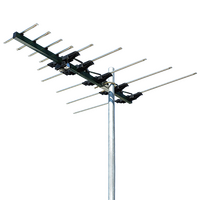

750MHz
Matchmaster 01MM-SA100 | Log Periodic Digital TV Antenna VHF/UHF 9 Elements
$54.95
$49.95 ex. GST
Search Results:
Search Results:
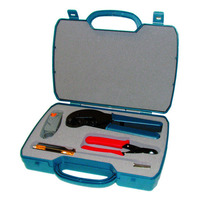
Find the best TV antenna installation kits here at Sparky Direct. [ Read More ]
A TV antenna installation kit is a bundled package that contains the antenna, cable, connectors, and mounting hardware required to receive free-to-air digital television in a single purchase. The kit is designed so that an installer (or competent DIYer working on the receiving end of a wall plate) has every part needed to complete the job without sourcing items separately. In Australia, free-to-air broadcasts run on the UHF band, and modern kits are tuned for this range.
Most kits centre on a digital UHF antenna paired with a length of coaxial cable, F-type connectors, weatherproofing tape, and a mounting bracket or U-bolt assembly. Higher-end kits also include a masthead amplifier and a power supply. Some bundles add a splitter for multi-room distribution. The contents vary by manufacturer, so the product description should always be checked before purchase.
Buying a kit removes the guesswork around component compatibility. The antenna gain matches the included amplifier, the cable length is sized for a typical residential install, and the connectors are the right type for the antenna terminals. Buying parts individually offers more flexibility for non-standard installations, longer cable runs, or specific brand preferences, but it requires more product knowledge.
Electrical wholesalers stock trade-grade antenna and distribution gear from established Australian brands such as Matchmaster and Hills. Hardware retailers tend to carry consumer-grade products aimed at one-off DIY purchases. For licensed cablers and electricians working on residential, commercial, or multi-dwelling projects, wholesale supply gives access to the gain ratings, build quality, and accessory range that the job requires.
A reliable supplier carries the major Australian antenna brands, stocks a full range of coaxial cable in trade lengths, and holds the matching connectors, splitters, amplifiers, and outlets in stock. Order processing times, freight options, and the ability to call a knowledgeable counter for technical advice are equally important.
Sparky Direct ships TV Antenna Installation Kits Australia-wide, alongside the broader TV Supplies range that covers cable, outlets, brackets, and signal-finding tools. Stock holdings are managed for trade demand, and orders placed early in the day generally despatch the same business day.
Indoor kits are intended for properties close to the broadcast tower, typically within a strong signal zone. They sit on a shelf, mount behind a TV, or fix to a window. Indoor kits are quick to install and need no roof work, but they are more sensitive to nearby obstructions, walls, and electrical interference.
Outdoor kits are the standard for most Australian homes. They mount to the roof or a fascia bracket, sit clear of obstructions, and deliver the most consistent reception. The kit includes weather-rated hardware, a longer coaxial cable run, and connectors suited to outdoor termination.
A directional antenna (such as a Yagi or log periodic) is aimed at a single broadcast tower and rejects signals from other directions, which improves signal-to-noise ratio. A multi-directional or omnidirectional antenna picks up signals from all bearings, which suits properties that receive transmissions from more than one tower or where alignment is uncertain.
The right type depends on three factors: distance from the broadcast tower, the bearing or bearings of the towers serving the area, and the level of obstruction between the property and the towers. ACMA's online coverage tools provide the data needed to make this decision.
Free-to-air signal strength drops with distance from the transmitter. Properties within 10 to 20 kilometres of the tower generally receive a strong signal with a basic outdoor antenna. Properties between 20 and 60 kilometres need a higher-gain antenna and may require a masthead amplifier. Beyond 60 kilometres, a high-gain directional antenna paired with low-loss cable becomes essential.
Australian free-to-air digital television broadcasts in the UHF band (channels 28 to 51, frequency range 526.5 to 694.5 MHz). VHF reception is no longer used for general broadcasts, so most modern kits are UHF-only. Antennas optimised for the local channel range deliver the cleanest signal.
Hills, dense tree cover, multi-storey buildings, and metal-roofed structures all attenuate or reflect UHF signals. A line-of-sight path to the tower is ideal but rarely available in practice. Reflections cause multipath interference, which appears as ghosting or pixelation. Mast height and antenna placement are the main tools for working around these problems.
The Australian Communications and Media Authority (ACMA) publishes a Digital TV reception location service that returns predicted signal strength, the bearing to the closest tower, and the polarisation (horizontal or vertical) for any Australian address. Running this check before quoting a job removes most of the guesswork around antenna selection.
Urban properties typically sit in a strong signal zone served by multiple repeaters. A modest-gain directional or phased-array antenna is usually sufficient. Regional properties may sit at the edge of the coverage map and need a high-gain log periodic or Yagi antenna with the boom length and element count to match.
High-gain antennas have more elements, a longer boom, and a tighter forward beam pattern. They concentrate the signal received from a single bearing and reject off-axis interference. The trade-off is alignment sensitivity: a high-gain antenna that drifts a few degrees off bearing can lose a useful portion of its gain.
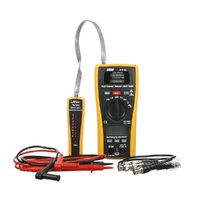
Directional antennas need to be pointed at the broadcast tower with reasonable accuracy. A TV signal finder simplifies this step by giving a real-time strength reading at the antenna terminals during alignment. The antenna is rotated slowly, the peak is identified, and the U-bolt is tightened to lock the position.
An over-specified antenna in a strong signal area can overload the tuner front-end and cause the same pixelation problems as a weak signal. In strong areas, the right approach is a moderate-gain antenna and, if anything, an attenuator rather than an amplifier.
RG6 is the current standard for digital TV installations in Australia. It has a thicker centre conductor (18 AWG vs RG59's 22 AWG) and more substantial shielding, which means lower signal loss per metre and better rejection of external interference. RG59 is older, thinner, and only suited to short patch leads. Any new installation should use RG6 throughout.
Standard RG6 uses a single foil and braid shield. Quad-shielded RG6 adds a second foil and braid layer, which improves rejection of LTE and 4G/5G interference from nearby mobile services. In suburbs with strong mobile signal, quad-shield is the safer specification.
Coaxial cable attenuates the signal as it travels along its length, and the loss is more pronounced at higher frequencies. As a working figure, RG6 loses around 0.2 to 0.3 dB per metre at UHF frequencies. A 30-metre run from antenna to outlet can give up around 6 to 9 dB, which is enough to push a marginal signal below the tuner threshold.
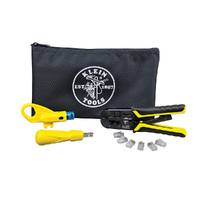
F-type connectors are the standard for digital TV in Australia. Compression fittings (applied with a dedicated compression tool) deliver a more reliable, weather-resistant joint than older crimp or twist-on connectors. Poor connector termination is one of the most common causes of installation faults, so the right tool and technique matter. Klein Tools manufactures cable installation kits that bundle the stripper, compression tool, and connectors needed for clean F-type terminations.
An amplifier is required when the received signal is too weak to drive the number of TV outlets in the installation, or when long cable runs and splitters cause cumulative signal loss. The decision should be data-driven: measure the signal at the antenna with a signal finder, calculate the cable loss and splitter loss, and only add an amplifier if the budget at the outlet falls short.
A masthead amplifier mounts at the antenna and boosts the signal before it travels down the cable. This is the preferred option because it amplifies the clean signal before any losses or interference are introduced. A distribution amplifier sits at the outlet end and compensates for losses across multiple TV points, but it amplifies any noise picked up along the cable as well.
A passive splitter divides the signal into two or more outputs with no power supply, and each output sees a fixed signal loss (around 3.5 dB for a 2-way, 7 dB for a 4-way). An active splitter (or distribution amplifier) compensates for this loss with a powered gain stage. TV splitters and amplifiers are stocked in 2-way, 3-way, 4-way, and 8-way configurations.
Amplifier gain should match the deficit, not the maximum available. Too much gain causes intermodulation distortion and the same pixelation seen on weak signal. As a rough guide, a residential installation with one to four TV points and a 20-metre cable run typically needs 15 to 25 dB of gain. Multi-dwelling installations with longer runs may need 30 dB or more.
Every passive split introduces insertion loss. A 2-way splitter divides the signal in half (3 dB loss per output, plus a small insertion loss for around 3.5 dB total). A 4-way splitter loses 7 dB per output, and an 8-way loses 10.5 dB. Cumulative losses across multiple stages add up quickly.
Multi-room installations benefit from a star topology: one central splitter feeding equal-length runs to each outlet. This keeps signal levels balanced and simplifies fault-finding. A daisy-chain layout, where one outlet feeds the next, suffers progressive signal degradation along the chain.
Where one TV point sits much further from the splitter than the others, an unequal-loss splitter (sometimes called a tap) can compensate. The shorter run gets more loss, the longer run gets less, and all outlets see a similar signal level.
Specifying a 4-way splitter when only two outlets are needed today gives headroom for future expansion at minimal extra cost. Installing a slightly larger data cabinet or recess box at the central distribution point also pays off later.
Roof mounts (tripod or mast) place the antenna at the highest practical point and are the most common option for new installations. Wall mounts use a fascia or gable bracket and are quicker to install but limit mast height. Chimney mounts use straps around the brickwork and avoid roof penetration, though chimney structural condition needs to be checked first.
Adding mast height clears the antenna from local obstructions: rooflines, trees, neighbouring buildings. Each extra metre of clearance can deliver a measurable signal improvement, particularly in fringe reception areas. Wind loading increases with height, so the mast and bracket need to be rated accordingly.
Antennas, masts, and brackets installed in Australian conditions need to handle UV exposure, salt-laden coastal air, and cyclonic wind loadings in northern regions. Galvanised or stainless steel hardware is the standard. Plastic-bodied antennas should be UV-stabilised.
Cheap mounting hardware corrodes within a few years in a coastal environment, taking the antenna and signal quality down with it. Hot-dipped galvanised brackets, stainless steel U-bolts, and aluminium antenna booms last longer and reduce return-visit costs.
A DIY installer with the right tools can usually replace a like-for-like antenna, run a new outlet from an existing cable, or install an indoor antenna. Anything involving in-wall cabling, working at height on a roof, or terminating cable on an outlet plate inside a wall cavity sits outside the DIY scope and requires a registered cabler.
Roof work carries fall, slip, and material handling risks. Tile and metal roofs become slippery in damp conditions, and steep pitches require harness and anchor systems. Most fatal residential roof accidents involve simple jobs done without fall protection. Where roof access is part of the install, a licensed installer is the safer choice.
The coaxial cable run from antenna to outlet should follow the shortest practical path, avoid sharp bends, and enter the building through a sealed and weatherproofed entry point. Drip loops at the entry prevent water tracking along the cable into the wall cavity.
A 15-minute site walk before starting saves hours of rework. Confirm the antenna bearing, identify the mast location, mark the cable route, locate the outlet positions, and check for any 240V cabling that the coax run needs to maintain separation from.
The antenna location should give the highest practical clearance from obstructions on the bearing to the broadcast tower. The antenna boom is oriented horizontally (the standard for Australian broadcasts) and pointed at the tower. Polarisation matches the local transmission (horizontal in most areas, vertical in some).
The mast or bracket is fixed to a structurally sound point: a rafter for tripod mounts, a fascia board reinforced behind for wall brackets, or a chimney capable of taking the wind load. All fixings are rated for outdoor use.
The coaxial cable is run from the antenna terminals down to the outlet, with weatherproofing at the antenna end and a drip loop at the wall entry. F-type compression connectors are terminated using a stripping tool and a compression tool, in that sequence. TV cable connectors are matched to the cable diameter (RG6 fittings for RG6 cable).
Once the system is wired, the TV is set to scan for new channels. A signal finder confirms strength and quality at each outlet. Pixelation on any channel is investigated before the install is signed off, and minor antenna adjustments are made if any channels sit close to the threshold.
Any cabling that is connected (or able to be connected) to the public telecommunications network must be installed by an ACMA-registered cabler. While free-to-air TV antenna cabling is generally outside this scope, in-wall structured cabling and customer premises networks fall under the registration requirement.
AS/CA S009 is the wiring rules standard for telecommunications customer cabling in Australia. It covers separation from electrical wiring, earthing requirements, and approved cable types. Antenna installers working on premises with structured cabling should be familiar with the standard.
In-wall cabling is permanent, hard to inspect, and difficult to modify after the fact. Installation by an unregistered person can create liability for the property owner if a fault later causes injury or interferes with neighbouring services. The cost of a registered cabler is small compared to the rectification cost.
A few degrees off bearing on a high-gain antenna can mean the difference between a stable picture and intermittent dropouts. A licensed installer with a proper signal meter completes alignment to a measurable standard, not by eye.
Gain is published in dBi or dBd and depends on element design, boom length, and frequency range. A well-built antenna holds its specified gain across the full UHF band, not just at a single test frequency. The element material and connection quality determine how the antenna performs after a few years of weather exposure.
Quality coaxial cable carries an Australian compliance mark and is manufactured to a published specification (impedance, attenuation, shielding effectiveness). Connectors should be compression-rated F-types from a recognised manufacturer. Cheap connectors are a frequent source of intermittent faults. Cable from established manufacturers such as Belden publishes full attenuation, return-loss, and shielding-effectiveness data, which makes specification straightforward.
An amplifier adds gain but also adds noise. The noise figure (typically 2 to 4 dB for a good masthead amplifier) sets the floor for the system's signal-to-noise ratio. Lower noise figure is better. Stability under wide voltage and temperature swings keeps the gain consistent across the day.
Australian-tested brands such as Matchmaster, Hills, and Digitek are designed for the local UHF band, climate range, and coastal exposure. Digitek and other established suppliers publish detailed specification sheets that allow direct comparison of gain, beamwidth, and noise figure.
Pixelation means the tuner is not getting a clean enough signal to decode the data stream. The cause is usually one of three things: too little signal (long cable, poor antenna placement), too much signal (over-amplified or strong-area overload), or interference (LTE, electrical, or multipath). A signal meter narrows down which one applies.
If an amplifier does not improve the signal, common causes include a faulty power supply to the masthead unit, a degraded coaxial cable, a poor connector termination, or amplifier saturation from too much input. Check the amplifier output at the wall plate with a signal meter to isolate the fault.
A loose or poorly compressed F-connector lets moisture in, drops shield contact, and creates intermittent faults that come and go with temperature and humidity. The fix is to cut the connector off, re-strip, and re-terminate with a proper compression tool.
An antenna pointed even 10 to 15 degrees off the broadcast bearing can lose 3 to 6 dB of gain. The cure is straightforward: loosen the U-bolt, adjust slowly while monitoring a signal meter at the antenna terminals, and retighten at the peak.
Entry-level kits cover urban properties in strong signal areas. They include a basic UHF antenna, a short cable run, F-type connectors, and a wall bracket. They suit single-TV installations close to the broadcast tower.
Mid-range kits step up to a larger antenna with more elements, a longer cable run, and often a masthead amplifier and 2-way or 4-way splitter. They suit suburban homes with two to four TV points and a moderate distance to the tower.
Professional kits include a high-gain log periodic or Yagi antenna, low-loss cable, a high-quality masthead amplifier with adjustable gain, and a structured distribution system. They suit regional properties, multi-dwelling buildings, and any site where reception is marginal.
Complete kits remove the risk of mismatched components and reduce ordering complexity. For standard installations they offer the best total cost. For unusual installations (very long cable runs, high splitter counts, custom mast heights), buying components individually gives the flexibility to specify each part to the requirement.
Single-dwelling residential installs are the bread-and-butter of antenna work: one antenna, one to four TV outlets, a masthead amplifier where needed. Standard kits cover most of these jobs without modification.
Retrofits often involve replacing an old VHF antenna with a UHF unit, upgrading from RG59 to RG6 cable, or adding outlets to rooms that did not have them in the original layout. The existing infrastructure determines how much of a kit is reused and how much is replaced.
Apartment buildings, townhouse complexes, and motels need a master antenna system (MATV) with a head-end amplifier and a distribution network feeding each unit. Component selection is more demanding here, and individual products from the kit range are usually combined with commercial-grade gear.
Regional and rural sites sit at the edge of coverage maps and need high-gain antennas, low-loss cable, and careful alignment. The site survey matters more than the brochure specs, because terrain shadows can defeat even the best antenna if it sits in the wrong spot.
Roof work requires fall protection: a harness with appropriate anchorage, edge protection, or a properly rigged scaffold. Safe Work Australia codes of practice cover the minimum requirements, and state-based WHS regulations apply on top.
Coaxial cable should maintain separation from 240V wiring, both inside the wall cavity and where it crosses other services. AS/CA S009 sets the minimum separation distances for telecommunications cabling. Bonded earthing of the antenna mast also reduces lightning-strike damage.
The antenna terminals, the masthead amplifier housing, and the cable entry point all need to be weatherproofed. Self-amalgamating tape and silicone-based sealants are the standard. Untreated joints corrode and fail within a season or two of exposure.
Antenna installations often outlive the original installer's involvement, so structural margin matters. A bracket sized for the calm-day load alone will fail in the first major storm. Sizing for the local wind region and using rated fixings keeps the install in service for the long term.
The selection process starts with a few simple questions. How far is the property from the broadcast tower? What bearing? How many TV outlets are needed? What is the cable run length from antenna to first outlet? Is there existing cable that can be reused, or is the install starting from scratch? The answers point directly to a kit specification.
Strong urban signal with one TV point: a basic outdoor kit. Suburban signal with two to four TV points: a mid-range kit with masthead amplifier and splitter. Fringe or regional signal: a high-gain kit. Multi-dwelling buildings: components selected individually around a kit core.
If existing RG6 cable is in good condition, the new kit's antenna and amplifier can be wired in without replacing the run. Older RG59, damaged cable, or cable with unrated connectors should be replaced for any installation that needs to perform reliably.
Quad-shielded RG6, slightly larger splitters than today's outlet count, and a masthead amplifier with adjustable gain all give the install headroom for future changes: more TV points, new mobile services, or extended runs to outbuildings.
Club Clipsal is Australia's largest electrician community offering trade rewards, business support, and exclusive benefits. When you nominate Sparky Direct as your preferred wholesaler, we automatically apply your Clipsal spend points to your Club Clipsal account daily.
Entry-level offering coaching, mentoring, and training discounts
Unlock exclusive industry tools and networking events
Access Toyota fleet offers and business software discounts
Maximum benefits, including VIP experiences and rewards
1. Sign Up: Create your Club Clipsal account at clipsal.com/club-clipsal or via the iCat mobile app
2. Nominate Sparky Direct: Select Sparky Direct from the wholesaler dropdown menu in your profile
3. Add Email: Enter your Sparky Direct account email address in the membership number field
4. Start Earning: Every dollar spent on Clipsal products earns points automatically
Redeem points from the rewards store, including gift cards, tools, and experiences. Access business summits, product training, and industry networking events. Receive early access to new product launches and special promotions. Connect with fellow electricians via the Club Clipsal community app.
Watch Matchmaster 01MM-SA100 | Log Periodic Digital TV Antenna VHF/UHF 9 Elements video
Watch Klein Tools VDV026-212 | Data Cable Installation Kit | Yellow & Black video
Watch Coaxial Cable Rg6 Quad Shield 20m Cut | 06MM-E6Q-20mtr video

Received my Matchmaster 01MM-SA100 Log Periodic Digital TV Antenna VHF/UHF 9 Element antenna as advertised. Installed this unit myself in about 40 minutes replacing old with new, f type fittings supplied made the process easy as I already have the cable cutting tool and crimper to complete the installation. Completed wiring, tightened clamp nuts, used a tv signal finder app from Google Play turned on tv and checked picture quality, made minor adjustments and the antenna works beautifully. Would highly recommend this product from if you live inner city and have good tv reception. The price from Sparky Direct was also a no brainer. PD - happy viewer.
I was having a great deal of problems with my TV reception since the recent upgrades to fixed wireless NBN in our area. It was unwatchable most of the time with screen static & pixelation. This has not 100 percent fixed the problem probably 98 percent but TV is watchable most of the time & only experiencing problems in servere storms. Very happy with product & service.
Installed cheaper unbranded splitter and resulted in poor signal. Installed Matchmaster splitter and no signal issues anymore. Premium product that does the job. Highly recommended.
Quality products in stock • Fast Australia-wide delivery • Competitive trade pricing
Browse TV Antenna Installation Kits → Get Expert Advice →Kits provide convenience by including compatible components needed for a standard installation.
Sparky Direct supplies TV antenna installation kits Australia-wide, offering reliable solutions with convenient delivery.
Kits are securely packaged and delivered via standard courier services.
Unused kits are generally eligible for return according to the seller’s returns policy.
Warranty coverage varies by manufacturer and typically covers defects in materials or workmanship.
Yes, antenna installation kits are sold as complete sets with listed components.
Yes, professional installation helps ensure correct signal performance and compliance.
TV antenna cabling work should be carried out by licensed or registered cablers to ensure compliance.
Once installed correctly, they generally require minimal maintenance.
Quality kits include weather-resistant components designed for outdoor use.
Yes, they are often used in conjunction with wall-mounted TV installations.
Yes, many kits are designed for single TV or basic installations.
Yes, they are commonly used when upgrading or replacing existing antenna systems.
They support proper installation, which can help achieve reliable TV reception when used correctly.
They are straightforward for trained installers, but correct setup is important for good signal quality.
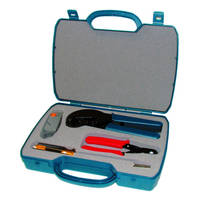
These Antenna Installation Kits come complete with all necessary tools required for installation.
Individual components such as cables and connectors are widely available if replacements are needed.
Many kits include brackets or mounting hardware, but inclusions vary by product.
They may be suitable for light commercial installations, depending on the system design.
Yes, they are commonly used in residential homes for new or replacement antenna setups.
Compatibility depends on the antenna type and mounting requirements, so product specifications should be checked.
Most kits are intended for outdoor antenna installations, but components may vary depending on the kit.
Yes, modern antenna installation kits are designed to support digital free-to-air television signals.
Many kits are designed to support installations that meet relevant AS/NZS cabling and safety standards when installed correctly.
Kits commonly include mounting hardware, coaxial cable, connectors, brackets, clamps, and fixings.
TV antenna installation kits contain the essential components required to install or replace a television antenna system.
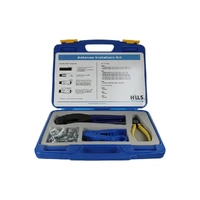
You can purchase the Hills Antenna Installers Kit and the MATCHMASTER 08MM-CRIMPKIT directly from our Sparky Direct website.
Both kits offer high-quality components and ease of installation but differ slightly regarding the tools included. Please refer to individual product descriptions for specific details.
At Sparky Direct, we buy in large bulk quantities so we can pass on the savings to our loyal customers.