
Search Results:
Search Results:
Search Results:
Search Results:
Three instruments cover most pressure and vacuum work on split systems, ducted systems, cold rooms and display cabinets. Each one measures a different stage of the job, so most service kits carry more than one. Sparky Direct supplies gauges alongside a wider range of air conditioning tools, with service tool brands including Value.
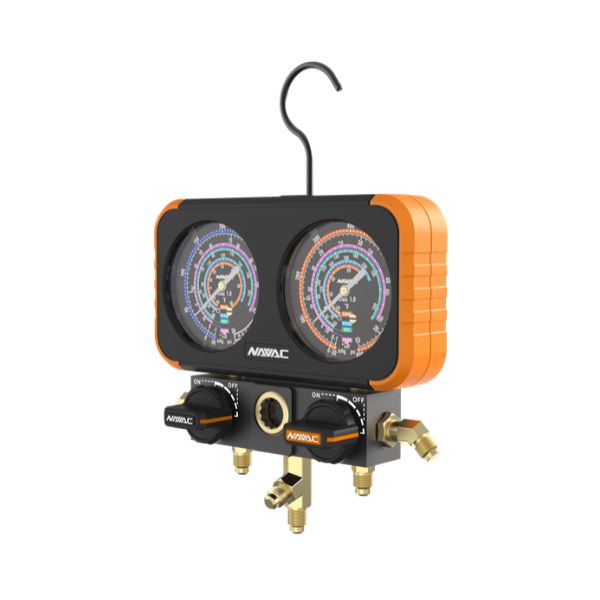
A manifold gauge set is a valve block fitted with two gauges and three hose connections. The blue hose runs to the low pressure service port and the red hose runs to the high pressure port. The yellow centre hose connects to whatever the job needs: a recovery unit, a nitrogen regulator, a vacuum pump or a refrigerant cylinder.
Two hand valves open or close the path between the centre hose and each side of the system. With both valves closed, the gauges read system pressure without letting anything in or out. Many small split systems provide a single service port on the outdoor unit, so the technician connects only one hose.
The blue low side gauge is a compound gauge: it reads positive pressure and also reads below atmospheric pressure, so it shows a vacuum being pulled. Its vacuum scale is coarse, which matters during evacuation.
The red high side gauge reads pressure only and carries a higher scale. R32 and R410A run at much higher pressures than R22, so the gauge range has to suit the refrigerant.
Blue connects to the low side and red connects to the high side. Yellow is the service hose for the vacuum pump, recovery unit, nitrogen or refrigerant cylinder.
Both types do the same core job, but they differ in how they present the reading and in how many refrigerants one set can cover.
| Feature | Analogue Manifold | Digital Manifold |
|---|---|---|
| Display | Needle on a printed dial | Numeric reading on a screen |
| Refrigerant coverage | Limited to the scales printed on the dial | Selected from a stored refrigerant list |
| Saturation temperature | Read by eye from the dial scale | Calculated by the gauge for the selected refrigerant |
| Pressure units | Fixed by the dial | Switchable on most models |
| Power | None needed | Batteries |
| Reading errors | Parallax and needle damage can affect the reading | No needle to misread |
| Typical role | Simple backup set that needs no batteries | Service work across several refrigerants |
Accuracy, pressure range and refrigerant lists vary between models, so the specifications on each product page are the reference point when comparing sets.
A digital manifold suits technicians who meet several refrigerants in a working week. Selecting the refrigerant on screen replaces reading a crowded dial scale, while an analogue set remains a simple backup that needs no batteries.
Evacuation removes air and moisture from the pipework before refrigerant is released. Moisture left in a system can form acids with the refrigerant and oil, and those acids damage the compressor over time. Air left in the lines raises operating pressure and reduces efficiency.
A compound manifold gauge cannot confirm the job is done. Its vacuum scale runs from 0 to about -100 kPa, and one kilopascal equals roughly 7,500 microns. A 500 micron target is about 0.067 kPa, which is far too small to read on a needle.
A digital vacuum gauge reads in microns, so it shows exactly how deep the vacuum is. It also shows what happens once the technician isolates the pump. A steady reading means the system is dry and tight, while a rising reading points to a leak or to moisture still boiling off.
The Australia and New Zealand Refrigerant Handling Code of Practice (2025 edition, Part 2) sets out how technicians measure and confirm evacuation. The Code requires a dedicated vacuum gauge to measure vacuum depth, not a standard manifold pressure gauge.
The Code's deep evacuation method pulls the system down to at least 500 microns (67 Pa absolute). The technician then isolates the pump for 60 minutes, and the vacuum must stay below 600 microns (80 Pa absolute). A rise of 100 microns or more indicates a leak or moisture.
Factory matched systems often carry their own evacuation instructions, so the manufacturer's installation manual is the first reference for those systems.
Protect the sensor: Positive pressure can damage a vacuum sensor, and each product's specifications list its maximum overload pressure. The technician isolates or removes the vacuum gauge before nitrogen or refrigerant enters the lines.
The pump matters as well: contaminated oil limits how deep a vacuum pump can pull, so regular changes of vacuum pump oil keep pull down times short.
Gauges, hoses and adaptors must be rated for the refrigerant and its working pressure. From 1 July 2024, Australia restricted the import and manufacture of small air conditioning equipment that uses refrigerant with a global warming potential (GWP) above 750. R410A (GWP 2,088) sits above that limit and R32 (GWP 675) sits below it.
R32 is now the standard refrigerant in new split system air conditioners. Current residential models from brands such as Daikin, Fujitsu and Mitsubishi Electric typically run on R32. Plenty of R410A systems remain in service, and older R22 units still turn up on repair and replacement jobs.
The outdoor unit nameplate states the refrigerant, and technicians confirm it before connecting any gauge.
| Refrigerant | Commonly Found In | Typical Service Port |
|---|---|---|
| R32 | Current split systems | 5/16 inch SAE |
| R410A | Split and ducted systems installed before the move to R32 | 5/16 inch SAE |
| R22 | Legacy air conditioning systems | 1/4 inch SAE |
| R134a | Refrigeration cabinets and vehicle air conditioning | 1/4 inch SAE on stationary systems |
| R404A | Cold rooms and freezers | 1/4 inch SAE |
Port sizes vary between manufacturers, so the fitting on the unit is the final check. A set with 1/4 inch hose ends needs 5/16 inch adaptors to reach R32 and R410A service ports, and some manifold sets include these adaptors in the case.
R32 carries an A2L safety classification, which means lower flammability. The Code of Practice requires tools and equipment used on flammable refrigerants to be rated for the relevant flammability class. Each tool's specifications state whether it suits A2L refrigerants.
The right gauge depends on the systems a technician works on, and five checks narrow the choice.
The gauge must list every refrigerant the work involves. Digital manifolds store many refrigerant profiles, while an analogue dial covers only the scales printed on it.
The maximum pressure rating must exceed the system's working pressure and any nitrogen test pressure. A gauge should never connect to a system that can exceed its rating.
A vacuum gauge needs to resolve readings well below the 500 micron target, and the specifications list the range, resolution, accuracy and sensor type.
Hose length, thread size and the adaptors supplied decide whether a set is ready to use out of the case.
Backlit displays help in roof spaces and plant rooms, while target alarms, where fitted, let a technician carry on with other tasks during pull down. Battery type and run time decide how well a digital gauge copes with a full day on site.
Gauges come out several times between running the pipework and handing over a working system. The sequence below is a general guide only, because the manufacturer's installation manual and the Code of Practice set the actual requirements.
Connecting a gauge to a refrigerant circuit is refrigerant handling work. Work on equipment that contains fluorocarbon refrigerants such as R32 and R410A requires a refrigerant handling licence, which the Australian Refrigeration Council (ARC) issues on behalf of the Australian Government.
Two licence types cover split system work: the full Refrigeration and Air Conditioning licence covers installation, service and repair on systems of any size. The restricted split system licence covers installation and decommissioning of single-head split systems under 18 kW.
ARC licence holders must follow the mandatory practices in the Refrigerant Handling Code of Practice. Refrigerant work and electrical work are licensed separately: an electrical licence covers the wiring to AS/NZS 3000, while the ARC licence covers the refrigerant circuit. State and territory licensing rules can also apply.
Licensed work only: The gauges in this category are trade tools for licensed technicians. Handling refrigerant without the appropriate licence is an offence under Commonwealth ozone protection regulations.
Gauges are measuring instruments, and a reading is only as good as the condition of the tool. A few simple habits keep gauges accurate between jobs.
Watch NAVTEK NTB7L | BreakFree Power Tube Bender video
Watch NAVTEK NEF6LM | HVAC Cordless Power Flaring Tool 7.4V 2Ah 14.8Wh video
Watch VALUE VET-19Li | HVAC Flaring Tool VET-19Li video

I bought this product dedicated for recovery set up. its a very handy and good quality tool to have.
Purchased for the installation of three air conditioning units. Well and truly paid for itself.
Very good item to find leaks, great pricing from sparky direct. Would definitely be purchasing more from these guys
Quality products in stock • Fast Australia-wide delivery • Competitive trade pricing
Browse Gauges → Get Expert Advice →A manifold gauge set reads the pressure inside a refrigerant circuit. Technicians use it to check operating pressures, recover refrigerant, pressure test with nitrogen and charge a system. Two hand valves control the flow between the service hose and the low and high sides.
A manifold gauge measures system pressure on the low and high sides. A vacuum gauge measures how deep the vacuum is during evacuation, usually in microns. The vacuum scale on a manifold gauge is too coarse to confirm a system is dry, so technicians carry both.
A micron gauge is a digital vacuum gauge that measures deep vacuum in microns. One micron is one thousandth of a millimetre of mercury, and atmospheric pressure is about 760,000 microns. Technicians use it to confirm an evacuation has reached its target before refrigerant is released.
The Australia and New Zealand Refrigerant Handling Code of Practice (2025 edition, Part 2) sets a deep evacuation target of at least 500 microns (67 Pa absolute). A 60 minute standing test follows with the pump isolated, and 600 microns is the ceiling for that test. On a factory matched system, the installer works to the manufacturer's evacuation instructions where they are supplied.
A rising reading means the system is not yet dry or tight. A reading that climbs and then levels off usually points to moisture still boiling off, while one that keeps climbing usually points to a leak. A system that climbs 100 microns or more during the Code of Practice's 60 minute hold has not passed.
Not unless the manufacturer rates it for system pressure. Positive pressure can damage a vacuum sensor, and each gauge lists a maximum overload pressure in its specifications. Technicians isolate or remove the vacuum gauge before nitrogen or refrigerant enters the lines.
Only where the manufacturer lists the gauge set for R32. R32 typically uses the same 5/16 inch SAE service port as R410A and runs at similar pressures, but it is classed A2L (lower flammability). Using tools that are not rated for flammable refrigerants is not permitted under the Code of Practice.
R32 and R410A split systems typically use 5/16 inch SAE service ports. Older R22 systems and stationary R134a and R404A refrigeration equipment typically use 1/4 inch SAE. Port sizes vary between manufacturers, so the fitting on the unit is the final check, and adaptors convert between the two sizes.
No. The Refrigerant Handling Code of Practice rules out putting refrigerant into a system just to pressure test it. Technicians pressure test with oxygen-free nitrogen and watch the manifold gauge for any drop. The gauge and hoses must be rated above the test pressure.
Yes, for any work that handles refrigerant. Handling fluorocarbon refrigerant is licensed work in Australia, and the licence comes from the Australian Refrigeration Council (ARC). An electrical licence covers the wiring only. A technician holding the restricted split system licence can install and decommission single-head split systems under 18 kW.
Air conditioning and refrigeration gauges are available online from Sparky Direct, an Australian electrical wholesaler established in 2005. Sparky Direct supplies electricians, tradies, and HVAC professionals nationwide, with Australia-wide delivery.