
Search Results:
Search Results:
Search Results:
Search Results:
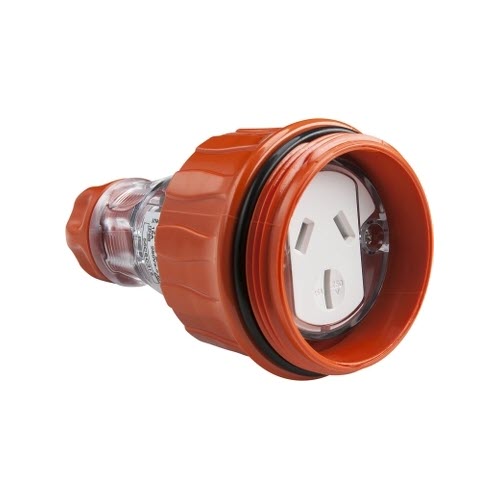
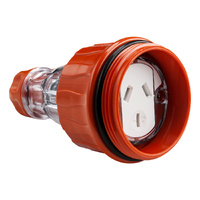
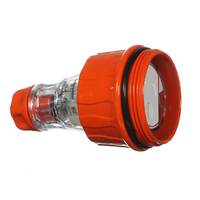
Find the best Clipsal Easy56 extension sockets here at Sparky Direct. [ Read More ]
An industrial extension socket is the female end of a portable power lead. The supply plug connects to a fixed outlet at one end of a flexible cable, and the extension socket sits at the load end so a tool, appliance, or temporary distribution board can plug in. On worksites the socket is the part that gets dropped, dragged, splashed, and stood on, so the build quality matters more than on a fixed outlet.
The IEC and Australian definition is simple: a rewireable, cord-mounted female outlet rated for the conditions it will see. Industrial-grade sockets are sealed against dust and water ingress, use heavier contact materials, and accept matching industrial plugs that lock in via a screwed coupling ring or a robust mechanical engagement.
Most worksite power is temporary. An extension socket lets a sparky run cable from a switchboard or generator out to a working position, then plug in tools or a distribution box at the far end. Semi-permanent setups (workshop benches, portable site offices, equipment yards) use the same fittings because they tolerate repeated handling without failing.
Domestic plug tops and extension sockets are designed for indoor use under controlled conditions. They are not built for daily handling, weather exposure, or contact with conductive dust. Industrial sockets in the IP66 class are the correct selection wherever the lead will see worksite conditions.
Easy56 is the modernised version of the long-running Clipsal 56 Series. The body design retains the IP66 sealing and the locking coupling ring of the original, with refinements aimed at faster termination, better cord retention, and easier identification on a busy site.
The extension socket line covers 3-pin 10A, 3-pin 15A, and higher-current configurations. Each socket pairs directly with a matching Easy56 straight or angled plug and integrates with the wider Easy56 family of switched socket combinations and appliance inlets.
The Australian trade brief is unforgiving: UV, salt air on coastal jobs, dust on civil sites, and cold water from hose-down cleaning. Easy56 sockets are specified for these conditions through their housing material, gasket design, and cable gland system.
The 56 Series has been the default Australian industrial format for decades. Easy56 keeps that compatibility while updating the user experience for installers, which is why it sees broad adoption across construction, marine, and facilities work.
Easy56 sockets are available from electrical wholesalers, online suppliers, and large hardware chains. The right channel depends on whether the buyer needs trade pricing, immediate stock, or delivery to a site.
Traditional wholesalers offer counter pickup and trade accounts, but stock varies by branch. Online suppliers like Sparky Direct's Clipsal range hold a wider catalogue, ship Australia-wide, and list current pricing, lead times, and product specifications on each page.
Genuine Clipsal stock, clear part numbers, current data sheets, and Australian compliance marking are the four essentials. Counterfeit 56-style fittings are not unknown in low-cost channels, and they often fail the IP66 claim under real conditions.
For projects that consume sockets in volume (formwork crews, scaffolders, test-and-tag operators), bulk purchase reduces per-unit cost and simplifies stock control. Trade-priced delivery direct to site is a routine part of how electrical wholesalers support contract work.
The mechanism is simple in principle and tightly engineered in practice. Three components carry the current path: the contacts inside the socket, the cable terminations, and the coupling that holds the matching plug in place.
The Easy56 socket accepts a corresponding plug with flat or round pins (depending on rating). The threaded coupling ring draws the plug face into the gasket on the socket, compressing the seal and locking the connection mechanically. The result is a joint that resists vibration and accidental disconnection.
In a typical worksite chain, the source socket on a switchboard feeds a lead with an Easy56 plug at the supply end and an Easy56 extension socket at the load end. From there, tools or a portable distribution box plug in. The Easy56 fitting is rated for the same current as the lead, so the lead's current capacity sets the limit, not the socket.
Mismatched components are the most common cause of trouble. A 15A plug should not be wired to a 10A lead, and a 10A socket should not be installed on a 15A circuit. Pin configuration, current rating, and cable size all need to align before a lead is placed in service.
Easy56 is not a standalone product. It plugs into the broader 56 Series catalogue: 3 Pin Switched Socket Combinations, isolators, and appliance inlets all share the same family of pin patterns and coupling rings. Components from older 56 Series stock generally interoperate with current Easy56 fittings of the same rating.
The pin configuration on each Easy56 socket dictates which plug fits. A 3-pin 15A socket accepts a 3-pin 15A plug, a 5-pin 32A socket accepts the matching 5-pin 32A plug, and so on. Cross-fitting is mechanically prevented by pin layout, which is part of the safety design.
Standardisation across the 56 Series means a fitting bought today still works with leads in service from previous decades. For trade buyers running a tool inventory across multiple sites, that compatibility is a meaningful operational advantage.
The housing is the first line of defence. Easy56 sockets are moulded from a tough engineering polymer that absorbs site impacts without cracking. UV stabilisation extends life on outdoor leads that live in the back of a ute.
The IP66 rating covers two things at once: total dust ingress protection, and resistance to powerful water jets from any direction. That combination is the practical baseline for outdoor power and wash-down environments.
Industrial extension sockets are not "fit once" components. They are pulled, twisted, and reconnected hundreds of times across the life of a lead. Easy56 contacts and coupling threads are built to that duty cycle.
The socket must equal or exceed the connected load's current draw. A 10A socket suits standard hand tools, lighting strings, and small appliances. A 15A socket covers higher-draw single-phase tools and caravan power inlets. Higher ratings move into three-phase territory for plant and welders.
Underspecified sockets overheat. Heat damages the contacts, melts the housing locally, and eventually causes intermittent or open circuits. The cost of a correctly rated socket is a fraction of the cost of a damaged tool or a fire incident.
"Light duty" in the industrial context still means a sealed, IP66 fitting. The light/heavy distinction is mostly about current rating and pin configuration, not build quality. Even the smallest Easy56 socket is a substantial fitting.
| Rating | Typical Use | Pin Configuration |
|---|---|---|
| 10A single-phase | Hand tools, work lights, small appliances | 3-pin flat |
| 15A single-phase | Heavier tools, caravan inlets, marine power | 3-pin flat (15A) |
| 20A single-phase | Welders, compressors, larger tools | 3-pin or 4-pin |
| 32A three-phase | Plant, mobile workshops, large equipment | 5-pin |
IP66 is shorthand for two performance numbers. The first 6 means the enclosure is fully protected against dust ingress. The second 6 means it resists powerful water jets from any direction. Together they describe a fitting that survives the conditions on a wet or dusty job.
Outdoor leads, marina and slipway power, civil site distribution, and exterior wash-down areas all rely on the IP66 spec. Indoor industrial environments with significant dust (joinery, concrete cutting) draw on the same rating for contamination resistance, not water alone.
The IP66 rating depends on the seal. A damaged gasket, a mismatched plug, or a poorly tightened cable gland breaks the seal and downgrades the protection. Sockets that get knocked about should be inspected periodically, and replaced once the gasket no longer compresses cleanly.
Construction is the heaviest user of industrial extension sockets. Site distribution boards feed leads out to forms, formworkers, scaffolders, and finishing trades. The lead population on a medium project numbers in the hundreds.
Mechanical workshops, fabrication shops, and maintenance bays use Easy56 sockets on bench leads, drop leads from overhead reels, and trolley-mounted distribution. The same fittings handle daily plug-and-unplug duty for years.
Cleaning crews, contractors performing planned maintenance, and inspection teams all need temporary power outlets that can be set up and pulled down without permanent wiring. Easy56 leads suit this in environments where dust or wash-down is part of the operation.
Generator-fed leads on remote sites, marina power posts, and outdoor event power all benefit from the sealed connection. Pairing the socket with appropriate orange circular cable gives a lead built for the conditions.
Start with the load. The connected equipment's nameplate current sets the minimum socket rating. Then factor in usage frequency: a daily-use lead earns the more robust option even if the load is modest.
If the lead lives outdoors, IP66 is non-negotiable. Indoor leads in clean conditions can step down, but most trades default to IP66 across the board so a single lead inventory works in any setting.
Extension sockets are cable-mounted by definition. Installation considerations focus on cable gland sizing for the chosen flex and on the strain relief built into the socket body.
The most frequent errors: choosing a domestic-grade socket for site use, mismatching pin configuration to the supply, and undersizing the cable for the socket's current rating. Each of these causes problems in service.
A domestic plug top uses lighter materials and is engineered for occasional reconnection in clean indoor conditions. An industrial socket is engineered to survive worksite handling for years.
Industrial fittings have larger contact areas, better thermal performance under sustained load, and locking mechanisms that prevent accidental disconnection under cable tension. These are safety-relevant differences in the contexts they target.
The summary is straightforward: domestic fittings on a worksite shorten lead life, increase failure rates, and create avoidable risk. Specifying industrial sockets from the outset is the correct decision for any commercial or trade application.
Wiring an extension socket onto a flexible cable is electrical work in Australia. It must be performed by a licensed electrician and the completed lead must be tested before placement in service.
Plug and socket ratings must match each other and match the cable. A 15A plug feeding a 10A socket through a 1.5mm flex is a non-compliant assembly even if it physically connects.
The cable gland on the socket compresses around the cable sheath and provides strain relief. Tightening to the correct torque without crushing the conductors is the technique that makes the seal work.
Beyond the wiring itself, periodic inspection and test-and-tag (where applicable) keep the lead compliant in service. Records of test dates support workplace safety obligations.
The relevant standards include AS/NZS 3000:2018 for installation practice and AS/NZS 3123 for the plug and socket fittings themselves. Genuine Easy56 stock carries the certification markings to demonstrate compliance.
Performance starts with the housing polymer and the contact metallurgy. Branded fittings publish material specs and back the rating with type-test data. Counterfeit fittings often fail at this level even when they look correct.
The coupling thread, the contact pressure, and the gasket compression all need to hold up across hundreds of mating cycles. Independent test data from the manufacturer is the best indicator on this point.
UV resistance, low-temperature impact rating, and chemical resistance to common site contaminants (fuels, cleaning chemicals, concrete slurry) round out the environmental specification.
Australian regulatory marking, RCM (Regulatory Compliance Mark) where required, and traceable manufacturer documentation distinguish certified product from uncertified imports.
Symptoms: hot socket body, melted plastic at the contact area, intermittent operation. Cause: connected load exceeds the socket rating. Fix: replace with the correct rating; do not "make do".
Symptoms: loose plug fit, sparking on connection, water entering during use. Cause: contact wear, cracked housing, perished gasket. Fix: replace the fitting; gaskets and contacts are not field-repairable on most variants.
Symptoms: plug will not fully seat, coupling ring will not close. Cause: mismatched series or non-genuine fitting. Fix: confirm both ends are from the same family and are genuine.
Symptoms: dust or grit fouling the contact face, corrosion at the contacts on coastal jobs. Cause: regular exposure without periodic cleaning. Fix: include the leads in a scheduled inspection routine; clean and inspect, replace gaskets where the design allows.
Electricians fitting site distribution boards or assembling lead inventories for builders typically order Easy56 sockets and matching plugs together with appropriate flex from a single supplier to keep pin configurations and cable specs aligned.
Larger projects pre-order lead populations sized to peak headcount. Standardising on Easy56 means leads are interchangeable across crews and across phases of the project.
Facility teams maintaining temporary power for cleaning, contractor work, or planned outages benefit from a single fitting standard across all departments.
Bulk pricing and consolidated delivery reduce both unit cost and admin overhead. The full industrial supplies catalogue at Sparky Direct supports this with single-purchase-order fulfilment.
Budget sockets exist. They cost less up-front and last a fraction of the time on an active site. Across the life of a project the true cost difference is much smaller than the sticker comparison suggests.
A failed lead means a tool out of service, a tradesperson stopped, and possibly a damaged tool or near-miss. The economics of paying for a quality fitting are clear once those downstream costs enter the picture.
Volume discounts on Easy56 stock are available through trade-priced wholesalers. Project quantities should be priced as a single line rather than stitched together over time.
A correctly specified Easy56 socket on quality flex routinely lasts the full life of a builder's lead population. That is the value proposition, and it is the reason the format has held its market position for decades.
Club Clipsal is Australia's largest electrician community offering trade rewards, business support, and exclusive benefits. When you nominate Sparky Direct as your preferred wholesaler, we automatically apply your Clipsal spend points to your Club Clipsal account daily.
Entry-level offering coaching, mentoring, and training discounts
Unlock exclusive industry tools and networking events
Access Toyota fleet offers and business software discounts
Maximum benefits, including VIP experiences and rewards
1. Sign Up: Create your Club Clipsal account at clipsal.com/club-clipsal or via the iCat mobile app
2. Nominate Sparky Direct: Select Sparky Direct from the wholesaler dropdown menu in your profile
3. Add Email: Enter your Sparky Direct account email address in the membership number field
4. Start Earning: Every dollar spent on Clipsal products earns points automatically
Redeem points from the rewards store, including gift cards, tools, and experiences. Access business summits, product training, and industry networking events. Receive early access to new product launches and special promotions. Connect with fellow electricians via the Club Clipsal community app.
Watch CLIPSAL EY56CSC315 | Extension Socket 3 Flat Pin 15Amp IP66 | Easy56 video
Watch CLIPSAL EY56CSC310 | Extension Socket 3 Flat Pin 10Amp IP66 | Easy56 video
Watch CLIPSAL 56CSC315-EO | Extension Socket 3 Flat Pin 15Amp IP66 | 56 series Orange video

It was used to connect power to a yacht. It is waterproof as it screws in to the male fitting with an O ring in place. It is easy to use.
Usual great Clipsal quality for a reliable watertight extension socket - very safe for marina power hookups
Great plugs to improve the plug staying plugged in, with great improvement of dust and water ingress.
Quality products in stock • Fast Australia-wide delivery • Competitive trade pricing
Browse Clipsal Easy56 Industrial Extension Sockets → Get Expert Advice →Yes. Their robust design helps reduce accidental disconnection and damage to electrical connections.
Easy56 industrial extension sockets are available from Sparky Direct, offering access to durable electrical products with Australia-wide delivery.
Delivery availability depends on the supplier and location, with options across metropolitan and regional Australia.
Yes. They are suitable for new extension leads, upgrades, and replacing worn industrial sockets.
Warranty coverage depends on the manufacturer and supplier, with conditions applying to correct use and installation.
Consider current rating, IP rating, cable compatibility, usage environment, and electrician recommendations.
They generally require minimal maintenance but should be checked during routine electrical inspections.
Yes. They are commonly used in workshops, garages, and service areas.
When used as intended, they are designed for long service life in demanding conditions.
Yes. Their tough housings resist dust and grime and can be wiped clean.
Yes. They are built to withstand repeated plugging and unplugging in high-use environments.
They feature an industrial design prioritising strength and protection rather than compact size.
Yes. When correctly rated and installed, they are suitable for powering outdoor tools and machinery.
Easy56 industrial extension sockets are heavy-duty electrical connectors designed to provide a secure power outlet at the end of an extension lead in demanding environments.
Yes. They are designed for straightforward connection and disconnection while maintaining a secure fit.
They offer increased durability, weather resistance, and reliability in tough environments.
Yes. Wiring and termination must be carried out by a licensed electrician to ensure safety and compliance.
Yes. They are widely used in commercial and light industrial applications.
Yes. They are specifically designed for use on extension leads to provide a durable socket end.
Yes. Easy56 industrial extension sockets are designed to mate with matching Easy56 straight or angled plugs.
Yes. They are designed to handle higher current ratings within their specified limits.
IP ratings vary by model and indicate protection against dust and water ingress for harsh environments.
Yes. They are designed with robust housings suitable for indoor and outdoor use when rated and installed as specified.
Easy56 industrial extension sockets supplied in Australia are designed to meet relevant AS/NZS electrical and safety standards when used correctly.
They are commonly used on worksites, workshops, factories, outdoor areas, and commercial or industrial locations requiring durable power connections.