

240v 9v
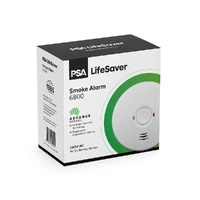
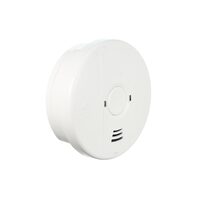
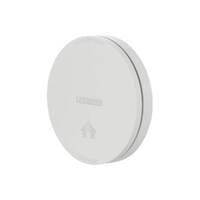
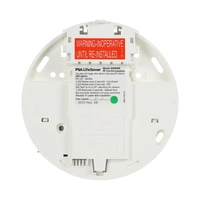
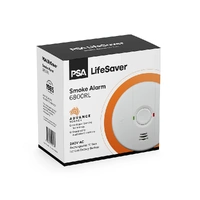
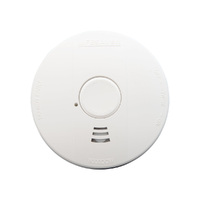
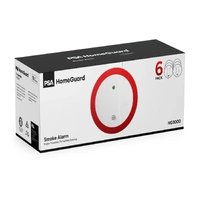
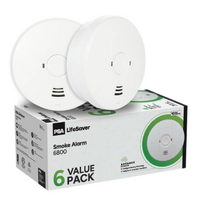
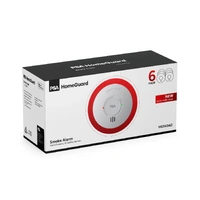
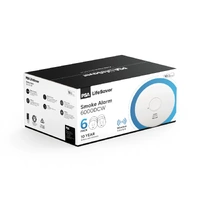
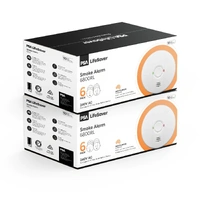
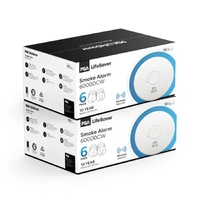
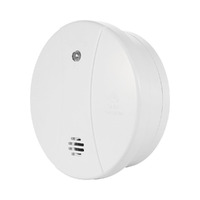
PSA HG3000 | HomeGuard Photoelectric Smoke Alarm 240V/9V White | Interconnectable | 10 Year Warranty
$31.89
$28.99 ex. GST
Search Results:
Search Results:
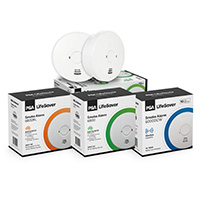
Find the best PSA photoelectric smoke alarms here at Sparky Direct. [ Read More ]
A photoelectric smoke alarm uses an optical sensing chamber. Inside the chamber sits an LED light source and a separate light sensor, positioned at an angle to each other. When the air is clear, the sensor sees almost no light. When smoke particles enter the chamber, they scatter the LED beam onto the sensor. Once that scattered light crosses the trigger threshold, the alarm sounds.
A photoelectric alarm is a residential or commercial fire detection device that responds to visible smoke. It is the alarm type recommended by Fire and Rescue services across Australia for general home use. It does not contain radioactive material, unlike older ionisation alarms.
The chamber is engineered to keep ambient light out while letting smoke in. When particles drift through the beam, light scatters in all directions. The angled sensor reads the change. The unit then signals the horn driver, which produces a T3 temporal pattern (three beeps, pause, repeat) at the frequency required by AS 3786:2014.
Most fatal home fires start as slow, smouldering events. A cigarette on bedding, a faulty power lead in a couch, or overheated insulation can produce thick smoke for many minutes before flames appear. Photoelectric chambers respond well to these large, visible smoke particles. The result is an earlier warning when occupants are most often asleep.
PSA Products is an Australian-owned manufacturer of fire safety and security products. The company designs and supports its smoke alarm range locally and supplies products into the residential, commercial, and rental compliance markets. The full PSA Products range is stocked at Sparky Direct.
Local design means the alarms are built around Australian wiring conventions, ceiling types, and humidity ranges. Replacement bases are matched to legacy PSA mounting plates, which makes upgrades simpler when an older alarm reaches the end of life.
Every PSA photoelectric smoke alarm sold in Australia must comply with AS 3786:2014, the standard that governs smoke alarm performance, sound output, and safety. PSA models carry the ActivFire certification mark, which is the recognised proof of compliance for Australian fire authorities.
The PSA range covers the three main configurations. The HomeGuard series suits straightforward residential builds. The Lifesaver LIF6000 and LIF6800 ranges add 9V battery backup or sealed 10-year lithium battery options. Wireless interconnect bases let installers link multiple alarms across a home without running interconnect cable.
Australian fire authorities have shifted firmly toward photoelectric detection for residential use. State legislation now reflects that position, with photoelectric alarms either required outright or strongly recommended in new builds, renovations, and rental properties.
Ionisation alarms detect by-products of fast-flaming fires through a small radioactive source. They respond more slowly to smouldering smoke than photoelectric units. Several states no longer permit ionisation alarms in new residential installations, and the trend across the country is to phase them out.
Independent testing by fire research bodies has shown faster activation times for photoelectric alarms in real-world residential fire scenarios. The earlier warning gives sleeping occupants more time to wake, alert others, and exit the building before conditions become untenable.
Queensland is the most prescriptive state, with full interconnected photoelectric coverage required by 1 January 2027 for all dwellings. New South Wales, Victoria, and other states require photoelectric alarms in new builds and substantial renovations, with rental properties subject to additional inspection rules. Owners should confirm current requirements with their local fire service before installing.
Two standards do most of the work in this space. AS 3786:2014 governs the smoke alarm itself. AS/NZS 3000:2018 (the Wiring Rules) governs the electrical installation when the alarm is hardwired to mains power.
AS 3786:2014 sets out the testing regime for sensitivity, audibility, and durability. It also requires manufacturers to mark each alarm with a date of manufacture and to publish a maximum service life. Compliance is verified through ActivFire listing, which is the Australian recognition mark used by fire authorities.
An alarm must produce at least 85 decibels at three metres when sounding. The T3 temporal pattern is mandatory, which is what creates the recognisable three-beep alert. The product label carries the AS 3786 reference, the manufacture date, and the replace-by date.
Every smoke alarm has a 10-year maximum service life from the date of manufacture. After 10 years, sensor sensitivity degrades, and the alarm must be replaced regardless of how it appears to be working. The 10-year rule applies to both 240V and battery models.
Look for the ActivFire mark, the AS 3786 reference, a clearly stamped manufacture date, and a 10-year replace-by date. Any alarm sold without these is not compliant for Australian residential use.
Queensland leads the country on smoke alarm reform. The 1 January 2027 deadline requires all Queensland dwellings to have interconnected photoelectric alarms in every bedroom, in hallways connecting bedrooms, and on every level of the home.
The Queensland transition has run in stages since 2017. New builds and major renovations have been required to meet the full standard from the outset. From 1 January 2022, properties leased or sold became subject to the same requirement. The 1 January 2027 date extends the rule to all remaining domestic dwellings, including owner-occupied homes that have not changed hands.
Property owners are responsible for installing and maintaining compliant alarms. Landlords must test alarms and replace them within their service life. Tenants must not interfere with installed alarms and must report faults. Real estate agents managing rental property usually arrange annual compliance inspections on the owner's behalf.
Under QLD rules, alarms must be installed in every bedroom, in any hallway connecting bedrooms to the rest of the house, and on every storey of a multi-level home. Each alarm must be photoelectric, must comply with AS 3786:2014, and must be either hardwired or sealed 10-year battery powered. All alarms must be interconnected so that if one sounds, every alarm sounds.
The difference between the two technologies is the type of fire each one detects fastest. That difference has driven the regulatory shift toward photoelectric for residential use.
| Feature | Photoelectric | Ionisation |
|---|---|---|
| Best at detecting | Smouldering, smoky fires | Fast-flaming fires |
| Typical residential scenarios | Bedding, upholstery, faulty wiring | Cooking flames, paper, solvents |
| Nuisance alarms | Lower in kitchens and bathrooms | Higher near cooking and steam |
| Radioactive material | None | Small Americium-241 source |
| Australian residential preference | Recommended and increasingly mandated | Being phased out |
In standardised tests using smouldering smoke, photoelectric alarms typically activate many minutes earlier than ionisation alarms. In flaming fire tests with low smoke output, ionisation can be slightly faster. The residential weighting favours photoelectric because most home fire deaths involve smoke inhalation during smouldering events.
A smouldering fire produces large, visible smoke particles that scatter light efficiently. A flaming fire produces smaller particles and more heat. Photoelectric chambers excel with large particles. The trade-off is acceptable for residential use because flaming fires usually generate enough smoke during their growth phase to trigger photoelectric detection well before flashover.
The regulatory direction across Australia is clear. Several states already prohibit ionisation alarms in new residential installations. Manufacturers including PSA, Clipsal, Brooks, and Red Smoke Alarms have shifted production toward photoelectric models. Clipsal and Legrand both list photoelectric units as their primary residential smoke alarm products.
PSA photoelectric smoke alarms are available in three main power configurations. The choice depends on the property type, the wiring already in place, and the level of compliance required.
Hardwired alarms run from the lighting circuit and use battery backup only during power outages. They are the standard fitment for new builds and are usually wired in groups with an interconnect lead, so that when one alarm detects smoke, all linked alarms sound together.
Sealed lithium models simplify retrofits in older homes where running cable to ceilings is not practical. The battery is built in and runs the alarm for its full 10-year service life. At end of life, the whole unit is replaced, which keeps maintenance simple for landlords and homeowners.
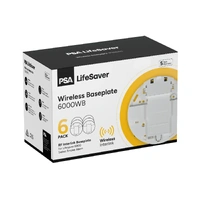
Modern PSA bases support both wired and wireless interconnection. Wired interconnect runs a third core between alarms during installation. Wireless interconnect uses RF to pair alarms after they are mounted, which suits properties with finished ceilings or detached structures.
Interconnection is the single biggest improvement to residential fire safety in the past decade. When one alarm sounds, every alarm in the system sounds, regardless of which room the fire started in.
A wired interconnect is a low-voltage signal carried on a third conductor between alarms. When an alarm in one room detects smoke, it raises the signal line, which triggers every other alarm on the same circuit. Wireless interconnect uses an RF protocol between paired alarms to achieve the same outcome without cable.
A fire in the laundry can wake occupants in a bedroom on the far side of the house. A garage alarm can warn the family inside before the fire spreads to living areas. Multi-storey homes gain the most: a downstairs alarm can wake people upstairs while there is still time to evacuate.
Most PSA wireless systems support up to 24 paired devices per network. Wired systems are usually limited by the number of alarms on a single interconnect circuit, which is documented in the installation guide. Mixing wired and wireless alarms is usually possible through a wireless base accessory. Heat alarms can also be added to interconnected networks for kitchens and garages where smoke alarms are unsuitable.
The right choice depends on what is already installed, what the property needs to comply with, and how the home is laid out. The decision usually comes down to power source, interconnection method, and battery type.
Properties built after the early 1990s usually have hardwired alarms in place. Replacing like with like is the simplest path. Older properties without ceiling cabling are better served by sealed 10-year battery alarms with wireless interconnection. Rentals subject to compliance inspections should match the standard in force in that state, including the QLD interconnection requirement where applicable.
Hardwired alarms are best when ceiling access exists, an electrician is on site, and long-term reliability matters most. Battery alarms are best when retrofitting to a finished home, when an electrician visit is impractical, or when the property is being prepared for sale or lease quickly.
PSA wireless interconnect uses a brand-specific RF protocol. PSA wireless bases pair only with other PSA wireless bases, which means mixed-brand wireless networks are not supported. If a home already has interconnected alarms from another brand, the simplest path is to replace the full set with PSA when the existing units reach 10 years.
Correct placement matters as much as the alarm itself. AS 3786:2014 and the Building Code of Australia together set the rules for where alarms must go.
Mount the alarm on the ceiling, at least 300mm from any wall, light fitting, or air conditioning vent. The exclusion zone exists because corner pockets trap stagnant air and delay smoke reaching the chamber. Nearby vents push smoke away from the sensor.
Bedrooms each get an alarm. Hallways serving bedrooms each get an alarm. Living rooms on storeys without bedrooms still need an alarm to meet the per-storey rule. Kitchens are usually fitted with heat alarms instead, to avoid nuisance alarms from cooking. Bathrooms and ensuites are excluded because steam triggers false alarms.
Multi-storey homes need at least one alarm per level. Open-plan spaces with high ceilings or vaulted designs may need multiple alarms to ensure smoke reaches a sensor before the protective layer becomes too dilute. The QFES guidance on placement is the authoritative reference for QLD properties.
Common placement mistakes: mounting too close to ceiling fans, fitting alarms inside bathrooms, placing alarms within 300mm of a wall, and forgetting the per-storey rule on stairwells and split-level homes.
Installation rules differ between hardwired and battery alarms. The line between DIY and licensed work is fixed by AS/NZS 3000:2018 and the relevant state electrical safety act.
Any 240V hardwired smoke alarm must be installed by a licensed electrician. Connecting an alarm to a lighting circuit is electrical work under state law. Battery-only alarms can be installed by the homeowner because they do not involve mains wiring.
Electrical work is mandatory when running new interconnect cabling, replacing a 240V alarm on a different base, or installing a new circuit. It is also required when bringing a property up to current QLD requirements with hardwired interconnected alarms.
The installing electrician must issue a Certificate of Electrical Safety or equivalent state document, and provide a record of compliance for the customer. This certificate is what real estate agents and conveyancers ask for during property transactions and rental inspections. Sparky Direct supplies the alarms; the licensed electrician on site is responsible for issuing the certificate.
Even compliant, correctly installed alarms need regular testing and cleaning to remain effective. The following routine matches the recommendations in the AS 3786:2014 user guidance and the major fire authority advice.
Press the test button on each alarm once a month. The alarm should sound within a few seconds. In an interconnected system, every linked alarm should sound when any single test button is held. If any alarm fails to sound, replace it.
Vacuum each alarm gently every six months using a soft brush attachment. Dust and insects in the chamber are the main cause of false alarms in PSA Lifesaver and HomeGuard models. Do not use wet cleaning, solvents, or aerosols near the sensor opening.
At least twice a year, run a full system test by triggering one alarm and confirming all paired units respond. Note any unit that does not sound or that sounds intermittently. Wireless interconnect systems should also be tested after any major Wi-Fi router or appliance change, since strong RF interference can occasionally affect older bases.
Smoke alarms are not a fit-and-forget product. The 10-year service life is built into the standard for a reason: chamber sensitivity drifts with age, and electronic components wear.
Every alarm carries a manufacture date and a replace-by date stamped on the housing. Replace each alarm by the printed date, regardless of how it appears to be functioning. The 10-year rule is an industry-wide minimum; some manufacturers including PSA back this with a 10-year warranty on selected models.
Common signs include intermittent chirps unrelated to low battery, frequent false alarms, yellowing of the plastic housing (a sign of UV exposure and age), and failure to sound on the test button. Any of these means immediate replacement, even if the printed date has not yet been reached.
Record the install date for each alarm in the property records. Setting a calendar reminder for nine years and six months from install gives enough lead time to budget and book the replacement. For rental properties, the property manager usually keeps this record.
The right model varies by property type. The same PSA range covers most cases, but the configuration changes.
For homes where the owner lives, the priority is reliability and simple maintenance. Hardwired LIF6800 or HomeGuard models with a sealed 10-year backup battery suit most owner-occupied properties. Add wireless bases on the existing alarms to extend coverage to garages or upper levels without further cabling.
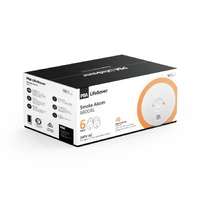
Rentals need to pass annual or biennial compliance inspections in most states. Sealed 10-year lithium battery alarms simplify the inspection process because there is no annual battery to replace. The PSA LIF6800RL is a popular choice for rental fitouts because the battery is rechargeable from the 240V supply.
New builds and major renovations must meet the current standard at the time of construction approval. That usually means hardwired interconnected photoelectric alarms in every bedroom, every hallway serving bedrooms, and every storey. Specify the alarm count at the design stage so the electrician can run interconnect cable cleanly.
Smoke alarms are sold through hardware retailers, fire safety specialists, and electrical wholesalers. Each channel has trade-offs in price, range, and advice.
Sparky Direct stocks the PSA range alongside Red Smoke Alarms, Clipsal smoke alarms, Legrand smoke alarms, and Matelec smoke alarms. Buying online suits trades and DIY customers who already know what they need.
Discount-store alarms usually meet the legal minimum but lack the warranty and the local support of trade brands. PSA, Brooks, Clipsal, and Red Smoke Alarms are the four most commonly specified residential photoelectric brands in Australia. Trade-grade units are easier to interconnect, easier to service, and have better long-term reliability records.
Confirm the AS 3786:2014 marking, check the manufacture date is recent, verify the 10-year warranty is included, and decide on hardwired or battery before ordering. For QLD compliance, confirm the alarm supports interconnection. Heat alarms, Matelec wireless models, and Red Smoke Alarms bundles are also stocked for mixed-protection installations.
Most alarm issues fall into three buckets: nuisance alarms, interconnect problems, and power or battery faults. Each has a typical cause and a typical fix.
Nuisance alarms usually mean the chamber is dirty or an insect has entered. Vacuum the alarm with a soft brush. If the issue continues, check the placement: alarms within 3 metres of a kitchen often trigger from cooking smoke. Move the alarm or replace the kitchen unit with a heat alarm.
If one alarm sounds but others do not respond, check the wired interconnect first by confirming the third-conductor connection at each base. For wireless systems, re-pair the network using the manufacturer instructions. Distance, concrete walls, and dense furniture can occasionally limit RF range.
A chirping alarm with mains power present usually means the backup battery is low. Replace the 9V battery on older models. On sealed 10-year models, a chirp indicates end of service life: replace the whole unit. If the alarm has no power at all, check the lighting circuit at the switchboard and verify the safety switch has not tripped.
Watch PSA LIFESAVER LIF6000 | 240v Photoelectric Smoke Alarm | 9v Battery Backup video
Watch PSA LIF6800RL | 240V Photoelectric Smoke Alarm with 10-Year Rechargeable Lithium Battery Backup video
Watch PSA LIF6800 | 240V Photoelectric Smoke Alarm with 9V DC Battery Backup | 10YR Warranty video

I bought this one to replace a LIF6000RL unit that kept false alarming in the wee small hours (I suspect that a small spider had managed to get into the sensor compartment, as there were cobwebs on the inside of the mesh which had a small gap). It was easy connecting it to the network and hopefully we will have no further arachnid invasions.
I've recent re-purchased the RIF6800RL which replace my 10 year old version of RIF5800RL, these are great the do not nuisance alarm. They work perfectly in sync together, hence why coming back the to PSA brand and quality.
These smoke detectors have a slim profile (look small on the ceiling) and their indicator light is not so bright as act as a night light in your bedroom at night. Work well, and Sparky Direct are fast and a good service.
Quality products in stock • Fast Australia-wide delivery • Competitive trade pricing
Browse PSA Photoelectric Smoke Alarms → Get Expert Advice →Photoelectric technology helps reduce false alarms from cooking fumes compared to other types.
Sparky Direct supplies PSA photoelectric smoke alarms Australia-wide, offering compliant fire safety solutions with convenient delivery.
They are securely packaged and delivered via standard courier services.
Unused products are generally eligible for return according to the seller’s returns policy.
Warranty coverage varies by model and manufacturer terms, usually covering defects.
Yes, PSA smoke alarms are typically sold as individual units.
Yes, correct placement ensures effective detection and compliance.
Yes, interconnected PSA alarms are suitable for multi-level dwellings.
Yes, they are commonly used in rental properties to meet safety regulations.
They are typically replaced every 10 years, depending on the model.
They should be tested regularly and kept free from dust and debris.
They emit a loud audible alarm designed to alert occupants throughout the home.
Yes, they include test buttons for simple routine testing.
PSA photoelectric smoke alarms are fire safety devices manufactured by PSA that use photoelectric technology to detect smoke.
Yes, photoelectric alarms like PSA are widely recommended for residential use.
They are trusted in Australia for reliability, compliance, and early smoke detection.
Hardwired PSA smoke alarms must be installed by a licensed electrician.
Yes, they are commonly used in new homes and renovations to meet compliance requirements.
Yes, many PSA models support interconnection so multiple alarms sound together.
Many PSA smoke alarms include battery backup for continued operation during power outages.
Yes, PSA offers hardwired smoke alarms for use where mains power is required.
PSA is well known for its range of photoelectric smoke alarms, which are widely recommended in Australia.
Yes, they are designed specifically for Australian residential requirements.
Yes, PSA photoelectric smoke alarms are designed to comply with relevant AS/NZS smoke alarm standards when installed correctly.
They detect visible smoke particles using a light sensor and trigger an alarm when smoke is present.