
Search Results:
Search Results:
Search Results:
Search Results:
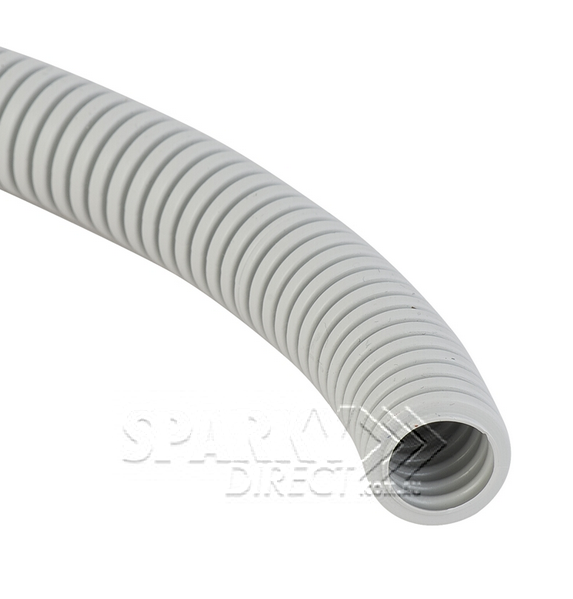
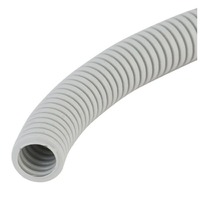
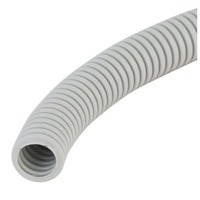
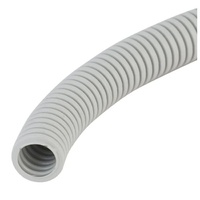
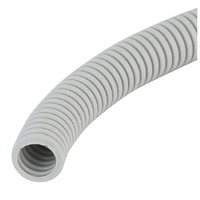
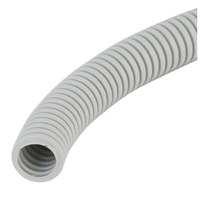
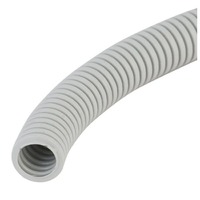
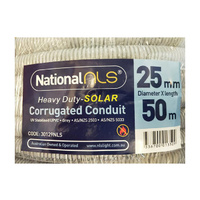
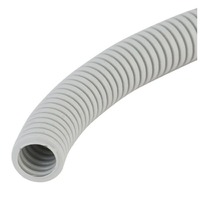
Grey corrugated conduit is a continuous, flexible PVC tube with a ribbed outer wall. The corrugations let the tube flex and curve while keeping its internal diameter open for cable to pass through. Cables run inside the conduit, isolated from concrete, masonry, timber framing, and the elements. The tube absorbs minor knocks and supports the cable along its full length.
Australian sites use colour to identify what runs inside a conduit. Grey signals a general low voltage power circuit, separating it visually from orange (heavy duty mains in slabs), white (communications), and other colour codes. Using the correct colour helps the next sparky on site know what they are cutting into before they cut.
The ribbed wall provides three layers of protection. It shields cable from physical impact during construction trades following behind. It isolates cable from chemical contact with wet concrete, plaster, and treated timber. It also gives a defined mechanical pathway for future cable replacement without breaking out the wall.
Corrugated conduit flexes through framing and around services without joiners. Rigid PVC needs cuts, glue, and elbows at every direction change. Steel conduit gives the highest mechanical protection but adds weight, cost, and earthing obligations. For most domestic and commercial cable runs, grey corrugated PVC strikes the practical balance of speed, protection, and cost.
Single-wall corrugated conduit uses one continuous PVC layer with the corrugations exposed inside and out. Twin-wall designs add a smooth inner liner, which reduces friction when drawing cables. The grey corrugated range stocked at Sparky Direct is single-wall medium duty PVC, suitable for the majority of residential and commercial cable runs.
A purely flexible system uses corrugated conduit from end to end, joined to fittings at terminations only. Hybrid systems combine corrugated runs with sections of medium duty rigid conduit where straight, exposed runs need a cleaner finish. Hybrid systems suit garages, switchboards, and plant rooms where neat presentation matters.
Standard grey corrugated conduit is rated for use indoors, in walls, in slabs, and underground. Prolonged direct sunlight can degrade unstabilised PVC over time, so any exposed run needs to be either UV-stabilised stock or sleeved inside something that blocks sunlight. Always check the product specification before specifying conduit for an exposed external run.
A smooth internal bore reduces drag during cable pulling, which matters for long runs or larger conductors. A fully corrugated internal wall trades some pulling friction for lower cost and greater flexibility. For short residential runs the difference is negligible. For commercial runs over 10 metres a smooth bore can save real time.
Grey corrugated conduit at Sparky Direct is stocked in three core sizes. The 20mm size suits single 2.5mm or 4mm twin and earth runs. The 25mm size handles multiple cables or larger 6mm and 10mm conductors. The 32mm size is used for heavy circuits, sub mains, and bundled runs. Larger 40mm and 50mm sizes are available for industrial and infrastructure applications.
AS/NZS 3000 sets the rules for how much cable can fill a conduit. The principle is straightforward: cables must be able to be drawn in and out without damage. As a working rule, fill should not exceed about 40 percent of the internal cross-section for a single cable, or 31 percent for two or more cables.
Grey corrugated conduit is classified by impact and compressive strength under AS/NZS 2053. Medium duty rated product covers most domestic walls, ceilings, and underfloor runs. Heavy duty product is used where the conduit will be embedded in a slab or buried underground.
PVC corrugated conduit handles a working temperature range from about minus 5 to 60 degrees Celsius. It resists most common construction chemicals, including wet concrete, lime, plaster, and standard timber treatments. It is not suitable for sustained contact with aggressive solvents or fuel.
Start with the cable schedule and work backwards. List every cable that will share the run, then select a conduit size that meets the fill rule with room to spare. Building in spare capacity makes future circuit additions much easier than ripping out and resizing.
Indoor wall and ceiling runs use standard medium duty conduit. Underground runs need heavy duty stock and a minimum cover depth specified in AS/NZS 3000. External above-ground runs need either UV-rated conduit or shielding from direct sunlight.
The required impact rating depends on where the conduit sits. Concealed in framing, medium duty is enough. In a slab, in a driveway, or any surface where vehicles or heavy traffic pass, heavy duty stock is the right choice.
The most common mistakes are undersizing for fill, using indoor conduit in exposed external runs, and using single-wall PVC where twin-wall would have saved hours of pulling time. Specify on the basis of the run, not just the cable count.
Most domestic rough-in uses 20mm or 25mm grey corrugated conduit through stud walls, joist spaces, and ceiling cavities. The flexibility lets the sparky route around plumbing, ducting, and structural members without staging multiple fittings.
Office and retail fit-outs use grey corrugated conduit above suspended ceilings to feed lighting, power, and data outlets. The system pairs with conduit junction boxes at branch points and PVC conduit saddles for support along ceiling grid runs.
Industrial sites use heavier rated grey conduit for general low voltage feeds, while orange heavy duty stock is reserved for in-slab and underground service runs. Where mechanical exposure is severe, rigid conduit or steel options take over.
Civil projects use larger diameter corrugated conduit for street lighting feeders, traffic signal cabling, and shared trench installations. These runs are typically buried at depths set by AS/NZS 3000 for the cable type and location.
AS/NZS 2053 defines the construction, classification, and testing of PVC conduit sold in Australia. Compliant product carries marking that identifies the standard, the manufacturer, the size, and the duty rating. Non-compliant or unmarked stock should never be installed in a regulated electrical run.
AS/NZS 3000 sets the rules for how conduit is installed and where it can be used. Key clauses cover minimum cover depths underground, separation from other services, support spacing, and the rules around bends and offsets. The sparky on site is responsible for compliance with the current edition.
Underground runs need a sand bedding layer, the conduit laid flat, then a sand cover, then warning tape, then backfill. Above-ground runs need support at intervals that prevent sag and protection from mechanical damage at low level entries.
Use conduit saddles at the spacings recommended for the conduit size and weight load. Avoid sharp internal bends. Keep conduit clear of hot services, sharp metal edges, and locations where future trades are likely to drill or cut.
Corrugated conduit terminates into junction boxes, switchboards, and accessory boxes using purpose-made glands. The gland threads onto the box and grips the corrugations of the conduit, locking it in place. Joining two lengths of corrugated mid-run is uncommon. Where a join is needed, the standard approach is a junction box, not an inline coupler.
Underground and external entries need to seal against water, soil, and pests. Straight glands compress the corrugations to form a seal at the box wall. For wet locations, a sealing washer or compound is added at the box face.
Grey corrugated conduit pairs with the standard 20mm, 25mm, and 32mm conduit fittings range. Conduit bends, solid elbows, and straight tees are sized to match. Glands and junction boxes work across both rigid and corrugated systems at the same nominal diameter.
A common pattern is corrugated through walls and ceilings, transitioning to rigid conduit for exposed surface runs around switchboards and plant rooms. The transition is made at a junction box, with a gland on the corrugated side and a coupling on the rigid side.
| Option | Best For | Trade-off |
|---|---|---|
| Grey Corrugated PVC | Concealed runs through framing, slabs, underground | Less neat for exposed surface runs |
| Rigid PVC Conduit | Exposed surface runs, switchboards, plant rooms | Slower to install, needs glued joints |
| Direct Burial Cable | Single dedicated buried circuits | No future cable replacement pathway |
| Cable Tray | High-density commercial and industrial cable bundles | Higher cost, needs structural support |
Corrugated conduit installs faster through framing because it bends in place. Rigid PVC needs cutting, gluing, and elbows at every direction change, but presents better on exposed walls and stays straight under support spacing.
Direct burial cable saves the cost of conduit but locks the circuit in place. Conduit costs more upfront but lets future cables be drawn in or replaced without excavation. For any long-life installation, conduit is the better lifecycle decision.
Cable tray suits high cable counts and routes that change frequently, such as data centres and large industrial plants. Corrugated conduit suits dedicated runs from source to destination. Most building work falls into the conduit category.
Use corrugated for the bulk of concealed runs. Use rigid for neat exposed presentation. Use cable tray for high density. Use direct burial only for short, dedicated, never-to-be-changed circuits.
Grey corrugated PVC absorbs impact through the flex of the corrugations, which is why it survives the rough handling of construction sites. The classification under AS/NZS 2053 sets the impact rating, with medium and heavy duty options for different exposure levels.
PVC handles wet concrete, lime, and most building chemicals without degradation. UV exposure is the main weakness for unstabilised stock, which is why exposed runs need either UV-rated conduit or sun protection.
Buried in concrete or sand, PVC conduit has a service life measured in decades. The cable inside ages faster than the conduit around it, which is exactly why the conduit is there: to let the cable be replaced when the time comes.
Conduit itself rarely needs maintenance. Periodic inspection of accessible junction boxes for water ingress, insect intrusion, and seal condition is the main routine. Underground runs are inspected when adjacent earthworks expose them.
Pricing varies by size, roll length, brand, and duty rating. Sparky Direct stocks budget range and Clipsal Turbo product across 10m, 20m, 25m, and 50m rolls. Larger rolls drop the per-metre cost significantly compared to short lengths.
For volume work, buying 50 metre rolls is the right call. For a small job, a 10 metre roll avoids waste and stores easily on a service van. Sparky Direct lists both ends of the range to suit the job at hand.
Unmarked or non-compliant conduit fails under impact, splits during installation, and cannot be certified to AS/NZS 2053. The saving on the roll never makes up for a failed inspection or a callback. Always check the marking.
Trade suppliers like Sparky Direct list compliant stock, support trade pricing, and ship direct to site. General retail channels often carry lower-spec product without the standards marking that compliance work needs.
Sparky Direct ships corrugated conduit Australia-wide from in-stock inventory. Roll product is bulky, so freight is calculated on the order. Bundling rolls with fittings on a single order keeps freight efficient.
Match the conduit duty to the location, the size to the cable schedule, and the colour to the circuit type. Document the decision against the wiring schedule so the next sparky on site has the same logic to follow.
The recurring mistakes are buying too small, buying too short, and forgetting the fittings. Order the rolls, glands, junction boxes, and saddles in one go to avoid second freight runs.
Add 15 to 20 percent to the measured run length for waste, bends, and offsets. Round up to the next standard roll length. Leftover conduit is rarely wasted in a working business: it goes into the next job.
Sparky Direct sells grey corrugated conduit online with trade pricing, in-stock availability, and Australia-wide delivery. Ordering through a trade channel ensures the stock is compliant and the documentation is in order for inspection.
Club Clipsal is Australia's largest electrician community offering trade rewards, business support, and exclusive benefits. When you nominate Sparky Direct as your preferred wholesaler, we automatically apply your Clipsal spend points to your Club Clipsal account daily.
Entry-level offering coaching, mentoring, and training discounts
Unlock exclusive industry tools and networking events
Access Toyota fleet offers and business software discounts
Maximum benefits, including VIP experiences and rewards
1. Sign Up: Create your Club Clipsal account at clipsal.com/club-clipsal or via the iCat mobile app
2. Nominate Sparky Direct: Select Sparky Direct from the wholesaler dropdown menu in your profile
3. Add Email: Enter your Sparky Direct account email address in the membership number field
4. Start Earning: Every dollar spent on Clipsal products earns points automatically
Redeem points from the rewards store, including gift cards, tools, and experiences. Access business summits, product training, and industry networking events. Receive early access to new product launches and special promotions. Connect with fellow electricians via the Club Clipsal community app.
Watch NLS 30188 | 20mm Corrugated Conduit Straight Gland video
Watch NLS 30189 | 25mm Corrugated Conduit Straight Gland video
Watch NLS 30313 | 32mm Corrugated Conduit Straight Gland video

Very easy to purchase from this company. I did not have to put up with - I can’t sell to you unless you have an electrical license like I have had with other companies. Information on the website made it very easy for me to purchase the correct item(s) I required.
I couldn't believe the difference in savings on both products compared to the prices from the biggest electrical products supplier that I had using. I'll keep using Sparkie Direct without hesitation.
I use this distributor because they proved themselves to me time and time again. Great products, great service, and great prices
Quality products in stock • Fast Australia-wide delivery • Competitive trade pricing
Browse Grey Corrugated Conduit → Get Expert Advice →Its flexibility makes it easier to install compared to rigid conduit.
Sparky Direct supplies grey corrugated conduit Australia-wide, offering reliable cable protection solutions with convenient delivery.
Grey corrugated conduit is securely packaged and delivered via standard courier services.
Unused products are generally eligible for return according to the seller’s returns policy.
Warranty coverage varies by manufacturer and typically covers defects in materials or workmanship.
Yes, it is available in various diameters to suit different cabling requirements.
Yes, choosing the correct size and type ensures proper cable protection and compliance.
Yes, it is commonly used in both new builds and renovation work.
Once installed correctly, it generally requires no maintenance.
Yes, it helps minimise damage caused by movement or friction.
It is usually concealed behind walls, ceilings, or other building materials.
Yes, it is lightweight and easy to handle on site.
Yes, it keeps cables neatly grouped and protected.
Grey corrugated conduit is a flexible electrical conduit used to protect and route electrical cables in building installations.
Yes, it is a standard product used in many electrical projects.
It provides flexible, reliable cable protection for everyday electrical installations.
Yes, it helps protect cables from abrasion, impact, and movement.
Yes, it is primarily designed for indoor and concealed installations.
Yes, it is suitable for commercial and light industrial applications.
Yes, it is widely used in residential electrical wiring projects.
It is typically made from durable plastic designed for electrical cable protection.
Yes, its corrugated design allows flexibility for easy routing around obstacles.
Grey is commonly used to identify conduit for general-purpose or non in-slab electrical installations.
Quality grey corrugated conduit is manufactured to meet relevant AS/NZS electrical and safety standards when used correctly.
It is commonly used for wiring in walls, ceilings, and other concealed areas not embedded in concrete.