
Search Results:
Search Results:
Search Results:
Search Results:
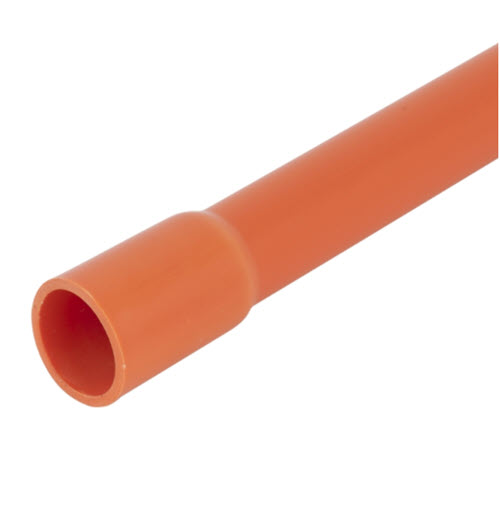
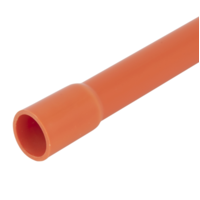
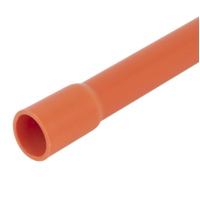
Find the best Heavy Duty Rigid Conduit here at Sparky Direct. [ Read More ]
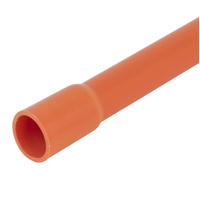
Heavy duty orange conduit is a rigid PVC pipe engineered to shield electrical cables from physical damage. It carries an HD impact rating, meaning the wall thickness and material density resist crushing, hammer strikes, and ground movement. The conduit forms a continuous protective sleeve around insulated conductors, allowing cables to be drawn through during installation and replaced during future maintenance.
The bright orange colour is a coding requirement under Australian electrical standards. Anyone excavating near a buried run can identify the contents at a glance, reducing the risk of accidental strikes. Heavy duty grade is the minimum specification for many underground power applications.
Buried cables face mechanical loads from soil pressure, vehicle traffic, and excavation work. Standard wall conduit cannot reliably handle these forces. Heavy duty orange conduit is rated to withstand the loads typical of trenched residential, commercial, and roadside installations.
The colour is functional, not decorative. Orange tells excavators, civil contractors, and asset locators that an electrical service runs below. This visual cue, combined with underground electrical warning tape laid above the conduit, is a recognised safety practice across Australian sites.
Conduit is graded by its impact and compression resistance. Heavy duty (HD) carries the highest impact rating commonly stocked, designed for direct burial and high-stress environments. Medium duty (MD) suits surface-mounted runs in walls, ceilings, and protected cavities. Light duty grades are restricted to enclosed, low-risk locations.
The wall thickness is the key difference. A 25mm HD conduit has a thicker wall than a 25mm MD conduit at the same nominal size. This adds weight and cost, but it is the trade-off for mechanical protection in the ground.
Conduit does more than prevent immediate damage. It separates the cable from soil chemistry, moisture cycling, and root intrusion. It allows cables to be replaced or upgraded without re-trenching. It provides a defined route that locator services can trace decades after the original install.
For infrastructure projects, conduit is part of the asset record. Network operators rely on accurate conduit routing to plan future works and avoid service strikes during excavation.
Rigid PVC dominates the Australian market for heavy duty orange applications. PVC offers a strong balance of impact resistance, chemical stability, low cost, and ease of installation. It cuts cleanly with a PVC pipe cutter and joins with solvent cement to form watertight, mechanically sound connections.
The Sparky Direct rigid conduits range covers the heavy duty grades trade buyers need for direct burial work, alongside medium duty grey for surface installs.
HDPE (high-density polyethylene) conduit is used on larger civil projects where flexibility and continuous lengths are advantages. HDPE comes in long coils, reducing the number of joints in a buried run. It tolerates ground movement better than rigid PVC and is favoured for highway, rail, and utility corridors.
For most residential and light commercial work, rigid PVC heavy duty remains the standard choice. HDPE selection is usually driven by the network operator specification or civil engineer's design.
Flexible conduit handles route changes without cutting, fitting, and gluing every bend. Orange corrugated conduit serves where the route bends, dips around obstacles, or needs to accommodate later movement. It is typically used for short underground sections or transitions in and out of buildings.
Rigid conduit is mechanically stronger and easier to pull cables through. The choice between rigid and flexible often comes down to the specific section of the run rather than the whole project. Many installations use both: rigid for the long straight runs, flexible for transitions and short bends.
PVC is rigid, predictable, and inexpensive. HDPE is flexible, tougher in cold conditions, and supplied in long coils. Steel conduit (used in heavy industrial and hazardous areas) gives the highest mechanical protection but costs more and adds installation complexity.
For 90% of orange conduit applications in Australia, rigid PVC heavy duty is the right call. It meets the standards, is widely stocked, and integrates cleanly with the available range of conduit fittings.
The standard heavy duty orange conduit sizes are 20mm, 25mm, 32mm, 40mm, 50mm, 63mm, and larger for sub-mains and primary distribution. Each size refers to the nominal outside diameter. The internal cable capacity steps up significantly between sizes, so correct sizing avoids costly re-runs.
For a typical residential sub-main or sub-circuit, 25mm covers most domestic cable runs. 32mm is common for larger sub-mains and consumer mains. 50mm and above are reserved for switchboard feeds, three-phase mains, and bundled multi-circuit runs.
Cable capacity is governed by AS/NZS 3000 fill ratios, which limit how much of the internal cross-section the cables may occupy. The fill ratio prevents heat build-up and allows the cables to be pulled through without damage. A conduit packed too tightly can damage insulation during installation and reduce current-carrying capacity in service.
Always plan for one or two spare draws. Additional cables added years after installation are far cheaper to pull through existing conduit than to trench again.
Internal diameter determines how easily cables can be drawn through. Heavy duty conduit has a slightly smaller internal bore than medium duty at the same nominal size, because the wall is thicker. This becomes important on long runs with bends, where pulling tension can rise quickly.
Good practice: limit total bend angle between draw points to around 270 degrees, and use sweep bends rather than tight elbows wherever the cable size allows.
Stepping up one conduit size beyond the calculated minimum is cheap insurance. The marginal material cost is small compared to the cost of trenching again to add a future cable. For underground runs to outbuildings, garages, sheds, and EV chargers, oversizing pays for itself the first time the property changes use.
Site conditions drive the conduit specification. Reactive clay soils, rocky ground, and high water tables push the choice toward HD grade with sealed joints. Stable, sandy ground may permit medium duty in surface or shallow runs, but anything below grade in a traffic zone needs heavy duty.
Underground use requires HD grade by default. Surface-mounted runs can use medium duty grey, but the orange identifier remains specific to electrical buried services. Mixing grades in a single run is fine where the route transitions from below ground to above, provided each section meets the standard for its location.
Driveways, car parks, road crossings, and machinery yards all impose dynamic loads on buried services. Specify HD grade and increase burial depth in these locations. Concrete encasement is sometimes required for road crossings or where the network operator mandates it.
The most common use is residential and commercial sub-main runs from the meter board to outbuildings, pumps, gates, and lighting. Heavy duty orange specifically marks these as electrical, separating them from communications conduits which are colour-coded differently.
Civil projects use heavy duty orange under road crossings, in median strips, and beside footpaths. Network operator specifications usually mandate the grade, depth, bedding, and warning tape requirements. Conduit installed under roads is often duplicated with spare draws to avoid future road closures.
Factory yards, warehouse perimeters, and industrial estates rely on heavy duty conduit to feed external lighting, security, switchboards, and process equipment. The mechanical loads from forklifts, trucks, and material handling make HD grade the only sensible choice.
Utility connections, NBN provisioning, and street lighting circuits all use heavy duty buried conduit. The conduit is often installed during civil works and left empty until the cable contractor arrives, so the conduit must hold its shape and seal long-term against silt and water.
The trench must be deep enough to clear traffic loads and meet AS/NZS 3000 minimum burial depths. Bedding is typically a layer of clean sand or fine soil under and around the conduit, protecting it from sharp rocks. Backfill is compacted in layers to prevent later settlement.
A marker tape is laid in the trench above the conduit, typically 150mm to 300mm above the conduit. This warns future excavators before they reach the cable.
Joints are made with solvent cement and matched conduit couplings. The technique is straightforward: clean both surfaces, apply conduit glue evenly, push together with a quarter turn, and hold for a few seconds. A correctly made solvent weld is mechanically as strong as the conduit itself.
The conduit is most vulnerable between delivery and backfill. UV exposure, mechanical impact from plant and equipment, and contamination from site debris all degrade joint integrity. Stage deliveries to match install progress, cap open ends to keep silt out, and inspect for damage before backfilling.
Use sweep bends for long-radius turns and solid elbows only where space forces a tight corner. Bending springs let installers form smooth bends in straight lengths without flattening the conduit. Sharp bends restrict cable pulling and concentrate stress at one point.
Heavy duty orange conduit installations are governed by AS/NZS 3000:2018 (the Wiring Rules) for the electrical aspects, and AS/NZS 2053 for the conduit material and impact ratings. Civil aspects, such as trench design near roads or services, may also fall under local council and network operator specifications.
Minimum burial depths vary with location. Domestic land, driveways, road crossings, and farmland each have their own minimums in AS/NZS 3000. Marker tape is required above buried services to warn excavators. Spacing from gas, water, and communications services is also specified.
Network operators (Energex, Ergon, Essential Energy, AusNet, Western Power, and others) publish their own specifications for service mains and connections within their territory. These often add to the AS/NZS minimums, requiring specific conduit sizes, additional marker tape, or pit configurations at the connection point. Always check the operator specification before ordering for a connection job.
Electrical work in Australia must be carried out by a licensed electrician. The conduit can be supplied to homeowners and trades, but the cable installation, terminations, and connection to the supply require an Electrical Contractors Licence. Sparky Direct supplies trade buyers and homeowners alike, with the understanding that final electrical connections are licensed work.
The single largest cause of cable failure on buried services is mechanical damage during later excavation. Heavy duty conduit, combined with marker tape and accurate as-built records, is the primary defence. A correctly installed conduit run takes a hit from a backhoe or post-hole digger and deflects the impact away from the cable.
Bright orange visual identification reduces the chance of a strike during future works. Asset locators can trace conduit using ground-radar or tracer wires, but the colour itself is the first warning when a trench gets close.
A well-installed conduit run lets electricians replace, upgrade, or add cables without disturbing the surface. This is valuable for solar additions, EV charger installs, and building extensions, where the original cable rating may need to step up. Pull cords left in unused conduit speed up later draws.
The labour cost of trenching, backfilling, and reinstating surfaces dwarfs the material cost of the conduit itself. Spending a little more on heavy duty grade and oversizing the bore protects the larger investment in civil works.
| Characteristic | Heavy Duty (Orange) | Medium Duty (Grey) |
|---|---|---|
| Wall thickness | Thicker, higher impact rating | Thinner, standard impact |
| Typical use | Underground, traffic, civil | Surface mount, cavity, ceiling |
| Burial | Direct burial approved | Not generally rated for buried |
| Cost per metre | Higher | Lower |
| Internal bore | Slightly smaller at same OD | Slightly larger at same OD |
Use medium duty grey for runs inside buildings, in walls, ceilings, and protected ducts. Use heavy duty orange anywhere the conduit is buried, exposed to traffic, or running through a high-risk environment. The grey medium duty rigid conduit range covers the surface and cavity applications.
Heavy duty costs roughly 30% to 50% more per metre than medium duty in the common sizes. For a typical residential underground run, the price gap is small in absolute dollars and is outweighed by the cost and disruption of a failure. For long civil runs, the price gap becomes meaningful, and engineers specify HD only where the loads require it.
Heavy duty is the default for any buried electrical conduit in Australia. It is required for direct burial in trafficked areas, for road crossings, and wherever the network operator or AS/NZS 3000 calls for HD impact rating. If in doubt, specify HD: the additional cost is small, and the consequences of underspecifying are large.
Top installation mistakes seen in the field: burial too shallow for the loads above, no marker tape laid in the trench, joints made without solvent cement, and undersized conduit for the cable bundle. Each of these creates a future problem that is far more expensive to fix than to prevent.
Burial depth in AS/NZS 3000 is the minimum, not a target. Driveways, vehicle access, and machinery yards demand deeper burial than the bare minimum. Shallow burial that just clears the standard often fails under repeated traffic loads.
A push-fit joint without solvent cement is not a sealed joint. Water, silt, and roots find their way in over time, contaminating the cable and potentially causing flashover at terminations. Always use the matched coupling, the correct solvent, and the manufacturer's set time.
Medium duty conduit buried under a driveway will eventually crack. The repair cost is the trench, the conduit, the cable, the surface reinstatement, and the loss of supply during the works. Specifying heavy duty at the outset is the cheap option.
Routes that double back, make excessive bends, or run too close to other services create draw difficulties and increase strike risk. Straight runs with sweep bends and adequate clearances from gas, water, and communications are the goal. Keep the route documented for future reference.
Heavy duty orange conduit is sold in 4-metre lengths in most sizes, with bulk and trade pricing available on full-bundle quantities. Prices vary with the PVC raw material market, but trade buyers can usually source competitive rates online. Sparky Direct lists current pricing on the heavy duty orange conduit page, with no-account, no-minimum buying.
Project quantities of 20+ lengths usually attract bundle pricing. For larger civil jobs, freight becomes a factor: the conduit is light but bulky. Plan deliveries to match site progress so unused stock is not exposed to UV and mechanical damage on site.
Some imported conduit fails to meet AS/NZS 2053 impact ratings even though it is sold as heavy duty. Always check the conduit is marked with the standard reference and the manufacturer's identification. Compliant product is the only product that should go in a trade installation. The price difference between a compliant and a non-compliant conduit is small; the risk of failure and liability is large.
Traditional electrical wholesalers stock the well-known brands but often gate access behind trade accounts and minimum orders. Online wholesalers like Sparky Direct supply licensed trades and homeowners on the same terms, with transparent pricing and Australia-wide delivery. The competitive pressure has narrowed the price gap considerably in recent years.
Lead times matter on jobs running to a programme. Heavy duty orange conduit and the related electrical accessories are stocked in Australia and dispatched daily. For metropolitan addresses, next-day or two-day delivery is the norm; regional and remote areas usually receive within a week.
Start with the cable schedule. Calculate the total cable cross-sectional area, apply the AS/NZS 3000 fill ratio, and select the smallest standard conduit size that satisfies both. Then step up one size for spare capacity. Confirm the grade matches the install location: heavy duty for buried, medium duty for surface.
A good rule of thumb: order 10% more conduit than the measured run, plus a generous count of couplings, bends, and conduit saddles. Add PVC conduit glue, marker tape, and pull cord for the run. Plan junction box positions and order matched conduit junction boxes.
Sparky Direct supplies heavy duty orange conduit, the full conduit fittings range, and the matching orange circular cables for direct burial work. Trade buyers and homeowners can order without account setup or minimum order, with Australia-wide dispatch from Australian stock.
Club Clipsal is Australia's largest electrician community offering trade rewards, business support, and exclusive benefits. When you nominate Sparky Direct as your preferred wholesaler, we automatically apply your Clipsal spend points to your Club Clipsal account daily.
Entry-level offering coaching, mentoring, and training discounts
Unlock exclusive industry tools and networking events
Access Toyota fleet offers and business software discounts
Maximum benefits, including VIP experiences and rewards
1. Sign Up: Create your Club Clipsal account at clipsal.com/club-clipsal or via the iCat mobile app
2. Nominate Sparky Direct: Select Sparky Direct from the wholesaler dropdown menu in your profile
3. Add Email: Enter your Sparky Direct account email address in the membership number field
4. Start Earning: Every dollar spent on Clipsal products earns points automatically
Redeem points from the rewards store, including gift cards, tools, and experiences. Access business summits, product training, and industry networking events. Receive early access to new product launches and special promotions. Connect with fellow electricians via the Club Clipsal community app.
Watch Heavy Duty Orange Rigid Conduit video
Watch Orange Conduit Installation video
Watch Underground Conduit Sweep Bends video

I couldn't believe the difference in savings on both products compared to the prices from the biggest electrical products supplier that I had using. I'll keep using Sparkie Direct without hesitation.
Needed some single entry 20mm Junction boxes for a renovation wiring project. Not use to buying small amounts of electrical fittings ?? Sparky Direct made it easier & simpler, at a competitive cost. Good price, and a varied range of fittings via a prompt post made it easier to finish my project.
This is a very compact tee and great if space is limited and looks so much better than the bulk inspection tees. Wires are easy to pass through the branch section, however consideration must be given to wire qty and sizing along with the number of through wires due to the minimal area for the radial turn of the branch wire. This tee was perfect for my job and I had no problem using it at all.
Quality products in stock • Fast Australia-wide delivery • Competitive trade pricing
Browse Heavy Duty Orange Conduit → Get Expert Advice →Yes, it provides straight, professional-looking conduit runs.
Sparky Direct supplies heavy duty rigid conduit, offering durable orange PVC conduit solutions.
No, heavy-duty condiut is a pick-up only item.
Unused products are generally eligible for return according to the seller’s returns policy.
Warranty coverage varies by manufacturer and typically covers defects in materials or workmanship.
Yes, heavy-duty rigid conduit is typically sold in standard 4-meter straight lengths.
Yes, choosing the correct duty rating ensures protection, compliance, and durability.
Once installed correctly, it generally requires no maintenance.
Yes, it is often used when upgrading or reinforcing existing wiring systems.
It may be concealed in concrete or visible in surface-mounted installations.
Yes, it can be surface-mounted where extra protection is required.
Yes, it is designed for long service life in demanding conditions.
It is stronger but still manageable for trained professionals using standard tools.
Heavy duty rigid conduit is a strong electrical conduit designed to provide high mechanical protection for electrical cables.
Yes, it is a standard choice for in-slab and heavy-duty electrical work.
It offers maximum protection for cables in high-risk or high-impact areas.
Yes, it is widely used in commercial and light industrial electrical installations.
Yes, it is typically manufactured from durable PVC designed for demanding environments.
They are available in 20mm, 25mm, 32mm, 40mm, and 50mm sizes.
Yes, when appropriately rated, it is suitable for outdoor and underground applications.
Yes, orange heavy duty rigid conduit is commonly used for in-slab electrical installations.
It provides high resistance to impact, compression, and environmental stress.
Quality heavy duty rigid conduit is manufactured to meet relevant AS/NZS electrical and safety standards when installed correctly.
It is commonly used in concrete slabs, underground runs, car parks, and industrial or commercial installations.
Orange rigid conduit is commonly used to identify heavy duty conduit, often suitable for in-slab or high-impact applications.