
Search Results:
Search Results:
Search Results:
Search Results:
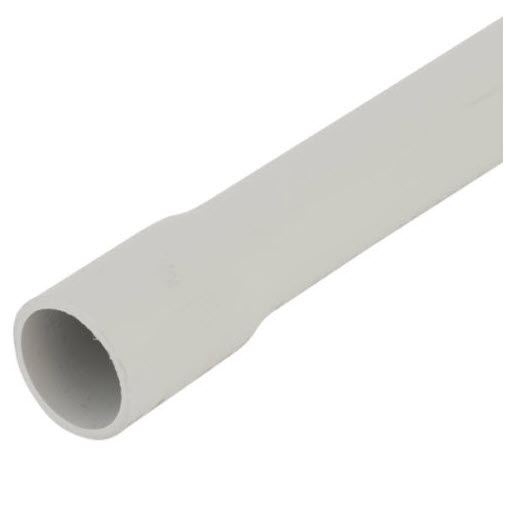
Find the best Medium Duty Rigid Conduit here at Sparky Direct. [ Read More ]
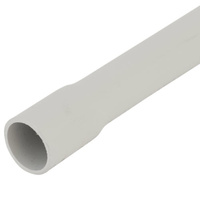
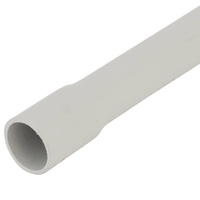
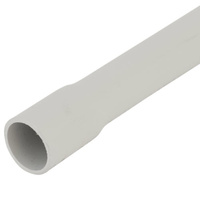
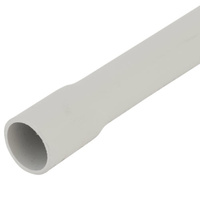
Medium duty rigid conduit is a straight, hollow PVC tube manufactured to protect electrical wiring. Cables are pulled through the conduit during installation, then secured at each end with fittings. The plastic wall provides mechanical protection, electrical insulation, and a defined cable pathway through walls, ceilings, and structural elements.
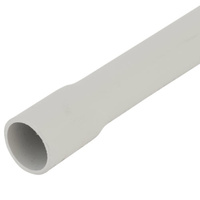
Australian medium duty rigid conduit is grey, supplied in 4-metre lengths, and joined using solvent cement and PVC fittings. It runs in straight lines and uses purpose-made bends and elbows to change direction. The system protects conductors from impact, abrasion, rodents, and minor environmental exposure.
The three classifications relate to mechanical strength under AS/NZS 2053.2. Light duty has the lowest impact and compression resistance and suits low-risk concealed work. Medium duty handles general wiring in walls, ceilings, and surface applications. Heavy duty (orange) is rated for direct burial, slab embedment, and any installation exposed to mechanical risk.
Medium duty rigid conduit is the default choice for above-ground concealed wiring in Australian construction. It balances mechanical performance, ease of installation, and cost. Most domestic and commercial fit-outs specify medium duty grey for cable runs in stud walls, ceiling spaces, and risers.
The conduit isolates cables from contact with timber framing, steel studs, plumbing, and adjacent services. It also forms part of the wiring system's compliance to AS/NZS 3000:2018, which references conduit selection as one method of meeting mechanical protection requirements for fixed wiring. Conduit saddles and PVC clip saddles hold the conduit in place at the spacings called up in the standard.
AS/NZS 2053.2 is the product standard for rigid conduit. It defines mechanical classifications, dimensional tolerances, marking requirements, and performance tests. Medium duty conduit must be marked with its classification and the standard reference. Compliant product carries the regulatory marking on every length.
Medium duty conduit is rated for medium compression and medium impact resistance. The classification numbers are stamped on the product. This rating governs where the conduit can be installed and what loads it is approved to handle.
AS/NZS 2053 testing covers compression (a vertical load applied to a measured length), impact (a falling weight at a controlled temperature), and flame retardancy. PVC medium duty conduit is self-extinguishing, which limits flame propagation through wall cavities and ceiling spaces.
AS/NZS 3000:2018 (the Wiring Rules) requires fixed wiring to be mechanically protected. Conduit is one of the recognised methods. Where medium duty is specified, it must be installed in environments matching its classification, supported at the required spacings, and joined with compliant fittings. Substituting an incorrectly classified conduit is a non-compliance.
Product standard: AS/NZS 2053.2. Installation reference: AS/NZS 3000:2018. Mechanical class: Medium. Use only conduit and fittings carrying valid AS/NZS markings. Sparky Direct stocks only certified product.
Standard grey PVC is the dominant material in Australia. It is rigid, lightweight, and easily cut with a hacksaw or rotary cutter. Grey conduit is identified visually by colour and mechanically by the printed classification along the length.
Standard grey medium duty PVC is not UV-rated. For external surface runs, electricians select either UV-stabilised conduit or a duct cover system. Where medium duty is used outdoors, it must be shielded from direct sunlight by cladding, lagging, or a covering board.
PVC is a non-conductive thermoplastic with high dielectric strength. The rigid form holds shape under loads encountered in walls and ceilings. PVC also resists most common building chemicals, including plaster, mortar, and timber treatment fluids.
Medium duty PVC handles a temperature range typical of Australian building interiors and protected exterior locations. Sustained ultraviolet exposure causes embrittlement. High ambient temperatures (such as uninsulated metal roof spaces in summer) can also reduce service life. For severe environments, heavy duty or metal alternatives apply.
Medium duty rigid conduit is supplied in nominal outside diameters from 16mm up to 63mm. The sizes follow the metric series defined in AS/NZS 2053. Each size has a defined wall thickness for the mechanical class and matching conduit couplings for joining lengths.
The three workhorse sizes are 20mm, 25mm, and 32mm. 20mm covers single power and lighting circuits in domestic work. 25mm is the standard for sub-mains and multi-circuit runs in commercial fit-outs. 32mm handles larger sub-mains and grouped cabling. Larger sizes (40mm, 50mm, 63mm) are used for main feeders and dense cable trunks.
Cable fill limits in AS/NZS 3000:2018 prevent overheating and pulling damage. The standard expresses fill as a maximum percentage of the conduit's internal cross-sectional area, varying by number and type of conductors. Overfilled conduit reduces current-carrying capacity and increases damage risk during pulls.
Allowing spare capacity is good practice. Future circuits, data cables, or upgrades cost far more if the original conduit is undersized. A common rule of thumb on sub-main runs is to specify one size larger than the current load requires, which adds little to installed cost but creates options later.
| Size | Typical Application | Common Cable Fill |
|---|---|---|
| 20mm | Lighting and GPO circuits, single TPS runs | 1 to 2 cables (residential) |
| 25mm | Sub-mains, multi-circuit groupings, data | 2 to 4 cables (commercial) |
| 32mm | Larger sub-mains, grouped feeds, comms trunks | 3 to 6 cables (commercial / industrial) |
| 40mm to 63mm | Main feeders, riser shafts, distribution | Designed per project specification |
Selection starts with the environment. Concealed wiring in a stud wall, surface wiring in an indoor plant room, and a riser shaft each have different mechanical risks. Medium duty handles the bulk of indoor concealed and protected surface work. Where impact risk rises, the specification moves up to heavy duty.
In residential builds, medium duty is the standard choice for circuits within wall cavities and ceiling spaces. In commercial fit-outs, medium duty also covers most ceiling-void and partition runs, while sub-mains and switchboard feeds frequently move to larger sizes or heavy duty.
Medium duty grey PVC is intended for indoor or protected outdoor use. Direct UV exposure shortens service life. Where conduit must run outside, it should be enclosed, shaded, or upgraded to a UV-stabilised option. Underground runs require heavy duty.
Specifying medium duty for direct burial, slab embedment, or high-impact zones is the most common selection error. Another is undersizing for cable fill, which creates compliance and pulling issues. A third is mixing classifications within one run, which makes the run only as strong as the lowest-rated section.
Medium duty conduit is widely used in new builds and renovations for circuits inside stud walls, between floors, and through ceiling spaces. Saddles and clips secure the conduit at the spacings called up by AS/NZS 3000. Junction boxes provide cable access at outlets and joins, including conduit junction boxes sized to match the conduit run.
In commercial buildings, medium duty conduit feeds lighting circuits, GPOs, and small power above suspended ceilings. The PVC body resists abrasion against ceiling grids and metalwork, and it is light enough to support without heavy bracketry.
Medium duty conduit also serves light industrial settings: workshops, storerooms, and offices within industrial premises. In these locations, surface mounting on saddles is common. Where machinery, forklifts, or stored loads create impact risk, the specification shifts to heavy duty or steel.
PVC conduit also routes structured cabling for data and communications. Communication conduits and rigid communications conduit products are available where dedicated comms infrastructure is required, with bend radii suited to data cable performance.
Medium duty is not approved for direct burial. Underground installations call for heavy duty orange PVC, which carries the higher compression class needed to survive soil loading and ground movement. Shallow burials, slab embedment, and trench-and-fill runs all require heavy duty.
Plant rooms with vehicle access, loading docks, and any zone with significant impact risk fall outside medium duty's classification. In these locations, heavy duty PVC, galvanised steel conduit, or armoured cabling is the correct choice.
Sustained UV exposure, chemical splash, and high-temperature areas (such as uninsulated metal roof voids) shorten medium duty service life. Specialty conduit or alternative cable management methods cover these environments.
The trigger to upgrade is any installation that involves burial, slab embedment, traffic exposure, or external mechanical loading. The Heavy Duty Rigid Conduit range carries the orange identification and the higher mechanical rating required for these conditions.
Heavy duty conduit has thicker walls and a higher compression class than medium duty. It survives soil loading, traffic loading, and slab embedment. Medium duty is engineered for protected indoor and concealed runs, not loaded environments.
Medium duty is cheaper per metre and lighter to handle. On large indoor jobs, this saves both material cost and installation time. Heavy duty costs more and adds weight, which is justified only where mechanical conditions require it.
Selection is driven by the installation environment, not personal preference. Indoor concealed and protected surface work is medium duty. Buried, embedded, or impact-exposed work is heavy duty. The standard does not allow trading one for the other on cost grounds.
Project specifications and AS/NZS 3000 dictate which classification applies. Substituting medium duty where heavy duty is called up creates a non-compliant installation, which carries certification and insurance consequences.
| Property | Medium Duty (Grey) | Heavy Duty (Orange) |
|---|---|---|
| Mechanical class | Medium | Heavy |
| Direct burial | Not approved | Approved |
| Slab embedment | Not approved | Approved |
| Indoor concealed | Standard choice | Acceptable but heavier |
| Wall thickness | Medium | Thicker |
| Cost per metre | Lower | Higher |
Medium duty conduit is supported by saddles fixed to the structure. Spacing is set out in AS/NZS 3000 and depends on conduit size and orientation (horizontal or vertical). Vertical runs typically allow wider spacings than horizontal runs of the same diameter. Saddles should be fitted within 150mm of every fitting and at every change of direction.
Medium duty PVC can be cold-bent in small sizes for gentle direction changes, but most direction changes use factory conduit bends and solid elbows. Heat-bending is possible with proper tools, but factory fittings give a cleaner finish and a consistent radius.
Lengths are joined with PVC couplings and solvent cement. The cement softens the PVC contact surfaces, which fuse as the solvent flashes off. PVC conduit glue must be the correct grade for electrical conduit. The joint should be made within the cement's working time, typically less than a minute.
Cable pulls must respect the fill limits in AS/NZS 3000. Long runs benefit from cable lubricant to reduce friction. Drawing wire is run in advance of cable pulls. Sharp pulls against unsealed conduit ends can damage cable insulation, so all entries should be deburred or fitted with bushes.
Installation note: All conduit and fitting work on fixed wiring in Australia must be performed by, or under the direct supervision of, a licensed electrician. The information here is general guidance only.
Couplings join straight lengths. Bends and elbows manage direction changes. PVC bends come in standard radii (typically 90 degrees) and longer sweep radii for data and communication runs. Sizing must match the conduit nominal diameter exactly.
Adaptors transition from conduit to enclosures, switchboards, and outlet boxes. Junction boxes provide cable access for joins, branches, and terminations. Sparky Direct stocks 20mm conduit junction boxes, 25mm conduit junction boxes, and 32mm conduit junction boxes matched to the common rigid sizes.
Inspection elbows, inspection tees, and access fittings allow cable access after installation. They are used at maintenance points, in long runs, and at terminations where future cable changes are likely.
All fittings, saddles, and accessories must match the conduit's nominal diameter and be approved to AS/NZS 2053. Mixing brands is acceptable provided every component carries the standard's marking. Screwed reducers handle transitions between sizes where a run steps down through a junction.
The primary role of conduit is mechanical protection. PVC walls absorb impacts that would otherwise damage cable insulation. The rigid form also resists crushing under typical wall and ceiling loads.
Sealed conduit with correctly cemented joints provides a barrier against moisture, dust, and small pests. In areas with potential ingress, fittings should be sealed and entries closed off with bushes or grommets.
In typical Australian residential and commercial building interiors, PVC medium duty conduit has a long service life. Properly installed runs commonly outlast multiple cable upgrades because the conduit itself remains serviceable while the cables it carries are replaced.
Conduit maintenance is largely visual. Saddle fixings should be checked, joins inspected for movement, and exposed runs assessed for UV damage or chemical attack. Damaged sections are cut out and replaced with fresh conduit and couplings.
Burying medium duty conduit, embedding it in concrete, or running it through high-impact zones is the most serious error. The conduit is not rated for these loads, and the wiring system fails compliance. The fix is correct specification at the design stage.
Conduit packed beyond AS/NZS 3000 fill limits causes pulling damage and reduced cable current ratings. Sizing should always be checked against actual cable count and fill percentage, not assumed from past projects.
Saddles spaced too far apart allow conduit to sag, especially in horizontal runs. Sag stresses joins, encourages cable bunching, and looks unprofessional. Fix to the spacings in AS/NZS 3000 and tighten supports near every fitting.
Unmarked or undersized fittings, generic plumbing PVC, and uncertified glue all create hidden compliance risks. Every component should carry the AS/NZS 2053 marking. Sparky Direct stocks only certified electrical-grade conduit and fittings.
Pricing varies by size, brand, and order quantity. 20mm and 25mm grey medium duty in 4-metre lengths sit at the most competitive end of the market because volume is high. Larger sizes (32mm and above) carry higher per-metre pricing reflecting raw material content.
Trade buyers ordering by the bundle pay less per length than walk-up retail buyers. Sparky Direct's online wholesaler model passes the bulk-pricing structure on without requiring trade-counter visits. This suits both project supply and ongoing top-up orders.
Bargain conduit with no AS/NZS marking is cheap for a reason. It has not been tested to the product standard, and using it on fixed wiring exposes the installer to liability. The price gap between certified and uncertified product is small. The compliance gap is total.
Online wholesalers typically offer lower headline prices than walk-in trade counters because their cost structure is leaner. The trade-off historically has been availability and delivery time. Modern online suppliers with national stock holdings have largely closed that gap.
For active jobs, delivery time is as important as price. Sparky Direct ships from stock, and the customer feedback in the reviews below highlights consistent same-week dispatch. This matters when a single missing length can hold up a switchboard cut-in.
Confirm the mechanical class against the project specification. Confirm the size against the cable schedule. Confirm the quantity against the run lengths plus a sensible offcut allowance. Order all matching fittings in the same delivery to avoid second-day site delays.
Common errors include ordering the wrong size junction boxes, forgetting solvent cement, and underestimating the number of bends required. Build a fitting count from the drawing, not from memory.
A simple ratio for typical runs is one coupling per joint, two saddles per length, and bends or elbows at every direction change plus one spare. Larger projects benefit from a takeoff list rather than a guess. Sparky Direct's full Rigid Conduits range covers grey medium duty, orange heavy duty, communications, and matching fittings in one supplier.
Sparky Direct supplies medium duty rigid conduit in trade quantities with national delivery. Stocked brands include Clipsal and NLS ranges, both certified to AS/NZS 2053. Account customers get pricing visibility online with ordering at any hour.
Club Clipsal is Australia's largest electrician community offering trade rewards, business support, and exclusive benefits. When you nominate Sparky Direct as your preferred wholesaler, we automatically apply your Clipsal spend points to your Club Clipsal account daily.
Entry-level offering coaching, mentoring, and training discounts
Unlock exclusive industry tools and networking events
Access Toyota fleet offers and business software discounts
Maximum benefits, including VIP experiences and rewards
1. Sign Up: Create your Club Clipsal account at clipsal.com/club-clipsal or via the iCat mobile app
2. Nominate Sparky Direct: Select Sparky Direct from the wholesaler dropdown menu in your profile
3. Add Email: Enter your Sparky Direct account email address in the membership number field
4. Start Earning: Every dollar spent on Clipsal products earns points automatically
Redeem points from the rewards store, including gift cards, tools, and experiences. Access business summits, product training, and industry networking events. Receive early access to new product launches and special promotions. Connect with fellow electricians via the Club Clipsal community app.
Watch NLS 30183 | 20mm PVC Standard Bend 90 Degree | Grey video
Watch NLS 30184 | 25mm PVC Standard Bend 90 Degree | Grey video
Watch NLS 30185 | 32mm PVC Standard 90 degree bend video

Needed some single entry 20mm Junction boxes for a renovation wiring project. Not use to buying small amounts of electrical fittings ?? Sparky Direct made it easier & simpler, at a competitive cost.
Super cheap & shipped and received within days. We need a couple of these to replace some sorely rusted out ones we had out the backyard. Bunnings didn't stock them but Sparky Direct had them in stock
The bend has great strength and quality. I bought quite a few. I'll be using them again for sure.
Quality products in stock • Fast Australia-wide delivery • Competitive trade pricing
Browse Medium Duty Rigid Conduit → Get Expert Advice →Yes, it provides clean, straight conduit runs with a professional finish.
Sparky Direct supplies medium duty rigid conduit, offering durable grey PVC conduit solutions.
No, medium-duty rigid conduit is a pick-up only item.
Unused products are generally eligible for return according to the seller’s returns policy.
Warranty coverage varies by manufacturer and typically covers defects in materials or workmanship.
Yes, it is typically sold in standard 4-meter straight lengths.
Yes, proper planning ensures a neat appearance and compliant installation.
Once installed correctly, it generally requires no maintenance.
Yes, it is commonly used when upgrading or extending existing wiring systems.
It may be visible in surface-mounted installations or concealed in building structures.
It is straightforward for trained professionals to cut, join, and install.
Yes, it helps protect cables from impact, abrasion, and general wear.
Yes, it is often used for surface-mounted wiring applications.
Medium duty rigid conduit is a solid PVC electrical conduit designed to provide moderate mechanical protection for electrical cables.
Yes, it is a standard choice for many general electrical installations.
It offers a good balance between strength, durability, and ease of installation.
Yes, it is commonly used in commercial and light industrial electrical installations.
Yes, it is typically manufactured from durable PVC material.
They are available in sizes such as 20mm, 25mm, 32mm, 40mm, and 50mm.
Yes, when correctly rated and installed, it can be used in outdoor applications.
Yes, it is widely used for indoor electrical installations.
It provides more protection than light duty conduit while remaining suitable for everyday installations.
Quality medium duty rigid conduit is manufactured to meet relevant AS/NZS electrical and safety standards when installed correctly.
It is commonly used for surface-mounted wiring in residential, commercial, and light industrial environments.
Grey PVC is commonly used for general-purpose electrical conduit installations.