
Search Results:
Search Results:
Search Results:
Search Results:
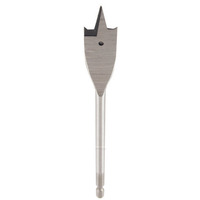
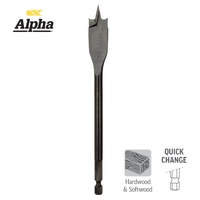
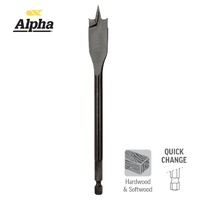
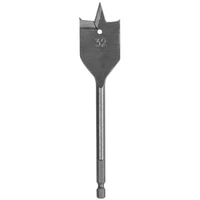
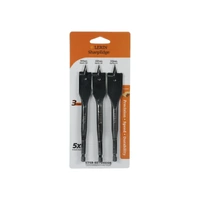
A spade bit is a flat, paddle-shaped wood-boring bit designed to cut large-diameter holes quickly in timber. Tradespeople often call them paddle bits or flat bits, and all three names describe the same tool. The flat steel blade has a central pilot point and two side cutting edges that shave timber as the bit spins.
Spade bits are built for timber, framing, soft plastics, and some light-duty composite materials. They are not suited to masonry, concrete, tile, or general metal drilling. For those jobs, use the right tool for the material: masonry drill bits for brick and concrete, or high speed drill bits for steel.
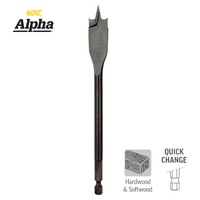
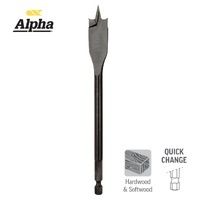
A spade bit has three working parts. The pilot point at the centre keeps the bit on line. The two flat cutting edges sweep through the timber as the bit spins. The wide blade clears chips out of the hole.
Common timber jobs include drilling through wall studs, floor joists, ceiling battens, and furniture panels. The fast cutting action makes spade bits a favourite for rough-in work where speed matters more than a clean visible finish.
The pilot point bites first and locks the bit into position. The flat blade then shears timber away as chips that fly out of the cut. Because the blade is flat rather than helical, chips do not auger themselves clear, so the operator must back off occasionally to clear the hole.
Faster cutting comes at a cost in finish quality. Spade bits leave a rougher hole than auger drill bits or Forstner bits, which is fine for hidden holes inside framing but not ideal for visible cabinetry.
Typical Australian spade bit sizes range from 13mm to 38mm, with specialist sizes up to around 50mm. For electrical rough-in, 20mm and 25mm are the workhorse sizes because they suit common cable bundles and 20mm or 25mm conduit clearances.
Larger 32mm and 38mm bits suit plumbing pipe routes or bundled cable runs through deep timber. Always match the bit size to the conduit, cable, or fitting requirement before drilling. Drilling a hole that is too tight makes the install harder and may breach fitting clearances.
The product mix is broader than many buyers expect. Choosing the right type saves time, reduces blow-out, and gives a longer service life on site.
Standard HSS spade bits are the lowest-cost option and the most common style sold for general timber drilling. They suit rough-in work where speed matters more than visible finish quality. Most entry-level and mid-range bits use high-speed steel construction with a flat blade and a simple pilot point.
Pilot-point and spur-tip bits add two outer spur cutters either side of the main blade. The spurs score the timber fibres before the flat blade lifts them out, which produces cleaner entry and exit holes with less splintering. Pilot points centre the bit accurately so it does not wander on hardwood or engineered timber.
Electricians and builders drilling frequent cable or pipe holes through framing should look at spur-tip bits. They cut faster and cleaner in softwood framing, hardwood studs, and laminated veneer lumber where a clean hole reduces tear-out around the cable route.
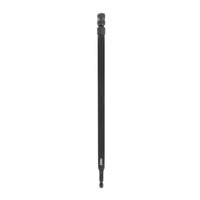
Extended-length spade bits suit deep studs, double-framed walls, thick joists, and tight access. When ordering, check both the overall bit length and the usable cutting depth, because the shank section does not cut. Some extended bits include hex-shank flats that lock into quick-change chucks. A locking extension bar can also reach deep holes without buying a long-shank bit for every size.
Adjustable spade bits use a sliding cutter on a single blade, letting one bit cut a range of hole sizes. They are useful for occasional non-standard holes but are less precise than fixed-diameter bits. Use them for rough structural holes rather than visible joinery.
Carbide-tipped bits have brazed tungsten carbide cutting edges that hold an edge far longer than plain HSS. They last longer in abrasive sheet materials including MDF, particle board, and treated pine, and they tolerate the higher loads of high-volume site use. For trade users drilling hundreds of holes a week, the cost-per-hole on carbide is usually lower than on plain HSS even at a higher up-front price.
Most spade bits on Australian sites are driven by tradespeople working through framing timber. The same bit type covers several disciplines, with size and finish quality changing for each.
Electricians use spade bits to drill through timber studs, top and bottom plates, and joists during rough-in. Common sizes for cable routes and conduit clearances are 20mm and 25mm, with 32mm for bundled cables or larger electrical conduits. Hex-shank spade bits suit impact drivers used on framing crews; round-shank bits suit standard drills with a keyed or keyless chuck.
Holes through structural timber must respect the timber framing requirements set by the building code, including hole size limits and spacing from member edges. Fixed wiring installation work is licensed work in Australia and must be carried out by a licensed electrician. The bit only drills the hole; the licensed work happens around it.
Plumbers use larger spade bits for water lines, drain clearances, pipe sleeves, and service penetrations through timber framing. Confirm pipe outside diameter, insulation thickness, and sleeve requirements before choosing a size. A bit one or two millimetres oversize gives clearance for insulation or a sleeve without wasting timber strength.
Carpenters and renovators use spade bits across studs, noggins, joists, battens, and general construction timber. Renovation work often needs fast, low-cost holes for services rather than furniture-grade finishes, which is exactly where spade bits earn their place.
Spade bits can drill large clearance holes, cable grommet holes, and rough mortises in workshop projects. For visible flat-bottomed holes in cabinetry, a Forstner bit gives a much cleaner result. Spade bits stay on site, Forstner bits stay in the workshop for most users.
Buyers often weigh spade bits against the other large-hole timber options. Each tool has a sweet spot.
Spade bits are cheaper, faster on through-holes, and lighter in the chuck. Auger drill bits have a screw-threaded lead that pulls the bit through the timber and a helical flute that clears chips automatically. Augers cut deeper, cleaner, and with less operator effort, but they cost more and load the drill harder.
Electricians drilling many deep joist holes often prefer augers for the self-feed and chip clearance. For quick stud holes in framing, spade bits remain the cheaper choice.
Hole saws suit larger diameters, sheet materials, and circular cut-outs in plasterboard, metal sheet, or composite panels. Arbor hole saws and hole saw kits typically cover 16mm to 152mm or more. Spade bits work in roughly the 13mm to 50mm range and only on timber and similar materials.
For cable and conduit holes in timber framing, spade bits are faster. For a precise larger diameter or a cleaner plug cut, a hole saw is the better tool.
Forstner bits create cleaner, flatter-bottomed holes for cabinetry, hinge cups, and visible joinery, but they are slower and more expensive per hole. Spade bits are faster, cheaper, and more practical on site for through-holes in framing where the hole is hidden.
Twist bits suit smaller holes and general drilling, including metal work with the right HSS or cobalt grade. Spade bits take over when the timber hole diameter is too large for practical twist-bit use, usually above 13mm. Below that size, twist bits give cleaner results in timber. For metal, use HSS twist bits, step drill bits, or hole saws designed for metal.
Five buying criteria cover almost every spade bit decision. Working through them in order avoids the most common purchase mistakes.
Match the diameter to the finished hole requirement, working from the fitting back to the cable rather than the other way around. Smaller sizes around 16mm handle single cable clearances, the 20mm and 25mm sizes cover most electrical rough-in, and larger 32mm and 38mm bits suit pipe routes, conduit bundles, or service penetrations.
Always check the manufacturer and standard requirements for the conduit, grommet, or fitting that the cable will pass through. The bit needs to match the fitting, not the cable on its own.
Standard spade bits run around 150mm to 160mm in total length. Extended versions reach 300mm or more for double-framed walls, deep joists, and tight-access situations. Check the usable drilling depth, not only the overall length. The shank section at the chuck end does not cut, so a 300mm bit may only have 200mm of effective drilling depth.
Hex shanks lock into impact-driver and quick-change chucks without slipping, which suits fast-paced framing work. Round shanks suit standard three-jaw drill chucks and offer a slightly smoother feed in fine work.
Impact drivers are convenient on site, but they apply rotational shock loads that can shorten bit life and roughen the finish. For deep, clean holes in hardwood, a high-torque drill with a 13mm chuck and a steady speed gives a better result.
Standard HSS spade bits handle softwood framing such as Australian radiata pine, oregon, and most softwood plate timber. For hardwood studs, MDF, particle board, and frequent trade use, spur-tip or carbide-tipped bits last far longer. Australian hardwoods such as spotted gum, blackbutt, and jarrah generate more heat in the bit, so speed should be reduced and the chip clearance should be checked between passes.
Rough-in work can prioritise speed and cost over a clean hole. Visible timber, cabinetry, or furniture needs spur-tip spade bits, Forstner bits, or brad-point bits depending on the result wanted. Choose the finish quality before you choose the bit type.
Safe spade-bit technique reduces injuries, broken bits, and wasted timber. The basics apply across every brand and size.
Lower the RPM as the diameter increases and as the timber gets harder. A small 13mm bit can run fast in softwood pine. A 38mm bit needs much slower revs to keep cutting cleanly without burning. Apply steady pressure and let the cutting edges work. Forcing the bit overloads the motor, generates heat, and dulls the edges.
To prevent blow-out on the exit side, clamp a sacrificial backing board behind the workpiece, or drill until the pilot point just emerges and finish the hole from the other side. Spur-tip bits also reduce splintering at both the entry and exit. For visible work, finish from both sides whenever possible.
Burning is caused by excessive speed, dull cutting edges, too much pressure, or chip build-up packed into the cut. Back the bit out to clear chips, drop the RPM, and check the cutting edges. If burn marks return after sharpening, the bit material may not suit that timber, and a spur-tip or carbide-tipped bit is the better choice.
Clamp loose timber before drilling so the workpiece cannot grab the bit and spin. Keep hands clear of the exit side; large bits can break through suddenly and the pilot point exits first. When drilling into installed walls, floors, or ceilings, check for hidden services with a stud and cable detector before any hole goes in. Fixed electrical work behind the wall must be done by a licensed electrician. Wear eye protection and use dust extraction for overhead or repetitive drilling. Browse electrical tools and PPE for site supply options.
Standard cordless drills handle most spade bits up to about 25mm in softwood. High-torque cordless drills, corded drills, and right-angle drills are the better choice for 32mm and larger bits, deep holes, and hardwood. Large-diameter spade bits can bind and produce sudden kickback if the drill is underpowered or the workpiece moves. A 13mm chuck and a side handle are worth using on bigger sizes.
A well-maintained spade bit cuts faster, burns less, and lasts longer between replacements. The work takes only a few minutes per bit.
HSS spade bits can be sharpened with a fine flat file or a bench grinder. Restore both main cutting edges to their original angle and dress the outer spurs if the bit has them. Keep the symmetry between the two cutting edges so the bit does not pull to one side. Carbide-tipped bits need diamond tooling or professional sharpening because standard abrasives will not cut the carbide cleanly.
Replace a spade bit when it shows burning, squealing, slow cutting, ragged holes, rounded spurs, chipped carbide, or blue heat marks on the cutting edges. A dull bit increases heat, drill load, and timber damage, and the cost of a replacement is usually less than the time lost fighting a worn bit on site.
Store bits in a case, roll, or rack rather than loose in a tool bag where the edges knock together. Wipe each bit down after use, especially after cutting treated timber, wet timber, or dusty site work. A light wipe of corrosion-inhibitor or machine oil before storage prevents rust on the cutting edges and the shank.
Buying spade bits online suits trade users who know the size, shank, and brand they want and value fast dispatch over walking a hardware aisle.
Confirm the diameter, length, shank type, and bit material. Decide whether you need a standard bit, a spur-tip bit, an extended-length version, or a carbide-tipped option. For sets, check the size range and the case quality. Sets are good value for broad coverage; individual bits are better for replacing the sizes you use most often, usually 20mm and 25mm.
Sets suit electricians, renovators, and builders who need multiple common sizes ready in one box. A typical eight-piece set covers 6mm to 32mm, which handles most rough-in jobs without buying bits separately. Individual bits are better for replacing high-wear sizes such as 20mm, 25mm, and 32mm without paying for the smaller sizes you already own. Contractors running several crews often standardise on one set per kit so consumables and replacements stay consistent across the team.
Online electrical wholesalers like Sparky Direct typically carry deeper trade-focused ranges than general hardware stores, with clearer price transparency and faster dispatch on stocked items. Hardware stores suit walk-in same-day pickup, and trade counters suit account customers buying in bulk. The choice usually depends on how soon the job needs the bit and how often you need to top up consumables.
For Brisbane-based electricians and contractors, fast shipping from local stock makes the difference between a job that finishes today and one that drags into tomorrow. Check stock status, dispatch cut-off times, and delivery options when an urgent job is on. Sparky Direct dispatches Australia-wide from Australian stock, with trade-friendly ordering that does not require an account application before the first purchase.
Spade bit choice changes with who is using it and what they drill. The categories below cover the common buying profiles.
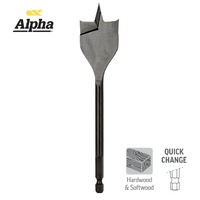
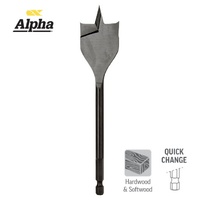
Electricians benefit from durable 20mm and 25mm bits in a hex-shank, spur-tip configuration for fast site work and clean cable holes. Extended-length options handle deep joist and double-stud work. Brands such as Alpha and Major Tech stock trade-focused spade bits in the sizes electricians use most.
Builders and contractors drilling repeated framing holes get the best cost-per-hole from robust sets, carbide-tipped options, and bulk replacement sizes. Look for sets with a hard case, locking bar compatibility, and a clear range of common sizes. Reliable stock availability matters as much as the bit itself when a crew is on the clock.
Renovators drilling occasional holes in softwood, shelving, and basic timber projects can stick with affordable HSS sets. Step up to spur-tip or carbide-tipped bits when the project moves to hardwood, MDF, or visible joinery where finish quality matters. Klein Tools offers a strong mid-range option for renovators who want better quality without trade-volume pricing.
Hardwood drilling exposes the weakness of cheap spade bits quickly. Premium spur-tip or carbide-tipped bits, lower RPM, and controlled feed pressure are the right combination for spotted gum, blackbutt, jarrah, and other dense Australian hardwoods. Bordo and AUSTSAW supply Australian-market cutting tools sized for local timber types.
Watch Spade Bit Set TS08-SET8 | Sheffield 8 Piece Alpha Spade Bit with Extension Bar - TurboBORE video
Watch 25mm Spade Bit - TurboBore | Faster Cleaner Hole | TS08-25 video
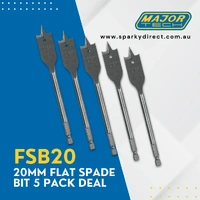
Watch Major Tech FSB20 | 20mm Flat Spade Bit video

Very high quality drill bit, slices through plaster board like a hot knife through butter.
They work well. The thread lock system doesn’t come lose easily, so not losing them down the wall any time soon. More worried about the drill Chuck coming loose.
Great product. Works well in tight spaces. Doesn’t feel like they will fall apart when locked in
Trade-grade sizes in stock • Fast Australia-wide delivery • Competitive trade pricing
Browse Spade Drill Bits → Get Expert Advice →