
Search Results:
Search Results:
Search Results:
Search Results:
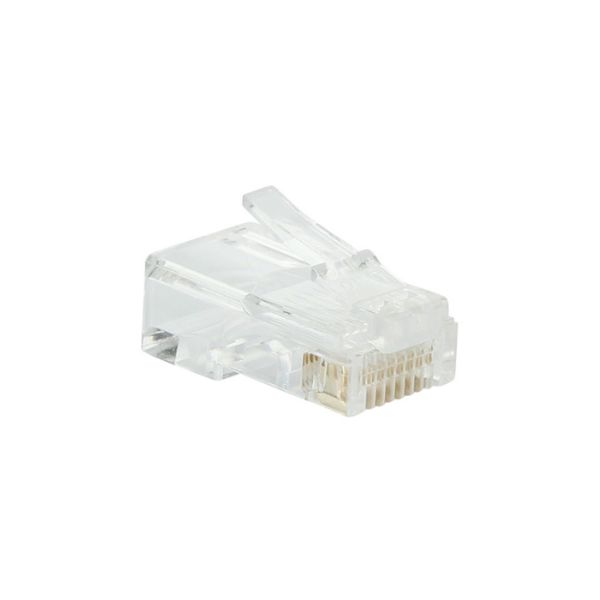
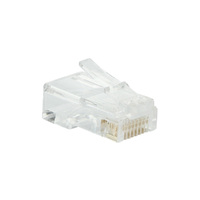
An RJ connector consists of a transparent plastic plug body with a row of metal contacts and a flexible locking tab on top. The plug mates with a matching jack housing in a wall outlet, patch panel, or network device. When the plug is pushed home, the locking tab clicks into a recess on the jack and holds the contacts firmly against the jack's mating pins.
The system uses Insulation Displacement Contacts (IDC). When the plug is crimped, sharp metal blades pierce each conductor's insulation and bite into the copper core. This creates a gas-tight electrical connection without stripping the wire ends individually. Pin numbering runs left to right when viewed from the contact side with the locking tab facing down.
Each pin in the plug aligns with a matching pin in the jack. The spring-loaded jack contacts press against the gold-plated plug pins when mated, completing the circuit for each pair of conductors. The contact pressure remains stable across thousands of insertion cycles, provided the connector is properly rated for the application.
RJ connectors carry low-voltage signal currents, typically under 0.5 amps for Ethernet PoE and a few milliamps for analogue voice. Power connectors handle higher current loads and use much larger contact areas. Never use an RJ connector on a circuit where mains voltage could be present, since the contact spacing is not rated for it.
RJ connectors are the universal interface between cabling and active equipment. Without standardised plugs and jacks, every device manufacturer would use proprietary connections, and structured cabling would not exist. The modular design lets installers terminate field-prepared cables to a known geometry that fits any compliant socket worldwide.
The 8P8C body used for RJ45 and the 6P6C body used for RJ11, RJ12, and RJ25 are defined by clear physical dimensions. This means a Cat 6 patch lead made in Sydney plugs into a router made in Taiwan with no compatibility issues. The same standardisation applies to telephone handsets and ADSL filters.
Modern Ethernet runs at frequencies up to 2,000 MHz on Cat 8 cabling. At those frequencies, even small impedance mismatches cause reflected signals and packet loss. Quality RJ connectors maintain consistent 100-ohm characteristic impedance through the contact zone, preserving the signal integrity needed for gigabit and multi-gigabit links.
In Australia, fixed cabling that connects to the public telecommunications network must comply with AS/CA S008 and the ACMA Cabling Provider Rules. Only licensed cabling providers can install or alter customer cabling that connects to a carrier network. Following Electrical Cables standards and using compliant connectors keeps installations on the right side of the regulations.
RJ stands for Registered Jack, a numbering system originally created by the US Bell System. Each number defines a specific physical body and pin configuration. Most variants share the same plastic shell but use different pin counts and wiring schemes for different applications.
RJ11 is the small connector found on every analogue telephone and most ADSL filters. It uses a 6-position body but only the centre two pins (3 and 4) carry the active line for a single-line phone. RJ11 plugs fit into RJ12 and RJ14 jacks because they share the same body width.
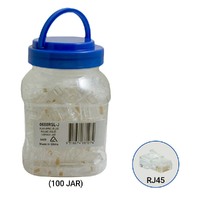
RJ45 is technically a misnomer. The original RJ45 was a single-line voice connector with a programming resistor. The 8P8C plug used for Ethernet is what most people call RJ45 today. The eight contacts carry four twisted pairs at high frequency, which is why pair geometry matters so much during termination.
RJ48 looks identical to RJ45 but uses pins 1, 2, 4, and 5 for the transmit and receive pairs in a T1 circuit. The body is often keyed so it cannot be plugged into standard Ethernet equipment. RJ48 is mostly found in carrier exchange rooms and enterprise WAN demarcation points.
Not every RJ45 connector is created equal. The plug must be rated for the cable category it terminates, otherwise the link will fail certification. The pin contacts, plastic body geometry, and load bar all affect how well the connector preserves the signal coming off the cable.
| Cable Category | Bandwidth | Max Data Rate | Typical Application |
|---|---|---|---|
| Cat 5e | 100 MHz | 1 Gbps | Residential and light commercial |
| Cat 6 | 250 MHz | 10 Gbps (up to 55m) | General office cabling |
| Cat 6A | 500 MHz | 10 Gbps (full 100m) | Data centres, enterprise |
| Cat 8 | 2,000 MHz | 40 Gbps (up to 30m) | Top-of-rack data centre links |
A Cat 6A connector terminated on Cat 5e cable still gives you Cat 5e performance, since the link is only as good as its weakest component. Always match the connector category to the cable category. Ethernet Wall Sockets are sold by category for this reason.
Unshielded Twisted Pair (UTP) connectors rely on the cable's own pair twist to reject noise. Shielded Twisted Pair (STP) connectors include a metal shroud that bonds to the cable's foil or braid screen and to the equipment chassis. Use shielded connectors in industrial environments with high electromagnetic interference, or for Cat 6A and Cat 8 runs near power cables.
PoE+ pushes up to 30 watts down the same four pairs that carry data. PoE++ (Type 4) raises this to 90 watts. Plated contacts are essential at higher PoE levels because arcing during disconnection can pit unplated contacts and cause eventual signal loss.
RJ connectors compete with several other termination methods in modern installations. Each has strengths and weaknesses, but the modular plug system has become dominant for low-voltage data work because of its speed and field repairability.
Terminal blocks like the Screw Connectors range hold conductors mechanically with a screw. They handle higher currents and larger conductor sizes than RJ plugs. However, they are slower to terminate and cannot maintain controlled impedance for high-speed data, which makes them unsuitable for Ethernet.
Industrial bus systems sometimes use proprietary M12 or D-sub connectors for ruggedness and IP67 sealing. RJ45 has caught up with the introduction of industrial Ethernet variants and sealed boots. For most office and residential work, the standard 8P8C plug is far cheaper and easier to source.
Modular plugs are field-terminable with a single tool. Replacement is fast: cut the cable, strip, crimp, and re-test. The plug body is small, so high-density patch panels can fit 48 ports in 1U of rack space. Worldwide standardisation also means parts from any compliant manufacturer interoperate.
Two wiring standards govern how the four pairs in an Ethernet cable connect to the eight pins in an RJ45 plug. Both deliver identical electrical performance, but mixing them on opposite ends of a single cable creates a crossover instead of a straight-through link.
T568A and T568B differ only in the position of the orange and green pairs. T568B is the more common standard in Australia and the United States, while T568A is sometimes specified for residential work and government installations. The choice does not affect performance, only consistency.
| Pin | T568A | T568B | Pair |
|---|---|---|---|
| 1 | White / Green | White / Orange | 3 / 2 |
| 2 | Green | Orange | 3 / 2 |
| 3 | White / Orange | White / Green | 2 / 3 |
| 4 | Blue | Blue | 1 |
| 5 | White / Blue | White / Blue | 1 |
| 6 | Orange | Green | 2 / 3 |
| 7 | White / Brown | White / Brown | 4 |
| 8 | Brown | Brown | 4 |
A straight-through cable uses the same standard at both ends. Almost every modern Ethernet device supports Auto MDI-X, which means crossover cables are rarely needed for new equipment. Older switches and routers occasionally still need a crossover to interconnect, so it pays to keep one labelled in the toolkit.
Pick one standard for the whole site and stick to it. Mixed termination causes hours of fault-finding when a future installer assumes one standard and finds the other. Document the chosen standard in the comms cabinet so the next person on site knows which scheme to follow.
Three questions answer almost every connector selection problem: what cable category is being terminated, what is the application, and what environment will the connector live in. Get those right and the rest follows.
For analogue voice or ADSL, an RJ11 plug is correct. For any Ethernet application, an RJ45 8P8C plug is the only correct choice. For multi-line PABX work, RJ12 or RJ14 may be specified. Check the equipment manual if there is any doubt about which body style is needed.
Connectors are sold by cable category. A Cat 6 connector will physically fit Cat 5e cable, but the link should be re-rated to Cat 5e. Shielded connectors only work properly with shielded cable, since the shield must be bonded to the connector's metal shroud.
For outdoor or industrial use, look for sealed boots, weatherproof shrouds, or IP-rated industrial RJ45 housings. For high-density patching, choose connectors with strain relief built in to reduce cable damage at the connector body. The Data Cabinets range covers most enclosure needs.
RJ connectors are everywhere data and voice signals travel over copper. The same modular plug terminates a home Wi-Fi router, a hospital nurse-call system, a factory PLC, and a stadium security camera feed.
Home networks and small office cabling almost always use RJ45 wall sockets feeding back to a central comms cabinet. Telephones still terminate on RJ11 outlets in many older buildings, although fibre rollouts and VoIP have reduced the need for legacy phone wiring.
Enterprise patching uses Cat 6A or Cat 8 connectors mounted in keystone patch panels. Patch leads with moulded boots protect the locking tab from snagging during high-density rack work. Colour-coded connectors help with VLAN identification on busy patch frames.
Factory floor Ethernet uses ruggedised RJ45 with bayonet locks and sealed shrouds. The connectors must withstand vibration, oil mist, and washdown cycles. Machine vision, robot controllers, and PLCs all rely on industrial RJ45 for control and diagnostics.
Modern AV systems run video, audio, and control signals over standard Cat 6 cabling using HDBaseT and similar protocols. Building management systems (lifts, HVAC, access control) increasingly use IP networks, all terminated with RJ45. Pair the connectors with quality HDMI Cables for video edges where copper Ethernet is not the right answer.
A bad termination wastes the money spent on premium cable. Three steps determine whether the link will pass certification: clean preparation, correct pair geometry, and a proper crimp.
Strip only the outer jacket needed to reach the load bar or contacts. Most connectors specify between 25 mm and 35 mm of jacket removal. Too little leaves the pairs untwisted inside the plug; too much exposes pairs outside the plug body where they pick up noise.
Cat 5e: 25 to 30 mm jacket removal. Cat 6: 30 to 35 mm. Cat 6A and Cat 8: follow the connector manufacturer's exact spec, since these often use a load bar that requires precise length.
Use a crimp tool rated for the connector. A pass-through plug needs a tool with a built-in flush cutter. Crimp firmly until the tool reaches its mechanical stop, then release in a single motion. Re-crimping a connector rarely works and usually means starting again with a fresh plug.
Keep each pair twisted as close to the contacts as physically possible. The standard allows 13 mm of untwist for Cat 5e and only 6 mm for Cat 6A. Excess untwist is the single biggest cause of failed certification on otherwise good cable runs.
Cabling licence reminder: In Australia, fixed cabling that connects to the public telecommunications network must be installed by an ACMA-registered cabling provider. Patch leads and behind-the-wall residential work outside the carrier boundary do not require a cabling licence, but customer cabling does.
Two levels of testing apply to copper data cabling. Verification confirms the link is connected correctly. Certification confirms the link meets the performance requirements of its category. Both have a place, but only certification proves the cabling will support its rated speed.
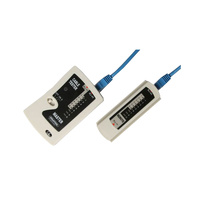
A basic Network Testers unit checks pin-out and continuity. Certification testers measure insertion loss, return loss, NEXT, FEXT, and ACR-F across the full frequency range of the cable category. AS/NZS/IEC 11801 sets the performance limits for each category.
The classic faults are split pairs, miswires, and reversed pairs. A split pair is the worst because basic continuity testers miss it: each pin is connected to the right pin at the other end, but the wrong wires are paired together. Crosstalk skyrockets and the link runs slowly without obvious error.
Certification reports prove the installation met its rated performance on the day of test. Most commercial clients require Permanent Link or Channel certification for every drop. Keep the test results filed for warranty claims. The cabling system warranty (often 25 years) usually depends on a clean certification report.
A well-installed RJ connector should last decades. Failures happen at the contact interface, in the locking tab, or in the cable strain relief. Quality connectors address all three failure modes with better materials and tighter manufacturing tolerances.
Most connectors use gold plating over nickel on the contact surfaces. Gold thickness ranges from 1.27 microns on basic connectors to 2.54 microns on premium parts. Thicker gold matters for high-cycle applications and for installations in coastal or industrial environments where airborne salt or sulphur compounds are present.
Standard RJ45 plugs are rated for at least 750 mating cycles. Premium parts reach 2,500 cycles or more. The locking tab is the most common mechanical failure point, especially on cheap injection-moulded plastic. Snag-free boots reduce tab breakage in patching environments.
A good link tested at install time will hold its performance if the connectors stay clean and undisturbed. Dust ingress is the slow killer. Keep dust caps on unused ports, especially in industrial or workshop spaces. A puff of dry air clears most contamination if a port has been left exposed.
The same handful of mistakes account for almost every failed termination. All of them are easy to fix once you know what to look for.
Connector pricing varies enormously, from a few cents per plug for unbranded bulk to several dollars for shielded Cat 8 parts. The cheapest option is rarely the right one for trade work. Pick connectors that match the warranty and certification requirements of the job.
Sparky Direct stocks RJ connectors and matching TV Cable Connectors for trade and DIY use. The full range of Connectors covers RJ, screw, gel, and modular types in one place.
Generic RJ45 plugs from auction sites usually have thin contact plating and loose tolerances. They may pass a basic continuity test but often fail certification at Cat 6 and above. Trade-grade brands like CABAC, Klein Tools, and Clipsal cost more per plug but rarely produce a failed termination.
Cabling contractors typically buy connectors in 50 or 100 packs to keep per-plug costs down. TV & Data Tools bundle deals are useful when fitting out a new comms room. Keep a supply of both Cat 6 and Cat 6A connectors on the truck so you can match what is in the wall.
Most network faults trace back to the cabling, not the active equipment. Working from the connector outward is usually faster than chasing the problem in software.
Intermittent links are almost always a marginal physical connection. Wiggle the patch lead. If the link comes and goes, replace the patch lead first, then check the wall outlet termination. Cracked solder joints inside cheap moulded leads are surprisingly common.
Slow throughput on a known good cable run usually means a duplex mismatch or a failing connector. Test with a certified patch lead at each end to isolate the fault to the permanent link. The Clipsal Iconic Network Connectivity range pairs well with certified patch cords for clean test setups.
If a fresh termination fails, look at the wiring sequence first. Cut the plug off, restrip, and lay the pairs in the correct order before re-crimping. Check the load bar (if used) is fully home and the conductors reach the front of the plug body where the contacts pierce.
Club Clipsal is Australia's largest electrician community offering trade rewards, business support, and exclusive benefits. When you nominate Sparky Direct as your preferred wholesaler, we automatically apply your Clipsal spend points to your Club Clipsal account daily.
Entry-level offering coaching, mentoring, and training discounts
Unlock exclusive industry tools and networking events
Access Toyota fleet offers and business software discounts
Maximum benefits, including VIP experiences and rewards
1. Sign Up: Create your Club Clipsal account at clipsal.com/club-clipsal or via the iCat mobile app
2. Nominate Sparky Direct: Select Sparky Direct from the wholesaler dropdown menu in your profile
3. Add Email: Enter your Sparky Direct account email address in the membership number field
4. Start Earning: Every dollar spent on Clipsal products earns points automatically
Redeem points from the rewards store, including gift cards, tools, and experiences. Access business summits, product training, and industry networking events. Receive early access to new product launches and special promotions. Connect with fellow electricians via the Club Clipsal community app.
Sparky Direct stocks RJ connectors and related data products from brands that consistently pass certification testing. Each brand suits a slightly different segment of the market.
Watch Klein Tools VDV826-703 | Pass-Thru™ Modular Data Plug | RJ45-CAT6 | 50 Pack video
Watch Major Tech KDRJ45R | Modular Connector Crimp Tool video
Watch NLS 30554 | Cat 6 Mech Data RJ45 | White video

I’ve used these a few times and never had a problem with them. Wouldn’t hesitate to make up another patch lead with these.
Works with Klein Tools VDV226-110. Definitely must-have for crimping RJ45 onto an ethernet cable end.
Excellent service from Sparky Direct like always. These RJ45 Sockets work great for small or large installations and are well priced.
Quality products in stock • Fast Australia-wide delivery • Competitive trade pricing
Browse RJ Connectors → Get Expert Advice →Yes, correct termination helps maintain signal quality and performance.
Sparky Direct supplies RJ connectors Australia-wide, offering reliable data and communication connection solutions with convenient delivery.
RJ connectors are securely packaged and delivered via standard courier services.
Unused products are generally eligible for return according to the seller’s returns policy.
Warranty coverage varies by manufacturer and typically covers defects in materials or workmanship.
Yes, RJ connectors are typically sold individually or in packs.
Yes, correct selection ensures compatibility and reliable performance.
Yes, they are commonly used when upgrading or extending data cabling.
They are usually concealed within outlets, patch panels, or equipment.
Yes, when matched to the correct cable category, they support modern data speeds.
Yes, they are widely used in home internet and data setups.
Quality RJ connectors are designed for long-term performance when correctly terminated.
Yes, different RJ types are easily identified by size and pin configuration.
RJ connectors are modular electrical connectors used to terminate and connect data and communication cables.
Yes, they are a standard component in structured cabling installations.
They provide a reliable and standardised way to connect communication devices.
Yes, they are commonly used in residential data and phone cabling systems.
Yes, they are designed for use with copper data and communication cables.
Yes, RJ connectors are available to suit Cat5e, Cat6, and higher-category cables.
Yes, RJ11 and RJ12 connectors are commonly used for telephone connections.
Yes, RJ45 connectors are widely used for Ethernet and data cabling.
Common types include RJ45 for data networks and RJ11 or RJ12 for telephone connections.
Quality RJ connectors are manufactured to meet relevant AS/NZS and telecommunications standards when used correctly.
They are used to connect devices in data, phone, and network systems.
RJ stands for Registered Jack, a standardised interface for telecommunications and data networking.