
Search Results:
Search Results:
Search Results:
Search Results:
WAGO connectors replace the screw with a calibrated steel spring. Each conductor enters its own port, and the spring clamps the wire against a current bar made from tin-plated copper alloy. The clamping force stays constant for the life of the connector, which removes the slow loosening that affects screw terminals over time.
A WAGO connector is a single-piece termination housing that contains one spring per port. The housing is moulded from polycarbonate or PA66 polyamide, both of which are flame-retardant and rated for continuous use at the connector's stated temperature limit. Inside, the current bar links every clamped wire so they sit at the same potential.
The exposed test slot on the front of each port lets you check voltage with a multimeter probe while the connection is energised. This is useful during fault-finding, since it removes the need to remove the wire to take a reading.
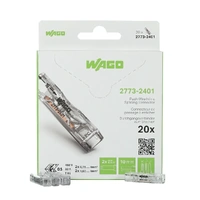
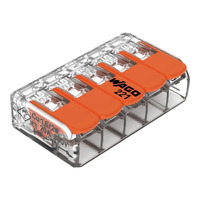
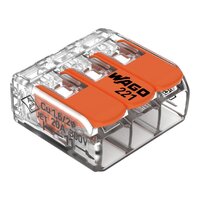
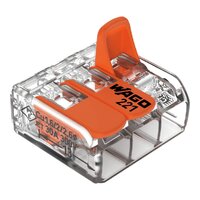
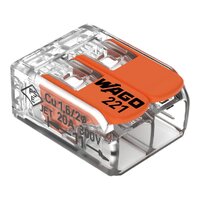
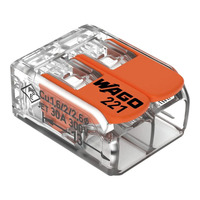
The 221 lever series uses an orange flip-up lever to load the spring. Lifting the lever opens the clamp, the stripped wire goes in, and pushing the lever back down releases the spring onto the conductor. The 2773 push-in series uses a different action: solid wire is pushed straight into the port and the spring grips it automatically, with no lever to operate.
Both designs apply the same calibrated force, regardless of operator strength or torque-driver settings. This is the key advantage over screw terminals, where torque can vary with the person installing it.
Spring-clamp terminations install in roughly a third of the time of a screw terminal, with no risk of stripped threads or over-tightened conductors. The clamping force is gas-tight, so oxidation does not creep in over time. Because there is no rotation against the conductor, fine-stranded cables stay intact instead of fraying under the screw.
Modern electrical work runs to tighter timeframes, smaller enclosures, and higher conductor counts than work from a generation ago. WAGO connectors solve all three pressures at once: faster termination, smaller footprint per joint, and consistent quality even when the same junction box is filled with different wire sizes.
Every spring leaves the factory tested to a defined force window. A run of 100 connectors will produce 100 identical clamps. This consistency removes the most common cause of long-term joint failure, which is a screw terminal that was either undertightened on the day of install or has loosened from thermal cycling.
On lighting circuits with multiple conductors per junction, switching from BP connectors to WAGO 221 lever connectors commonly saves 30 to 50 percent of termination time. The labour saving compounds on commercial fit-outs, where a single switchboard or ceiling space may carry hundreds of joints.
The 221 and 2773 series carry international approvals (ENEC, VDE, UL, CSA) and are recognised under AS/NZS 3000:2018 for general electrical installation work in Australia. The Wiring Rules call for connections that maintain the conductor's current-carrying capacity and remain reliable over time, which spring-clamp connectors satisfy when used within their rated parameters.
WAGO publishes several distinct product families, each suited to a different installation context. Stocking the right mix saves time on the van and reduces returns to the supplier mid-job.
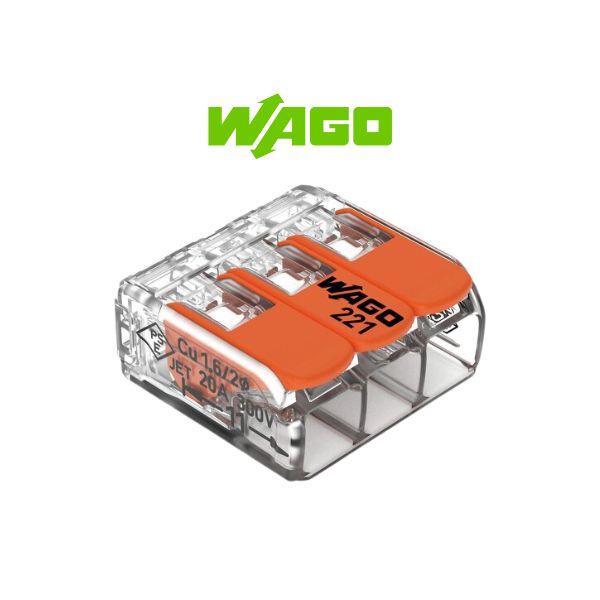
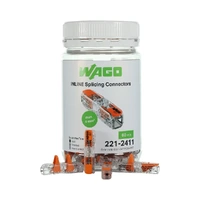
The 221 series is the most popular WAGO product line in Australian sparkies' kits. The compact 221-412, 221-413, and 221-415 cover 2, 3, and 5-way joins for cables up to 4mm². The transparent housing lets you confirm the conductor is fully inserted before you flip the lever closed. The inline 221-2411 splices two cables in a straight line, useful for repairs in tight cavities.
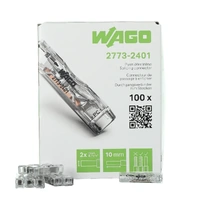
The 2773 series is engineered for solid copper conductors only and is widely used in mass-produced lighting and downlight runs. Without a lever, the connector is smaller and quicker for repetitive joints, but it cannot accept stranded cable. Verify the wire type before specifying.
For distribution boards and switchboards, WAGO TOPJOB S and railway-style terminal blocks deliver the same spring-clamp technology in DIN-rail form. These systems carry higher current ratings than the splicing range and accept conductors up to 35mm².
WAGO's Green Range uses recycled plastics and reduced packaging while keeping the same electrical performance and approvals. Many specifiers now request Green Range options on Green Star and NABERS-rated commercial projects.
Two questions decide whether a WAGO is the right choice on a given job: what conductors you are joining, and what environment they sit in. The table below summarises the practical differences against the methods WAGO most often replaces.
| Method | Time per Joint | Strands Accepted | Reusable | Best Use Case |
|---|---|---|---|---|
| WAGO 221 Lever | 5 to 10 seconds | Solid, stranded, fine-stranded | Yes | General installation, mixed conductors |
| WAGO 2773 Push-In | 3 to 5 seconds | Solid only | No (one-time) | Repetitive solid-wire joints |
| BP Connector | 20 to 40 seconds | Solid, stranded | Limited | Legacy retrofit work |
| Screw Terminal Block | 15 to 30 seconds | Solid, stranded (with ferrule) | Yes | Switchboard rail terminations |
| Wire Nut | 10 to 20 seconds | Solid, stranded | Limited | Not approved under AS/NZS 3000 |
Screw terminals remain valid for switchboard rail-mounted work, especially at higher currents. For point-of-use joints inside ceiling spaces and junction boxes, however, the spring-clamp design is faster, smaller, and removes torque variability from the equation.
Wire nuts (twist-on connectors) are common in North American electrical practice but are not approved under AS/NZS 3000:2018 for installation work in Australia. WAGO connectors fill the same role with proper Australian compliance.
On a labour-cost basis, the higher unit price of a WAGO connector pays back inside the first job for most contractors. On a safety basis, the consistent clamping force removes the human-error variable that accounts for many post-installation failures. On long-term reliability, gas-tight spring contact outperforms a screw under thermal cycling.
Specifications vary by product line, so always check the data sheet for the exact part number. The figures below are typical for the 221 series, which covers most general installation use.
| Spec | 221-412 / 221-413 / 221-415 | 221-612 / 221-613 / 221-615 (6mm²) | 2773 Series |
|---|---|---|---|
| Rated current | 32 A | 41 A | 24 A (typical) |
| Rated voltage | 450 V | 450 V | 450 V |
| Conductor range | 0.2 to 4mm² | 0.5 to 6mm² | 0.75 to 2.5mm² solid |
| Strip length | 11mm | 13mm | 11mm |
| Operating temperature | -35 to +85°C | -35 to +85°C | -35 to +85°C |
The 221 series rates 32 A at 450 V across the 0.2 to 4mm² range, comfortably covering general lighting and most power circuits. Always size the connector to the smallest conductor in the joint, since current capacity is limited by the smallest cable, not the connector itself.
Different ports on the same connector can carry different conductor sizes, which is one of the design's strengths. This makes the 221 ideal for mixing 1mm² and 1.5mm² lighting circuit conductors, or stepping down from a 2.5mm² mains tail to a 0.75mm² flex on a luminaire.
For circuits running above the connector's rated current, move to TOPJOB S DIN-rail terminals or other rail-mount alternatives. Splicing connectors are not designed for sub-main or feeder duty.
Selection comes down to three questions: What conductor types are you joining? How many conductors per joint? And what environment will the joint live in?
Mixed conductor types (solid plus stranded, or building cable plus flex) demand the lever-style 221 series. Pure solid-wire installs, such as builders' wire on a downlight loop, can use the cheaper push-in 2773. Fine-stranded control cable always requires the lever style.
For lighting circuits up to 16 A, the 221-4xx series is comfortable. For 20 A and 32 A circuits in 4mm² and 6mm² conductors, the 221-6xx six-millimetre series is the correct choice. Above 32 A, switch to terminal blocks.
Indoor, dry locations: any 221 or 2773 part. Outdoor, damp, or buried locations: pair the 221 inline connector with a matched WAGO Gelbox for IP68 protection. Vibration-prone industrial sites: the 221 spring tolerates vibration well above what most installations encounter.
Residential is where WAGO has the broadest reach in Australia. Domestic lighting circuits, downlight loops, ceiling roses, fan installations, and renovation rewiring all benefit from the time saving. Builders' twin-and-earth (1mm², 1.5mm², 2.5mm²) drops straight into the 221-4xx range.
Office, retail, and hospitality fit-outs run to compressed schedules, where labour-time savings on hundreds of joints become significant. WAGO terminal blocks dominate commercial switchboard work where DIN-rail termination is standard.
Industrial control panels, solar PV combiner boxes, EV charging infrastructure, and battery storage systems all use WAGO products. Vibration-resistance and the maintenance-free spring design are especially valuable in industrial settings where access for retightening is costly.
Strip length is the most important variable. Too short and the conductor will not reach the current bar; too long and bare copper sits exposed outside the housing. The 221-4xx specifies 11mm strip length, the 221-6xx specifies 13mm. A quality wire stripper with a length stop produces consistent results across a job.
For 221 connectors, lift the lever fully (90 degrees from the body), insert the stripped conductor until it stops at the back of the port, then close the lever fully. For 2773 push-in connectors, push the conductor straight in with steady pressure until it bottoms out. To remove a wire from a push-in connector, twist the wire while pulling.
The two most common errors are under-stripping (leaving insulation in the clamp area) and over-stripping (leaving exposed copper outside the housing). Both create code-compliance issues and potential safety risks. A test pull on each conductor after closing the lever confirms the clamp has engaged correctly.
Before turning circuits back on, tug each conductor at the connector with light force. If a wire pulls free, the lever is not fully closed or the strip length is wrong. Re-terminate before energising.
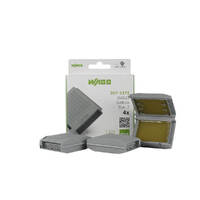
Bare WAGO connectors are designed for installation inside an enclosure, junction box, or fitting. They are not weather-rated on their own. For outdoor or damp installations, use the WAGO Gelbox system or place the connector inside an IP-rated junction box.
The polycarbonate housing resists moisture, but condensation inside an enclosure is enough to oxidise exposed copper at the connector if no further protection is provided. Vibration resistance, on the other hand, is a strong point: spring-clamp termination tolerates vibration far better than screw torque.
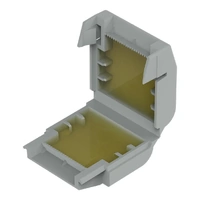
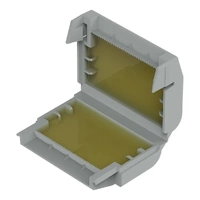
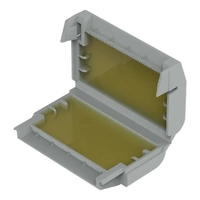
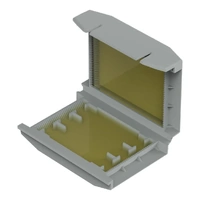
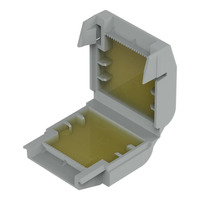
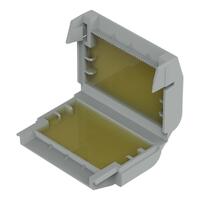
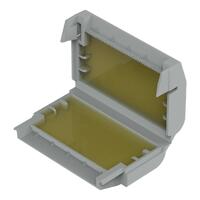
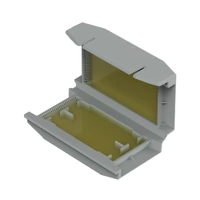
The Gelbox range is purpose-built for outdoor lighting, garden installations, irrigation, signage, and pool equipment. The connector goes inside the box, the box is filled with silicone gel, and the assembly achieves IP68 once sealed. This system is approved for direct burial.
Joints in lighting circuits go through thousands of heat-up and cool-down cycles over their service life. Screw torque relaxes over thousands of cycles; spring force does not. This is the single biggest advantage WAGO holds over screw terminals on long-life installations.
The spring maintains contact pressure through vibration that would loosen a screw terminal. On industrial machinery, mobile plant, and rooftop solar (where wind loading transfers vibration through the structure), this stability matters.
Once installed correctly, a WAGO connector requires no periodic retightening for the life of the installation. The maintenance saving is significant on commercial assets where a building manager would otherwise budget for periodic switchboard inspections that include screw-tightening.
Putting fine-stranded cable into a 2773 push-in connector will not result in a reliable joint. The 2773 is solid-only. Always check the connector data sheet for stranded compatibility before installing.
An under-inserted conductor will not contact the current bar, even if the lever closes. The transparent housing on the 221 series exists for this reason: visually verify each conductor is bottomed out before closing the lever.
The 32 A rating on a 221 lever connector is real. Loading the connector beyond this on a sustained basis causes thermal degradation of the housing and eventual failure. For higher current applications, move to terminal blocks rated for the load.
Safety reminder: All electrical installation work in Australia must be carried out by a licensed electrician in accordance with AS/NZS 3000:2018. The information on this page is for trade reference and does not replace professional inspection or compliance verification.
Sparky Direct stocks the full connectors range, including the complete WAGO 221 lever series, 2773 push-in, Gelbox, and TOPJOB S DIN-rail products. Trade pricing applies on bulk orders, and stock dispatches Australia-wide on the same business day for orders placed before cut-off.
Cheap online imitations of the 221 housing exist and look almost identical from the outside. The internal spring grade, contact materials, and approvals are not equivalent. For installation work, only genuine WAGO products carry the certifications that satisfy AS/NZS 3000:2018 compliance.
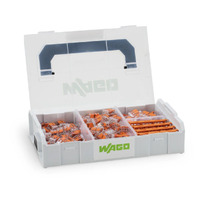
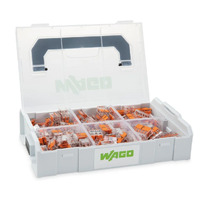
Most WAGO splicing connectors come in jars (25, 30, 50, 60, or 100 pieces), with bulk multipack options for high-volume users. Sparky Direct offers tiered trade pricing for contractor accounts; contact the team for a quote on larger volumes.
Genuine WAGO connectors carry the WAGO logo embossed into the housing, along with the part number and approval marks (ENEC, VDE, UL, CSA). Counterfeit products often carry blurred logos or missing approval marks. Crisp, deeply moulded markings are a good sign.
Counterfeit WAGO 221 connectors have appeared on online marketplaces, particularly in jar quantities sold at suspiciously low prices. The springs in counterfeit units are often softer steel and lose clamping force quickly. Always buy from authorised distributors.
Sparky Direct sources WAGO products through authorised Australian distribution. This guarantees genuine product, full warranty backing, and compliance with the approvals required under AS/NZS 3000:2018.
If a circuit shows intermittent fault behaviour at a WAGO joint, the most likely cause is incomplete lever closure or insufficient strip length. Open the connector, re-strip to the recommended length, and re-terminate. The transparent 221 housing makes this diagnosis quick.
If the conductor moves under a tug test, it is not seated. Re-strip if the bare copper is too short, and re-insert until you feel the wire bottom out before closing the lever.
A push-in 2773 used with stranded wire will eventually fail. A 221-4xx loaded above 32 A will overheat. If a connector shows discolouration of the housing, replace it and re-evaluate the application against the published ratings.
Watch Wago 221-412 | 4mm² 2-Way Compact Splicing Connector | Jar of 100 video
Watch Wago 221-413 | 4mm² 3-Way Compact Splicing Connector | Jar of 50 video
Watch Wago 2773-2401-995-020 | Push Wire Inline Splicing Connector for 4mm² Solid and Stranded Wires | 20-Pack video

I used WAGO two terminal connectors to go from fixed 1 mm2 building wiring to 0.75 mm stranded wiring when installing pre-wired down-lights. I found traditional screw connectors where not satisfactory in this use case. Using two terminal WAGO connectors allowed 1 mm2 building wiring to connect to 0.75 mm2 stranded wire quickly with an positive and non damaging connection. Small enough to fit in a standard J-box, quick and easy to use.
Excellent quality, Large strong push wire terminals. Adjustable output voltage extremely handy for less common voltages or ability to compensate for volt drop on control voltage. Not common on compact power supplies like these. Great price.
Couldn't wait to receive these little buggers, they arrived real quick under the Xmas delivery load and I was able to utilise them instead of the old BP connectors and they were much easier to use in tight situations, great invention.
Quality products in stock • Fast Australia-wide delivery • Competitive trade pricing
Browse WAGO Connectors → Get Expert Advice →Yes, they significantly reduce installation time compared to traditional connectors.
Sparky Direct supplies WAGO connectors Australia-wide, offering reliable and compliant electrical connection solutions with convenient delivery.
WAGO connectors are securely packaged and delivered via standard courier services.
Unused products are generally eligible for return according to the seller’s returns policy.
Warranty coverage varies by product and manufacturer terms, typically covering defects.
Yes, WAGO connectors are typically sold individually or in packs.
Yes, selecting the correct connector ensures safety and compliance.
Once installed correctly, they generally require no maintenance.
Yes, reusable designs make them ideal for upgrades and changes.
Yes, they are commonly used in lighting and downlight wiring.
Quality WAGO connectors are designed for long-term performance.
Yes, their design helps ensure secure and repeatable connections.
Yes, their lever or push-in design makes them simple for trained professionals to use.
WAGO connectors are lever and push-in electrical connectors used to join electrical conductors quickly and securely.
Yes, they are widely used by electricians for their reliability and ease of use.
They offer faster installation and consistent connection quality without screws.
Yes, they are commonly used inside junction boxes and electrical enclosures.
Yes, they are suitable for residential, commercial, and light industrial applications.
Yes, they are widely used in residential electrical wiring.
Yes, lever-style WAGO connectors are designed to be reusable.
Yes, many WAGO connectors are suitable for both solid and stranded conductors.
Yes, they are designed for use with copper conductors.
They use a spring-clamp mechanism that holds conductors firmly in place when the lever is closed.
Quality WAGO connectors are manufactured to meet relevant AS/NZS electrical and safety standards when used correctly.
They are used to connect, terminate, or join electrical cables in lighting circuits, junction boxes, and electrical enclosures.