
Search Results:
Search Results:
Search Results:
Search Results:
Every compliant switchboard in Australia needs a clearly identified main switch. The device gives electricians a single, visible point to cut supply for maintenance, emergency shutdown, testing, switchboard upgrades, and fault checks. It sits between the consumer mains and the protective devices that serve each circuit. The category is bought by licensed electricians, electrical contractors, facilities teams, and informed buyers who source compliant switchboard parts for homes, commercial sites, and industrial work. Replacement and install must always be carried out by a licensed electrician.
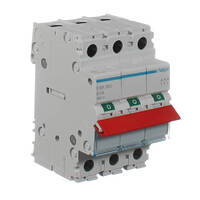
A main switch manually disconnects the active supply conductors feeding an electrical installation, distribution board, or grouped circuits. It acts as the visible and accessible isolation point for the board. Common applications include residential meter boxes, commercial distribution boards, solar-ready switchboards, and sub-board isolation in sheds, granny flats, and tenancies. The switch lets a licensed electrician verify that supply has been removed before any work begins on downstream wiring or protection devices.
A standard isolator main switch provides isolation only. It does not deliver automatic overload, short-circuit, or earth leakage protection. Those functions are handled by separate devices: MCBs for overcurrent, RCDs for residual current, and RCBOs for combined protection. Service fuses, surge protection devices, and sub-circuit protection complete the layered protection system. A circuit breaker main switch is a different product type and does combine isolation with overcurrent protection.
The simplest way to compare these devices is by what triggers them. A main switch is operated manually for isolation, while a circuit breaker trips automatically on fault current.
| Device Type | Primary Function | Operation |
|---|---|---|
| Main switch (isolator) | Manual isolation of supply | Manual only |
| Circuit breaker | Automatic overcurrent protection | Manual and automatic trip |
| RCBO | Overcurrent plus residual current protection | Manual and automatic trip |
| RCD | Residual current protection only | Manual and automatic trip |
Some products are designed to serve as both a main switch and a circuit breaker. The selection depends on the installation type, distributor requirements, and the board design.
Australian electrical work must include suitable isolation devices under AS/NZS 3000 and related wiring rules. The main switch is the device that meets the core isolation rule for a board. It lets a worker cut supply quickly during emergencies and supports verified testing before any downstream work. Selection, install, and replacement are fixed electrical work in every Australian state and territory. These jobs sit firmly inside the scope of licensed electrical contractors and must not be tried by unlicensed persons.
Sparky Direct provides compliant product ranges so contractors can match the board design to verified, locally-supported devices. The category supports new builds, upgrades, and sub-board layouts for homes, shops, offices, and light industrial sites.
A main switch is a core rule in a compliant Australian switchboard. The exact arrangement depends on the project context, including supply type, board type, state-based rules, solar or battery setup, and whether the switchboard is new, altered, or upgraded. Both home and shop boards rely on a clearly identified main switch as the primary isolation device. A licensed electrician confirms the right arrangement for each project based on the supply authority rules and the board design.
AS/NZS 3000 sets the wiring rules that drive main switch choice in Australia. IEC 60947-3 is the global standard cited for switch-disconnector devices used in distribution work. Some Australian states, supply authorities, or solar connection rules require a circuit breaker main switch rather than a plain isolator. Electricians should check local distributor rules, state electrical safety rules, and any project-specific switchboard schedules before they choose a product.
Replacing or installing a main switch is fixed electrical work and must be completed by a licensed electrician. The job involves working close to live consumer mains and requires isolation, testing, correct termination, labelling, and post-install checks. Compliance papers may also be required depending on the project type and state rules. A licensed electrician follows the right safety steps, uses proper test gear, and confirms that the board returns to a safe and compliant state after the work.
Main switches are grouped by pole configuration, by device type, and by application context. Buyers select a product based on supply arrangement, switchboard design, and whether the device needs to provide isolation only or also include automatic protection. Australian terminology covers main switch, isolator, switch-disconnector, circuit breaker main switch, sub-main switch, and DIN rail isolator.
The pole count describes how many conductors the switch interrupts when operated. Selection ties directly to supply type and switchboard design.
An isolator main switch is a switch-disconnector. It interrupts the circuit on demand but does not respond to fault current. A circuit breaker main switch combines isolation with automatic overload and short-circuit protection. Some installations need a breaker-type main switch because state distributor rules, consumer mains protection requirements, solar connection rules, or specific upgrade contexts call for it. The board design and supply authority requirements determine which product is suitable.
Different sites use different product families. Residential work covers standard switchboards, meter boxes, home renovations, and solar-ready boards. Commercial work covers tenancy boards, distribution boards, plant rooms, and service isolation. Industrial sites use higher-current switch-disconnectors, lockable IP66 key lockable isolator switches, and dedicated maintenance isolation points for machinery and plant. Sparky Direct stocks products across all three groups, so contractors can complete the full job from one supplier.
The product rating is set by current, voltage, pole count, fault performance, and the host switchboard. Each parameter must align with the load calculation, cable size, service fuse rating, supply authority requirements, and the overall board design. A licensed electrician verifies the final selection against the project specification before ordering parts in volume.
Australian residential and commercial work typically uses 40A, 63A, 80A, and 100A main switches. The specific value depends on supply size and installation type. Residential boards commonly use 63A, 80A, or 100A devices, with selection driven by supply arrangement and load calculation. A 100A main switch may be specified for larger homes, commercial boards, or three-phase switchboards, but it must still match the designed installation. Comparing prices for 100A main switches online is straightforward when the product code, brand, and pole configuration are fixed by the board design.
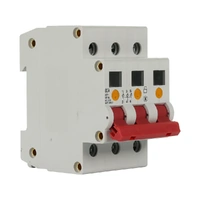
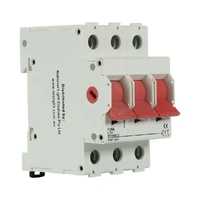
Single-phase and three-phase boards require different main switch configurations. Three-phase applications need devices rated for the appropriate line-to-line voltage and the correct pole arrangement. Product listings should be checked for voltage rating, pole count, and DIN module width to confirm the switch will fit the available rail space and connect correctly to the busbar arrangement.
Plain isolators are not rated the same way as circuit breakers for fault interruption. Where a circuit breaker main switch is used, its breaking capacity must suit the prospective short-circuit current at the installation. Common selection contexts in Australian switchboard work involve 6kA and 10kA devices. This is electrician and specifier guidance: fault-level calculations are part of the board design and are not a DIY decision.
Match the main switch to four things: the supply size (amps), the supply type (single or three phase), the pole count required by the board design, and the device type (isolator or breaker). A licensed electrician confirms the final selection against the project documentation.
Brand selection is driven by product range, busbar compatibility, switchboard ecosystem, and stock depth. Australian contractors most often work with Clipsal (Schneider Electric) and Hager, along with NLS, Legrand, Eaton, and Siemens for specific switchboard applications. Sparky Direct supports each of these ranges for residential, commercial, and light industrial work.
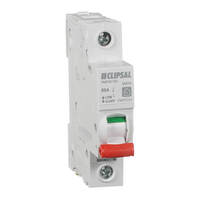
Clipsal and Schneider Electric products are widely deployed in Australian residential and commercial switchboards. The Resi MAX and MAX9 circuit protection ranges include DIN rail main switches and isolators that integrate with Clipsal busbars and switchboard enclosures. The MAX9 system supports slim RCBOs and matched accessories, which helps electricians complete clean, compliant board layouts on tight timelines.
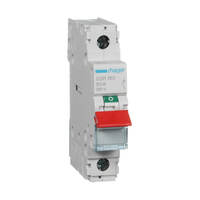
Hager produces DIN rail main switches and a coordinated protection ecosystem widely used in residential switchboard upgrades. Hager devices integrate well with Hager RCBOs, busbars, and labelled enclosures designed for Australian board layouts. Contractors specifying a Hager main switch for a residential upgrade typically pair the device with matching components for system compatibility.
Brand comparison comes down to a small number of practical criteria. The product must hold Australian compliance documentation. The pole configuration and amp range must match the project. DIN rail width, busbar compatibility, and the switchboard system must align with the existing or planned board. Stock availability for urgent jobs and local warranty support also influence the decision. Reliable circuit protection comes from matching all of these factors, not from any single brand promise.
High-intent trade work goes well beyond a like-for-like main switch swap. Upgrades, solar setups, and sub-board jobs each bring their own main switch needs. Install in every case must be designed and done by qualified pros working to AS/NZS 3000 and any applicable solar or battery system standards.
A switchboard upgrade often involves replacing an outdated main switch as part of a wider modernisation. Common triggers for an upgrade include old ceramic fuses, heat damage, missing RCD or RCBO protection, overcrowded enclosures, and unclear labelling. An electrician assesses the board condition, identifies the components needing replacement, and completes the work with proper testing and compliance verification. Distribution boards and meter boxes from the same brand ecosystem help keep the upgrade tidy and compatible.
Solar PV and battery setups often require clearly labelled isolation and dedicated main switch arrangements. Labels such as "main switch grid supply" appear on solar-ready boards alongside inverter isolators and dedicated solar circuit breakers. Solar and battery energy storage switchboard setup must be designed and installed by qualified pros in line with AS/NZS 3000 and the relevant solar and BESS standards. Solar isolator switches and matched main switches keep the supply path clearly tagged for service techs.
Sub-main switches handle isolation for sheds, granny flats, commercial tenancies, workshops, and dedicated distribution boards. The difference is scope: a sub-main isolates a sub-board, while the main switch isolates the whole installation. Selection still involves pole count, amp rating, enclosure space, and clear labelling so the sub-board can be identified and isolated independently of the main installation.
A main switch is a mechanical and electrical device, so it eventually wears or fails. Recognising early warning signs lets a homeowner or facilities manager arrange a licensed electrician before a small fault becomes a serious safety issue. Switchboard covers should not be removed by unlicensed persons under any circumstances.
Several signs suggest a main switch needs assessment by a licensed electrician. Look for the following indicators on a residential or commercial board.
If any of these signs appear, contact a licensed electrician and avoid further switching attempts until the board has been inspected.
A failed main switch can produce several outcomes, all of which warrant prompt professional attention. Possible consequences include loss of reliable isolation, intermittent supply to circuits, overheating at terminals, and an inability to safely disconnect the supply during an emergency. If the failure progresses, terminal heating can develop into a fire or shock risk. The correct response is to contact a licensed electrician quickly and avoid relying on the device for ongoing isolation.
Routine checks by a licensed electrician spot loose terminations, heat damage, and outdated parts before they cause supply faults. Commercial and industrial boards often benefit from thermal imaging to detect hot joints. Clear switchboard schedules and well-kept labels support ongoing care by making circuits easy to find, isolate, and test.
Buying main switches online suits both trade and informed retail buyers when the spec is fixed and the part needs to land quickly. Sparky Direct supplies compliant branded stock to electricians, electrical contractors, and switchboard builders across Australia, with clear product info and Australia-wide delivery.
Confirm the following details against the project specification or existing switchboard before placing an order.
Affordable main switches in Australia are widely available online, but value depends on the combination of price, stock depth, and compliance assurance rather than the unit price alone.
The cheapest unit price rarely represents the best value across a full project. Contractors weigh several factors when sourcing main switches. Compliance assurance, genuine branded stock, delivery speed, stock depth, returns policy, project quantity availability, and the ability to source matching switchboard components all influence the final decision. Sparky Direct main switch prices and stock availability are visible on each product page, which supports fast comparison between models, pole counts, and amp ratings.
Electricians and contractors often need a Clipsal, Hager, or NLS main switch in a hurry for maintenance and upgrade jobs. Reliable main switch suppliers for electrical contractors offer transparent pricing, accurate stock visibility, and dependable dispatch timing. Sparky Direct provides Australia-wide delivery on in-stock items, which lets contractors plan around realistic arrival dates and avoid wasted site visits. Ordering a Clipsal main switch for fast delivery starts with the correct product code and confirmed stock status on the product page.
A short decision framework helps buyers confirm the right main switch before placing the order. The checklist covers the technical specification, the compliance position, and the procurement details that affect project timelines.
Club Clipsal is Australia's largest electrician community offering trade rewards, business support, and exclusive benefits. When you nominate Sparky Direct as your preferred wholesaler, we automatically apply your Clipsal spend points to your Club Clipsal account daily.
Entry-level offering coaching, mentoring, and training discounts
Unlock exclusive industry tools and networking events
Access Toyota fleet offers and business software discounts
Maximum benefits, including VIP experiences and rewards
1. Sign Up: Create your Club Clipsal account at clipsal.com/club-clipsal or via the iCat mobile app
2. Nominate Sparky Direct: Select Sparky Direct from the wholesaler dropdown menu in your profile
3. Add Email: Enter your Sparky Direct account email address in the membership number field
4. Start Earning: Every dollar spent on Clipsal products earns points automatically
Redeem points from the rewards store, including gift cards, tools, and experiences. Access business summits, product training, and industry networking events. Receive early access to new product launches and special promotions. Connect with fellow electricians via the Club Clipsal community app.
Watch CLIPSAL RMSW180 | 80 amp Main Switch single pole | Resi Max 4 video
Watch HAGER SBR380 | Main switch three pole 80 amp video
Watch HAGER SBR180 | Main switch single pole 80 amp video

These are awesome products, very fast to install and neat. Make sure you are careful when you select all parts and breakers, as a different height means it won't connect to the busbar and I found there are a few different sizes available..
Competitively priced and arrived within days. Entire order was correct and job completed as planned. I would definitely use Sparky direct again.
For under 120$ how could you go wrong? A perfect accessory to your solar installation, why? You install this and it is now your work, not to be touched by the next fly by nighter cowboys. It guarantees your work wont be fiddled with as its config locks in main switch, solar and another solar or battery inv cct. You then wire from the main switch off to their existing bus wiring so you spell out what is your work and what is existing. Awesome for compliance because ot shows you care about your work and best bang for buck as it is well priced. Don't stress about hot joints, this bad boy has got you coverrd.
Quality products in stock • Fast Australia-wide delivery • Competitive trade pricing
Browse Main Switches → Get Expert Advice →