
Search Results:
Search Results:
Search Results:
Search Results:
The Martec exhaust fan range is built around a clear job: clearing wet-area air faster than a window can. Each model is designed for residential ventilation in bathrooms, ensuites, separate toilets and laundries where steam and odour control matter. Knowing what these fans do, where Martec sits in the local trade market and why ventilation matters helps electricians, builders and homeowners choose the right fit.
Martec exhaust fans extract moisture, steam, odours and stale air from wet areas to a vent on the external wall, eave or roof. The practical outcome is less condensation on mirrors and ceilings, lower mould risk on paint and grout, and faster steam clearance after showers. The line-up commonly suits residential renovations, new builds, rental upgrades and small commercial amenities where reliable airflow and a tidy fascia matter. Many sites use the same model across multiple bathrooms for consistent cut-outs and easy spare parts.
Martec is an established Australian supplier of ventilation, ceiling fans, lighting and bathroom heating. Electricians and builders often specify known ventilation brands for predictable cut-out dimensions, accessible spares, clear installation documentation and warranty support on residential jobs. Sourcing through an electrical wholesaler also makes it easier to match the fan with compatible exhaust fan accessories, ducting, timers and remotes in one order. That reduces the chance of a return trip mid-job.
Inadequate bathroom ventilation drives condensation, mould, paint damage, swollen cabinetry, ceiling staining and persistent odours. Australian wet areas need adequate natural or mechanical ventilation under National Construction Code requirements, particularly where windows alone cannot clear shower steam. Bathroom electrical installation must be assessed against wet-area zones and completed by a licensed electrician where fixed wiring is involved. A correctly sized fan from the broader bathroom exhaust fans range, ducted outside the building, is the most reliable way to protect finishes and indoor air quality over time.
Martec offers several distinct families covering different bathroom styles, ceiling heights and feature priorities. The Flow series leads on integrated lighting and clean fascia design. Saturn focuses on stronger extraction with backdraft control. Core suits straightforward replacement work where airflow and price matter more than features. Matching the family to the bathroom application is the first decision before sizing and airflow.
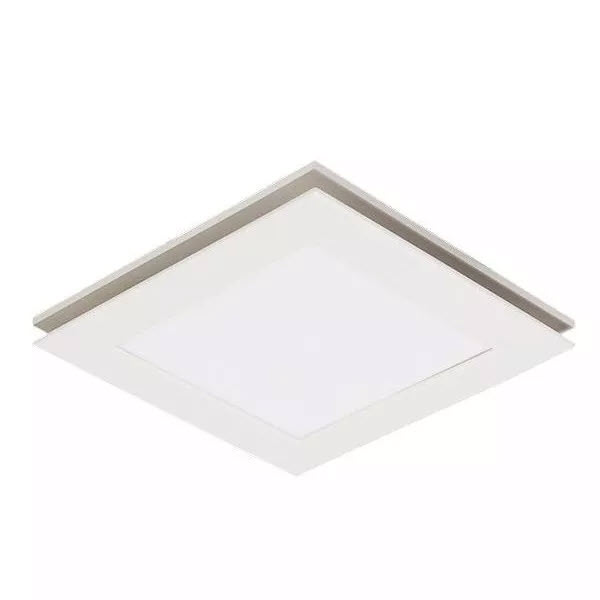
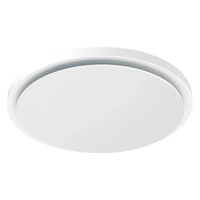
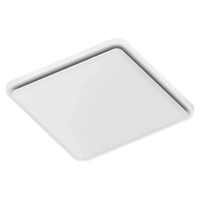
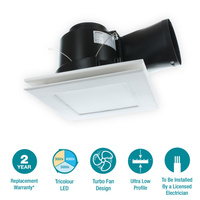
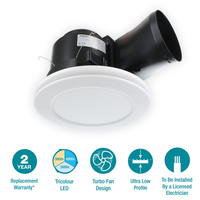
The Martec Flow series is a modern low-profile option suited to bathrooms where appearance and integrated lighting matter. Flow models commonly come in round and square fascia styles, sitting close to the ceiling like a slim downlight. Tricolour LED selection, remote compatibility and thermal protection feature across the range, with white finishes that suit most ceilings. Choose Flow when the customer wants ventilation and lighting in one ceiling fitting, especially in renovated bathrooms or small ensuites where ceiling clutter should be kept down.
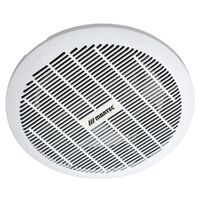
Saturn fans are positioned as a stronger extraction option for bathrooms where steam clearance and backdraft prevention are priorities. A backdraft stopper sits in the airflow path to reduce reverse air movement, cold draughts and external odours when the fan is off. The simple ceiling-mount design suits common Australian ceiling installations with standard joist spacing and accessible roof cavities. Saturn is a sensible pick where a previous fan left lingering steam or where the bathroom sees heavy daily use.
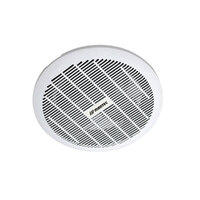
The Core series targets practical replacement work in bathrooms or laundries where value, airflow and straightforward installation are the priority. Before purchasing, users should check ceiling cut-out size, fan diameter, duct connection size, plug or flex arrangement and the airflow rating against the room. Even plug-and-flex style products still need compliant positioning, correct ducting and an existing legal power outlet arrangement. Core is well-suited to landlord-driven swaps and tidy like-for-like upgrades that do not need integrated LED features.
Buyers usually choose between four functional types. Fan-only models suit bathrooms with separate ceiling lighting. Exhaust fans with light work well in renovations where the ceiling has limited space or where one fitting is preferred. Remote-compatible fans reduce the need for extra wall switches. Higher-airflow models suit large family bathrooms with poor natural ventilation. Remote compatibility must still be planned by a licensed electrician when fixed wiring is involved, since switching strategy affects circuit design.
The table below summarises the main Martec exhaust fan choices at a glance.
| Model Family | Best Use Case | Key Benefit | Buying Consideration |
|---|---|---|---|
| Flow series | Renovated bathrooms, small ensuites, single-fitting installs | Low-profile fascia with integrated tricolour LED light | Check existing light position and ceiling cut-out |
| Saturn series | Family bathrooms, heavy-use wet areas, mould-prone rooms | Stronger extraction with backdraft control | Plan duct path and external termination carefully |
| Core series | Like-for-like replacement, rental upgrades, laundries | Practical airflow at a sensible price point | Confirm cut-out, fan diameter and duct connection |
| Fan with LED | Small bathrooms, ensuites, ceiling-clutter sensitive layouts | One ceiling fitting replaces separate light and fan | Switching change usually needs an electrician |
Sizing is the single most common mistake on bathroom exhaust fan jobs. A fan rated for the wrong room volume, or a fan with airflow choked by long ducting, will not clear steam fast enough to prevent moisture damage. Working through airflow ratings, room volume and fan diameter gives a defensible selection that suits the bathroom rather than the box.
Airflow is rated in cubic metres per hour (m3/h) or litres per second (L/s). To convert, divide m3/h by 3.6 to get L/s. A fan rated 200 m3/h delivers around 56 L/s in ideal conditions. Rated airflow is measured on a test rig with short straight ducting and no restrictions. Real installed performance often drops once long flexible duct, bends, grilles and external terminations are added to the path. Australian bathrooms with showers or long duct runs should sit above the bare minimum rating to allow for that real-world loss.
Calculating the right airflow is straightforward. Multiply length by width by ceiling height to get the room volume in cubic metres. Then multiply that volume by the target air changes per hour, commonly eight to ten for bathrooms with showers. For example, a 3 m by 2 m bathroom with a 2.4 m ceiling has a volume of 14.4 cubic metres. At ten air changes per hour, that needs around 144 cubic metres per hour of rated airflow. A small ensuite usually suits compact lower-to-mid airflow units. A standard family bathroom typically needs stronger extraction. A large master bathroom with freestanding bath and shower may need a higher-capacity fan or careful duct design.
Martec fans cover common diameters around 200 mm, 240 mm, 250 mm, 290 mm and 295 mm depending on the model. Diameter alone is not enough. Buyers must also compare airflow rating, ceiling cut-out size, duct outlet diameter, fascia dimensions, noise level and any integrated lighting. For replacement jobs, measure the existing ceiling cut-out and check available ceiling clearance above the joists before ordering. A 240 mm Flow may suit a small bathroom that previously had a 200 mm fan, provided cut-out size and ducting can be reworked cleanly.
Higher airflow clears moisture faster, which shortens condensation time on walls, mirrors and ceilings. This reduces the conditions that grow mould. Airflow still has to be balanced with make-up air, duct design and fan placement. An oversized fan can be louder and less efficient if the bathroom lacks adequate air entry under the door or through a vent. The common mistake is buying by fan diameter alone instead of checking airflow, ducting size and cut-out compatibility against the actual room.
Choosing a bathroom exhaust fan by diameter alone instead of checking airflow rating, ducting kit size, ceiling cut-out and noise rating against the room. A 250 mm fan rated at 150 m3/h will under-ventilate a family bathroom that needs 250 m3/h, no matter how good the brand.
Quiet operation is one of the most-asked questions on bathroom fans. Noise depends on more than the motor itself. Blade design, housing vibration, duct restriction, grille resistance and installation quality all combine to produce the dBA rating heard in the room. Knowing what makes a fan quiet helps buyers compare models on fair grounds.
Motor quality, blade balance, housing vibration, duct restriction, grille resistance and installation quality all affect sound. Decibel ratings appear on some product pages, but they must be compared on like-for-like conditions. A fan rated at 35 dBA in a test rig can sound louder if installed with a compressed duct or a loose ceiling fitting. "Quiet" also depends on room size and expected extraction rate. A small ensuite tolerates a softer fan because the air change requirement is lower.
For small bathrooms, look for correctly sized airflow, an efficient motor, low-profile fascia, backdraft control and compatible timer or remote control. Small bathrooms often do not need the largest available fan. A well-sized quiet model usually outperforms an oversized noisy one, both for comfort and for moisture removal. Integrated LED units suit small bathrooms where reducing ceiling clutter is a priority, especially when the existing light position can be reused for the new fitting.
Rattling, humming and air turbulence often come from loose mounting, compressed flexible duct, backdraft damper movement, debris in the impeller or poor ceiling support. If a fan suddenly becomes noisy after months of quiet operation, switch it off at the wall and arrange an inspection rather than ignoring it. Avoid opening live electrical equipment. A licensed electrician can check mounting, ducting condition and impeller condition without exposing the user to live parts.
Direct "quieter" claims are tricky because tested conditions vary by manufacturer. A fair comparison covers airflow rating, dBA rating, duct requirements, motor type, warranty and fascia design. Blanket claims that Martec is always quieter than every alternative are not useful. A correctly selected and well-installed Martec fan can outperform a poorly matched alternative, especially where ducting and airflow have been planned properly. Brands like Ventair, Fantech and Clipsal offer competing options worth comparing on the same metrics.
Fan-light combinations have become a default choice in many Australian bathroom renovations. A single ceiling fitting handles both ventilation and task lighting, which keeps the ceiling clean and simplifies the layout. Tricolour LED control adds flexibility for warm evening use or brighter task light at the vanity.
Combining a fan and light reduces ceiling penetrations, simplifies visual design and improves task lighting where it is needed. This often suits ensuites, powder rooms and renovated bathrooms where ceiling space is limited above shower recesses or vanities. Lighting output, colour temperature and switching configuration should all be reviewed before purchase. Pair the fitting with appropriate light switches so the fan and light can be controlled independently if the customer prefers.
Tricolour LED is a selectable colour temperature feature. The user picks warm, neutral or cool white depending on preference and room use. Warm white suits softer evening use. Neutral white is a balanced choice for general bathroom tasks. Cool white assists with grooming, shaving and makeup where accurate skin tone visibility matters. Remote-compatible light control is supported on some models, allowing colour selection without rewiring the existing switch arrangement.
LED lighting in modern fan-light units uses far less power than older incandescent or halogen lamps. That reduces both running cost and maintenance frequency, since LEDs typically outlast their hosting fixture in residential use. Compare energy efficiency by looking at airflow delivered per watt, the LED lighting wattage and any built-in timer or run-on control. A run-on timer keeps the fan extracting briefly after the light is switched off, removing residual moisture without the fan being left running all day.
Before purchase, check the ceiling cut-out, existing light position, duct path, switch wiring, IP rating, light output, colour temperature and whether a licensed electrician is needed. A fan-light fitting commonly replaces a separate light and fan, which usually involves changes to switching and is electrician work. Provide the electrician with the chosen model, installation manual and desired switching arrangement before the job. That reduces surprise variations during the install.
Bathroom electrical work sits under wet-area rules in circuit protection standards and the National Construction Code. Exhaust fan compliance includes wet-area zones, IP ratings, ducting discharge and switching design. Knowing the planning factors helps buyers prepare for an electrician visit without trying to do regulated work themselves.
Australian bathrooms are divided into wet-area zones with different requirements for fixtures and fittings. Exhaust fan suitability depends on its location relative to the shower, its IP rating and the manufacturer instructions. IP ratings describe protection against solids and water, with the second digit covering water ingress. Final zone determinations for an individual bathroom should be assessed by a licensed electrician, since ceiling layout, shower screens and zone overlap all affect what is acceptable.
Australian homes require adequate ventilation through natural or mechanical means. Mechanical exhaust is commonly needed where bathrooms, toilets or laundries do not have adequate operable windows or natural cross-ventilation. Ducting must discharge to the outside of the building rather than into the roof cavity. Discharging into the roof space pushes moist air into ceiling insulation and timber framing, which causes condensation, mould and long-term structural damage that is expensive to remediate.
Fixed wiring, fan-light wiring, switch changes and wet-area electrical work must be completed by a licensed electrician. The electrician will check circuit suitability, RCD protection, switch configuration, IP rating, mounting location and duct route, then test the installation before leaving site. For replacement scenarios, check local legal requirements and the product instructions before assuming any task is permitted to a non-licensed person. Even simple-looking swaps usually involve regulated electrical work in Australian homes.
Step-by-step wiring instructions are not provided here. At a planning level, fan-light combinations may require switched active conductors, a neutral, earth continuity, isolation and compliant circuit protection. The exact arrangement depends on the model, the existing switch board layout and the bathroom circuit. Provide the electrician with the product model, the installation manual, the desired switching arrangement and the existing ceiling plan before the job. A clear scope upfront usually means fewer variations and a cleaner finish.
Electrical safety note: Fixed wiring, switch changes, fan-light wiring and wet-area electrical work in Australian bathrooms must be carried out by a licensed electrician. This includes replacing an existing hardwired exhaust fan, even where the new fan appears to be a direct swap. Do not attempt these tasks as DIY work.
Ducting often makes the difference between a fan that clears steam quickly and one that struggles. The fan body is only part of the system. The duct path, external termination, mounting location and any in-line damper all affect installed performance and noise. Planning these factors before purchase reduces returns and rework.
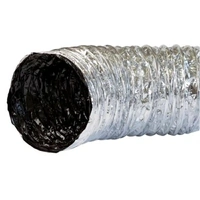
A ducting kit is needed when the fan must vent steam and air to an external wall, eave or roof vent. Discharging into the roof cavity is not acceptable as a long-term solution. It causes condensation on timber framing, soaked insulation, mould and visible ceiling staining over time. Typical ducting kit components include the flexible duct itself, an external grille or cowl, clamps, a wall or eave adaptor, and a backdraft damper where the model does not have one built in.
Best-practice placement puts the fan near the moisture source, with make-up air entering from the opposite side of the room where possible. Place the fan too close to a door and it short-circuits the airflow path, pulling fresh air straight under the door without clearing the shower zone. Shower recesses, large bathrooms and separate toilet rooms need more careful layout planning. A fan over the shower clears steam fastest, provided IP rating and zone rules allow that location.
Ceiling-mounted fans are the common choice for Australian bathrooms with ceiling cavity access. They give clean visual lines and short duct paths to eaves or external walls. Wall-mounted fans are useful where ceiling access is limited or where the shortest duct path is through an external wall directly behind the fan. Selection factors include wall structure, duct length, external termination position, room layout, waterproofing on the external side and electrician or builder access during installation.
Run-on timers extract residual moisture for a set period after the light or fan is switched off. Ceiling fan remotes can also control compatible exhaust fans where the model supports remote operation. Backdraft dampers, sometimes built into the fan housing and sometimes added inline, reduce reverse airflow when the fan is off. Bringing these accessories together with the fan in one order reduces the chance of a return trip mid-job, especially on multi-bathroom renovations where consistency across fittings matters.
Replacing an old bathroom exhaust fan often happens during a wider renovation or after the existing unit becomes noisy, weak or unreliable. Smart pre-purchase checks reduce the chance of an awkward install where the new fan doesn't fit the existing ceiling cut-out or duct. Planning a replacement also opens the option to upgrade rather than swap like-for-like.
Replacement checks cover the ceiling cut-out, fascia size, duct diameter, power connection type, airflow rating, fan depth, ceiling clearance, IP rating and whether the old fan was ducted externally. Old fans may have brittle ducting, missing dampers, undersized outlets or non-compliant roof-cavity discharge that should be corrected during the swap. Trade users should confirm product dimensions before quoting replacement labour, since cut-out mismatches add time on site that is hard to recover from a fixed quote.
A like-for-like replacement may be appropriate where the existing fan size, ducting and switching are adequate and the user only wants a quieter or newer unit. Upgrade scenarios include adding LED lighting, increasing airflow, adding timer control, improving ducting, reducing noise or correcting non-compliant discharge. Older bathrooms often benefit from upgraded ventilation during broader renovation work, especially when paint, tiles, cabinetry, bathroom heaters or mirror demisters are being refreshed at the same time.
Hands-on disconnection, connection, testing and compliance sign-off is licensed electrician work. The homeowner or builder can prepare the job by measuring the ceiling opening, photographing the existing fan, confirming roof or ceiling access and choosing desired features before the electrician attends. This preparation usually saves time on site and helps the electrician quote accurately. Do not attempt DIY removal of a hardwired fan, even where the ceiling looks accessible.
Burning smell, scorch marks, buzzing, a seized fan, repeated tripping of the circuit, water staining around the fitting, sudden rattling, excessive heat or exposed damaged wiring all require licensed inspection before further use. Switch the fan off at the wall and arrange an electrician visit. Continuing to run a faulty fan can damage ceiling finishes, cause electrical faults elsewhere on the circuit and create a fire risk that an early inspection would have avoided.
Bathroom exhaust fans need very little maintenance, but a small amount of attention every six to twelve months keeps airflow and noise at expected levels. Most performance complaints trace back to dust on the impeller, blocked external vents or compressed ducting, not the fan itself.
Dust buildup on the fascia and grille reduces airflow and increases noise. Switch off the power at the wall switch before any cleaning. Wipe the exterior grille and fascia with a damp cloth. Vacuum dust from accessible external surfaces using a soft brush attachment. Do not spray water into the fan, do not remove the cover from a hardwired fan, and do not attempt to clean inside the motor housing. Internal electrical components, hardwired connections and motor faults should be inspected by a licensed electrician.
Common causes include a loose fascia, debris in the blades, a damaged impeller, worn bearings, loose ducting, a vibrating backdraft damper, poor mounting or fan housing movement against the ceiling joists. Rattling soon after installation usually points to a mounting or ducting issue. Rattling after years of service usually points to wear on the motor or impeller. Arrange inspection before the fan fails completely or damages the surrounding ceiling opening, since both outcomes increase the repair cost.
Watch for lingering steam after showers and fogged mirrors that take longer than usual to clear. Other warning signs include mould returning soon after cleaning, damp patches on the ceiling, persistent odours, weak airflow at the grille or a fan that does not start consistently. Check the external vent is not blocked by leaves, paint or insect mesh. Confirm the ducting is intact and not compressed. Poor airflow is often a system issue across duct, vent and fan rather than a problem with the fan motor alone.
Warranty terms vary by model and should be checked on the product page or in the manufacturer documentation supplied with the unit. Keep proof of purchase, installation details and the model number on file for warranty claims. Trade buyers should confirm warranty coverage for residential, commercial or rental installations before specifying the same fan across multiple properties. Documentation matters most when a claim runs years after the original purchase, where the original invoice and install date can be hard to reconstruct.
Comparing Martec with other bathroom ventilation brands should focus on measurable factors rather than brand loyalty. The same room can be ventilated well by several brands when the right model is chosen. A structured comparison reduces wrong-product purchases and helps buyers understand the trade-offs between budget, mid-range and premium options.
Useful comparison factors are airflow rating, noise rating, IP rating, ceiling cut-out size, duct diameter, backdraft protection, integrated lighting, remote compatibility, warranty and Australian availability. Electricians can also compare installation time, accessory compatibility, available documentation and replacement-part suitability. Homeowners should compare room fit, long-term performance and total job cost rather than purchase price alone, since a cheaper fan with poor airflow can cost more to live with.
Budget exhaust fans may suit low-use rooms, but buyers should check airflow, noise, motor quality, warranty and whether ducting accessories are compatible. A cheaper fan can cost more overall if it is noisy, undersized, difficult to install or not matched to the room. Generic budget units sometimes lack proper documentation, making warranty claims and replacement-part sourcing harder later. Compare on measurable specs rather than headline price when the fan will run daily in a family bathroom.
Premium alternatives may include advanced humidity sensors, ultra-low noise ratings, in-line motor options or smart controls, with brands such as Mercator Lighting also stocking competing bathroom ventilation lines. Martec sits as a practical residential option where buyers want a balance of performance, familiar styling, installation practicality and accessible spares. The choice between Martec and a premium brand often comes down to whether the bathroom needs sensor-driven smart control or whether a well-sized standard fan with a timer will do the job. Match the brand to the room, not the room to the brand.
| Comparison Factor | What to Check | Why It Matters |
|---|---|---|
| Airflow rating | m3/h or L/s against room volume | Undersized fans cannot clear steam in time |
| Noise rating | dBA where listed, plus motor type | Comfort, especially in small bathrooms or ensuites |
| IP rating | Second digit covers water protection | Determines acceptable bathroom zone placement |
| Cut-out and duct size | Fan diameter, ceiling cut-out, duct outlet | Avoids extra ceiling rework on replacement jobs |
| Backdraft control | Built-in damper or external accessory | Stops reverse airflow, draughts and external odours |
| Warranty | Manufacturer warranty terms and Australian support | Cover for residential, rental or commercial use |
Buying online suits trade and DIY buyers who know what they need and want a clear spec match before checkout. Price is one factor, but ducting, accessories, warranty and dispatch matter just as much when the job is on a deadline.
Compare price alongside airflow rating, integrated lighting, accessories, ducting requirements, warranty, freight and stock availability. A lower upfront fan price may not include the ducting kit, remote, external grille or compatible switchgear needed to finish the job. Build a complete materials list before checkout. That avoids a second order for an external vent or backdraft damper that delays the bathroom by several days while the electrician is already booked in.
Typical trade buying scenarios include bathroom renovations, rental property maintenance, builder selections, multi-room upgrades, property management replacement work and small commercial amenities. Practical needs cover clear product specifications, bulk ordering where available, fast dispatch on common models, compatible accessories in the same order and proper invoice documentation for warranty claims later. A wholesaler that stocks the matching ducting and switchgear reduces split orders.
Run a final pre-checkout list to reduce returns and wrong-product purchases.
Watch MARTEC MXFLFR25W Flow Small Round 240mm Exhaust Fan with LED Tri Colour Light White video
Watch MARTEC MXFLFS25W Flow Small Square 240mm Exhaust Fan with LED Tri Colour Light White video
Watch Martec MBHT2000W Thermo Bathroom Ceramic Heater White video

Heaps of air flow. 100mm duct required to plumb to external eves. Looks a lot like a downlight which keeps the fittings very similar if you’ve got downlights elsewhere. Seperate 10A plugs for the fan and light made wiring easier than fans with combined switches.
Quick & Easy installation-Good Design
Flush fit, clean look, quiet operation
Light is bright enough for bath/toilet
Purchased 4 of this, Fast shipping from Sparky Direct
Exactly the right cutout and specs I needed,
Easy to order, friendly and prompt service,
Have and will continue to keep using sparkydirect!
Quality products in stock • Fast Australia-wide delivery • Competitive trade pricing
Browse Martec Exhaust Fans → Get Expert Advice →