

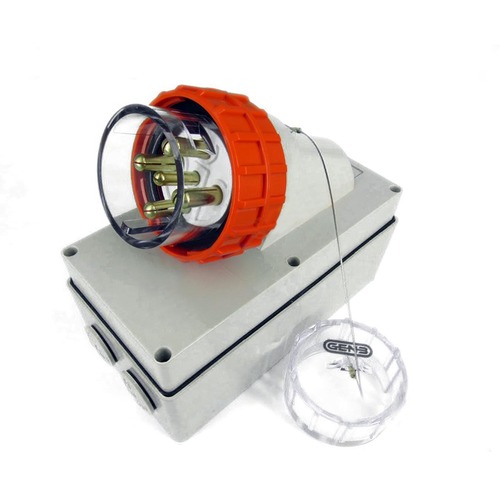

32Amp Inlet
NLS 30802 | Weather Protected Appliance Inlet | 5 Round Pins 32amp 500V IP66 (Grey/Orange)
$82.00
$74.55 ex. GST
Search Results:
Search Results:
A 5 pin appliance inlet is a permanently mounted male connector that lives on the equipment side of a three phase power connection. It is fitted to a machine cabinet, generator panel, control enclosure, switchboard, or portable site power unit. The inlet accepts a matching 5 pin plug attached to a flexible supply lead, so power can be quickly connected and disconnected without touching any fixed wiring.
The power pathway is straightforward. Supply leaves the source. It travels through the lead. The plug couples to the appliance inlet. From there, the conductors enter the equipment and feed the internal circuits. This arrangement keeps the fixed installation tidy while still allowing the connected equipment to be moved, isolated, or swapped out.
The fixed male connector format is what makes an appliance inlet different from a wall socket or an extension plug. A wall socket is a fixed female outlet on the supply side. A plug is a male connector on the lead. An appliance inlet is a male connector on the equipment side, designed to receive the female end of a supply lead.
You will hear the same component called several names on site: appliance inlet, panel inlet, equipment inlet, industrial inlet, and three phase inlet. They all refer to the same product family. Inlets are the right choice wherever a piece of equipment needs a secure but detachable supply, such as machinery that gets moved between bays or generators that connect to portable distribution.
The five conductors inside the connector are L1, L2, L3, neutral, and earth. The three actives feed any three phase load such as a motor or heater bank. Neutral supplies single phase circuits and the earth pin provides a protective fault path back to the supply.
The inlet itself is a passive component. It does not generate power and it does not replace circuit protection. The matching plug, lead, upstream protective device, and inlet must all carry the same current rating and suit the supply voltage. A weak link anywhere in that chain limits the safe capacity of the whole connection.
5 pin inlets show up wherever three phase equipment needs a removable connection. Common applications include generators, industrial machinery, compressors, welders, workshop equipment, mobile plant, site power units, temporary distribution boards, and control enclosures.
You will find them across construction, manufacturing, agriculture, mining, commercial facilities, event power, and maintenance environments. The five pin format is especially useful when equipment runs three phase loads alongside single phase control circuits, onboard lighting, or low voltage electronics that need a neutral reference.
The five pin layout exists because not every three phase load is purely three phase. Many machines combine a three phase motor with single phase control circuits that need a neutral. The 5 pin connector handles both inside one coupling, which keeps the cable count low and the connection simple.
L1, L2, and L3 carry the three phases that supply the three phase load. Neutral provides a return path for any single phase circuits inside the equipment. These often include control electronics, contactor coils, onboard lighting, and small auxiliary devices. Earth is the safety conductor that bonds exposed metalwork and provides a low impedance path for fault current.
Specific terminal identification, phase rotation, and wiring details belong with the licensed electrician completing the installation. The information above is for product selection, not field wiring.
A 4 pin inlet carries three actives and earth only. It suits balanced three phase loads that do not need a neutral, such as straight three phase motors. A 5 pin inlet adds the neutral, which is required for any equipment that draws single phase current from one of the phases. The equipment manual and the circuit design dictate which connector is correct. If you are not sure, check the equipment nameplate or speak to the manufacturer before ordering.
Sparky Direct stocks both formats. The 4 pin industrial range and the 5 pin industrial range are kept separate to make matching easier.
A 3 pin inlet is single phase. It carries one active, one neutral, and one earth. It is built for single phase equipment running at standard household and light commercial voltage. A 5 pin inlet is three phase and serves equipment that needs higher rotational power or larger total capacity.
Single phase and three phase supplies are not interchangeable, and compliant connector designs prevent accidental cross-connection. The pin counts, keying, and physical layouts are deliberately incompatible. If you need a single phase inlet, the 3 pin appliance inlet range is the correct starting point.
Industrial connectors sold for Australian installations are built around several key standards. Knowing which standards apply helps buyers compare products on more than just price and helps electricians confirm compatibility before specifying a part.
AS/NZS 60309 covers industrial plugs, socket outlets, couplers, and appliance inlets. The standard sets out voltage bands, pin arrangements, colour coding, keying positions, and ingress protection ratings. Compliant products with the same rating and configuration are designed to mate safely with each other regardless of manufacturer.
That cross-brand compatibility is one of the practical strengths of the standard. A site can mix brands across replacement cycles without worrying about coupling mismatches, provided the rating and configuration are identical.
AS/NZS 3000 governs how electrical equipment and circuits must be installed, protected, and tested in Australia. Installation, alteration, and testing of fixed electrical equipment must be carried out by a licensed electrician. The standard covers circuit protection, cable sizing, labelling, accessibility, and mechanical protection at a level that goes well beyond the scope of a category page.
This page is a product selection guide. Installation procedures and field wiring instructions are deliberately left to the qualified tradesperson on site.
Inlets sold for Australian installations should carry the appropriate regulatory compliance marking. Specifiers and trade buyers should check compliance details, especially when assessing low cost imports or unfamiliar brands. Non-compliant products can fail prematurely and create issues with safety, warranty, insurance, and legal liability if used on a regulated site.
Established brands such as Clipsal, NLS, Hager, HPM, and PDL publish compliance documentation that is straightforward to verify.
Wiring diagrams are useful reference material for electricians who need to confirm terminal identification, phase sequence, and any manufacturer-specific terminal layouts. They are not a substitute for licensed installation. Final wiring, testing, and energising must be completed by a licensed electrician working to the relevant standards and the manufacturer datasheet supplied with the product.
For trade buyers planning a job, the manufacturer datasheet is the most reliable single source of installation information for a specific product code.
Voltage and current ratings are the two specification numbers that drive most product selection. They have to match the supply, the protective device, the cable, and the connected equipment. A mismatch on any of those points results in either an unsafe installation or a unit that will not perform as expected.
Australian three phase equipment typically operates in the 400 to 415 volt AC band. The exact figure depends on the supply documentation and the equipment label. Supply frequency is 50 hertz. Voltage rating on the inlet must match the supply and the equipment specification, with a comfortable margin where required by the standards.
Common current ratings for 5 pin industrial inlets include 10 amp, 20 amp, 32 amp, 40 amp, 50 amp, 63 amp, and 125 amp. The current rating affects the physical size of the connector and the keying that prevents accidental cross-mating with a different rating. Higher current ratings are usually paired with heavier machinery, large compressors, welders, generators, and site distribution equipment.
Stock depth at each rating varies by brand and product family. The product listings show what is currently available across the standard rating ladder.
Selection is based on the equipment full load current, the upstream circuit protection, the cable capacity, the duty cycle, and the operating environment. The inlet rating must never sit below the rating of the protective device or the requirement of the connected equipment. A suitable engineering margin should be allowed where the standards or the manufacturer recommend it.
Final specification decisions belong with the licensed electrician or the qualified electrical designer responsible for the job. The spec sheet on each product page lists the rating and approval information needed for that decision.
Continuous current capacity is affected by ambient temperature, ventilation, enclosure heat, and sustained loading. Manufacturer derating data should be consulted for harsh environments. Examples where derating matters include engine rooms, enclosed generator housings, plant rooms, and outdoor metal enclosures sitting in direct sun. In those settings, a connector rated for an indoor benchmark may need to be sized up.
IP ratings indicate how well an enclosure resists solids and water. For appliance inlets, the rating applies when the cover is closed and the seals are intact. Once a plug is engaged, the assembly typically remains rated provided the connector pair was designed for it and installed correctly.
IP44 protects against solid objects larger than 1 mm and splashing water from any direction. It suits sheltered indoor locations. IP66 adds protection against heavy seas, powerful jets of water, and dust ingress, which makes it the common choice for exposed outdoor, dusty, or wash-down environments. IP67 adds short term immersion resistance, useful for areas with periodic flooding or heavy hose-down cycles.
For a deeper dive into related IP66 hardware, the IP66 isolator switch range uses the same protection logic in a slightly different form factor.
Higher IP ratings are appropriate for outdoor plant, food processing, agriculture, marine adjacent areas, mining, wash-down zones, and mobile equipment that lives outdoors. Sheltered indoor installations may not need the same level of protection, although stepping up one tier for future flexibility is often a small extra cost.
Site conditions are the deciding factor, not just the climate. A site that runs hose-down cleaning every shift will degrade lower rated equipment quickly even if the building is otherwise indoors.
The completed installation only performs as well as the lowest rated component or seal. Panel gaskets, O-rings, hinged covers, dust caps, gland seals, and the host enclosure all influence the final protection level. An IP66 inlet mounted into an IP44 enclosure with a poor cutout will not deliver IP66 in service.
Damaged seals, missing covers, and incorrect mounting orientation are the most common reasons for a rated assembly failing in the field. Routine inspection catches these issues before they cause downtime or damage.
5 pin appliance inlets come in several mounting and entry styles. Choosing the right format at specification stage saves rework and produces a tidier finished installation.
Panel mount inlets are the most common format on machinery panels, switchboards, control enclosures, generator panels, and distribution units. They install through a flange or mounting plate on the host enclosure, with a panel cutout that matches the body shape. A gasket seals the body to the panel face, which preserves the IP rating of the assembly when correctly fitted.
Panel mount is the right choice whenever the inlet forms part of the equipment housing rather than sitting on a separate bracket.
Surface mount inlets fix to walls, posts, fixed structures, distribution pillars, and outdoor supply points. They do not need a cutout, which makes them faster to install on solid surfaces. Conduit entry and cable entry locations vary by product, so checking the orientation against the available cable run is worth doing before ordering.
Common applications include construction site supply points, agricultural sheds, outdoor plant areas, and temporary service locations.
Angled and horizontal entry designs help manage cable routing in restricted spaces. They direct the connected lead away from the panel face at a fixed angle, which reduces strain on the cable and keeps cabinet doors clear of trailing leads. The result is a cleaner installation layout and easier access to the connection during maintenance.
Choosing the right entry style at specification stage avoids field modifications. The matching 5 pin angled plugs work well with angled inlets when the cable approach is awkward.
Heavy-duty variants use stronger housings, higher current ratings, more robust pins, better sealing, and UV stabilised materials. These features matter on industrial plant, large compressors, welders, mining equipment, and generator systems where the connector is exposed to vibration, mechanical impact, weather, or sustained heavy load.
Body material and current rating should be matched to the application rather than chosen on price alone. A connector rated for the right current but built from a material that fails in UV will end up costing more in replacements than the heavier duty option would have on day one.
Comparing inlets on price alone misses the parts of the spec that actually drive service life and reliability. A practical buying framework looks at compatibility, ratings, build quality, mounting format, environment, and stock availability together.
The core checklist covers voltage rating, current rating, pin count, IP rating, mounting style, body material, terminal type, cable entry, plug compatibility, compliance marking, and any required accessories. One mismatch on this list can make an otherwise good product unsuitable for the job. The most common avoidable mistake is ordering the wrong current rating because the existing connector was assumed rather than checked.
Confirming the connected plug and lead before ordering replacements removes most of the risk on like-for-like jobs.
The plug, inlet, lead, circuit protection, and equipment all need to work together as one rated system. Current rating must match across the components and the physical connector format must match exactly. Equipment manuals, site drawings, and existing connector markings are useful references for the electrician confirming the match.
For complete replacement chains, pairing the inlet with matching extension sockets and quality extension leads from the same family produces the most predictable result.
Common housing materials include thermoplastic, polycarbonate, and glass-filled nylon. Polycarbonate offers a good balance of impact resistance and clarity for inspection windows. Glass-filled nylon adds heat resistance and dimensional stability under load. The right choice depends on impact risk, UV exposure, and chemical exposure on site.
Terminal style matters for installation efficiency and long term reliability. Screw terminals are familiar and accept a wide range of conductor sizes. Cage clamp terminals reduce installation time and cope better with vibration. Pins, seals, flanges, covers, and locking mechanisms are all worth checking when comparing brands.
The strongest candidates for heavy-duty service combine the correct current rating, a high IP rating, a durable body material, reliable terminals, strong sealing, a suitable mounting format, and proven compliance with Australian standards. Typical applications include heavy machinery, generator panels, mobile plant, welding equipment, and site distribution boards.
No single product is universally best. The right inlet for a steel fabrication shop differs from the right inlet for an outdoor pump station. Matching the spec to the job is what separates a reliable installation from a recurring maintenance ticket.
Lowest unit price should not override compliance, correct rating, or durability. Total project cost includes service life, the cost of unscheduled replacement, and any downtime caused by a failed connector. Consistent product families across a site also reduce the spares inventory needed for routine maintenance.
Established trade brands such as NLS often deliver compliance and durability at a noticeably lower price point than premium brands, which is reflected in many of the customer reviews further down this page.
Specialist online electrical wholesalers are well suited to industrial connector purchasing because they typically carry the depth of current ratings, IP ratings, and mounting types needed for trade work. Generic retail outlets rarely stock the full ladder of options across a connector family.
Online ordering lets buyers compare product specifications against requirements before committing to a purchase. Stock availability, delivery location, and project timing all influence the practical lead time on a job. For replacement work, in-stock availability often matters more than headline price.
Bulk ordering makes sense for switchboard builds, equipment fleets, large installations, and rolling maintenance programs. Sticking with one consistent product family across a project simplifies installation, reduces installer errors, and keeps the spares inventory manageable. Allowing for spares, planned replacements, and damaged components is part of any well-planned procurement.
For larger orders, the Sparky Direct sales team can confirm volume availability and lead times before ordering.
The pre-checkout checks worth running every time include pin configuration, current rating, IP rating, mounting type, body dimensions, compatible plug type, compliance marking, and quantity. Verifying the spec against the site requirement at this stage prevents the most common cause of job delays: the wrong part landing on site.
A neutral buyer comparison comes down to a few practical signals. Range availability across ratings and formats matters first. Then transparent product detail on each listing, an Australian compliance focus, fast online ordering, suitability for trade buyers, and delivery coverage to the work site. These signals matter when evaluating any wholesaler, not just one supplier.
Related categories worth a look on the same site include 5 pin IP66 combination sockets, electric switchboards, and electrical enclosures for complete supply solutions.
This section covers what to plan and check around installation. It is not a wiring guide. The wiring itself is licensed work and the standards demand that it stays that way.
Installation of fixed 5 pin appliance inlets must be carried out by a licensed electrician. Electrical work must comply with AS/NZS 3000 and any state or territory legislation that applies to the site. Documentation, testing, and certification requirements vary by jurisdiction, with most requiring a certificate of compliance or equivalent record on completion.
The planning checks worth running before the inlet is even ordered include supply voltage, phase configuration, current rating, cable size, circuit protection, mounting surface, panel cutout dimensions, enclosure IP rating, and environmental exposure. Verifying these early prevents the most common ordering mistakes and reduces field rework.
Procedural wiring instructions are deliberately omitted here. The licensed electrician completing the install works to the standards and the manufacturer datasheet for the specific product code on the job.
Before energising, electricians verify continuity, insulation resistance, earth integrity, phase sequence, polarity, and mechanical fit according to the applicable standards and the manufacturer instructions. Test results are typically recorded on the installation documentation. Manufacturer datasheets list any product-specific test requirements that go beyond the standard checks.
Routine inspection of an installed inlet looks for overheating, discolouration, cracked housing, bent pins, damaged seals, loose mounting, corrosion, worn locking mechanisms, and any sign of water ingress. Damaged or overheated inlets should be removed from service and replaced. Field repair is rarely the right answer when the housing or contact set has been compromised.
Inspection frequency depends on the operating environment and the duty cycle. Outdoor and high vibration installations need more frequent checks than equipment in a controlled indoor environment.
Watch GWR GEN3AI532 | Appliance Inlet 5 Pin 32Amp IP66 500v Rated GEN 3 video
Watch NLS 66CV532 | 5 Pin 32Amp Switched Socket Outlet IP66 | 30495 video
Watch NLS 66P520 | 5 Pin 20Amp Straight Plug IP66 | 30476 video

This unit was installed for us for our CNC machine close to 3 years ago. In Feb. 2022 our facility went under with the floods. After a good clean up, guess what, the GWR GEN3A1532 is still working, good as gold!
Surprisingly Good Quality. We got stung on a job and bought from a well known Electrical Wholesaler in Melton Victoria. I just bought multiples of these items including plugs for a fraction of the price and they were just as good. Sparky Direct is now my preferred supplier for these items.
Recently purchased and installed this 5 pin 20A outlet and found it to be of the same high quality as the major brands. More than happy with the product. The service provided by Sparky Direct was also excellent. Will be using again for sure.
Quality products in stock • Fast Australia-wide delivery • Competitive trade pricing
Browse 5 Pin Appliance Inlets → Get Expert Advice →Yes. They provide a controlled connection point that helps reduce risks during servicing.
5 pin appliance inlets are available from Sparky Direct, offering access to reliable three-phase electrical products with Australia-wide delivery.
Delivery availability depends on the supplier and location, with options across metropolitan and regional Australia.
Yes. They are suitable for new installations, upgrades, and replacing existing appliance inlets.
Warranty coverage depends on the manufacturer and supplier, with conditions applying to correct installation and use.
Consider voltage and current rating, IP rating if required, mounting type, and electrician recommendations.
With proper installation and use, they are designed to provide many years of reliable service.
Yes. They are designed to handle frequent connection and disconnection.
Yes. When correctly installed, they are designed for long-term use in demanding environments.
They generally require minimal maintenance but should be inspected during routine electrical checks.
They are primarily intended for fixed equipment, with suitability depending on the application.
They have a practical, industrial design focused on durability rather than aesthetics.
Yes. They are widely used in commercial kitchens, workshops, and industrial facilities.
A 5 pin appliance inlet is a fixed electrical connection point designed to allow three-phase appliances or equipment to be safely connected to a power supply.
Yes. They are designed for straightforward connection and disconnection by qualified personnel.
Appliance inlets allow equipment to be disconnected for maintenance or replacement without altering fixed wiring.
Yes. Installation must be carried out by a licensed electrician to ensure safety and compliance.
Many models are surface mounted, making them suitable for exposed industrial installations.
Yes. They are designed to mate with compatible 5 pin appliance plugs of the same rating and configuration.
Voltage ratings vary by product and must be selected to suit the appliance and electrical supply.
Some models are rated for outdoor use, depending on their IP rating and installation conditions.
Yes. They are designed for industrial and commercial environments where robust three-phase connections are required.
Quality 5 pin appliance inlets supplied in Australia are designed to meet relevant AS/NZS electrical and safety standards when installed correctly.
They are commonly used for fixed industrial machinery, commercial equipment, and three-phase appliances.
A 5 pin configuration is typically used for three-phase power, including active, neutral, and earth connections.