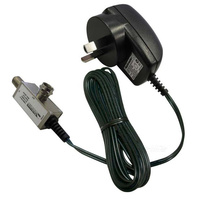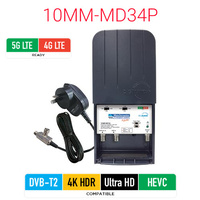

Search Results:
Search Results:
Search Results:
Search Results:
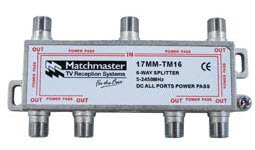
Find the best TV antenna splitter amplifier here at Sparky Direct. [ Read More ]
A splitter amplifier sits between the antenna and the TV outlets in a home or building. It does two jobs at once: it divides one incoming signal into multiple outputs, and it amplifies the signal to offset the loss that splitting always introduces. Without amplification, a single antenna feed split four ways can drop below the level needed for clean digital reception.
A TV antenna splitter amplifier accepts a coaxial input from the antenna or masthead, boosts the signal using an internal amplifier circuit, and distributes the result across two, three, four or eight output ports. The amplification stage typically delivers 10dB to 34dB of gain, depending on the model.
A passive splitter has no power supply and no internal amplifier. It simply divides the signal, and every split introduces measurable signal loss. An amplified splitter is powered, contains active electronics, and adds gain to compensate for that loss. The choice between the two depends on signal strength at the input and the number of outputs required.
In any installation with more than one or two TV points, splitter amplifiers are the standard solution for keeping picture quality consistent across every outlet. They are central to home distribution, apartment buildings, hotels, and any commercial setup with multiple screens fed from a shared antenna.
For Australian installers, the choice of supplier affects price, availability, brand range, and delivery speed. Sparky Direct is an online electrical wholesaler that supplies splitter amplifiers and related TV and data products directly to electricians, antenna installers, and trade buyers across Australia.
Electrical wholesalers carry compliance-grade products designed for installation by licensed cablers. AV retailers tend to focus on consumer-grade kit aimed at single-TV setups. For multi-TV distribution work, an electrical wholesaler is usually the better source for trade-grade Matchmaster, Clipsal and similar brands.
Trade buyers should look for verified stock levels, clear product specifications, support for trade accounts, and a brand range that covers the major Australian-compliant manufacturers. Access to related products such as coaxial cable, TV cable connectors, and signal finders from one supplier reduces job time.
Large jobs benefit from bulk pricing on splitters, cabling, and accessories. Sparky Direct ships across Australia with consolidated orders, which is useful for multi-room installs and apartment fitouts where dozens of components are needed at once.
Splitting a TV signal is not free. Every time the signal is divided, the available power at each output drops. Understanding how this loss works is the foundation of choosing the right device.
Signal strength is measured in decibels (dB). A 2-way passive splitter introduces around 3.5dB of insertion loss per output. A 4-way splitter loses about 7dB per output, and an 8-way splitter loses around 10.5dB per output. These figures include the theoretical division loss plus practical insertion loss from the splitter's internal components.
If your antenna feed delivers 60dBuV at the splitter input, a 4-way passive split leaves around 53dBuV at each TV outlet before any cable loss is added. Many TV tuners struggle below 50dBuV, so margins disappear quickly with longer cable runs or weaker incoming signals.
An amplified splitter adds gain to overcome these losses. A typical 4-way amplified splitter with 10dB of gain effectively cancels out the splitting loss, leaving each output at roughly the same level as the input. For larger systems or weaker source signals, higher-gain models are used.
Three device types are used to share a TV signal across multiple outlets. Each suits a different scenario.
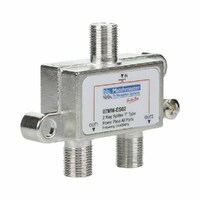
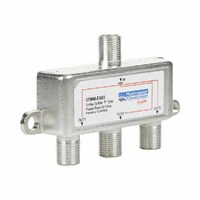
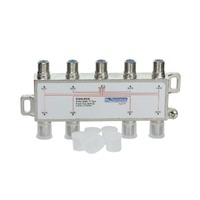
Passive splitters work well when the incoming signal is strong (above 65dBuV at the antenna feed) and the number of outputs is small. They have no power requirement, no electronics to fail, and typically last for the life of the building. Sparky Direct stocks passive options including 2-way splitters, 3-way splitters, 4-way splitters, and 8-way splitters.
Amplified splitters are the typical choice for homes with three or more TV points, weak signal areas, or long cable runs. The amplifier offsets splitting loss and gives consistent picture quality at every outlet.
Distribution amplifiers are higher-gain devices designed for buildings with many outlets. They typically deliver 20dB to 40dB of gain and are common in apartment blocks, hotels, and multi-storey commercial sites where the signal must reach a large number of TV points.
| Device Type | Typical Use | Power Required | Output Count |
|---|---|---|---|
| Passive splitter | Strong signal, 2 to 4 outlets | No | 2 to 8 |
| Amplified splitter | Standard residential, 3 to 8 outlets | Yes | 2 to 8 |
| Distribution amplifier | Apartments, hotels, large commercial | Yes | 4 to 24+ |
Gain figures only matter when matched to the specific installation. Too little gain leaves outlets weak. Too much gain overdrives the tuner and creates its own problems.
Gain is the amount of signal boost an amplifier adds, measured in decibels. A 10dB amplifier multiplies the signal power by ten, while a 20dB amplifier multiplies it by one hundred. The right gain figure depends on input signal strength, splitter loss, and total cable length.
For a typical 4-way home install with a moderate signal, an amplifier with 10dB to 18dB of gain is usually sufficient. For weak fringe-area signals or larger 8-way splits, a 25dB to 34dB amplifier or a masthead unit is the better choice.
Australian digital TV broadcasts in the UHF band (mostly 526MHz to 694MHz after the spectrum restack) and a small VHF Band III component. Splitter amplifiers must cover the relevant frequency range, and modern units include filtering to reject 4G and 5G mobile signals that overlap the upper edge of the old UHF TV band.
Adding too much gain pushes the signal level above what the TV tuner can handle. Symptoms include pixelation, dropouts, and sometimes complete loss of certain channels while others still work. If signals are already strong, a passive splitter is the correct solution.
Over-amplification warning: If the antenna is in a strong-signal area and a high-gain amplifier is added, the result is often worse reception, not better. Always measure signal strength before specifying an amplifier.
Splitter selection comes down to output count and how outputs are matched to TV points. Plan for current needs plus reasonable future expansion.
2-way splitters suit homes with a main TV and a bedroom outlet. 4-way splitters cover most family homes with TV points in lounge, bedrooms, and an outdoor area. 8-way splitters serve larger homes, apartment blocks, or commercial installs with multiple display points.
Count active TV points first, then add planned points. Always specify a splitter with at least the number of outputs needed. Unused outputs must be terminated with a 75-ohm terminator to prevent signal reflections, which can cause ghosting and dropouts.
It is usually cheaper to install a 4-way splitter for three current TV points than to upgrade later when a fourth point is added. Cabling work is the expensive part of any change, so leaving headroom in the splitter saves time and labour cost down the track.
All-port splitters provide an equal signal at every output. Tap-style splitters provide one strong main output and weaker tap outputs, which is useful when one TV is the primary viewing point, and others are secondary. Most residential and small commercial installs use all-port splitters for simplicity.
An amplifier boosts the signal but it also boosts the noise. The quality of what arrives at the splitter input determines what every TV downstream receives.
Amplifiers raise the level of whatever is on the input, including noise, multipath reflections, and interference. If the antenna delivers a poor signal, amplifying it produces a louder poor signal. The fix is at the antenna: better aerial, better aim, better location, or a masthead amplifier mounted at the antenna itself.
Signal-to-noise ratio (SNR) measures how clean the signal is relative to the background noise floor. Digital TV needs an SNR of around 20dB or better for reliable reception. Below that, error correction starts to fail and pixelation appears.
A digital TV signal finder is the standard tool for measuring signal strength and quality at the antenna and at each outlet. Sparky Direct stocks TV signal finders for installers who need accurate readings before specifying gain.
Where the antenna is a long cable run from the TVs, a masthead amplifier mounted at the antenna keeps SNR high before cable losses accumulate. This is the better option for long cable runs, weak fringe-area signals, or any install where the splitter sits more than 15 to 20 metres from the antenna.
Where the splitter sits in the system has a measurable effect on performance. The general rule is to amplify before significant losses, not after.
The ideal location is as close to the antenna feed entry point as practical, typically in a roof space, wiring cabinet, or central distribution point. Placing the amplifier near the antenna minimises cable loss before amplification.
Every metre of coaxial cable adds loss. RG6 cable typically loses 0.2dB per metre at UHF frequencies. A 30-metre run before the amplifier loses 6dB before the signal even reaches the amplifier input, so siting the amplifier near the antenna preserves SNR.
In larger installs, all coax runs feed back to one central data cabinet or distribution panel. The splitter amplifier sits in this central point, which makes future maintenance and upgrades straightforward.
Standard splitter amplifiers are designed for indoor or protected installation. Roof space placement is acceptable provided the unit is sheltered from direct moisture. Outdoor masthead amplifiers are weatherproofed for direct exposure at the antenna.
Cable choice has as much impact on signal quality as the splitter or amplifier. Substandard or aged cabling undoes the benefit of any active equipment downstream.
RG6 is the modern standard for digital TV distribution, with lower loss per metre and better shielding than older RG59. RG59 is still found in legacy installs but should be replaced in any new work. Sparky Direct stocks coaxial cable in trade lengths suited to multi-TV installs.
RG6 loss is roughly 0.2dB per metre at UHF frequencies. A 50-metre run adds around 10dB of loss. For long runs, either upgrade to a lower-loss cable specification, add a masthead amplifier at the antenna, or both.
Quad-shielded RG6 has four layers of shielding (two foil, two braid) instead of the standard two. It performs better in environments with electromagnetic interference, such as near electrical equipment, transformers, or industrial buildings.
F-connectors must be properly crimped or compressed onto the cable. Loose, corroded, or poorly terminated connectors cause intermittent signal loss that is difficult to diagnose. TV cable connectors and termination tools are available from Sparky Direct's TV and data range.
Active splitters need power. How that power reaches the unit affects installation flexibility and reliability.
Mains-powered amplifiers ship with a plugpack that connects directly to the unit. They are simple to install where a power outlet is nearby. The trade-off is the need for a GPO at the splitter location, which can be a constraint in roof spaces or wiring cabinets.
Some amplified splitters and most masthead amplifiers use power-over-coax. The power supply unit sits indoors near a power outlet, and DC power travels up the same coaxial cable that carries the TV signal. This avoids needing a GPO at the antenna or in the roof.
Plugpacks are the most common failure point in amplified splitters. Specifying a quality unit with a robust power supply, or a power-over-coax system with the supply mounted in a serviceable indoor location, reduces long-term maintenance.
For new builds, plan a GPO at the planned splitter location during the rough-in stage. For retrofits, power-over-coax is often the practical solution because it avoids running new mains cabling to roof or wall cavities.
Three amplifier types each solve a different problem. Larger or more complex installs use more than one in combination.
Splitter amplifiers are the standard choice for distributing one antenna feed across multiple TV points in a single building. They combine the splitter and amplifier in one indoor unit, which simplifies installation and reduces cabling complexity.
Masthead amplifiers mount at the antenna itself. They boost the signal before any cable loss occurs, which preserves SNR for long runs or weak signal areas. They are weatherproof, powered via the coaxial cable, and pair well with passive splitters indoors.
In-line boosters are small amplifiers inserted into a single coaxial run to compensate for cable loss. They suit single-TV runs that are too long for a passive feed but do not need full multi-output distribution.
In apartment buildings, a typical configuration is a masthead amplifier at the antenna plus a multi-way distribution amplifier or splitter at the building entry point. The masthead protects SNR over the long roof run, and the distribution amplifier handles the split across all units.
Selection comes down to matching the device specifications to the installation environment. The wrong choice creates picture problems that no amount of fault-finding will fix.
Residential installs typically use 2-way to 4-way amplified splitters with 10dB to 18dB gain. Commercial installs (hotels, clubs, large homes) use 8-way amplified splitters or full distribution amplifiers with 20dB to 40dB gain. Apartments often use a masthead at the antenna feeding multiple distribution amplifiers in the riser.
Australian-compliant brands include Digitek and Clipsal alongside Matchmaster. Compliance is shown by the RCM mark and conformity with applicable Australian standards.
Common mistakes include choosing too much gain (over-amplification), choosing too few outputs (forcing daisy-chained splitters), and ignoring noise figure (degrading SNR). Spec the device against actual measured signal strength, not assumed values.
Good installation technique is as important as device specification. Most reception complaints trace back to cabling and connector issues, not the splitter itself.
Measure signal strength and quality at the antenna feed before specifying any equipment. A signal finder shows actual dBuV at the antenna lead-in, which determines whether amplification is needed and how much.
F-connectors must be properly compressed or crimped, with the centre conductor extending the correct distance past the connector body. Loose terminations cause intermittent dropouts, particularly in temperature-cycling environments like roof spaces.
Every unused output port on a splitter should be fitted with a 75-ohm terminator. Open ports cause signal reflections that travel back through the splitter and degrade picture quality on all outputs.
After installation, run a channel scan on at least one TV and check signal strength on each outlet. Most modern TVs report signal strength and quality in the tuner setup menu, which is sufficient for verification.
Most splitter amplifier faults present as pixelation, dropouts, or complete loss of channels. The diagnostic process works backwards from the symptom.
Pixelation indicates either weak signal or excess noise. Check signal strength at each outlet first. If the affected outlet reads low, the issue is in the cable run or the splitter port. If all outlets read low, the issue is upstream at the antenna or amplifier input.
If channels at the high end of the band drop while others work, over-amplification is a likely cause. Try removing or reducing the amplifier and re-check. Some amplified splitters include adjustable gain (variable attenuators) for this reason.
Inspect F-connectors for corrosion, looseness, and broken centre conductors. Wiggle each connector while watching the TV for breakup. Replace any suspect terminations using fresh connectors.
If all outlets lose signal at once, suspect the power supply. Check the LED on the amplifier (most units have a power indicator). Plugpacks are the most common failure component and are usually replaceable as a separate part.
TV distribution systems are largely set-and-forget but benefit from periodic checks, especially after roof work, storms, or building modifications.
Inspect F-connectors annually in roof spaces for corrosion and looseness. Look for signs of rodent damage to cabling, which is a common issue in older homes.
Outdoor connections should be weatherproofed with self-amalgamating tape or proper boots. Moisture ingress at the antenna or masthead amplifier is a leading cause of progressive signal degradation.
If reception quality drops gradually over months or years, the amplifier may be degrading. Compare current signal readings to baseline measurements taken at installation, if available.
Re-scan channels every 12 months and after any broadcaster announcement of frequency changes. Australian digital TV has undergone several restacks since launch, and tuner channel maps need to keep up.
Splitter amplifiers range from budget consumer units to trade-grade equipment built for long service. The lifetime cost of a poor unit usually exceeds the upfront saving.
Budget amplifiers may work in benign installations but tend to fail earlier, particularly in heat-stressed roof spaces. Trade-grade units use better components, better shielding, and stronger power supplies. The premium is usually small relative to the labour cost of a callback.
A poorly performing splitter creates ongoing reception complaints, return visits, and customer dissatisfaction. The cost of one fault-finding callback typically exceeds the difference between budget and premium units.
Apartment fitouts, hotel projects, and aged-care developments benefit from bulk pricing on splitters, cabling, connectors, and outlets. Sourcing all components from one wholesaler reduces freight, simplifies invoicing, and avoids mixed-brand compatibility issues.
A quality splitter amplifier installed correctly should provide reliable service for 10 to 15 years or more. The cost per year of service is small, and the alternative (intermittent reception, repeat truck rolls, customer complaints) is expensive in any commercial context.
Splitter amplifiers appear in a wide range of installations. The right specification depends on building type, signal environment, and number of outlets.
Standard family homes with three to five TV points use 4-way amplified splitters with 10dB to 18dB gain. The unit typically sits in the roof space or near the meter board, fed from a roof-mounted antenna.
Apartment blocks use a centralised distribution system with a masthead amplifier at the rooftop antenna and 8-way or larger splitters at each floor riser. The communal antenna feeds all units through a structured cabling system.
Hotels, pubs, clubs, and aged-care facilities run distribution amplifiers feeding dozens of TV points. These systems often combine free-to-air with cable, satellite, or in-house video, requiring a more complex headend than a simple residential amplifier.
Retrofits often involve replacing aged passive splitters with amplified units to add new TV points without re-running cable. Signal testing before and after is essential to confirm the upgrade actually improved reception.
TV cabling work in Australia is regulated, and certain installation tasks require licensed trades. Understanding the boundaries protects both the installer and the end user.
The installation of fixed customer cabling that connects to the telecommunications network is regulated under the ACMA cabling rules. Splitter amplifiers fed from a roof antenna for free-to-air TV reception are not subject to the same registration requirements as telecommunications cabling, but related electrical work is governed by AS/NZS 3000:2018.
Where TV cabling integrates with telecommunications cabling (such as MATV systems in apartment buildings), an ACMA-registered cabler is required. For standard free-to-air domestic installs, an electrician or competent installer is typical.
Working in roof spaces requires care: heat stress, fragile ceiling materials, and proximity to live mains all present risks. Always isolate power before working near electrical equipment, and use appropriate PPE for confined or hot environments.
All electrical equipment sold in Australia must carry the Regulatory Compliance Mark (RCM), confirming compliance with applicable EMC, electrical safety, and telecommunications standards. Look for the RCM logo on splitter amplifier packaging or the unit itself.
Club Clipsal is Australia's largest electrician community offering trade rewards, business support, and exclusive benefits. When you nominate Sparky Direct as your preferred wholesaler, we automatically apply your Clipsal spend points to your Club Clipsal account daily.
Entry-level offering coaching, mentoring, and training discounts
Unlock exclusive industry tools and networking events
Access Toyota fleet offers and business software discounts
Maximum benefits, including VIP experiences and rewards
1. Sign Up: Create your Club Clipsal account at clipsal.com/club-clipsal or via the iCat mobile app
2. Nominate Sparky Direct: Select Sparky Direct from the wholesaler dropdown menu in your profile
3. Add Email: Enter your Sparky Direct account email address in the membership number field
4. Start Earning: Every dollar spent on Clipsal products earns points automatically
Redeem points from the rewards store, including gift cards, tools, and experiences. Access business summits, product training, and industry networking events. Receive early access to new product launches and special promotions. Connect with fellow electricians via the Club Clipsal community app.

Installed cheaper unbranded splitter and resulted in poor signal. Installed Matchmaster splitter and no signal issues anymore. Premium product that does the job. Highly recommended.
This is a high performance, good noise filtering amp. We have used it in our multi-dwelling building and it has performed well, along with a Matchmaster GM04 4-way splitter.
Wow..wired this beauty up and red lining! 100% Signal strength and quality, even after an downstream split! Recommended...For sure!
Quality products in stock • Fast Australia-wide delivery • Competitive trade pricing
Browse TV Antenna Splitter Amplifiers → Get Expert Advice →A TV splitter allows one antenna connection to supply multiple televisions.
Yes, over-amplifying a signal can cause distortion or signal problems.
Sparky Direct supplies TV splitters and amplifiers Australia-wide, offering reliable signal solutions with convenient delivery.
They are securely packaged and delivered via standard courier services.
Unused items are generally eligible for return according to the seller’s returns policy.
Warranty coverage varies by manufacturer and typically covers defects in materials or workmanship.
Yes, they are sold as individual components depending on the setup required.
Yes, signal and cabling issues should be assessed by licensed or registered cablers.
Splitters do not require power, but amplifiers usually do.
Yes, they are often used in multi-room TV setups.
They may help if pixelation is caused by weak signal, but not if interference is the issue.
They are usually hidden behind TVs or inside cabinets or ceiling spaces.
Yes, they are commonly used behind walls or in roof spaces for clean installations.
Can too much amplification cause issues?
An amplifier is useful when signal strength is weak or when multiple TVs are connected.
A passive TV splitter divides the signal from the antenna equally between the connected TVs. This can lead to a loss of signal quality, especially if multiple TVs are connected. An active TV splitter amplifies the signal before it is divided, which helps to prevent signal loss.
They are commonly used in both homes and commercial buildings.
Yes, amplifiers are often used before or after splitters to maintain signal strength.
Yes, outdoor amplifiers are weather-resistant and designed for external installations.
TV splitters are available with various output options, commonly 2-way, 3-way, or 4-way.
Many products are designed to meet relevant AS/NZS cabling and signal performance standards.
Amplifiers can improve picture quality if signal strength is weak, but they cannot fix poor signal sources.
Yes, modern TV splitters are designed to support digital free-to-air TV signals.
Splitting a signal can reduce strength, which is why amplifiers are often used when connecting multiple TVs.
A splitter divides one TV signal into multiple outputs, while an amplifier increases signal strength to reduce signal loss.
TV splitters and amplifiers are used to distribute television signals to multiple devices and boost signal strength where required.
You will need the following tools to complete a professional installation.
The best place to put a TV splitter is as close to the antenna as possible. This will help to prevent signal loss.
The number of TVs you can connect to a single antenna depends on the type of splitter you use. A passive splitter can typically support up to four TVs, while an active splitter can support up to eight TVs.