
Search Results:
Search Results:
Search Results:
Search Results:
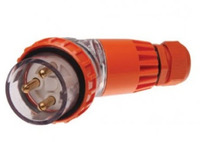
Find the best Industrial 3 Pin Angled Plugs here at Sparky Direct. [ Read More ]
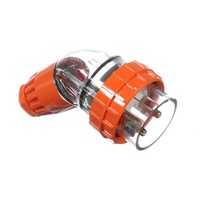
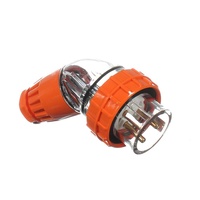
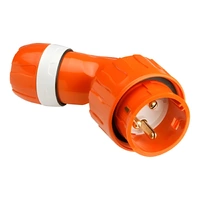
Industrial plugs are weatherproof connectors built to handle higher currents and harsher conditions than standard domestic plug tops. The 3 pin angled version uses a right-angle body that turns the cable 90 degrees to the pin axis, which keeps the cable tight against the equipment or wall surface. They are commonly fitted to portable tools, generators, pumps, and trailing leads on construction sites and in workshops.
The IP66 rating means the plug body is dust-tight and protected against powerful water jets when correctly assembled and mated to a compatible socket. The pins carry current through the connection, while the rubber gland and body seal block water and dust from reaching the live terminals. The angled body simply changes cable direction without affecting the electrical performance.
A 3 pin plug carries single-phase 230V supply: active delivers current to the load, neutral provides the return path, and earth bonds the equipment frame to ground for fault protection. The earth pin is longer than the others so it makes contact first and breaks last. This sequence keeps the equipment chassis bonded throughout the connection cycle.
Angled plugs solve a practical problem: cables hanging off straight plugs catch on edges, kink at the gland, and pull outward from sockets mounted on walls. The right-angle exit holds the cable flat, reduces the lever effect on the body, and protects the gland seal from repeated flexing.
Both types have the same electrical rating and IP66 protection. The difference is purely mechanical. A straight plug projects the cable directly away from the socket, which suits installations where the cable runs out into open space. An angled plug routes the cable parallel to the socket face, which suits wall-mounted sockets, tight enclosures, and cable management on mobile equipment.
The IP code defines how much protection an enclosure provides against solids and liquids. The first digit covers solid ingress, the second covers water. For industrial plugs and sockets, IP66 is the standard rating in Australia.
IP66 means the enclosure is dust-tight and protected against high-pressure water jets from any direction. Translated to a plug, this allows safe use in rain, in wash-down areas, and on outdoor equipment exposed to hose cleaning. The rating only applies when the plug is correctly mated and the gland is tightened to the cable.
Dust ingress is blocked by the moulded body and the rubber sealing rings between the plug and socket. Water ingress is blocked by the same seals plus the cable gland at the rear. If the gland is loose or the cable is undersized for the gland, water tracks down the cable and into the terminal chamber.
| Rating | Solid Protection | Water Protection | Typical Use |
|---|---|---|---|
| IP66 | Dust-tight | Powerful water jets from any direction | Outdoor industrial, wash-down, exposed equipment |
| IP67 | Dust-tight | Temporary immersion to 1 metre | Equipment subject to brief submersion |
For most Australian industrial plug applications, IP66 is the working standard. IP67 only adds value where the plug body could be briefly submerged, which is rare in normal portable equipment use.
IP66 does not cover continuous immersion, pressure-washing at extreme close range, or use with damaged seals. The rating also assumes the plug is fully engaged. A partly inserted plug loses its sealing surface and lets water in around the pins.
Selecting the correct rating starts with the load current and the supply voltage. A plug must match or exceed the equipment current draw, and the cable size must match the plug terminal capacity.
3 pin angled industrial plugs are commonly available in 20A and 32A ratings. Match the plug to the maximum continuous current of the connected equipment. A 32A plug is suitable for larger single-phase loads such as compressors, large pumps, and welders. A 20A plug suits medium portable equipment and smaller workshop machines.
Australian single-phase supply is 230V at 50Hz. Industrial 3 pin plugs sold for the Australian market are rated for this supply. Verify the plug body marking matches the supply before installation.
The cable size must carry the rated current and fit the gland and terminal cavity. A 20A plug typically accepts cable up to 4mm². A 32A plug typically accepts cable up to 6mm². Oversized cables will not seat properly under the gland; undersized cables overheat at the terminals. Pair the plug with a matching cable gland if external sealing is required at the equipment end.
Check the equipment nameplate for current draw and required supply. Match the plug rating to the nameplate, then check the cable specification supplied by the equipment manufacturer. Where the equipment is supplied without a fitted plug, the licensed electrician selects the plug to match both the equipment and the source socket.
Industrial plugs are built differently from domestic plug tops. The body, contacts, and seals are specified for repeated insertion, exposure to weather, and rough site handling.
Plug bodies are typically moulded from glass-reinforced nylon or thermoplastic with high impact resistance. The material resists cracking when dropped on hard surfaces and tolerates UV exposure on outdoor sites without becoming brittle.
Internal pins and terminals are brass or copper alloy with surface plating to resist corrosion. Terminal screws are sized to clamp full-rated cable cores without crushing the strands. Heat resistance is set by the body polymer and the cable insulation, not the metalwork.
The cable gland sits at the rear of the plug body and compresses around the cable sheath when tightened. A rubber compression ring forms the seal. The gland must be tightened firmly enough to grip the sheath but not so hard that the rubber tears or the cable insulation deforms.
Reliability depends on the seal staying intact and the contacts remaining clean. Plugs left disconnected and exposed should be capped or stored to keep dust and moisture out of the contact chamber. Periodic inspection catches cracked bodies and damaged glands before they cause faults.
Selection comes down to four checks: current rating, environment, cable size, and physical clearance. Each check rules out unsuitable products before pricing matters.
Indoor workshop equipment with controlled conditions has different needs from outdoor pumps in coastal locations. The plug specification stays the same in both cases, but the inspection schedule and gland tightness checks become more important in salt-air environments.
For indoor dry use, IP66 is more than required but does no harm. For outdoor use, IP66 is the working standard. For harsh conditions such as salt spray, abrasive dust, or chemical exposure, IP66 still applies but expect shorter service life and add inspection points to the maintenance routine.
The angled body shines where cable management matters. On wall-mounted sockets the cable drops down the wall instead of projecting outward. On portable generator sockets the angled exit keeps the lead off the ground. On equipment panels the plug tucks in close to the casing.
3 pin angled industrial plugs cover most single-phase portable power needs across construction, manufacturing, trade, and outdoor work.
On construction sites, temporary power leads run from site distribution boards to tools, lights, and small machinery. Angled plugs reduce trip hazards by keeping cable runs flat to the source rather than projecting outward into the work area.
Workshops use 20A and 32A circuits for compressors, welders, dust extraction, and bench machinery. The angled exit on plugs fitted to wall sockets keeps the cable run vertical, away from spillage paths and forklift wheels.
Pumps, irrigation controllers, and outdoor lighting circuits often run from weatherproof isolator switches through IP66 plugs and sockets. The IP66 rating on the plug works with the isolator rating to maintain weather protection across the whole connection.
Maintenance teams often have a kit of leads with different plug types. The angled 3 pin sits alongside 3 pin straight plug versions and other 4 and 5 pin options for three-phase work. Standardising on one supplier across the kit simplifies replacements.
A correctly installed plug holds its IP66 rating for years. Most failures trace back to errors at installation rather than product defects.
Strip the cable sheath and core insulation to the lengths marked on the plug body or in the manufacturer instructions. Core insulation must reach inside the terminal cavity, with bare conductor only at the screw clamp. Tighten terminal screws to the specified torque.
Pass the cable through the gland nut and gland body before terminating. Once cores are landed, slide the gland forward and tighten the gland nut. The rubber seal compresses around the sheath. Check the seal grips the sheath, not the inner cores.
The gland provides strain relief when correctly tightened. The cores inside the plug should have a small amount of slack so that any tug on the cable pulls against the gland, not the terminals. Sharp bends right at the cable entry shorten the life of the sheath.
After assembly, the licensed electrician carries out continuity, insulation resistance, and earth integrity checks. The plug then goes back into service. Periodic test and tag inspection picks up wear and damage during the service life.
Industrial plugs are part of the fixed and portable wiring system, so they sit under the same compliance requirements as the rest of the installation.
Installations must comply with AS/NZS 3000:2018, the Wiring Rules, including provisions for plug and socket connections, earth continuity, and circuit protection. Plug and socket products sold in Australia carry approval marks confirming compliance with the relevant product standards.
The earth conductor protects against shock if a fault energises the equipment frame. Correct termination at the earth pin, plus continuity through the cable to the equipment chassis, is the difference between a contained fault and a serious incident. Earth continuity is verified at installation and at each periodic test.
Overload causes terminal heating, which in turn damages insulation and seals. The right-rated plug for the load, on a properly protected circuit, keeps the connection cool. Loose terminals are a common cause of heating, so the screw torque check at installation and at periodic test is not optional.
In Australia, fitting a plug to a flexible cable that supplies 230V or higher is electrical work and must be done by a licensed electrician. DIY plug fitting is not permitted on mains-rated equipment. Sparky Direct supplies the trade and licensed contractors.
Both plug types do the same electrical job. The choice between them is about cable routing, mechanical stress, and the geometry of the install.
An angled plug exits parallel to the socket face. This routes the cable across rather than away from the wall, which suits flush mounting and tight enclosures. A straight plug exits perpendicular to the socket face, which suits free-air installations where the cable runs into open space.
On a straight plug, gravity and incidental cable movement put a bending load on the gland and the cable sheath right at the entry point. On an angled plug, the right-angle body absorbs some of that movement, which reduces wear on the sheath and gland over time.
| Scenario | Better Fit | Reason |
|---|---|---|
| Wall-mounted socket, vertical cable run | Angled | Cable drops down wall, no projection |
| Floor or panel socket, free-hanging lead | Straight | Cable runs into open space cleanly |
| Generator panel with limited clearance | Angled | Plug tucks in close to panel face |
| High-flex extension lead | Straight | Symmetrical bending in any direction |
Use angled where the cable needs to lie flat against a surface or where clearance is tight. Use straight where the cable runs into open space or where the lead is flexed in multiple directions. Many trade kits carry both types so the right plug is on hand for the install.
An IP66 plug is a long-life component when matched to the application and maintained on schedule. Service life depends more on installation quality and inspection than on initial purchase price.
The IP66 seal holds up against wet and dusty environments when the gland is tight, the cable sheath is undamaged, and the plug is fully engaged with a matching socket. Disengaged plugs left exposed lose their protection until they are mated again.
The angled body keeps the cable away from the socket face, which reduces flex fatigue at the gland. Cables lasting longer between replacements directly reduce maintenance cost on portable equipment.
Inspection points on a plug include: body cracks, gland tightness, sheath condition at the gland, contact discolouration, and earth pin integrity. A periodic test and tag schedule catches each of these before they cause a fault.
Cheap non-compliant plugs fail early, often in ways that damage the connected equipment or create safety incidents. The cost of a quality industrial plug is a small fraction of the lead it terminates and a tiny fraction of the equipment it powers. Matching the plug specification to the application is the best value decision.
Most plug failures are caused by a small set of recurring installation errors. Each one is preventable with care at termination and a torque check before service.
Loose terminals heat under load. Heat damages the body polymer, the cable insulation, and the contact plating. Tighten terminals to the specified torque, then re-check after the first heating and cooling cycle.
The gland seal must compress on the cable sheath, not the inner cores. Stripping too much sheath leaves the cores exposed inside the gland, breaking the IP66 seal. Stripping too little jams the cores against the gland.
A 20A plug on a 25A continuous load runs hot, even if the breaker does not trip. The contacts and terminals soften, and the seal degrades. Always rate the plug at or above the maximum continuous current, never below.
A plug rated IP66 still needs the right install. Mounting a plug where it sits in a puddle, or where a hose stream hits it directly at close range every shift, shortens life even at the rated protection. Choose the install location with the same care as the plug.
Plug pricing varies by brand, current rating, and pin configuration. The right comparison is between like-for-like products at the same rating, not the lowest price across all options.
Pricing depends on rating and brand. 20A units typically sit below 32A units. NLS and Clipsal are the dominant brands in this category. Sparky Direct lists current pricing for each variant on the IP66 3 pin industrial outlets and sockets range.
Site fit-outs and trade kits often need multiple units across ratings. Trade buyers purchasing in volume work with the supplier on consistent pricing across ratings rather than negotiating each line separately.
Non-compliant or grey-import plugs may carry the IP66 marking without meeting the rating in service. The risks are seal failure, contact heating, and safety incidents. Purchasing through a recognised electrical wholesaler closes off this risk.
Trade counters carry stock for immediate pickup. Online wholesalers carry wider catalogues with next-day or two-day delivery to most Australian metro and regional areas. The right channel depends on urgency and the size of the order.
Sparky Direct ships nationally, with stock held on common rated lines for same-day or next-day dispatch. For project orders, confirm availability of all required ratings before scheduling the install.
The buying decision starts with the project specification, not the catalogue. Pin down the loads, the cable sizes, and the install conditions first, then select the plug.
List each piece of equipment requiring a plug, its current draw, and the cable size already in place. The plug rating equals or exceeds the load. The plug terminal accepts the cable. The plug type matches the install geometry.
Look for the IP66 rating clearly marked on the body, the current rating, and the manufacturer name. Australian-market plugs from established brands such as NLS and Clipsal meet the relevant standards.
Order enough for the install plus spares. Spares cover damaged units during fit-out and replacements during the early service life. A small buffer on each rating is cheaper than emergency reorders mid-job.
Sparky Direct stocks 20A and 32A 3 pin angled industrial IP66 plugs with national delivery. The category sits within the broader industrial outlets and sockets range, which also covers 4 pin angled industrial plugs for three-phase loads and matching extension and switched socket products. For project advice on rating selection or stock availability, contact the team via the contact page.
Club Clipsal is Australia's largest electrician community offering trade rewards, business support, and exclusive benefits. When you nominate Sparky Direct as your preferred wholesaler, we automatically apply your Clipsal spend points to your Club Clipsal account daily.
Entry-level offering coaching, mentoring, and training discounts
Unlock exclusive industry tools and networking events
Access Toyota fleet offers and business software discounts
Maximum benefits, including VIP experiences and rewards
1. Sign Up: Create your Club Clipsal account at clipsal.com/club-clipsal or via the iCat mobile app
2. Nominate Sparky Direct: Select Sparky Direct from the wholesaler dropdown menu in your profile
3. Add Email: Enter your Sparky Direct account email address in the membership number field
4. Start Earning: Every dollar spent on Clipsal products earns points automatically
Redeem points from the rewards store, including gift cards, tools, and experiences. Access business summits, product training, and industry networking events. Receive early access to new product launches and special promotions. Connect with fellow electricians via the Club Clipsal community app.
Watch NLS 66PA320 | 3 Round Pin 20Amp Angled Plug IP66 video
Watch NLS 66PA332 | 3 Round Pin 32Amp Angled Plug IP66 video
Watch CLIPSAL EY56P310 | 3 Pin Flat 10 Amp Straight Plug IP66 | Easy56 video

I have been using these type of plugs for many years, they provide good service, while keeping water & dust out if installed correctly, then tightened properly when plugging in. Great for caravans, camper, and boat shorepower plugs
Personally I like the Clipsal brand and appreciate there are other models out there (have used some), however I find these are easier to work with in the installation, and hold up well when placed on equipment and electrical leads that are out in the field daily.
I needed this for a fish pond filter. Sparky Direct was the only place I could find the right plug for the job. Delivered in a day or so and the fish are now happy and healthy.
Quality products in stock • Fast Australia-wide delivery • Competitive trade pricing
Browse 3 Pin Angled Industrial Plugs → Get Expert Advice →Yes. The angled design reduces bending stress, which can help extend cable lifespan.
3 pin angled plug industrial IP66 products are available from Sparky Direct, offering access to durable industrial electrical connectors with Australia-wide delivery.
Delivery availability depends on the supplier and location, with options across metropolitan and regional Australia.
Yes. They are suitable for new installations, upgrades, and replacing existing industrial plugs.
Warranty coverage depends on the manufacturer and supplier, with conditions applying to correct installation and use.
Consider voltage and current rating, IP rating, cable size, installation environment, and electrician recommendations.
With correct installation and use, they are designed for long service life in harsh conditions.
They generally require minimal maintenance but should be inspected during routine electrical checks.
Yes. They are designed to withstand repeated connection and disconnection in demanding environments.
Yes. They are often used to supply power to portable tools and fixed equipment.
Yes. They are commonly used in agricultural and rural settings due to their weather resistance.
They feature a robust industrial design that prioritises durability and protection.
Yes. The IP66 rating makes them suitable for wash-down areas and dusty industrial sites.
A 3 pin angled plug industrial IP66 is a heavy-duty electrical plug designed for industrial use, featuring an angled cable entry and high protection against dust and water.
Yes. They are designed for secure yet straightforward connection by trained personnel.
They provide reliable power connections while protecting against dust, water, and physical stress on the cable.
Yes. Termination and installation must be carried out by a licensed electrician to ensure safety and compliance.
Yes. They are designed to mate with matching 3 pin industrial sockets of the same rating and configuration.
Ratings vary by model and must be selected to suit the electrical supply and connected equipment.
Yes. The IP66 rating makes them suitable for outdoor and wash-down environments when installed as specified.
Angled plugs help manage cable direction, reduce strain on the cable, and suit installations with limited space.
They are commonly used in workshops, factories, agricultural sites, outdoor installations, and industrial equipment connections.
Products supplied in Australia are designed to meet relevant AS/NZS electrical and safety standards when used correctly.
A 3 pin configuration is typically used for single-phase power, including active, neutral, and earth connections.
IP66 means the plug is fully protected against dust ingress and resistant to strong water jets, making it suitable for harsh environments.