
Search Results:
Search Results:
Search Results:
Search Results:
Find the best industrial outlets & sockets here at Sparky Direct. [ Read More ]
Industrial connectors carry the loads that residential outlets cannot. Electricians, contractors and site managers use them to run machinery, welders, compressors, pumps and three phase distribution. The housings, contacts and seals are designed to take impact, dust, vibration and weather on a daily basis. Sparky Direct stocks a complete industrial supplies range covering fixed wall outlets, equipment plugs, appliance inlets, extension-style connectors and switched combinations.
The category spans single phase 10A units through to 32A and 40A three phase systems. Each connector type performs a distinct role within a power circuit. Choosing the correct combination of plug, inlet and socket keeps equipment matched to the supply, the site environment and the relevant Australian standards.
Industrial outlets and residential GPOs are built for different jobs. Industrial units carry higher current ratings, use mechanical locking systems, seal against dust and water, and survive impact, UV and chemical exposure on site. Standard domestic GPOs are rated for indoor household use at 10A only, with no provision for locking, weather sealing or three phase supply.
A workshop welder, a generator inlet on a portable switchboard or a 32A EV charging point cannot legally or safely run from a domestic GPO. Matching the connector type to the duty cycle, the environment and the equipment rating plate is essential. The wrong choice causes overheating, contact damage and potential fire risk.
The three components form a complete circuit. A socket outlet is the fixed supply point, mounted to a wall, switchboard or surface. A plug is the mobile connector fitted to a lead or piece of equipment. An inlet is the receiving connector mounted on equipment, a portable switchboard, a generator or a caravan, where power flows in rather than out.
Voltage, current rating, pin configuration and IP rating must match across all three. A 15A 3 pin plug will not engage with a 20A 4 pin socket, and a single phase inlet cannot accept a three phase plug. The matching system is deliberate, since mismatched ratings would create a serious safety hazard if forced.
Industrial connectors appear wherever portable or heavy-duty equipment connects to mains or generator supply. Common uses include workshop welders, air compressors, dust extractors, pumps, mixers, food processing equipment, mining support gear, farm sheds, event power distribution, EV chargers and temporary builder boards on construction sites.
Caravan, marine and motorhome users also rely on industrial-grade inlets and plugs for reliable shore power connections. The same products see service in commercial kitchens, mechanical workshops, agricultural sheds and emergency generator changeovers. Each application calls for a specific current rating, pin count and IP class drawn from the wider category.
Sorting out what each product does helps narrow the buying choice before comparing prices. The industrial outlets range at Sparky Direct breaks down into five main families, each suited to a particular role in the circuit. Knowing which family you need first makes the rest of the selection much faster.
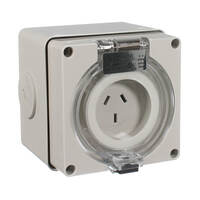
Fixed industrial sockets mount to walls, surfaces, panels and switchboards. Sparky Direct stocks both single phase and three phase versions across 3 pin, 4 pin and 5 pin configurations. Indoor units carry lower IP ratings while weatherproof versions reach IP66 for harsh outdoor exposure. Surface-mounted sockets dominate workshop installations, while flush switchboard-mounted units suit distribution boards and panel builds.
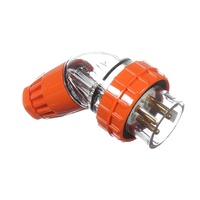
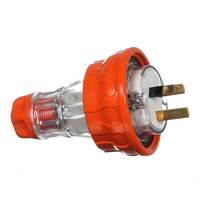
Portable plugs fit equipment leads and temporary distribution cables. The category includes straight plugs and angled plugs, with the angled body reducing cable strain in tight spaces. Correct cable entry matters: the gland must grip the cable diameter listed by the manufacturer, the strain relief must be tightened to specification, and the flexible cord must match the current rating of the plug.
Inlets receive power, rather than supply it. They mount to generators, portable switchboards, caravans, motorhomes and any equipment that draws external supply. Sparky Direct carries both 3 pin appliance inlets and 5 pin appliance inlets across the common amperage ratings. The locking ring on industrial inlets stops the plug from being pulled out under vibration or accidental tugs.
Interlocked units combine a socket with an isolating switch in a single enclosure. The mechanism prevents the plug from being inserted or removed while the switch is on, which eliminates arcing under load. Sparky Direct stocks switched combinations across 3 pin, 4 pin and 5 pin formats. The safety benefit is significant in workshops, sheds and sites where staff or apprentices may operate plant during a shift.
Every industrial connector is built for a specific voltage, current rating and phase arrangement. The rating plate on the equipment dictates the matching connector. Trying to fit a plug onto a circuit it was not designed for will either fail to engage or cause overload, overheating and contact damage. The four key factors below drive every selection decision.
Australian mains delivers 230V single phase and 415V three phase from the same network. Single phase covers most workshop tools, smaller machinery and caravan supply. Three phase runs welders above about 15A, larger compressors, hoists, CNC plant, three phase EV chargers and any motor designed for balanced phase rotation.
A three phase load drawn through a single phase outlet will not function correctly and will likely damage the motor windings. Three phase equipment must only connect to a properly rated three phase circuit, sized and protected by a licensed electrician. Confirm phase rotation where motor direction matters.
Current rating determines the heaviest load a connector can carry continuously. Light-duty 10A and 15A units handle portable tools, small machinery and general use, with 15A widely used on caravan and small workshop circuits. Workshop plant, larger machinery and site distribution typically sit at 20A or 32A.
High-current 40A products cover larger machinery and high-draw three phase loads. Buyer guidance: 10A and 15A for lighter trade gear, 20A and 32A for workshop, site and machinery use, 40A for heavy-duty industrial plant. Match the connector rating to the equipment rating plate, not the available cable size.
Pin count and arrangement indicate how many active conductors, neutral and earth conductors the connector carries. A 3 pin connector handles single phase active, neutral and earth. A 4 pin unit covers three phase active, active, active and earth. A 5 pin unit adds neutral to the four-pin layout for three phase plus neutral systems.
Pin configurations are not interchangeable. Forcing or modifying a pin layout defeats the safety design and creates a fire and shock hazard. Always match the pin count and orientation to the equipment rating plate and the existing circuit design.
Australian industrial connectors commonly follow IEC-style colour conventions tied to voltage and frequency. Red identifies 400V three phase systems, blue identifies 230V single phase, yellow identifies 110V circuits often used on construction sites internationally. Australian 56 Series products typically appear in grey, orange or red housings depending on the application.
Colour is a quick visual guide, not a substitute for checking the printed voltage and current rating. Always verify the markings on the body of the connector before installation.
The IP (Ingress Protection) code tells you exactly how well a connector resists dust and water. The first digit covers solids, the second covers liquids. For industrial outlets the common ratings range from IP44 for protected indoor splash zones up to IP66 and IP67 for direct exposure to dust and high-pressure water. The right rating depends on where the connector lives day to day.
IP44 resists solid objects above 1mm and water splash from any direction. It suits protected indoor areas, light splash exposure and sheltered locations. IP56 adds protection against dust ingress and powerful water jets, which suits more exposed external walls and washdown zones.
IP66 takes the protection further: complete dust tightness and resistance to heavy water jets from any direction. This is the standard for most weather-exposed industrial outlets stocked at Sparky Direct, including the Clipsal 56 Series and the NLS 66 range. IP67 adds temporary immersion resistance, suited to very wet or flood-prone areas.
"Waterproof" is a loose term. An IP66 outlet is highly water resistant when the lid is closed and the cable entry is properly sealed. The same outlet may lose protection if the lid is left open, the gland is loose or the wrong cable diameter is used. Performance also drops when a plug is inserted, since the seal then depends on the plug-to-socket interface.
Outdoor and wet-area installations should always be assessed by a licensed electrician. The electrician confirms the IP rating is adequate, the installation method preserves that rating, and the circuit protection suits the environment.
A dry indoor workshop can run IP44 or IP56 connectors safely. A dusty agricultural shed needs IP66 to keep particulate out of the contacts. An outdoor wall in southern Australia typically calls for IP66 to handle wind-driven rain.
Construction sites face mud, water, impact and abrasive dust, so IP66 is the practical baseline. Washdown areas in food processing and commercial kitchens push toward IP66 or IP67 to handle pressure cleaning. Coastal sites face salt-laden air, where housing material matters as much as the IP rating.
Australian electrical standards exist to protect installers, end users and property. Industrial connectors must comply with the relevant product standard and be installed under the wiring rules. Compliance is not optional, and uncertified imported products carry real risk for both the installer and the end user.
AS/NZS 3123 covers plugs, socket outlets and couplers for industrial purposes. It defines pin configurations, mechanical strength, electrical performance and IP test requirements. Products sold for fixed industrial use should carry markings that show compliance with this standard.
AS/NZS 3000, known as the Wiring Rules, governs the installation itself. It covers circuit protection, cable sizing, earthing, environmental suitability and the testing required before energising a circuit. The Wiring Rules apply to every installation involving these connectors, from a single workshop outlet to a full site distribution board.
The Regulatory Compliance Mark (RCM) shows that an electrical product meets the relevant Australian standards and has been registered through the national database. Buying RCM-marked products from established suppliers gives traceable compliance documentation if a problem arises later.
Uncertified imports from marketplace listings are a known risk in the industrial connector space. The fittings may look correct but fail under load, with no recourse for the buyer or installer. Sticking to RCM-approved product from a reputable wholesaler removes that risk.
Australian law requires that fixed wiring work, including the installation or alteration of industrial socket outlets, plugs hardwired to equipment, inlets and the supporting circuits, must be completed by a licensed electrician. This applies in every state and territory. DIY installation of fixed industrial connectors is not permitted.
The licensed electrician confirms the cable size, protection devices, IP class and earthing arrangement are correct, then tests the circuit before energising. Sparky Direct supplies the products only and does not provide wiring instructions; the installer takes responsibility for the work performed.
Two connectors with the same rating and IP class can still perform very differently in service. The housing material, the contact metallurgy and the cable entry design all drive how long a connector lasts in a workshop, shed or site environment. Looking past the rating sticker shows where the real quality lives.
Most industrial connectors use reinforced plastics, polycarbonate or nylon. Polycarbonate offers high impact strength and good UV stability for outdoor mounting. Nylon resists chemicals and abrasion well, which suits agricultural and mechanical workshop use. Some heavy-duty units use metal housings for the toughest applications.
UV rating, impact rating and temperature range matter for outdoor and exposed installations. A housing that becomes brittle in summer sun is a safety problem, not a cosmetic one.
Internal contacts are typically brass, often plated to resist corrosion and reduce contact resistance. Good contact pressure and clean mating surfaces keep the resistance low. High resistance creates heat, heat damages the housing and the cable insulation, and the connector fails. Reliable contact design is one of the clearest markers of a quality industrial connector.
Arcing marks on contact faces are a serious warning sign. They indicate switching under load, contact wear or undersized cable, and the connector should be replaced.
The cable entry is where IP rating is most often lost in the field. The gland must match the cable outer diameter listed in the manufacturer's specification. Too loose and water enters, too tight and the cable jacket is damaged. Strain relief should be set so the cable cannot be pulled through under normal handling, removing stress from the conductor terminations.
Check the cable diameter and gland compatibility before purchase, especially when fitting a plug to an existing lead.
Selection comes down to nine factors that need to line up before the purchase decision is made. Working through the checklist in order avoids the common mistake of ordering on price first and discovering compatibility problems on site. The same checklist applies whether the connector is being added to new equipment, replacing a damaged unit or specifying a full site distribution build.
Fixed industrial sockets are permanently wired into the building and protected by the switchboard. Portable connections include equipment plugs, leads and temporary distribution units assembled with industrial connectors. Both have a place on site.
Portable electrical equipment used in Australian workplaces falls under the inspection and testing regime in AS/NZS 3760. That applies to leads and any plug-and-lead equipment used commercially. The fixed installation falls under AS/NZS 3000 and is the licensed electrician's responsibility.
Construction sites need durable housings, IP66 protection as a baseline, RCD-protected distribution and connectors that are easy to replace quickly. The RCD-protected switched socket range covers the common ratings for builder boards and site distribution. Plan stock levels for fast on-site replacement, since damaged plugs and sockets are routine on a working site.
Test and tag schedules apply to portable leads under workplace law. Site rules typically set inspection frequency tighter than the legal minimum.
Workshops often need a mix of single phase and three phase connections to suit different tools. A welder, a compressor and a three phase machine each call for a different connector. The 4 pin switched socket combinations stocked at Sparky Direct handle three phase loads with the safety of integrated isolation.
Industrial switch sockets are a sensible choice for sheds and workshops where multiple people, apprentices or visiting trades use the power points. The interlock removes the risk of arcing when a plug is pulled while equipment is still running. IP66 housings handle the dust and grime typical of a working shed without breaking down.
Price comparisons across industrial connectors only make sense when the underlying specification is matched. A cheap 32A socket without RCM markings is not the same product as a Clipsal or NHP unit with the same nominal rating. Looking at compliance, construction and supplier support gives a fair comparison.
Quality markers include RCM compliance and AS/NZS approval, consistent moulding with no flash or weak spots, and firm contact pressure. Other markers include robust lid seals on weatherproof units, UV-stable housings on outdoor products, clear and durable rating markings, and the availability of spare gaskets or replacement parts. These signals separate genuine industrial-grade product from look-alike imports.
Reviewing the contact design and the gland fit tells you more than the catalogue photo. Quality manufacturers publish full datasheets with cable size ranges and torque specifications.
Clipsal is the dominant premium brand in Australian industrial installations, with the 56 Series and Easy56 ranges fitted across workshops, sites, marinas and commercial buildings nationwide. The higher price reflects long service life, consistent build quality, full compliance documentation, system compatibility across a wider product family and strong trade familiarity. These factors reduce risk on a job and make Clipsal the default specification for many electricians.
National Light Sources (NLS) delivers compliant industrial product at a lower price point. The NLS 66 Series covers plugs, sockets, inlets and extension sockets across the common single phase and three phase ratings. NLS suits cost-sensitive jobs, replacement stock and high-volume site purchases. Match the brand to the duty cycle, the warranty expectation and the budget rather than picking one brand for every situation.
Buying online from Sparky Direct gives full stock visibility, transparent pricing, fast delivery anywhere in Australia and access for sole traders who do not have a trade account at a local wholesaler. Order history and quick reorders save time on repeat jobs. The full Easy56 switched socket combinations range and the Easy56 straight and angled plugs range are visible side by side, with current prices and availability shown clearly.
Before ordering, verify the certification, confirm cable and pin compatibility with what is already installed, check stock availability for the quantity needed, and review the returns policy. The same checks apply whether buying online or over the counter.
Standardising on common ratings across a project keeps stock simple and replacement fast. Sparky Direct supports bulk ordering with trade-friendly pricing and quick Australia-wide delivery. Holding a small project stock of the most common ratings, such as 15A 3 pin and 32A 5 pin, removes the wait when a damaged connector needs replacing mid-job.
Small businesses, sole traders and larger contractors can all order through the same online checkout. Regional delivery to construction sites and rural workshops uses the same network.
Club Clipsal is Australia's largest electrician community offering trade rewards, business support, and exclusive benefits. When you nominate Sparky Direct as your preferred wholesaler, we automatically apply your Clipsal spend points to your Club Clipsal account daily.
Entry-level offering coaching, mentoring, and training discounts
Unlock exclusive industry tools and networking events
Access Toyota fleet offers and business software discounts
Maximum benefits, including VIP experiences and rewards
1. Sign Up: Create your Club Clipsal account at clipsal.com/club-clipsal or via the iCat mobile app
2. Nominate Sparky Direct: Select Sparky Direct from the wholesaler dropdown menu in your profile
3. Add Email: Enter your Sparky Direct account email address in the membership number field
4. Start Earning: Every dollar spent on Clipsal products earns points automatically
Redeem points from the rewards store, including gift cards, tools, and experiences. Access business summits, product training, and industry networking events. Receive early access to new product launches and special promotions. Connect with fellow electricians via the Club Clipsal community app.
Installation work on fixed industrial connectors is licensed electrician territory. The information below covers the planning and product-side considerations only, since detailed wiring instructions sit outside what a supplier should publish. Understanding the broad steps helps the person specifying the job ask the right questions of their electrician.
Before installation, the electrician confirms the current rating of the connector matches the circuit protection. The cable size must suit the load and the run length. The enclosure must suit the environment, and the product documentation must match what is being installed. Product certification, batch markings and any supplied gaskets are checked against the datasheet.
For three phase work, phase rotation is verified before energising. For wet-area installations, the IP rating is checked against the actual exposure rather than the nominal rating shown in the catalogue.
Commissioning a new industrial outlet involves insulation resistance testing, earth continuity testing, polarity verification and functional testing under load. These tests follow the methods in AS/NZS 3000 and are performed by the licensed electrician. The results are recorded in line with state and territory requirements.
Documenting the test results matters as much as the test itself. The record protects the installer and the end user if a question arises later about the installation.
Portable industrial leads, extension leads and plug-and-lead equipment used in Australian workplaces fall under AS/NZS 3760 for inspection and testing. The standard sets minimum test frequencies based on the work environment, with construction sites and harsher environments tested more often than general office areas. Site rules and state codes may set tighter intervals.
The inspection covers the plug, the cable, the socket end and the equipment connection. Any damage to the housing, exposed conductor, loose pins or scorch marks is grounds for immediate replacement.
Replace any industrial connector that shows visible damage. Warning signs include a cracked housing, a broken lid or hinge, a loose plug-to-socket fit, and heat discolouration around the contacts. Other red flags are a damaged cable entry or gland, corroded or pitted pins, arcing marks on the contact faces, or any unreliable connection during use.
None of these are cosmetic problems. Each one signals a developing fault that will worsen with use. Continuing to run a damaged connector risks equipment damage, downtime, fire and personal injury.
Generally no. Standard home appliances ship with 10A 3 pin plugs designed for residential GPOs. Industrial plugs and sockets use different pin layouts, locking mechanisms and current ratings. Fitting an industrial plug to a domestic appliance, or running a domestic appliance from an industrial outlet, is only acceptable when the equipment, plug, outlet and circuit are correctly rated and legally installed.
A three phase outlet delivers higher power than single phase, distributed across three live conductors with a neutral and earth. The arrangement runs three phase motors smoothly, supports larger machinery, and supplies high-draw equipment such as larger welders, CNC plant, three phase EV chargers and commercial appliances that single phase cannot power efficiently.
Only where the load, environment or equipment requires it. A shed running small power tools and lighting may need only standard weatherproof GPOs. A shed housing a welder, compressor, three phase machinery or a workshop setup is a different case. Industrial switch sockets suit those situations because they handle higher loads, weather sealing and safe switching under load.
Outdoor industrial sockets usually need IP66 as a baseline in Australia. The rating handles dust ingress and heavy water spray driven by wind. Coastal, washdown or flood-prone sites may push the requirement to IP67. The installation method and gland fit must preserve the rating in service, since a poorly fitted IP66 unit performs no better than IP44.
Yes, when appropriately rated and installed. Construction sites need IP66, RCD protection, robust housings and connectors that survive impact and dust. The Sparky Direct industrial outlets range includes products built for site conditions, with switched and RCD-protected options for builder boards and temporary distribution.
A fair price comparison includes the current rating, IP class, brand reputation, RCM and AS/NZS approvals, material quality, warranty terms, stock availability and delivery time. Two sockets at different prices may look identical in the listing but differ significantly in build quality and compliance documentation. Confirm the underlying specification before the price comparison is made.
Watch NLS 66CV532 | 5 Pin 32Amp Switched Socket Outlet IP66 | 30495 video
Watch NLS 66P532 | 5 Pin 32Amp Straight Plug IP66 | 30478 video
Watch NLS 30801 | Weather Protected Appliance Inlet | 3 Round Pins 32amp 500V IP66 (Grey/Orange) video

This was used to replace the standard caravan/RV 15 amp 240v input which never really holds the plug very well. The plug always works itself loose or gets kicked off. However this problem is now permanently resolved by replacing it with the Clipsal EY56AI315. It’s waterproof and takes a positive locking connection that will never accidentally fall off.
Recently purchased and installed this 5 pin 20A outlet and found it to be of the same high quality as the major brands. More than happy with the product. The service provided by Sparky Direct was also exceptional.
Bought for our 7.4Kw EV charger. Fast shipping, easy to deal with. Our electrician had no problem installing and we used it that night. Solid.
Quality products in stock • Fast Australia-wide delivery • Competitive trade pricing
Browse Industrial Outlets → Get Expert Advice →