
Search Results:
Search Results:
Search Results:
Search Results:
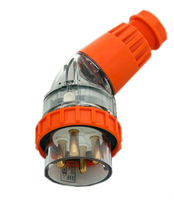
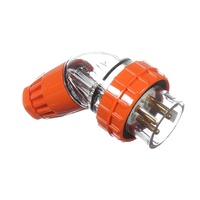
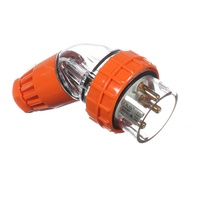
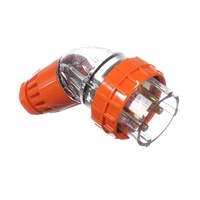
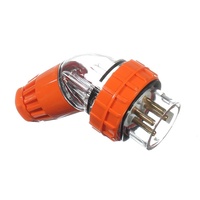
Find the best 4-pin industrial angled plugs here at Sparky Direct. [ Read More ]
A 4 pin industrial plug is a heavy duty connector built to AS/NZS 3123 for three-phase loads that do not require a neutral conductor. The four contacts carry three active phases plus a dedicated earth. The body is moulded from impact resistant plastic, sealed to IP66, and fitted with a screw-on coupling ring that mates with the corresponding industrial socket.
Three-phase power delivers three alternating voltages offset by 120 degrees. In a 4 pin configuration, all three phases connect to the load and the fourth pin returns earth to the supply. This setup suits balanced loads such as three-phase motors, where the windings draw equal current from each phase and the neutral path is not needed.
The angled body exits the cable at 90 degrees to the pin axis. This keeps the cable flat against the wall or panel, removes the lever effect that wears straight plugs, and prevents the cable from bending sharply at the gland. The result is reduced cable strain, fewer broken cores at the entry, and a tidier installation in switchrooms, plant rooms, and on equipment skids.
Traditional counter-based wholesalers stock common ratings but often charge trade list prices and limit hours to weekdays. Online specialist suppliers carry a deeper range of ratings, brands, and matching accessories. These include 4 pin extension sockets, 4 pin straight plugs, and 4 pin switched socket combinations. Prices are visible upfront.
A reliable supplier displays the brand, model number, current rating, voltage rating, IP rating, and cable entry size on every listing. Stock should be held in an Australian warehouse with same-day or next-day dispatch. Compliance documentation, including RCM numbers, should be available on request, and customer reviews should reflect consistent product quality.
For larger projects, contractors can request trade pricing and bulk quotes on multiple cartons. Fast Australia-wide dispatch matters when a generator hookup or switchboard refit is on a tight schedule. Sparky Direct ships from Brisbane and offers competitive trade pricing across the full industrial supplies range.
The plug carries male pins arranged in a fixed pattern that only mates with a socket of the same configuration. A keyway prevents incorrect insertion. Once seated, a threaded coupling ring screws onto the socket body, drawing the gasket against the mating face and forming the IP66 seal.
Each active pin carries one phase of the supply. With a balanced three-phase load, the current divides evenly across the three phases and the earth pin carries no current under normal operation. The earth path provides a low-impedance fault return so that protective devices can clear an earth fault quickly.
A plug must match its socket on three counts: pin count, current rating, and voltage rating. A 4 pin 32A plug will not mate with a 5 pin 32A socket because the pin patterns differ. A 20A plug should never be forced into a 32A socket because the pin diameters differ and the contact pressure becomes unsafe.
A straight plug carries the cable away from the socket along the pin axis. If the cable hangs or is pulled sideways, the load bends the cable at the gland and over time the cores can fracture. An angled plug exits the cable at 90 degrees, transferring the load along the cable run rather than through the gland.
Straight plugs add length equal to the plug body plus the cable bend radius. In a switchboard cupboard, behind a machine, or under a workbench, this clearance is often unavailable. An angled plug sits flush, leaving the wall-to-cable depth at roughly the plug body length only.
Choose angled when the cable will run downward, sideways, or behind the equipment. Choose straight when the cable run is unobstructed and the plug sits in open air. For a comparison of options, browse the full industrial outlets and sockets range.
| Feature | Angled Plug | Straight Plug |
|---|---|---|
| Cable exit direction | 90 degrees to pin axis | In line with pin axis |
| Strain at cable gland | Low (load runs along cable) | Higher (lever effect on gland) |
| Wall clearance required | Plug body depth only | Plug depth plus bend radius |
| Best use | Tight spaces, vertical drops | Open mounting, horizontal runs |
4 pin plugs suit three-phase loads that do not need a neutral. Three-phase motors, three-phase resistive heaters, and balanced three-phase rectifiers all run from L1, L2, L3, and earth alone. Removing the neutral pin reduces cost, simplifies wiring, and matches the equipment terminal layout.
5 pin plugs add a neutral conductor and suit mixed loads where some circuits run single-phase from a phase-to-neutral connection. Three-phase distribution boards that feed both motor circuits and 230V single-phase outlets need the neutral. Always check the equipment nameplate before selecting between 5 pin industrial outlets and sockets and 4 pin equivalents.
Fitting a 4 pin plug to equipment that needs a neutral leaves the neutral conductor disconnected. Single-phase loads inside the equipment will then float at unpredictable voltages, damage components, or trip protection. Conversely, a 5 pin plug used on a 4 pin only socket will not mate at all and the keyway will block insertion.
Industrial 4 pin plugs are commonly available in 10A, 20A, 32A, and 50A ratings. The rating refers to the continuous current the contacts will carry per phase under normal operating conditions. Ratings step up in coordination with cable sizes and circuit protection.
The plug rating must equal or exceed the full-load current of the equipment. A three-phase compressor drawing 28A per phase requires a 32A plug, not a 20A plug. Selecting the next size up provides headroom for ambient temperature, harmonic content, and minor overload.
Three-phase motors draw between five and seven times their full-load current at start. The plug contacts handle this transient because the surge lasts only a few seconds. The protective device upstream, not the plug, must be selected to ride through the start-up profile without nuisance tripping.
Australian three-phase distribution operates at 415V line-to-line and 240V line-to-neutral. Industrial 4 pin plugs are designed to handle the 415V phase-to-phase voltage across all combinations of pins.
Most quality industrial plugs carry a 500V rating, providing a safety margin above the nominal 415V system voltage. This margin accommodates voltage rise at the supply transformer, switching transients, and short-term voltage swings without compromising insulation integrity.
AS/NZS 3123 sets the dimensional, electrical, and performance requirements for industrial plugs and sockets used in Australia. AS/NZS 3100 covers general electrical safety for low-voltage equipment. Together, these standards define the test regime that any plug sold for industrial use must pass.
The IP code rates protection against solids and liquids. IP44 resists splashing water from any direction. IP55 adds dust protection and copes with low-pressure water jets. IP66 blocks dust completely and withstands powerful water jets. IP67 adds short-term submersion protection.
| IP Rating | Solids Protection | Liquids Protection | Typical Use |
|---|---|---|---|
| IP44 | Objects above 1mm | Splashing water | Indoor sheltered |
| IP55 | Limited dust ingress | Low-pressure jets | Workshop, light industrial |
| IP66 | Dust tight | Powerful water jets | Outdoor, wet processing |
| IP67 | Dust tight | Temporary submersion | Below-grade, washdown |
Indoor switchrooms with controlled temperature can use IP44 or IP55. Workshops with dust, swarf, or occasional washdown need at least IP55. Outdoor sites, wet processing plants, and any location with high-pressure cleaning need IP66. IP67 suits below-grade pits and locations subject to short-term flooding.
For exposed installations, IP66 is the practical minimum. The seal between the plug and socket relies on a clean gasket and a fully tightened coupling ring. A loose ring or a damaged gasket reduces the rating significantly, regardless of the marked IP value on the body.
For a construction site exposed to rain and dust, choose IP66 or higher. For an indoor switchboard, IP44 may be adequate. When in doubt, specify IP66: the cost premium is small and the protection margin is substantial.
Quality industrial plugs use polycarbonate or glass-filled nylon for the body. Both materials resist impact, withstand extended UV exposure, and operate across a wide temperature range. Glass-filled nylon adds rigidity, useful for plugs that see frequent connection and disconnection cycles.
The IK rating measures resistance to mechanical impact. IK07 covers a 2 joule impact, IK08 covers 5 joules, and IK10 covers 20 joules. Plugs intended for construction sites and mobile plant should carry at least IK08 to survive accidental drops and bumps.
Some plug designs include a transparent housing or hinged inspection cover. This allows the electrician to verify terminal tightness and confirm correct phase termination without unbolting the plug. The feature is particularly useful on hire equipment and frequently relocated installations.
Industrial plugs accept a range of cable diameters at the entry point. The bundled cable gland or compression nut must match both the plug entry thread and the cable outside diameter. Common entry sizes include 20mm and 25mm thread. For dedicated cable management accessories, see the cable gland range.
Each phase conductor terminates at its dedicated terminal inside the plug. The earth conductor connects to the marked earth terminal. Phase rotation must be consistent through the installation so that motors run in the correct direction when energised. Reversing two phases reverses motor rotation.
The internal cable clamp grips the cable sheath, not the conductors. The clamp prevents tension on the cable from being transmitted to the terminal screws. A correctly tightened clamp leaves no visible movement when the cable is pulled firmly by hand.
Wiring an industrial plug onto a flexible cable is electrical work under state and territory regulations across Australia. The work must be performed by a licensed electrician and tested before energisation. DIY installation is not permitted, regardless of the property type.
Compliance Note: Industrial plug installation must comply with AS/NZS 3000:2018 (Wiring Rules) and AS/NZS 3123. Only a licensed electrical worker can legally terminate, install, and certify the work.
AS/NZS 3123 specifies the dimensions, current ratings, voltage ratings, and test requirements for industrial plugs and socket outlets. Compliance ensures that plugs from any compliant manufacturer mate correctly with sockets from any other compliant manufacturer at the same rating and configuration.
Industrial plugs sold in Australia must carry the Regulatory Compliance Mark (RCM). The RCM confirms that the supplier has tested the product against the relevant Australian standard and registered the compliance with the regulator. The mark appears on the plug body or its packaging.
Plugs imported without RCM certification may look identical to compliant products but can fail in service. Common failure modes include undersized contacts that overheat at rated current, brittle housings that crack on impact, and gaskets that lose elasticity within months. Insurance claims following a fire or shock incident traced to non-compliant equipment are routinely denied.
Confirm the equipment full-load current from the nameplate, then select a plug with a matching or higher rating. Confirm the system voltage is 415V three-phase. The plug voltage rating, usually 500V, should sit comfortably above the system voltage.
Match the IP rating to the installation environment. Indoor sheltered locations can use IP44, but most three-phase applications justify IP66 for the small extra cost. Pits, washdown bays, and locations subject to flooding need IP67.
Measure the outside diameter of the flexible cable. Order a plug with a gland that brackets this diameter in its sealing range. Select the angle direction (left, right, or down exit) that suits the cable run on the equipment.
Common errors include ordering a 5 pin plug for a 4 pin socket, undersizing the rating, and overlooking the cable entry size. Cross-check the socket type, the equipment current draw, and the cable diameter before placing the order.
Plugs on hire equipment, mobile plant, and construction site distribution may see hundreds of mate-and-unmate cycles per year. Quality plugs maintain contact pressure and seal integrity across at least 5,000 cycles. Budget plugs can lose their seal within a few hundred cycles.
Contacts heat under load. Quality plugs use brass or bronze contacts with high conductivity and stable spring temper. The contact heating at rated current should remain below 45 degrees Celsius above ambient when measured per AS/NZS 3123.
UV exposure, salt air, oils, and cleaning chemicals all attack plug housings over time. Polycarbonate handles UV well, glass-filled nylon resists chemicals, and good gaskets maintain elasticity across the operating temperature range. Specify materials suited to the site.
Brands with established RCM compliance, published test data, and a track record of warranty support carry less risk than unbranded imports. Pay the small premium for traceable manufacture on equipment that powers critical processes.
Symptoms include intermittent operation, visible damage at the cable entry, and conductor strands broken inside the plug body. The cause is usually excessive mechanical load on the cable. Replace the plug, fit a strain relief loop, and reconsider whether an angled plug suits the cable run better than a straight one.
An undersized plug runs hot, discolours the housing, and softens the contact carrier. Measure the actual current draw at the plug and confirm the plug rating. Replace with a plug rated above the measured current and investigate why the equipment draws more than expected.
If a plug will not seat fully in a socket, do not force it. Confirm the pin count, current rating, and pin pattern match. Mismatched ratings have different pin diameters that prevent insertion. Use the correct socket from the matching rating range, such as a 4 pin extension socket for a portable supply.
Cracked housings, perished gaskets, and corroded contacts indicate end of service life. Once the seal is compromised, the IP rating is void. Replace the plug rather than attempting field repair.
Inspect plugs at least annually, or after any incident that could have damaged the cable or housing. Look for cracks, discolouration, deformed pins, and damaged gaskets. Check that the coupling ring still tightens fully against the socket.
Open the plug body and confirm the cable clamp still grips the sheath firmly. Tug the cable to check for movement at the clamp. Confirm each terminal screw is still tight and that no conductor strands have escaped the terminal.
Wipe the plug body with a damp cloth and mild detergent. Avoid solvents that attack polycarbonate. After cleaning, confirm the gasket sits flat in its groove and shows no cuts, tears, or compression set.
Replace plugs that show housing damage, contact discolouration, gasket failure, or repeated nuisance disconnection. A plug used on a heavy duty mobile circuit may need replacement every two to three years. A plug on a permanent installation can last a decade if undisturbed.
Electricians fit and replace industrial plugs as part of new installations, machinery commissioning, and breakdown repairs. Stocking common ratings (20A and 32A) on the truck reduces return trips and downtime for the customer.
In-house maintenance teams need spare plugs to match every connector type used on site. A spare parts policy that lists each plug rating and quantity reduces emergency procurement during breakdowns.
Site distribution for construction, events, and mobile plant relies on industrial plugs and matching extension leads. Plugs and sockets in this service must be rated for portable use and inspected before each redeployment.
Large projects pre-order plugs by the carton, matched to the cable schedule. Buying in volume from a single source reduces price per unit and ensures that all plugs on site come from the same compliant batch.
Budget plugs from unbranded sources can cost half the price of compliant equivalents. The saving disappears at the first failure: a single tripped circuit or damaged piece of plant costs more than a carton of quality plugs. Specify RCM-compliant brands as the default.
Industrial plug failures cause downtime, equipment damage, and in worst cases fire or shock. The cost differential between a budget and a quality plug is small in the context of total project cost or annual maintenance budget.
Sites running multiple three-phase circuits should buy plugs by the carton in standard ratings. Bulk pricing typically reduces per-unit cost by 10 to 25 percent and ensures spares are on hand for fast replacement.
A quality plug installed correctly delivers a decade of service in a permanent installation. Even on hire equipment, quality plugs typically outlast budget alternatives by a factor of three or four. The lifecycle cost favours quality every time.
Watch NLS 66PA432 | 4 Round Pin 32Amp Angled Plug IP66 | 30627 video
Watch NLS 66PA420 | 4 Round Pin 20Amp Angled Plug IP66 | 30473 video
Watch NLS 66SCS410 | 4 Pin 10Amp Extension Socket IP66 | 30526 video

Website was smooth and easy to use. Best pricing for this product compared to competitors and freight was quick. Great quality.
Fast Service and great quality product. I ordered this in the afternoon and it was shipped within less than 20 minutes, Australia express post delivered it the next day! Very reliable and will have confidence to use again!
Solid socket, great price. I recommend using these although I can't comment on the long term reliability of this product
Quality IP66 plugs in stock • Fast Australia-wide delivery • Competitive trade pricing
Browse Angled 4 Pin Plugs → Get Expert Advice →Yes. The angled design reduces bending stress, which can help extend cable life.
4 pin angled plug industrial IP66 products are available from Sparky Direct, offering access to durable industrial electrical connectors with Australia-wide delivery.
Delivery availability depends on the supplier and location, with options across metropolitan and regional Australia.
Yes. They are suitable for new installations, upgrades, and replacing existing industrial plugs.
Warranty coverage depends on the manufacturer and supplier, with conditions applying to correct use and installation.
Consider voltage and current rating, IP rating, cable size, installation environment, and electrician recommendations.
With correct installation and use, they are designed for long service life in harsh environments.
They generally require minimal maintenance but should be inspected during routine electrical checks.
Yes. They are designed to withstand repeated connection and disconnection in demanding conditions.
Yes. They are often used to supply power to fixed or portable industrial machinery.
Yes. They are commonly used in agricultural and rural applications due to their weather resistance.
They feature a robust, industrial design focused on durability rather than compactness.
Yes. The IP66 rating makes them suitable for challenging environments such as wash-down areas.
A 4 pin angled plug industrial IP66 is a heavy-duty electrical plug designed for industrial use, featuring a right-angled cable entry and high protection against dust and water.
Yes. They are designed for secure yet straightforward connection by trained personnel.
They provide reliable power connections while protecting against dust, water, and physical strain on the cable.
Yes. Termination and installation must be carried out by a licensed electrician to ensure safety and compliance.
Yes. They are designed to mate with matching 4 pin industrial sockets of the same rating and configuration.
Ratings vary by model and must be selected to suit the electrical system and equipment requirements.
Yes. The IP66 rating makes them suitable for outdoor and wash-down environments when installed as specified.
Angled plugs help manage cable direction, reduce strain on the cable, and suit installations with limited space.
They are commonly used in factories, workshops, agricultural sites, outdoor installations, and industrial machinery connections.
Products supplied in Australia are designed to meet relevant AS/NZS electrical and safety standards when used correctly.
A 4 pin configuration is commonly used for three-phase power with an earth connection in industrial electrical systems.
IP66 means the plug is fully protected against dust ingress and resistant to powerful water jets, making it suitable for harsh environments.